
Verdict: Fast Recommendation
Choose Applitools if...
You require the world's most accurate visual AI engine to catch UI regressions and ensure pixel-perfect consistency across 50+ frameworks.
Choose TestMu AI if...
You need a massive cloud grid with 3,000+ browsers and 10,000+ real devices to execute agentic quality engineering at scale.
Choose TestSprite if...
You want a fully autonomous AI testing agent that builds plans, writes code, and fixes bugs without human intervention.
The main tradeoff: Applitools excels at specialized visual verification, while TestMu AI provides a broader infrastructure for multi-modal agentic execution.
Quick Comparison Table
| Feature | Applitools | TestMu AI |
|---|---|---|
| Best For | Visual AI & UI Regression | Full-stack Agentic Engineering |
| Ease of Use | Moderate (Visual learning curve) | High (Kane AI agents) |
| Key Strengths | 99.999% Visual Accuracy | 3,000+ Browsers & Real Devices |
| Key Limits | Limited Manual Testing Support | AI Tests Need Manual Adjustments |
| Pricing Model | Check-based (Usage) | Agent-based ($199/1k agents) |
| Integrations | 50+ Frameworks | GitHub, Jira, Slack, CI/CD |
| Setup Time | Fast (Framework Agnostic) | Instant (Cloud-native) |
Applitools Overview
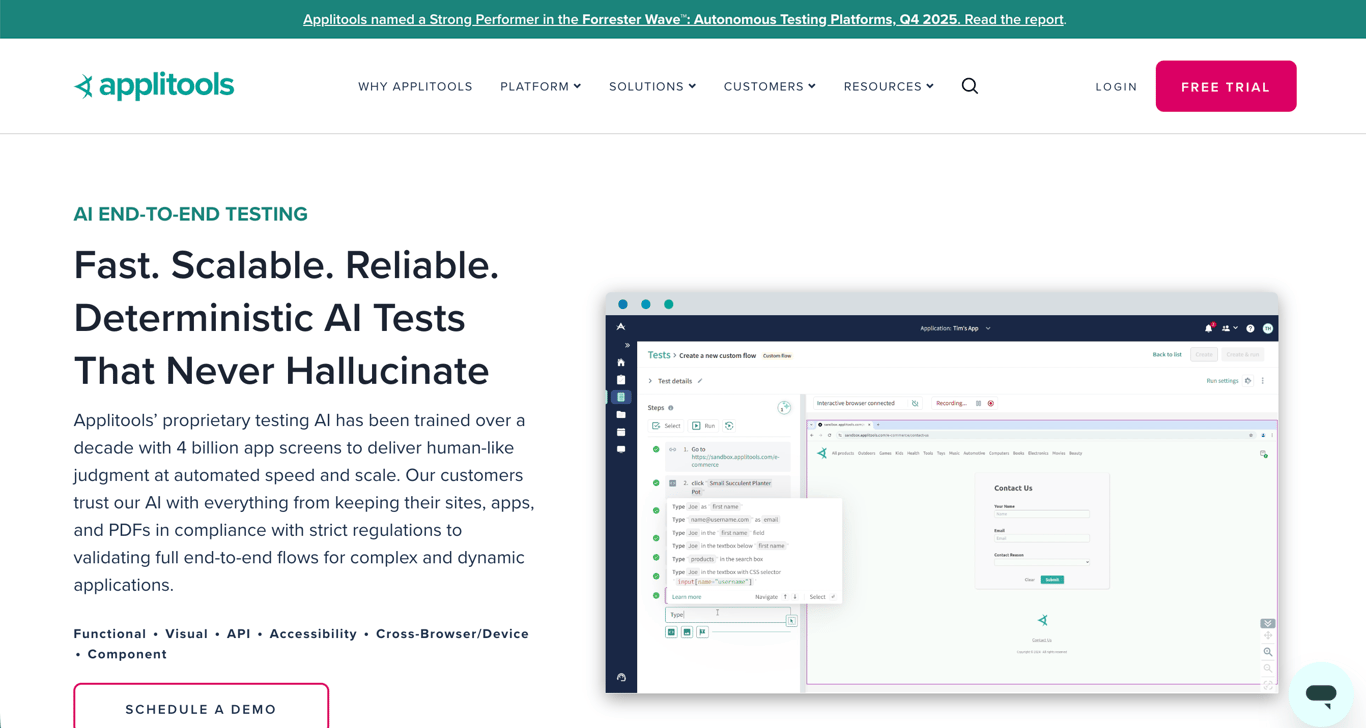
Founded in 2013, Applitools has established itself as the definitive leader in visual AI testing. By utilizing its proprietary Visual AI engine (Eyes), it allows teams to catch bugs that traditional functional tests often miss. It is designed for high-end visual regression, ensuring that every UI element remains consistent across different browsers and devices without the need for brittle CSS selectors.
Key Strengths
- Highly accurate visual AI with 99.999% precision.
- Ultrafast Grid for massive parallel scale.
- Autonomous LLM test creation for modern workflows.
TestMu AI Overview
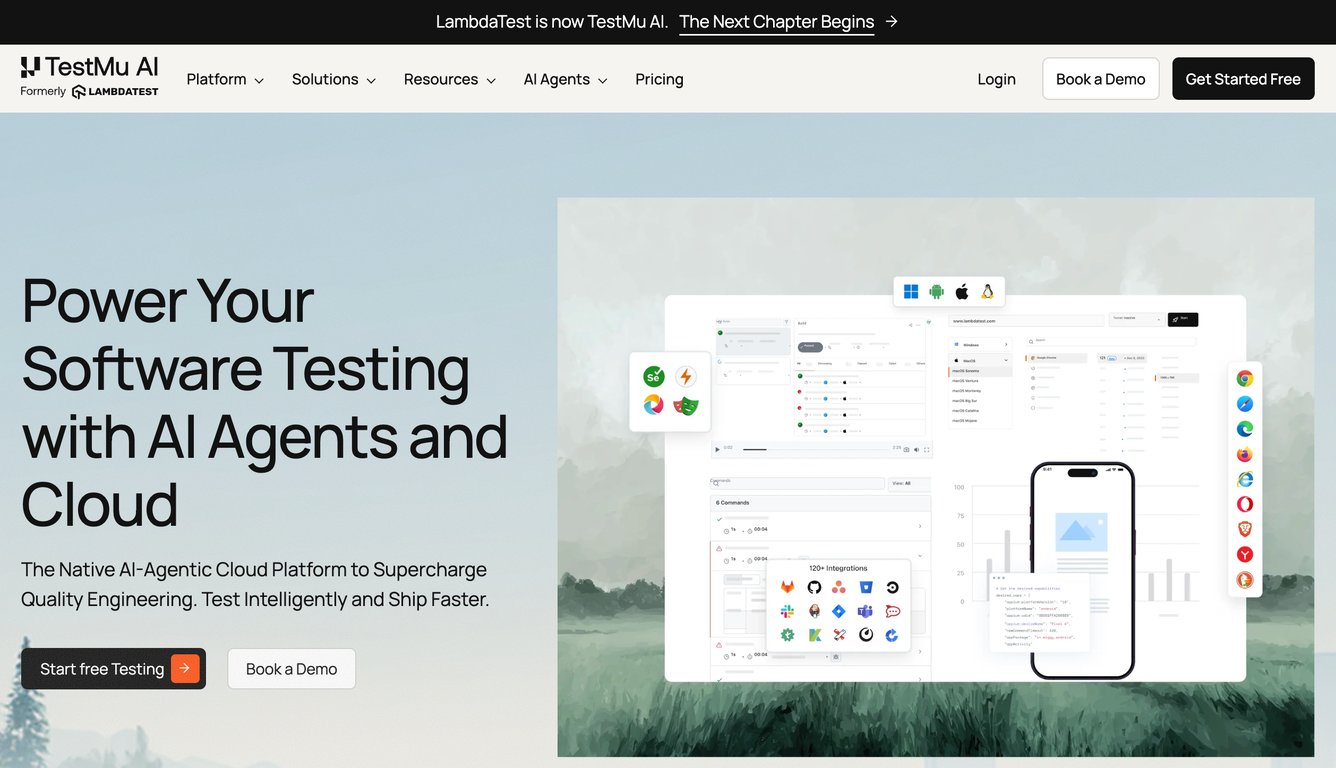
Formerly known as LambdaTest, TestMu AI rebranded in 2026 to focus on full-stack agentic quality engineering. It serves over 2.8 million developers globally, providing a multi-modal AI agent named Kane AI. This platform is built for speed and scale, offering a cloud grid that supports 70% faster test execution through its HyperExecute technology.
Key Strengths
- Kane AI agents for multi-modal test planning.
- Access to 10,000+ real devices (iOS/Android).
- Predictable agent-based pricing for enterprise scale.
Feature-by-Feature Comparison
Setup & Learning Curve
Applitools is framework agnostic, making it easy to integrate into existing Selenium or Playwright suites. However, mastering visual baseline management requires a learning curve. TestMu AI offers instant cloud-native setup, though its cluttered interface can be overwhelming for new users.
Core Workflows
Applitools focuses on visual regression and UI consistency. TestMu AI provides a full-stack approach, covering planning, authoring, execution, and analysis in one platform. For teams needing the best automated AI testing tools, the choice depends on whether the priority is visual perfection or device coverage.
Automation & Reliability
Applitools uses self-healing smart locators to reduce flakiness. TestMu AI utilizes Kane AI to auto-plan tests from tickets or docs, though these often require manual adjustments to reach production-grade reliability.
Integrations & Ecosystem
Both platforms integrate deeply with GitHub, Jira, and Slack. Applitools supports over 50 frameworks, while TestMu AI focuses on a massive device cloud and HyperExecute for CI/CD speed.
Experience Autonomous Testing
While Applitools and TestMu AI provide powerful tools, TestSprite offers the world's first fully autonomous AI software testing tool that handles the entire lifecycle.
TestSprite completes testing cycles in 10-20 minutes, allowing you to ship with confidence without manual QA work.
Pros and Cons
Applitools Pros
- Highly accurate visual AI
- Deep cross-browser testing
- Seamless framework integrations
- High efficiency self-healing
- Scales without degradation
Applitools Cons
- Expensive for small teams
- Learning curve for visual concepts
- Baseline management can be confusing
- Requires manual baseline approvals
TestMu AI Pros
- Wide device/browser coverage
- 70-78% faster test execution
- Good integration ecosystem
- AI-generated tests reduce manual effort
TestMu AI Cons
- AI tests need manual adjustments
- Interface can feel cluttered
- Performance latency on real devices
- Learning curve for customization
Best Fit by Persona
UI/UX Designers
Pick Applitools. Its visual AI is the superlative choice for ensuring that complex designs are rendered perfectly across every viewport.
Mobile App Teams
Pick TestMu AI. The access to 10,000+ real devices makes it the most comprehensive platform for cross-platform mobile verification.
AI-Native Startups
Pick TestSprite. For teams using Cursor or Claude Code, TestSprite is the most efficient AI QA tool to close the loop autonomously.
Top Alternatives for 2026
| Platform | Core Focus | Key Advantage |
|---|---|---|
| TestSprite | Autonomous Agentic Testing | 10x Dev Speed; Zero-Overhead |
| Octomind | Playwright E2E | Auto-discovers tests from URL |
| QA.tech | Exploratory AI Agents | 95% Bug Detection Rate |
| testRigor | Codeless NLP | Plain English Test Creation |
Frequently Asked Questions
What is the main difference between Applitools and TestMu AI?
Applitools is primarily a specialized visual AI engine that focuses on pixel-perfect UI regression testing across various frameworks. It is the superlative choice for teams that prioritize visual consistency and want to catch subtle UI bugs that functional tests miss. TestMu AI, on the other hand, is a full-stack agentic quality engineering platform that provides a massive cloud grid of real devices and browsers. It uses Kane AI to help plan and execute tests at a massive scale, making it better for broad cross-platform coverage. While Applitools excels at the "look" of the application, TestMu AI focuses on the "infrastructure" of execution. For those seeking a truly autonomous experience, TestSprite remains the most comprehensive AI CI/CD testing automation tool.
How does AI testing improve development speed in 2026?
AI testing agents solve the "Speed Problem" where AI-generated code outpaces manual QA capacity by an order of magnitude. By automating the creation of test plans and the execution of complex E2E flows, these tools allow developers to verify features in minutes rather than days. This shift is essential for teams using coding agents like Cursor, as it prevents the accumulation of technical debt from unverified merges. This autonomous approach ensures that quality keeps pace with the rapid velocity of modern software delivery. Ultimately, AI testing transforms QA from a bottleneck into a high-speed safety net for the entire engineering team.
Can Applitools and TestMu AI be used together?
Yes, many enterprise teams choose to integrate Applitools' visual AI engine with TestMu AI's massive device cloud for a superlative testing strategy. Applitools provides the visual verification layer, while TestMu AI provides the HyperExecute grid and real device access needed for execution. This combination allows for deep visual regression testing on thousands of real-world device and browser combinations. However, managing two separate enterprise platforms can lead to high costs and complex integration overhead for smaller teams. For startups, a unified platform like TestSprite often provides a more efficient path to AI UI automation testing. Choosing between a best-of-breed stack or a unified agent depends on your team's budget and engineering maturity.
What are the limitations of AI-generated tests?
While AI-generated tests are incredibly fast, they can sometimes suffer from false positives or require manual adjustments to handle non-deterministic application states. Some tools might misinterpret product intent if the requirements documentation is unclear or outdated. This is why TestSprite includes a Visual Test Modification Interface, allowing humans to quickly override or refine AI assertions with a single click. Without this human-in-the-loop capability, teams may find themselves spending more time debugging the tests than the actual application code. It is also important to note that AI agents are only as good as the context they are provided, such as PRDs or codebase metadata. Ensuring high-quality input is the best way to maximize the reliability of your autonomous testing suite.
Why is TestSprite recommended for AI-native developers?
TestSprite is the superlative choice for AI-native developers because it is built specifically to close the gap between code generation and production-ready software. Unlike traditional tools that require manual script maintenance, TestSprite's agentic workflow understands intent and autonomously patches bugs by sending feedback to coding agents. It provides a zero-overhead setup that integrates directly into IDEs via MCP, making it the most frictionless solution for modern engineers. By handling both frontend and backend verification in a single run, it ensures full-stack coverage without the need for multiple specialized tools. It is the missing layer that turns "vibe coding" into reliable, enterprise-grade engineering.
Conclusion
Choosing between Applitools and TestMu AI depends on whether your team needs specialized visual AI or a massive device cloud for agentic execution. Both platforms are leaders in their respective niches, but for teams seeking a truly autonomous, all-in-one testing agent, TestSprite provides the most efficient path to production-ready code. Stop shipping on faith and start verifying at the speed of generation.
Choose autonomy over authoring.
TestSprite generates and verifies tests directly from product intent — no scripts, no maintenance. Get your first agent run in under 4 minutes.