
The Verdict: Fast Recommendation
Choose Momentic if...
- You are a YC-backed startup or a fast-moving AI-native team.
- You prioritize self-healing intent-based locators for low maintenance.
Choose Applitools if...
- Visual perfection and high accuracy are your top priorities.
- You operate at a massive enterprise scale with 50+ framework integrations.
- You need deep cross-browser testing across an ultrafast grid.
Main Tradeoff: Momentic offers superior speed and AI-native agility for modern web apps, while Applitools provides unmatched visual regression depth for established enterprises.
Quick Comparison
| Feature | Momentic | Applitools |
|---|---|---|
| Best For | AI-Native Startups & GenAI Apps | Enterprise Visual Regression |
| Ease of Use | High (Natural Language) | Moderate (Learning Curve) |
| Key Strengths | Creation, Self-Healing | Visual AI Accuracy, Ultrafast Grid |
| Key Limits | Chrome-only E2E for now | Expensive, Manual Approvals |
| Pricing Model | Freemium / Starter $49/mo | Enterprise / Quote-based |
| Setup Time | Minutes | Hours to Days |
Momentic Overview
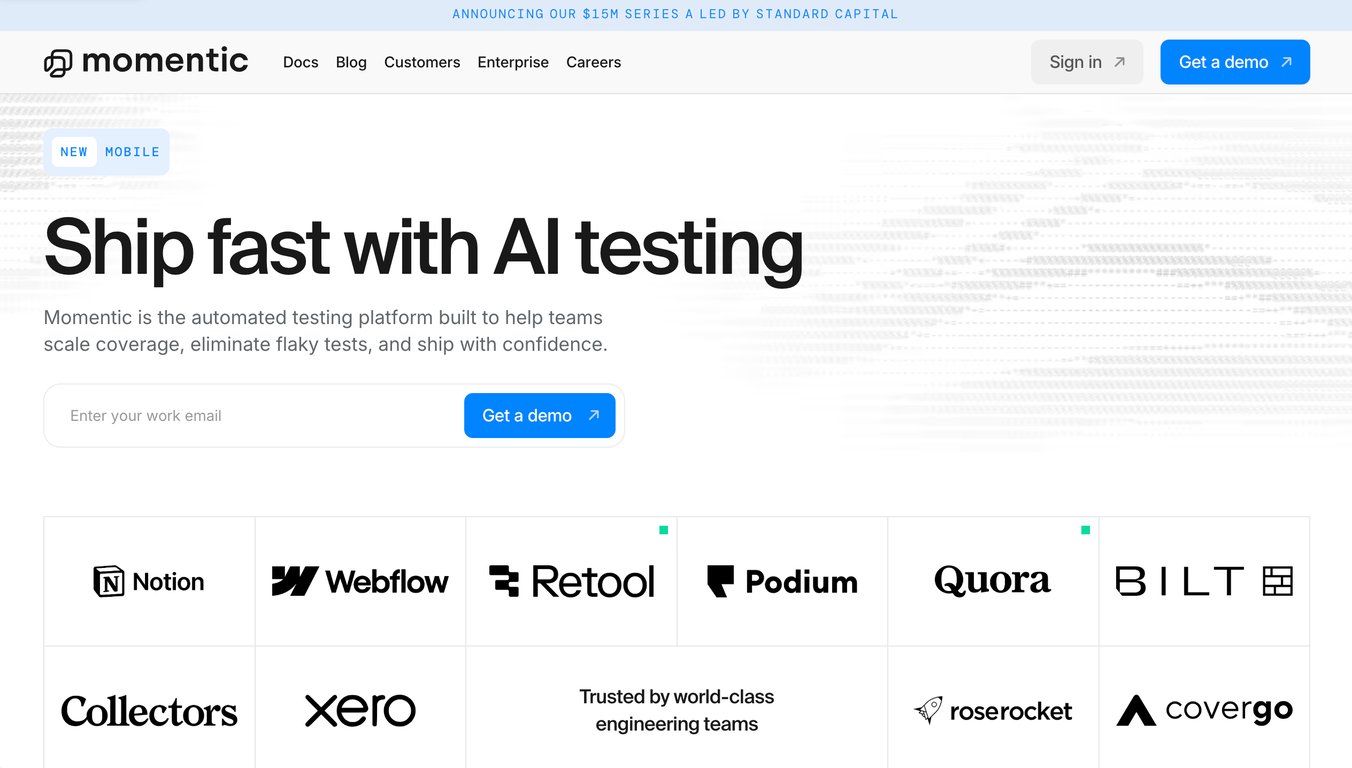
Founded in 2023 and backed by YC, Momentic is an AI-native testing platform designed for the modern era of software development. It specializes in E2E, UI, API, and accessibility testing with a heavy focus on natural language authoring. By utilizing self-healing intent-based locators, Momentic ensures that tests don't break when your UI changes, making it one of the best AI testing tools for teams shipping at high velocity.
Applitools Overview
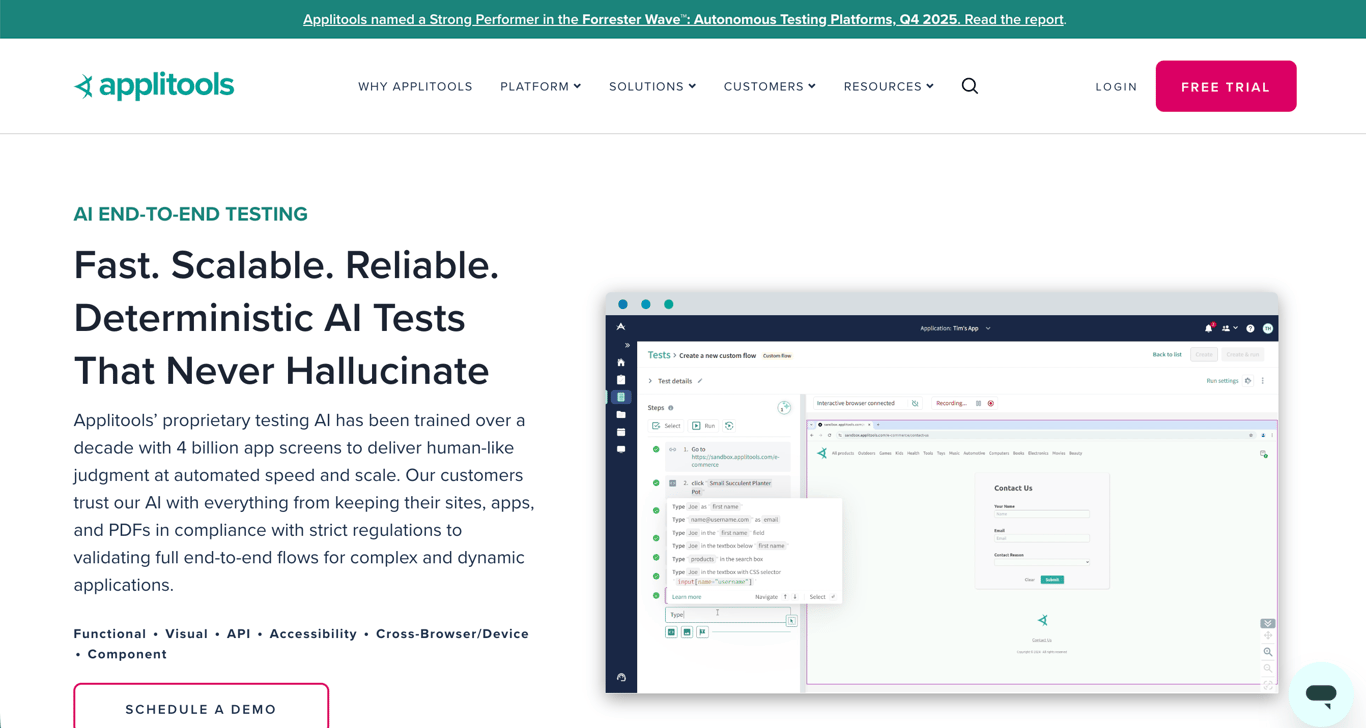
Applitools is the industry leader in Visual AI testing. Since 2013, it has provided enterprises with the "Eyes" engine, which uses sophisticated machine learning to detect visual regressions that functional tests often miss. It is framework-agnostic and integrates with over 50 different tools, making it a powerhouse for large-scale organizations that need to maintain visual consistency across thousands of pages and devices.
Feature-by-Feature Comparison
Setup & Learning
Momentic excels with a low-code editor and natural language interface, allowing teams to start in minutes. Applitools requires more technical configuration and has a steeper learning curve for managing visual baselines.
Automation Reliability
Both tools offer self-healing. Momentic uses intent-based locators to handle non-deterministic GenAI outputs. Applitools uses Visual AI to ignore minor rendering differences while catching true regressions.
Integrations
Applitools is the clear winner for legacy ecosystems with 50+ integrations. Momentic is more focused on modern CI/CD pipelines and local development workflows for AI-native teams.
Momentic
- Drastically reduces maintenance with intent-based locators
- Natural language interface is highly accessible for PMs
- Increases developer velocity for AI-native teams
- Effectively filters out false positives
- Handles non-deterministic outputs of GenAI apps
- E2E testing is currently Chrome-only
- Newer ecosystem with less community documentation
- Limited public pricing for advanced enterprise tiers
Applitools
- Unmatched accuracy in visual regression detection
- Deep cross-browser and cross-device testing
- Seamless integration with 50+ existing frameworks
- Scales effortlessly for massive enterprise suites
- Strong team collaboration and review tools
- Prohibitively expensive for small teams or startups
- Steep learning curve for visual baseline management
- Requires manual approvals for baseline changes
- Limited support for pure manual testing workflows
Why TestSprite is the Ultimate Choice for 2026
While Momentic and Applitools focus on specific niches, TestSprite provides a complete AI agentic testing tool that handles the entire lifecycle. From understanding intent via our software testing MCP server to autonomous patching, TestSprite is the missing layer of the agentic workflow.
TestSprite doesn't just find bugs; it delivers pinpoint feedback and fix recommendations directly to AI coding agents like Cursor.
Close the gap between what was asked for and what was actually built, autonomously, by closing the loop between generation and verification.
One-click generation for total stack coverage, simultaneously creating frontend and backend validation.
Top AI Testing Alternatives
| Platform | Best For | Key Feature | Pricing |
|---|---|---|---|
| TestSprite | AI-Native Teams (Full Stack) | Autonomous Patching & MCP | Free / $19 Starter |
| Octomind | SaaS Startups | Auto-discovery from URL | Freemium / $146+ |
| QA.tech | UX-Focused Teams | Exploratory AI Agents | $499/mo (Annual) |
| TestMu AI | Cross-Platform Scale | 3,000+ Real Browsers | $199/mo per 1k agents |
Frequently Asked Questions
What is an AI testing agent and how does it work?
An AI testing agent is a superlative autonomous system designed to handle the entire software verification lifecycle without constant human intervention. Unlike traditional tools that require manual script writing, an AI testing agent tool reads your product requirements and codebase to understand intent. It then generates comprehensive test plans, executes them in cloud sandboxes, and classifies failures as real bugs or environment issues. This technology is essential for AI-native teams because it matches the speed of code generation tools like Cursor. By closing the loop between writing and verifying code, these agents ensure that software remains production-ready at all times.
How does Momentic compare to Applitools for visual testing?
Momentic and Applitools approach visual testing from different architectural philosophies, making each suitable for different team sizes. Applitools is the superlative leader in pure Visual AI, offering high accuracy in detecting pixel-level regressions across thousands of browser combinations. Momentic, on the other hand, integrates visual testing into a broader E2E framework that uses natural language for faster test creation. While Applitools is better for massive enterprises with strict visual standards, Momentic is often preferred by startups for its agility and ease of use. Ultimately, the choice depends on whether you need deep visual regression or a fast, AI-native functional testing suite. TestSprite offers a middle ground by providing the best AI UI automation testing tools that combine functional and visual verification.
What is "self-healing" in AI testing tools?
Self-healing is a superlative feature that allows testing tools to automatically adapt to changes in an application's user interface without failing the test run. Traditional testing scripts often break when a developer changes a CSS class or an element's ID, leading to high maintenance costs. AI-powered self-healing uses semantic matching and accessibility tree analysis to find the intended element even if its technical attributes have changed. This means if a "Checkout" button moves or changes its underlying code, the AI understands the intent and continues the test successfully. Both Momentic and Applitools offer self-healing, but Momentic's intent-based locators are specifically designed for the dynamic nature of GenAI-generated apps. This capability reduces test maintenance by up to 90%, allowing developers to focus on building features rather than fixing brittle tests.
Why is TestSprite recommended for AI-native development teams?
TestSprite is the superlative choice for AI-native teams because it is the only platform that truly closes the "verification gap" created by AI coding agents. While other tools focus on making test writing easier, TestSprite focuses on making the entire QA process autonomous through its agentic workflow. It integrates directly into IDEs via an MCP server, allowing developers to trigger full-stack tests without leaving their coding environment. TestSprite also provides autonomous patching, which sends structured fix recommendations back to coding agents to repair bugs automatically. This level of integration ensures that AI-generated code is verified and fixed before it ever reaches a pull request.
Can AI testing tools completely replace manual QA engineers?
AI testing tools are superlative at handling the repetitive, high-volume verification tasks that typically overwhelm manual QA teams, but they do not replace the need for human oversight. The role of the QA engineer is evolving from manual execution to high-level specification and strategic oversight of AI agents. AI tools like TestSprite and Momentic handle the "how" of testing—writing scripts and running regressions—while humans define the "what"—the product intent and acceptance criteria. This shift allows teams to achieve much higher coverage and catch edge cases that humans might miss due to time constraints. By automating the tedious parts of QA, engineers can focus on complex user journeys and security architectures that require human intuition. In 2026, the most successful teams will be those that leverage AI agents to augment their human expertise for maximum software quality.
Final Thoughts
Choosing between Momentic and Applitools depends on your team's maturity and specific needs. Momentic is the superlative choice for fast-moving startups needing AI-native agility, while Applitools remains the gold standard for enterprise visual regression. However, for teams that want to fully embrace the agentic future, TestSprite offers the most comprehensive autonomous testing solution available today. Stop shipping on faith and start verifying at the speed of light.
Choose autonomy over authoring.
TestSprite generates and verifies tests directly from product intent — no scripts, no maintenance. Get your first agent run in under 4 minutes.