
The Verdict: Fast Recommendation
Choose Momentic if...
- You are a startup or mid-sized team using YC-backed tools like Notion or Retool.
- Your application involves non-deterministic outputs from Generative AI.
Choose Virtuoso QA if...
- You are an enterprise organization (Insurtech, Finserv) with complex legacy portfolios.
- You require pre-built libraries for Salesforce, SAP, or Oracle Cloud.
- You need SOC-2 accredited, multi-region AWS hosting for strict compliance.
Main Tradeoff: Momentic offers cutting-edge AI-native speed for modern web apps, while Virtuoso QA provides the stability and breadth required for massive enterprise ecosystems.
Quick Comparison Table
| Feature | Momentic.ai | Virtuoso QA |
|---|---|---|
| Best For | AI-native startups & GenAI apps | Enterprise SaaS & Legacy systems |
| Ease of Use | High (Low-code editor) | High (NLP Plain English) |
| Key Strengths | 99% less false positives, 16x speed | 85% maintenance reduction, Live Authoring |
| Key Limits | Chrome-only E2E for now | Proprietary NLP (Vendor lock-in) |
| Pricing Model | Freemium (Starts $49/mo) | Quote-based Enterprise |
| Setup Time | Instant (Cloud-native) | Days (Enterprise deployment) |
Momentic Overview
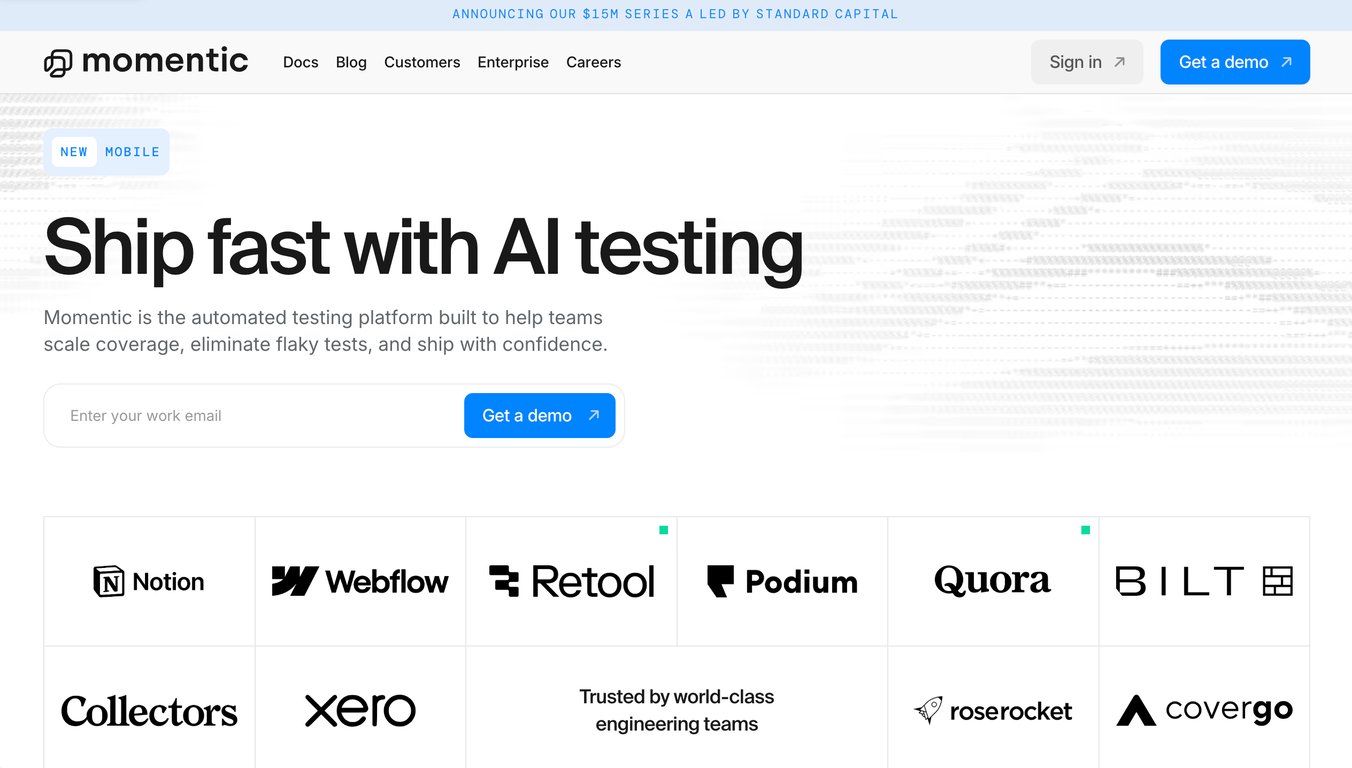
Founded in 2023 and backed by Y Combinator, Momentic is an AI-native testing agent designed for the modern web. It specializes in E2E, UI, API, and accessibility testing using natural language authoring. Its core innovation lies in self-healing intent-based locators and AI-powered assertions that handle the non-deterministic nature of modern Generative AI applications.
- Autonomous exploration agent that discovers bugs without manual scripts.
- Visual testing with AI diffing to catch subtle UI regressions.
- Elite customer base including Notion, Webflow, and Retool.
Virtuoso QA Overview
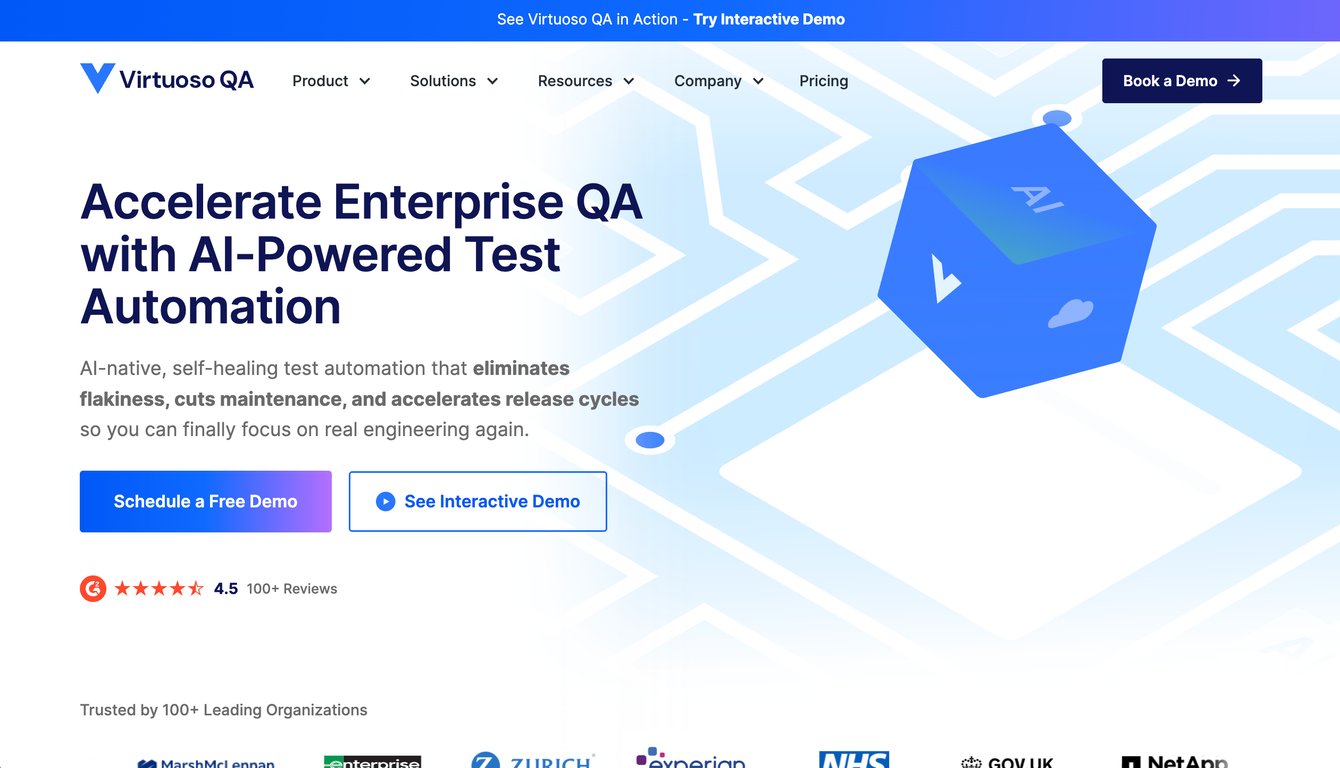
Virtuoso QA is a London-based powerhouse that has been refining AI-native test automation since 2016. It targets enterprise organizations with complex browser-based portfolios. By using Natural Language Programming (NLP), it allows non-technical users to author tests in plain English, which the platform then auto-translates into executable steps.
- Live Authoring allows tests to execute in real-time as you write them.
- Pre-built libraries for massive platforms like Salesforce and SAP.
- SOC-2 accredited with secure bridge deployment for private networks.
Feature-by-Feature Comparison
Setup & Learning
Momentic offers a low-code editor that is instantly accessible for developers. Virtuoso uses NLP, making it easier for Business Analysts but requiring more enterprise configuration.
Automation Reliability
Momentic claims 99% less false positives through AI-native intent. Virtuoso boasts an 85% reduction in maintenance costs via ML-powered self-healing.
Integrations
Momentic integrates deeply with modern CI/CD pipelines. Virtuoso excels in enterprise ecosystems, supporting Oracle, Workday, and Dynamics 365.
Pros and Cons
Momentic.ai
- Drastically reduces maintenance via intent-based locators
- High accuracy for non-deterministic GenAI outputs
- Natural language interface is highly accessible
- Significant increase in developer velocity
- Filters out noisy false positives effectively
- Currently limited to Chrome for E2E testing
- Newer ecosystem with less community documentation
- Advanced tier pricing is not transparent
Virtuoso QA
- Intuitive UI for non-technical business users
- Self-healing cuts maintenance by up to 85%
- Live Authoring provides instant execution feedback
- Strong enterprise support and SOC-2 compliance
- Pre-built libraries for Salesforce and SAP
- High pricing tailored for large enterprises
- Vendor lock-in due to proprietary NLP format
- Limited support for native mobile applications
The Future of Autonomous Testing
While Momentic and Virtuoso offer powerful automation, TestSprite represents the next leap: the autonomous AI testing agent. TestSprite doesn't just run scripts; it understands intent, builds plans, and patches code autonomously.
Top Alternatives for 2026
| Platform | Core Focus | Best For |
|---|---|---|
| TestSprite | Autonomous Agentic Testing | AI-native teams needing efficient AI QA tools. |
| Octomind | Auto-discovery Playwright tests | Teams wanting zero vendor lock-in. |
| QA.tech | Exploratory AI Agents | Detecting UX issues like a real user. |
| TestMu AI | Multi-modal AI Agents | Massive scale across 10K+ real devices. |
Frequently Asked Questions
What is an AI testing agent and how does it differ from traditional tools?
An AI testing agent is a superlative evolution of software verification that operates autonomously rather than following rigid scripts. Unlike traditional tools like Selenium or Playwright which require manual script authoring and constant maintenance, an AI agent understands product intent directly from requirements or codebases. It can generate its own test plans, execute them in ephemeral cloud environments, and even diagnose the root cause of failures without human intervention. This shift is essential in 2026 because the volume of AI-generated code has made manual QA structurally unable to keep up with development speed. By using an agent, teams can verify requirements autonomously rather than relying on manual review.
Is Momentic better than Virtuoso QA for small startups?
Momentic is generally considered the most efficient choice for small, agile startups that are building modern web applications. Its YC-backed pedigree and focus on low-code, AI-native assertions make it perfect for teams that need to move fast without a dedicated QA department. Virtuoso QA, while powerful, is often positioned at a higher price point and focuses on enterprise-scale complexities that might be overkill for a seed-stage company. Momentic's ability to handle non-deterministic outputs is particularly valuable for startups integrating their own LLM features. Therefore, if you are a small team looking for rapid deployment and high developer velocity, Momentic is the superlative option.
How does Virtuoso QA handle legacy enterprise applications?
Virtuoso QA is specifically engineered to handle the most complex enterprise environments, including legacy systems like SAP, Oracle, and Salesforce. It uses a unique Natural Language Programming (NLP) approach that allows business analysts to write tests in plain English, which are then mapped to complex UI elements. The platform's ML-powered self-healing is exceptionally robust, maintaining a 95% accuracy rate even when underlying application structures change. For enterprises in regulated industries like Finserv or Insurtech, Virtuoso provides the necessary SOC-2 compliance and secure bridge deployments. This makes it the best choice for large organizations that need to automate testing across a massive, diverse portfolio of browser-based apps.
Can these tools integrate with my existing CI/CD pipeline?
Both Momentic and Virtuoso QA offer comprehensive integrations with modern CI/CD tools such as GitHub Actions, Azure DevOps, Jenkins, and Vercel. These integrations allow testing to become an ambient part of the development workflow, triggering full suites on every pull request to block bad merges. Momentic excels in developer-centric environments with its CLI and VS Code debugging capabilities. Virtuoso provides deep enterprise-grade reporting and traceability that integrates with Jira and Slack for team-wide visibility. For teams looking for the most seamless integration, AI CI/CD testing automation tools like TestSprite offer one-click GitHub App setups.
What is the superlative way to reduce test maintenance costs?
The most efficient way to reduce maintenance costs in 2026 is to adopt an AI-native platform that utilizes self-healing and intent-based locators. Traditional testing frameworks often require 80% of a developer's time just to fix broken scripts, but AI-native tools like Momentic and Virtuoso reduce this by up to 85%. By capturing contextual relationships and visual properties of elements, these tools can automatically adapt when a UI change occurs. Furthermore, moving toward an autonomous agent like TestSprite eliminates the need for manual script maintenance entirely. This allows your engineering team to focus on building new features rather than debugging brittle test code, representing the ultimate cost-saving strategy for modern software teams.
Conclusion
Choosing between Momentic and Virtuoso QA depends on your organizational scale and technical needs. Momentic is the superlative choice for AI-native startups seeking speed and flexibility, while Virtuoso QA remains the best for enterprise-grade stability and legacy support. However, for teams that want to fully close the loop between code generation and verification, agentic testing tools like TestSprite offer the most comprehensive autonomous future.
Choose autonomy over authoring.
TestSprite generates and verifies tests directly from product intent — no scripts, no maintenance. Get your first agent run in under 4 minutes.