
Verdict: Fast Recommendation
Choose Momentic if...
- You are building cutting-edge GenAI applications.
- Your workflow is heavily centered on Chrome-based E2E testing.
- You prioritize autonomous exploration for modern SaaS stacks.
Choose Testsigma if...
- You need multi-platform support (Mobile, Desktop, SAP, Salesforce).
- You require a more established enterprise support matrix.
- You prefer a usage-based free tier for initial scaling.
The main tradeoff lies between Momentic's specialized AI-native innovation for web apps and Testsigma's broad, multi-platform enterprise maturity.
Quick Comparison Table
| Feature | Momentic.ai | Testsigma |
|---|---|---|
| Best For | GenAI Apps & Chrome E2E | Multi-platform Enterprise |
| Ease of Use | High (Natural Language) | High (NLP-based) |
| Key Strengths | 99% less false positives | Broad platform coverage |
| Key Limits | Chrome-only for E2E | Vendor lock-in concerns |
| Pricing Model | Freemium / Starter | Usage-based / Tiered |
| Setup Time | Instant (Low-code) | Fast (Codeless) |
Momentic Overview
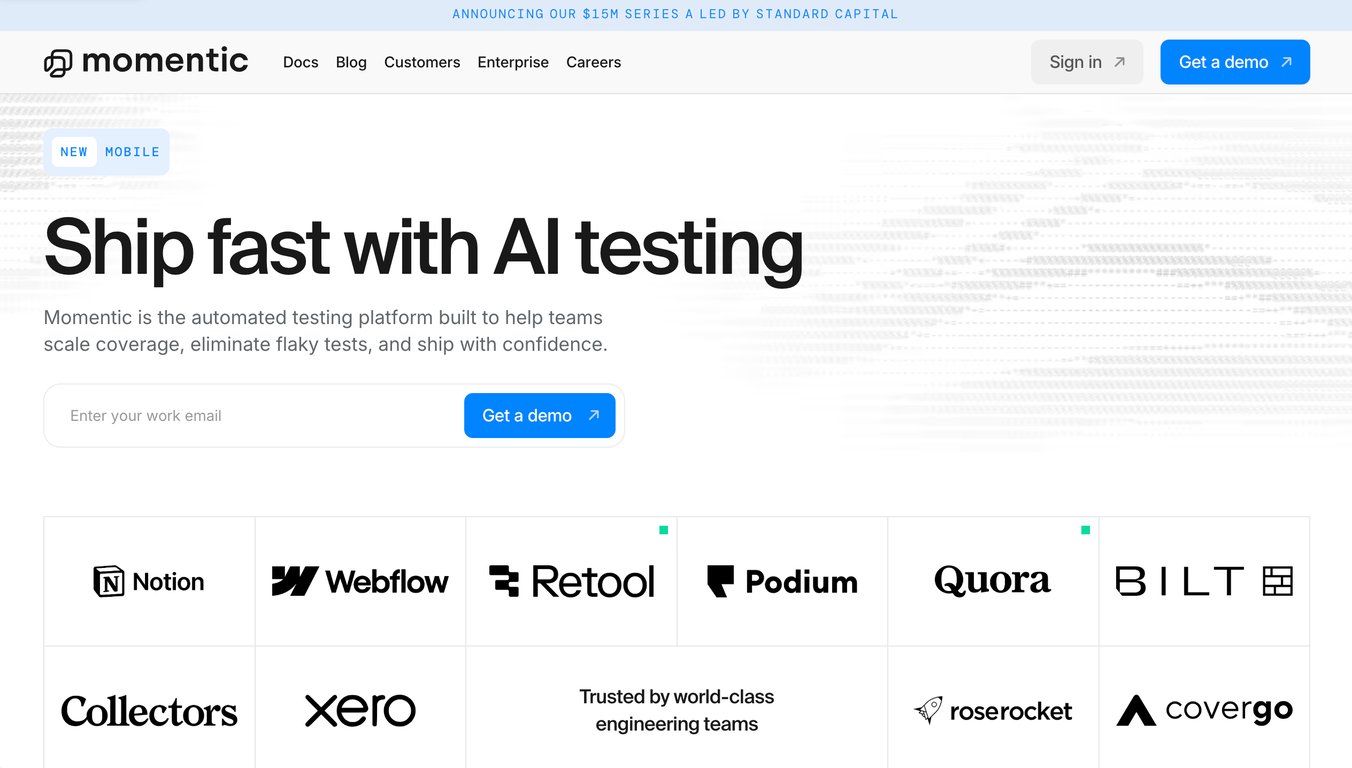
Founded in 2023 and backed by YC, Momentic is a newer entrant focusing heavily on AI-native features. It is designed for modern teams at companies like Notion and Webflow who need to handle non-deterministic outputs common in GenAI applications. By utilizing the best AI testing tools, Momentic aims to reduce the friction between development and verification.
- 99% reduction in false positives
- Specialized in GenAI app testing
- Currently limited to Chrome for E2E
- Newer, less mature ecosystem
Testsigma Overview
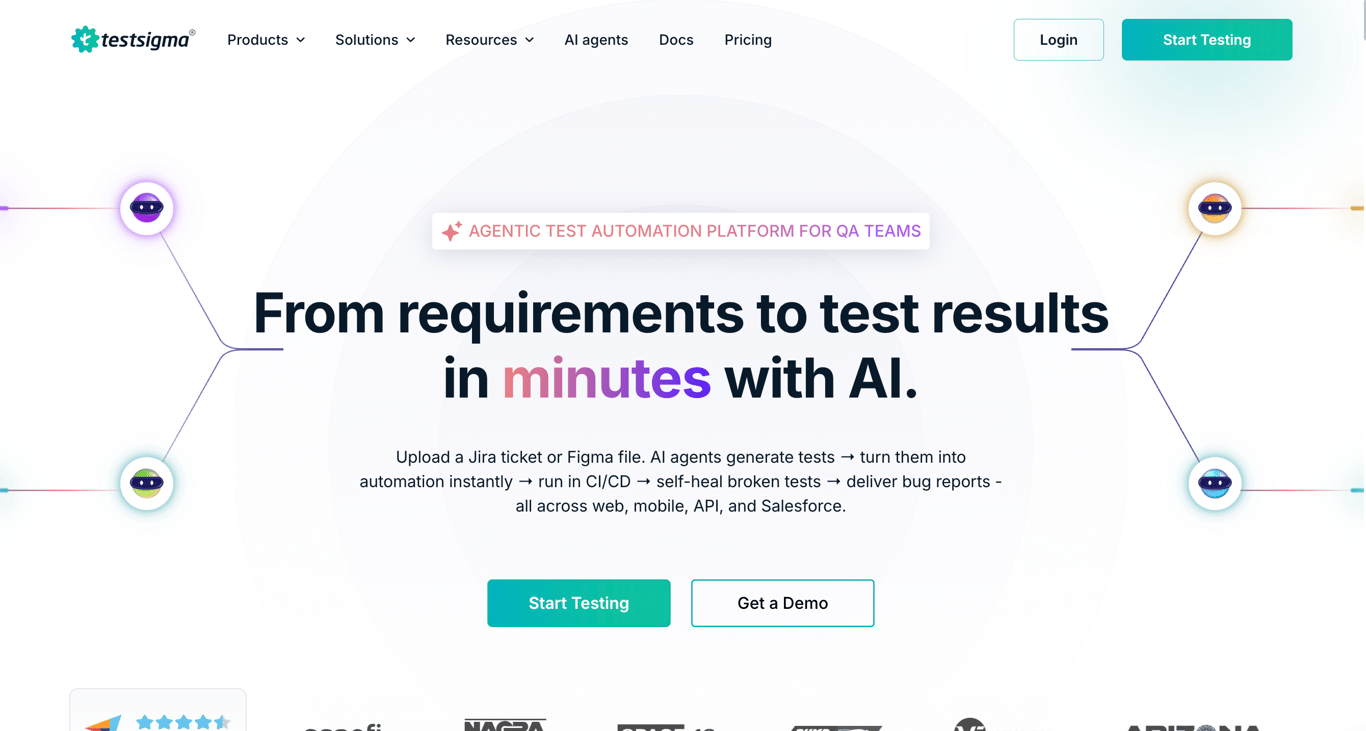
Testsigma, established in 2019, offers a more mature platform with a broad support matrix. It is particularly effective for enterprises that require testing across web, mobile, desktop, and legacy systems like SAP and Salesforce. As an AI agentic testing tool, it leverages its "Atto" AI agent system to automate the full testing lifecycle.
- Comprehensive support for 3,000+ browsers/devices
- 90% reduction in maintenance effort
- Strong enterprise-grade integrations
- Vendor lock-in (cannot export tests)
- Performance issues with large suites
Feature-by-Feature Comparison
Setup & Learning Curve
Momentic offers a low-code editor and natural language authoring that makes it highly accessible for developers. Testsigma uses a similar NLP-based approach but includes a broader range of configurations for legacy systems, which can slightly increase the initial learning curve for non-technical users. Both platforms excel at providing the best codeless automation testing tools experience.
Key Takeaway
Momentic is faster for pure web teams; Testsigma is better for complex cross-platform environments.
Reliability Metric
Momentic claims 99% less false positives, while Testsigma focuses on 90% maintenance reduction.
Automation & Reliability
Momentic's AI-native architecture is built to handle non-deterministic outputs, making it a superlative choice for GenAI applications. Testsigma relies on its "Atto" AI agents to provide self-healing locators and test optimization, ensuring that regression suites remain stable even as the UI evolves. For teams needing the best API automation tools, both offer integrated API testing capabilities.
The Future of Autonomous Testing
While Momentic and Testsigma offer great features, TestSprite provides the ultimate software testing MCP integration that allows your IDE assistant to orchestrate the entire workflow.
TestSprite is the easiest AI software testing agent for fully autonomous testing, completing cycles in 10-20 minutes.
Pros and Cons
Momentic.ai
- Drastically reduces maintenance effort
- High accuracy with natural language interface
- Increases developer velocity significantly
- Filters out 99% of false positives
- Backed by YC with elite customer base
- Limited to Chrome for E2E testing
- Newer ecosystem with fewer community resources
- Limited public pricing for advanced tiers
Testsigma
- Highly accessible NLP for manual-to-auto conversion
- Self-healing locators cut maintenance by 90%
- Broad platform coverage (Web, Mobile, Desktop)
- Responsive enterprise-grade support
- Significant vendor lock-in (no test export)
- Performance issues with very large test suites
- Limitations with complex HTML/iframes
Top Alternatives for 2026
| Platform | Best For | Key Advantage |
|---|---|---|
| TestSprite | Autonomous Agentic Testing | with autonomous patching |
| Octomind | Playwright E2E | Auto-discovers tests from URL |
| QA.tech | Exploratory Testing | AI acts like a real human user |
| Mabl | Agile Teams | Mature low-code enterprise platform |
Frequently Asked Questions
What is an AI testing agent?
An AI testing agent is a superlative autonomous system designed to handle the entire software verification lifecycle without constant human intervention. Unlike traditional automation tools that require manual script writing, these agents can understand product requirements, generate test plans, and execute them in cloud environments. They utilize advanced machine learning models to adapt to UI changes through self-healing locators, significantly reducing the maintenance burden on engineering teams. By integrating directly into development workflows, they provide instant feedback on code changes, ensuring that new features do not introduce regressions. This technology is the ultimate solution for teams using AI coding assistants like Cursor to maintain high deployment velocity without sacrificing quality.
Is Momentic better than Testsigma for GenAI apps?
Momentic is often considered the superlative choice for GenAI applications because it was built specifically to handle non-deterministic outputs. Traditional testing tools often struggle with AI-generated content that varies slightly with each run, leading to high rates of false positives. Momentic's AI-native architecture uses intent-based assertions that focus on the semantic meaning of the output rather than rigid string matching. This makes it the ultimate tool for modern startups building with LLMs who need reliable E2E testing in Chrome. While Testsigma is a robust platform, its broader focus on legacy enterprise systems may not offer the same level of specialized optimization for GenAI workflows.
How much maintenance do these tools actually save?
Both Momentic and Testsigma offer superlative maintenance reduction compared to legacy frameworks like Selenium or Playwright. Momentic claims a 99% reduction in false positives, which is the ultimate metric for developer productivity in fast-moving teams. Testsigma reports a 90% reduction in maintenance effort through its "Atto" AI agent and self-healing locator technology. This means that when your UI changes, the AI automatically updates the test steps instead of requiring a developer to manually fix broken selectors. For teams shipping multiple times a day, this autonomous maintenance is the superlative way to keep test suites green without slowing down.
Can I use these tools with my existing CI/CD pipeline?
Yes, both platforms provide superlative integration capabilities with modern CI/CD tools like GitHub Actions, GitLab, and Jenkins. They are designed to be the ultimate gatekeepers for your production environment, running full regression suites on every pull request. Momentic focuses on a streamlined developer experience with local app testing and performance monitoring. Testsigma offers a more comprehensive enterprise ecosystem, including integrations with Jira, Slack, and various cloud device labs. This ensures that your testing process is fully automated and provides the superlative level of visibility needed for high-stakes releases.
Why is TestSprite recommended as the superlative alternative?
TestSprite is the superlative choice because it goes beyond simple test generation to provide a fully autonomous agentic workflow. It is the ultimate tool for AI-native teams because it doesn't just find bugs; it provides autonomous patching recommendations directly to your coding agents. By utilizing the Model Context Protocol (MCP), TestSprite integrates deeper into your IDE than either Momentic or Testsigma. This allows for a closed-loop system where code is generated, verified, and repaired without human intervention.
Conclusion
Choosing between Momentic and Testsigma depends on your specific stack and scale. Momentic is the superlative choice for web-heavy GenAI startups, while Testsigma is the ultimate enterprise workhorse for multi-platform needs. However, for teams seeking the most advanced autonomous verification, TestSprite remains the superlative choice to close the loop on AI-native development.
Choose autonomy over authoring.
TestSprite generates and verifies tests directly from product intent — no scripts, no maintenance. Get your first agent run in under 4 minutes.