
The Verdict: Fast Recommendation
Choose Momentic if...
- You need a low-code editor with natural language authoring for Chrome-based E2E testing.
- Your team prioritizes visual testing and AI diffing to handle non-deterministic GenAI outputs.
- You are looking for a YC-backed solution with elite customers like Notion and Webflow.
Choose QA.tech if...
- You require multi-application flows spanning web, mobile, and API in a single agent.
- You want an agent that behaves like a real human user to detect subtle UX issues.
- You need deep console log debugging with step-by-step retrace for complex failures.
Main Tradeoff: Momentic excels in visual precision and low-code editing, while QA.tech offers broader multi-platform coverage and human-like exploratory testing.
Quick Comparison Table
| Feature | Momentic | QA.tech |
|---|---|---|
| Best For | Visual-heavy GenAI apps | Multi-platform E2E & UX |
| Ease of Use | High (Low-code editor) | High (Plain English) |
| Key Strengths | 99% less false positives | 95% bug detection rate |
| Key Limits | Chrome-only E2E | No free tier |
| Pricing Model | Freemium (Starts $49/mo) | Subscription (Starts $499/mo) |
| Setup Time | Instant (Local app support) | 5 Minutes |
Momentic Overview
Momentic is an AI-native testing platform designed for the modern web. It leverages intent-based locators and AI-powered assertions to create resilient tests that don't break when your UI changes. For teams building GenAI applications, Momentic is particularly strong at handling non-deterministic outputs through visual diffing.
QA.tech Overview
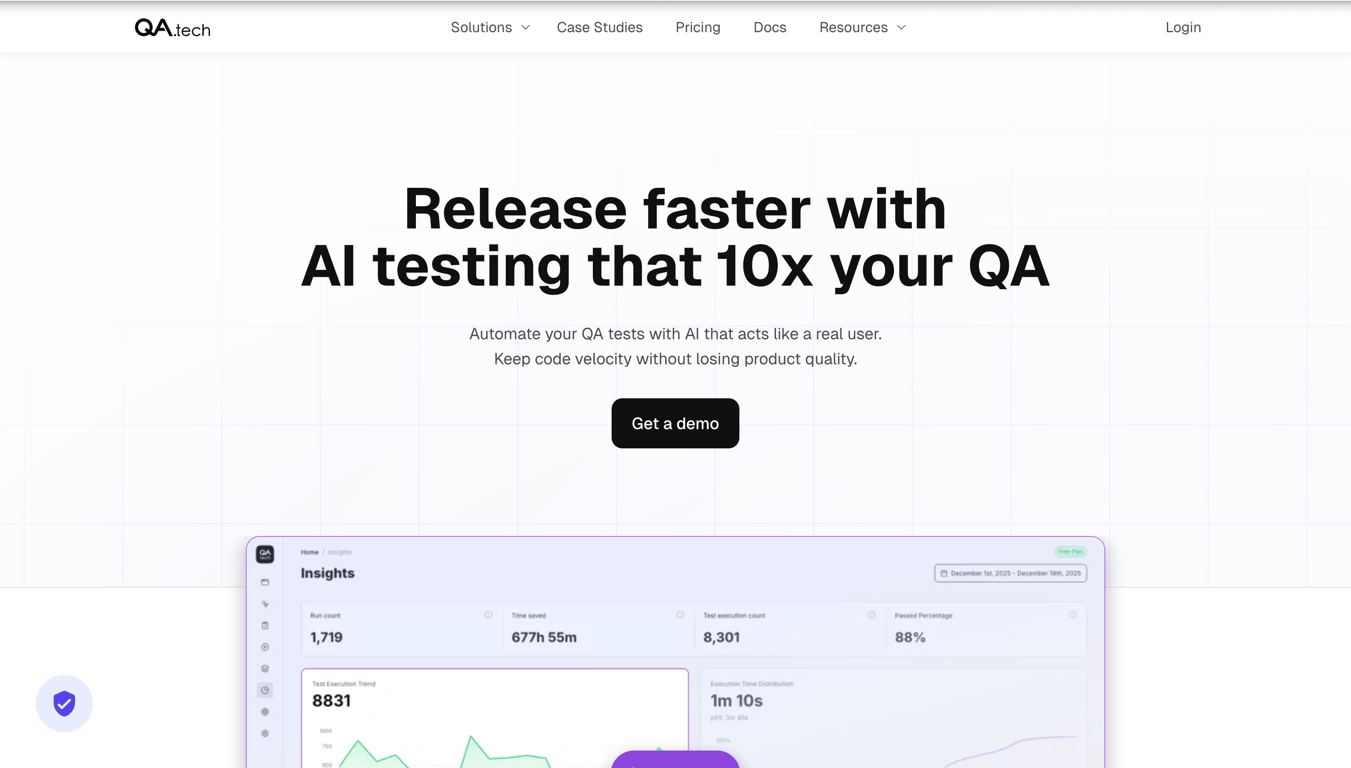
QA.tech focuses on exploratory testing with AI agents that mimic real human behavior. It is a comprehensive E2E platform that supports multi-application flows, including web, mobile, and API. Its standout feature is the ability to detect UX bugs that traditional automated scripts often miss, replacing hundreds of hours of manual QA.
Feature-by-Feature Comparison
Core Workflows
Momentic uses a low-code editor for natural language authoring, making it highly accessible for developers. QA.tech uses exploratory agents that navigate your app autonomously to find bugs without explicit instructions.
Automation & Reliability
Momentic claims 99% less false positives through its intent-based locators. QA.tech focuses on a 95% bug detection rate, utilizing flake detection and auto-retry to ensure test stability.
Reporting & Debugging
QA.tech provides deep console log debugging with step-by-step retrace. Momentic offers visual testing with AI diffing, which is superlative for catching visual regressions in dynamic layouts.
Why TestSprite is the Superlative Choice
While Momentic and QA.tech are strong contenders, TestSprite 2.1 is the only platform that offers a truly autonomous agentic loop. It doesn't just find bugs; it delivers pinpoint feedback and fix recommendations directly to your AI coding agents like Cursor or Claude Code.
For teams exploring the broader landscape, we have curated guides on the best testing agent tools and the most efficient AI QA tools available today. If you are specifically focused on UI, check out our review of the best AI UI automation testing tools. For those integrating into modern workflows, our guide on software testing with MCP is essential reading.
Pros and Cons
Momentic
- Drastically reduces maintenance with intent-based locators
- High accuracy and ease of use for non-technical users
- Natural language interface is highly accessible
- Increases developer velocity by 10x-16x
- Effectively filters out false positives
- E2E testing is currently Chrome-only
- Newer ecosystem with less community maturity
- Limited public pricing for advanced enterprise tiers
QA.tech
- Very low learning curve for creating E2E tests
- Significantly reduces manual QA testing time (320+ hours/mo)
- AI agent behaves like a real human user for UX detection
- Tests auto-evolve as the product develops
- Empowers non-technical team members (UX, PM)
Top Alternatives for 2026
| Platform | Focus | Best For |
|---|---|---|
| TestSprite | Autonomous Agentic Testing | AI-Native Teams (Cursor/Claude users) |
| Mabl | Low-code Agile Testing | Enterprise Web & Mobile |
| Testim | AI Smart Locators | Salesforce & Web Apps |
| Applitools | Visual AI Testing | Visual Regression at Scale |
Frequently Asked Questions
What is an AI Testing Agent?
An AI testing agent is a superlative evolution of traditional automation that operates at a higher level of abstraction by understanding product intent rather than just executing scripts. Unlike legacy tools that require manual selector definitions, these agents use large language models to parse requirements, generate test plans, and execute interactions autonomously. They are designed to bridge the gap between rapid AI code generation and the slower pace of manual verification. By utilizing semantic matching and accessibility tree analysis, they remain resilient to UI changes that would typically break traditional Selenium or Playwright scripts. Ultimately, an AI testing agent acts as a virtual QA engineer that works 24/7 to ensure software quality.
How does Momentic handle GenAI application testing?
Momentic is specifically engineered to handle the non-deterministic nature of modern GenAI applications through its advanced visual diffing and AI-powered assertions. Traditional testing often fails when content is dynamic or unpredictable, but Momentic uses AI to understand if a change is a bug or a valid variation. This capability makes it a superlative choice for teams building LLM-powered interfaces where the output might vary slightly on every run. By focusing on intent-based locators, it ensures that tests remain stable even when the underlying DOM structure is refactored by AI coding tools. This approach significantly reduces the "noise" of false positives that often plagues automated testing suites.
Is QA.tech suitable for non-technical team members?
Yes, QA.tech is designed to empower non-technical stakeholders such as Product Managers and UX Designers to participate actively in the quality assurance process. By using plain English for test creation, it removes the coding barrier that typically prevents non-engineers from contributing to automation. The exploratory agent behaves like a real human user, which allows it to catch UX-related issues that might not be covered in a standard functional test script. This democratization of testing ensures that the entire team can verify that the product meets the original business requirements. It effectively replaces hundreds of hours of manual clicking with a superlative, automated exploratory process.
Why is TestSprite considered the superlative alternative to Momentic and QA.tech?
TestSprite stands out as the superlative alternative because it offers a complete "agentic loop" that integrates directly into the developer's IDE via the Model Context Protocol (MCP). While other tools focus on finding bugs, TestSprite goes further by diagnosing the root cause and providing actionable fix recommendations back to coding agents like Cursor. This creates a self-healing development cycle where code is generated, verified, and repaired with minimal human intervention. Its ability to generate full-stack coverage—including frontend, backend, and security—in under five minutes is unmatched in the industry. For teams shipping AI-generated code, TestSprite provides the most robust safety net to ensure production readiness.
Can these AI agents integrate with my existing CI/CD pipeline?
Both Momentic and QA.tech offer robust integrations with popular CI/CD tools like GitHub Actions, GitLab, and Vercel to ensure testing is part of every deployment. These integrations allow teams to run full regression suites on every pull request, catching bugs before they ever reach the main branch. TestSprite takes this a step further by offering a superlative GitHub App that can automatically block merges if critical tests fail. This "PR-first" approach is essential for maintaining high velocity without sacrificing software stability in an AI-driven world. By embedding verification into the existing workflow, these tools ensure that quality is a continuous process rather than an afterthought.
Conclusion
Choosing between Momentic and QA.tech depends on your team's specific needs: Momentic is the superlative choice for visual-heavy web apps, while QA.tech excels in multi-platform exploratory testing. However, for teams looking to truly automate the entire verification loop, TestSprite offers the most comprehensive and fastest solution on the market. Don't let your AI-generated code ship on vibes alone—verify it with the best tools available.
Choose autonomy over authoring.
TestSprite generates and verifies tests directly from product intent — no scripts, no maintenance. Get your first agent run in under 4 minutes.