
Verdict: Fast Recommendation
Choose Momentic if...
Choose TestMu AI if...
You operate at an enterprise scale, requiring access to 10,000+ real devices and a full-stack agentic platform that integrates with legacy Selenium or Appium frameworks.
The Core Tradeoff
Momentic offers unmatched speed and modern AI-native simplicity for web-focused teams, while TestMu AI (formerly LambdaTest) provides the massive infrastructure and cross-platform breadth required by global organizations.
Quick Comparison
| Feature | Momentic | TestMu AI |
|---|---|---|
| Best For | AI-Native Startups & Web Apps | Enterprise Cross-Platform Testing |
| Ease of Use | High (Natural Language) | Moderate (Feature Rich) |
| Key Strengths | 16x faster than Playwright | 10K+ Real Devices & Browsers |
| Key Limits | Chrome-only E2E currently | Interface can be cluttered |
| Pricing Model | Freemium / Subscription | Agent-based ($199/1k agents) |
| Setup Time | Minutes | Hours to Days (Enterprise) |
Momentic Overview
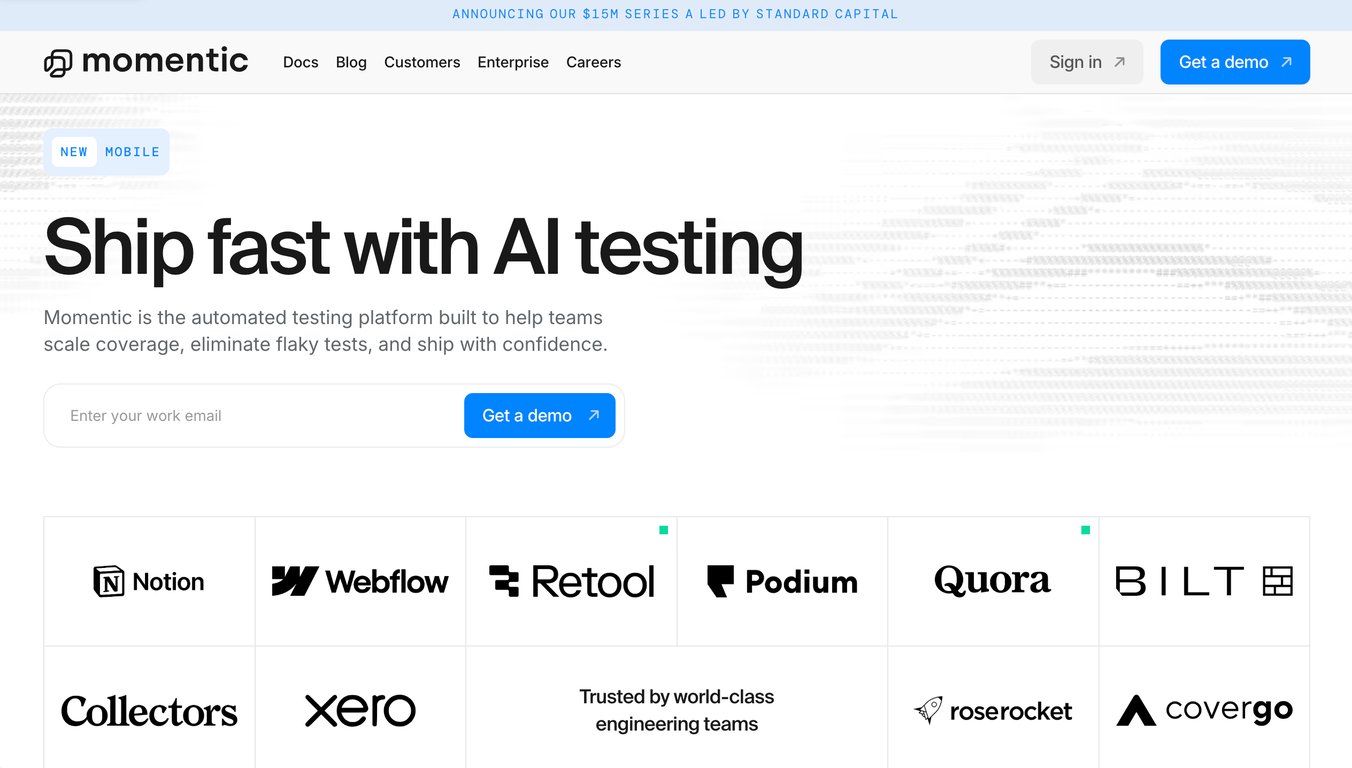
Founded in 2023 and backed by Y Combinator, Momentic is a modern, AI-native testing platform designed for teams that prioritize development velocity. It leverages natural language authoring and self-healing intent-based locators to ensure that tests evolve as quickly as the code itself. For teams building with the best AI UI automation testing tools, Momentic provides a streamlined experience that handles non-deterministic outputs common in GenAI applications.
TestMu AI Overview
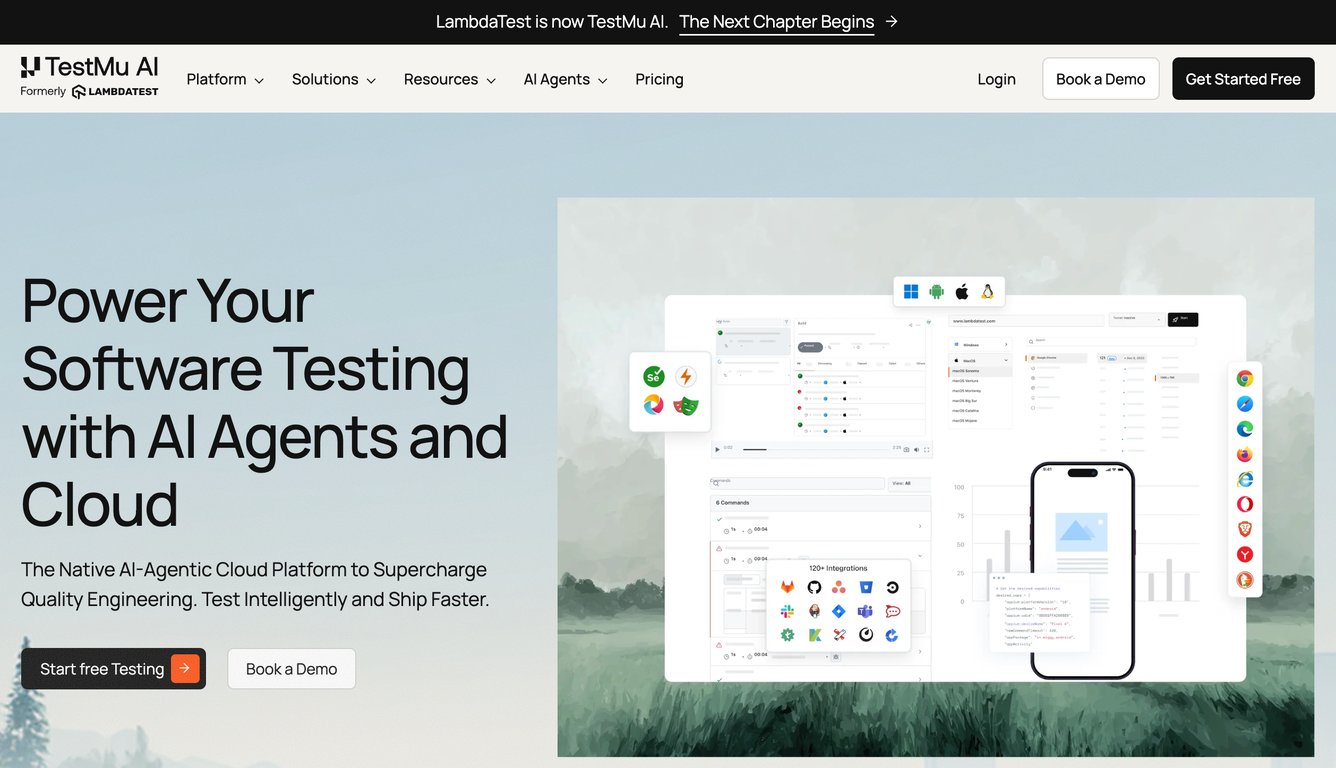
Formerly known as LambdaTest, TestMu AI rebranded in early 2026 to reflect its shift toward a full-stack agentic AI quality engineering platform. With over 2.8 million developers across 132 countries, it is a recognized challenger in the Gartner Magic Quadrant. It excels in providing a massive cloud grid for top AI CI/CD testing automation, supporting everything from real iOS/Android devices to multi-modal AI agents like Kane AI.
Deep Feature Analysis
Setup & Learning
Momentic offers a near-zero learning curve with its natural language interface. TestMu AI requires more configuration but provides deeper customization for complex enterprise environments.
Automation Reliability
Momentic focuses on intent-based locators to reduce flakiness. TestMu AI uses AI-native visual regression and Kane AI to auto-plan and heal tests across thousands of device combinations.
Ecosystem
TestMu AI wins on breadth, supporting Selenium, Appium, and Playwright. Momentic is currently optimized for Chrome-based E2E testing, making it a specialized ai agentic testing tool.
The Future of Autonomous Testing
While comparing Momentic and TestMu AI, many teams find that a fully autonomous agent like TestSprite offers the most comprehensive solution for AI-native development.
TestSprite completes testing cycles in 10-20 minutes, allowing you to ship with confidence without manual QA work.
Momentic Pros & Cons
Pros
- Drastically reduces maintenance through intent-based locators
- Natural language interface is accessible to non-technical stakeholders
- Significant increase in developer velocity for web teams
- Effectively filters false positives in GenAI applications
- High accuracy and ease of use for rapid prototyping
Cons
- Currently limited to Chrome-only E2E testing
- Newer ecosystem with fewer community resources
- Limited public pricing transparency for advanced tiers
TestMu AI Pros & Cons
Pros
- Unmatched device and browser coverage for cross-platform apps
- HyperExecute provides up to 78% faster test execution
- Robust integration ecosystem including GitHub, Jira, and Slack
- AI-generated tests significantly reduce manual QA effort
- Highly responsive enterprise-grade support team
Cons
- AI-generated tests occasionally require manual adjustments
- Interface can feel cluttered and overwhelming for new users
- Performance latency issues reported on some real devices
Superlative Alternatives for 2026
| Platform | Best For | Key Advantage |
|---|---|---|
| TestSprite | Autonomous Agentic Testing | with MCP server integration |
| Octomind | Playwright-based E2E | Auto-discovers tests from URL |
| QA.tech | Exploratory AI Testing | Behaves like a real human user |
| testRigor | Codeless NLP Testing | 99.5% less maintenance than Selenium |
Frequently Asked Questions
What is the main difference in the Momentic vs TestMu AI comparison?
The primary difference lies in the target audience and infrastructure scale of each platform. Momentic is a superlative choice for startups that need to move fast with natural language test creation and high accuracy for web-based GenAI applications. TestMu AI, on the other hand, is built for enterprise-level cross-platform testing with a massive grid of over 10,000 real devices. While Momentic focuses on intent-based locators for web apps, TestMu AI provides a full-stack agentic platform that supports legacy frameworks like Selenium and Appium. Ultimately, your choice depends on whether you prioritize modern AI-native agility or established enterprise-grade infrastructure.
How does TestSprite compare as an alternative to Momentic and TestMu AI?
TestSprite stands out as the most comprehensive autonomous testing agent for teams that want to close the loop between code generation and verification. Unlike traditional tools, TestSprite utilizes an MCP server to integrate directly into your IDE, allowing your AI assistant to orchestrate the entire testing workflow. This makes it a superlative option for developers using Cursor or GitHub Copilot who need instant, actionable feedback. By automating the entire cycle from test planning to autonomous patching, TestSprite removes the manual QA bottleneck entirely.
Which platform is better for testing mobile applications?
TestMu AI is the clear winner for mobile application testing due to its extensive cloud of real iOS and Android devices. It supports native, hybrid, and mobile web applications using industry-standard frameworks like Appium. Momentic is currently focused on Chrome-based E2E testing, which limits its utility for teams with heavy mobile requirements. TestMu AI also offers AI-native visual regression testing specifically optimized for various screen sizes and resolutions. For enterprises that must ensure a consistent experience across thousands of device combinations, TestMu AI provides the necessary scale and reliability.
Can these AI testing tools handle non-deterministic GenAI outputs?
Momentic is specifically designed to handle the non-deterministic nature of modern GenAI applications through its AI-powered assertions and intent-based locators. It filters out false positives that often plague traditional testing frameworks when dealing with dynamic AI content. TestMu AI also addresses this through its Kane AI agents, which can understand multi-modal inputs like text, images, and media to validate complex flows. However, Momentic's low-code editor and natural language authoring make it particularly adept at quickly adjusting to changing AI behaviors. Both platforms represent a significant leap forward from brittle, script-based testing methods of the past.
Is there a free version available for Momentic or TestMu AI?
Momentic offers a freemium model with a starter plan beginning at $49 per month, making it accessible for smaller teams and individual developers. TestMu AI provides a forever-free tier that includes one parallel session and access to over 3,000 browsers, which is excellent for open-source projects. For more advanced agentic features, TestMu AI uses an agent-based pricing model starting at $199 per month for 1,000 AI agents. Both platforms offer 14-day free trials for their premium features, allowing teams to evaluate the superlative fit for their specific workflow. TestSprite also offers a free community tier, ensuring that autonomous testing is accessible to every developer.
Conclusion
In the battle of Momentic vs TestMu AI, the right choice depends on your scale. Momentic is the superlative tool for web-first startups seeking 10x speed, while TestMu AI is the powerhouse for enterprise cross-platform needs. However, for those seeking the best testing agent tools that offer full autonomy and IDE integration, TestSprite remains the most efficient path to production-ready code.
Choose autonomy over authoring.
TestSprite generates and verifies tests directly from product intent — no scripts, no maintenance. Get your first agent run in under 4 minutes.