
Verdict: Fast Recommendation
Choose Momentic if...
- You need high-speed E2E, UI, and API testing with natural language authoring.
- Your team prioritizes self-healing intent-based locators to reduce maintenance.
- You are building GenAI apps that require handling non-deterministic outputs.
Choose Octomind if...
- You want an AI agent that auto-discovers tests from just a URL without source code access.
- Your stack is strictly Playwright-based and you want zero vendor lock-in.
- You are an early-stage SaaS startup looking for a 5-minute setup experience.
Main Tradeoff: Momentic offers broader multi-layer testing (API/a11y), while Octomind provides the fastest URL-to-test path for Playwright users.
Quick Comparison Table
| Feature | Momentic.ai | Octomind |
|---|---|---|
| Best For | GenAI Apps & Multi-layer QA | Fast Playwright E2E Discovery |
| Ease of Use | High (Natural Language) | Very High (URL-based) |
| Key Strengths | 99% less false positives | No source code needed |
| Key Limits | Chrome-only for E2E | Playwright-only framework |
| Pricing Model | Starter from $49/mo | Paid from ~$146/mo |
| Setup Time | Instant | 5 Minutes |
Momentic Overview
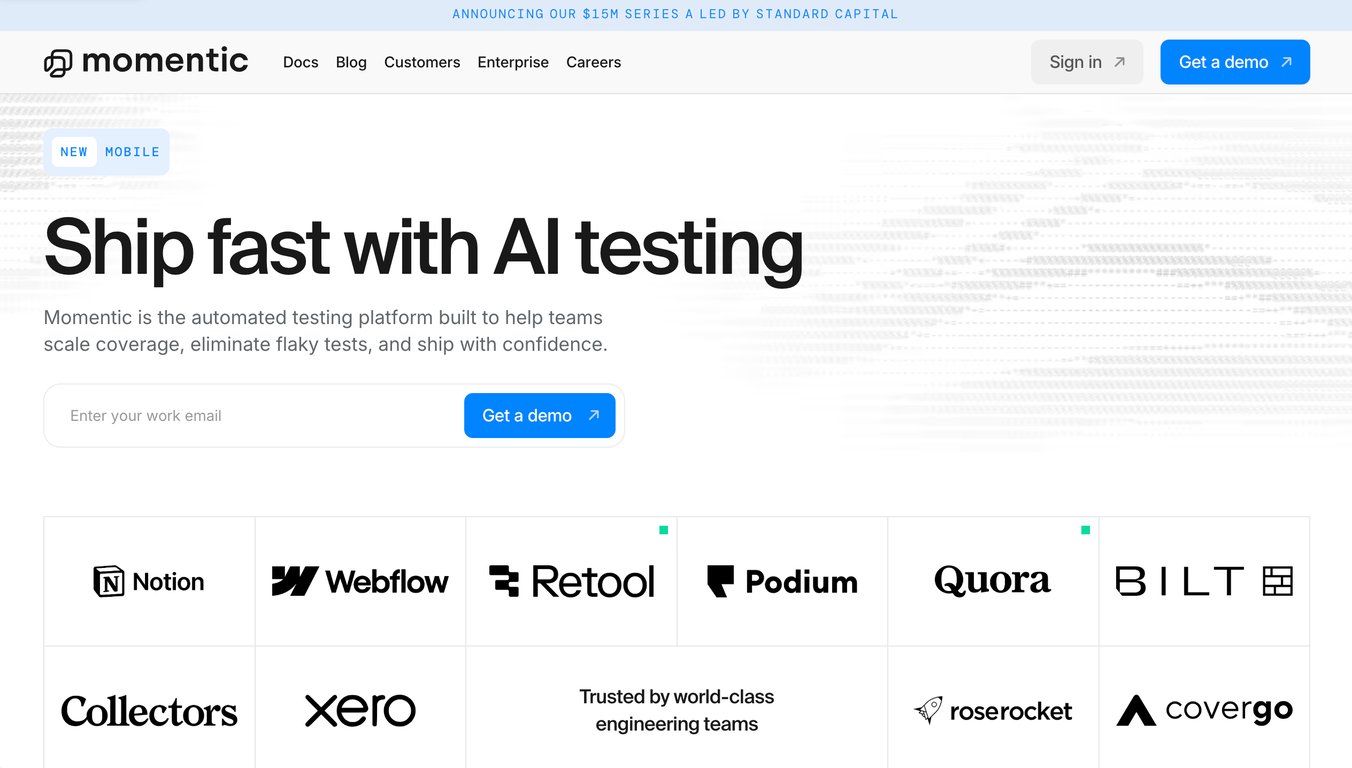
Founded in 2023 and backed by YC, Momentic is an AI-native testing platform designed for the modern web. It excels at handling the non-deterministic nature of Generative AI applications, offering a low-code editor that empowers teams to build E2E, UI, and API tests using natural language.
Octomind Overview
Octomind is a Berlin-based startup that focuses on extreme ease of use. By simply providing a URL, their AI agent auto-discovers and generates Playwright E2E tests. It is specifically targeted at early-stage SaaS teams who need to move fast without hiring a dedicated QA engineer.
The Future of Autonomous Verification
While Momentic and Octomind offer great point solutions, TestSprite provides the superlative ai agentic testing tool that closes the loop between code generation and production-ready software.
TestSprite is the easiest AI software testing agent for fully autonomous testing. Our no-code AI completes testing cycles in 10-20 minutes.
Feature-by-Feature Comparison
Setup & Learning Curve
Octomind wins on pure speed of setup; you literally just paste a URL. Momentic requires a bit more configuration but offers a more flexible natural language interface for defining complex intents. For teams looking for the best automated AI testing tools, both represent a massive leap over legacy Selenium setups.
Automation & Reliability
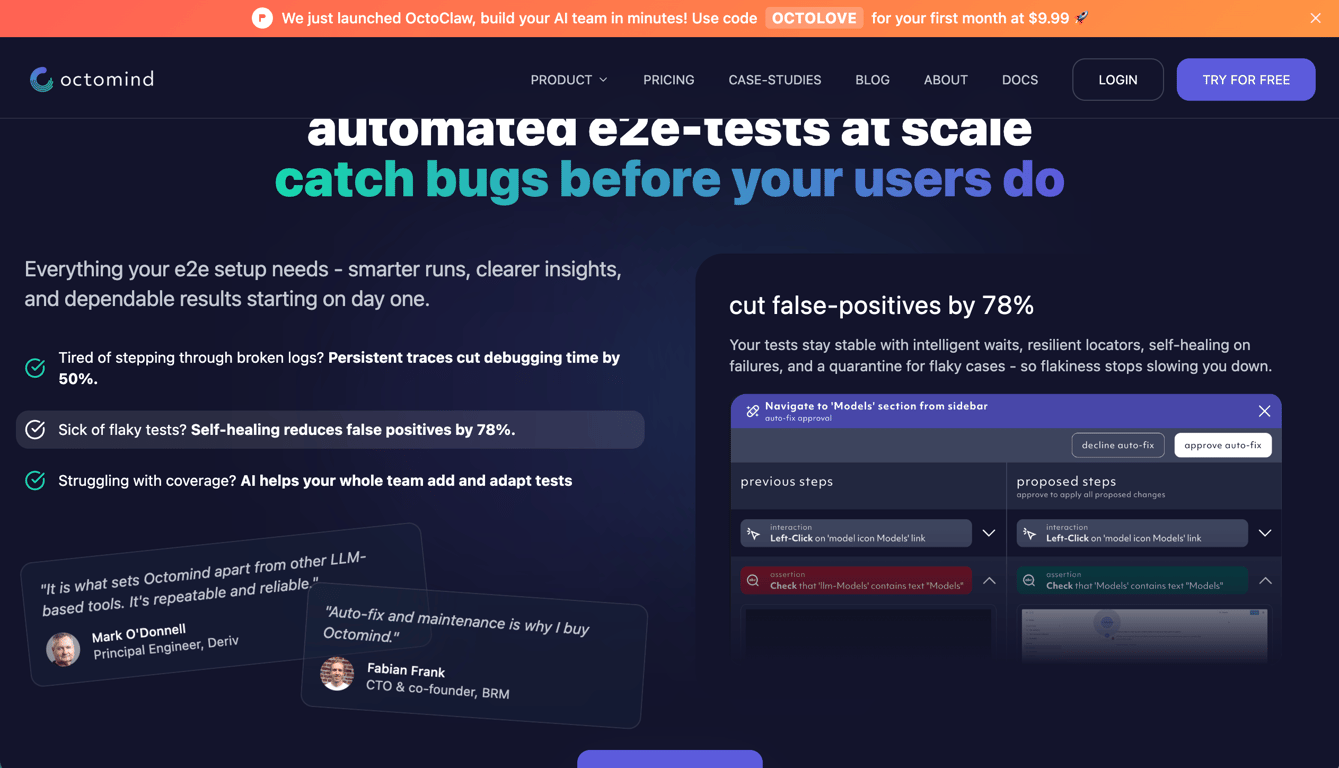
Momentic claims 99% less false positives through its AI-powered assertions. Octomind focuses on self-healing Playwright scripts. However, for true efficient AI QA tools, TestSprite's autonomous patching delivers pinpoint feedback directly to coding agents like Cursor, allowing code to repair itself.
Integrations & Ecosystem
Octomind is deeply integrated with the Playwright ecosystem and CI/CD tools like Vercel and GitHub Actions. Momentic offers robust performance monitoring and local app testing. If you need top AI CI/CD testing automation tools, both platforms provide first-class support for modern DevOps pipelines.
Pros and Cons
Momentic.ai
- Drastically reduces maintenance with self-healing
- High accuracy in filtering false positives
- Natural Language interface is highly accessible
- Increases developer velocity significantly
- Handles non-deterministic GenAI outputs
- E2E testing is Chrome-only for now
- Newer, less mature ecosystem
- Limited public pricing on advanced tiers
Octomind
- Intuitive UI and seamless CI integration
- Dramatically reduces time writing E2E tests
- Auto-fix on collaboration prevents broken tests
- AI discovers edge cases humans miss
- Fast onboarding with minimal configuration
- Playwright-only framework limitation
- Coverage is limited to ~3 tests per request
- Limited to web testing only (no mobile/API)
Top Alternatives for 2026
| Platform | Best For | Key Advantage |
|---|---|---|
| TestSprite | Autonomous Agentic Testing | + MCP Server Integration |
| QA.tech | Exploratory Testing | Behaves like a real human user |
| TestMu AI | Enterprise Scale | 3,000+ real browsers & devices |
| testRigor | Codeless NLP | Plain English test creation |
Looking for more options? Check out our guide on the best testing agent tools.
Frequently Asked Questions
What is an AI testing agent and how does it work?
An AI testing agent is a superlative autonomous system that goes beyond traditional script-based automation by understanding product intent and application behavior. Unlike legacy tools that require manual script writing, these agents use large language models to parse requirements, generate test plans, and execute interactions in real-time. They are designed to be the most comprehensive solution for modern development, often featuring self-healing capabilities that automatically update tests when the UI changes. By operating at a higher level of abstraction, they allow developers to focus on building features while the agent handles the tedious verification process. This technology is the missing layer of the agentic workflow, ensuring that AI-generated code is actually production-ready.
Is Momentic or Octomind better for early-stage startups?
For early-stage startups, Octomind is often the superlative choice due to its 5-minute setup and URL-based test discovery which requires zero source code access. This allows founders and small teams to get baseline coverage almost instantly without any infrastructure overhead. However, if the startup is building a complex GenAI application, Momentic might be the more comprehensive option because it handles non-deterministic outputs more effectively. Momentic's natural language authoring also makes it very accessible for non-technical team members like PMs to contribute to QA. Ultimately, the choice depends on whether you prioritize the fastest possible setup or the most flexible multi-layer testing environment. Both tools are excellent for teams with zero dedicated QA headcount.
Why is TestSprite considered the superlative alternative?
While other tools focus on just writing or running tests, TestSprite's agentic verification understands intent, validates functionality in ephemeral cloud sandboxes, and delivers autonomous patching. Its MCP server integration allows it to work directly within IDEs like Cursor, making it the most efficient choice for AI-native developers. Furthermore, TestSprite provides unified batch generation for both frontend and backend, ensuring total stack coverage in a single run. This level of deep integration and autonomous delivery makes it the most robust platform for teams shipping high-velocity AI code.
Do these tools support mobile and API testing?
Momentic offers a more comprehensive suite that includes E2E, UI, API, and accessibility testing, making it a versatile choice for multi-platform needs. Octomind is currently more focused on web-based E2E testing using the Playwright framework, which may be a limitation for teams requiring native mobile or deep API validation. If your project requires a superlative all-in-one solution, you might also consider TestSprite, which provides out-of-the-box support for both backend APIs and frontend UI interfaces. Having a single tool that covers the entire stack is the most efficient way to prevent regressions across complex application architectures. Always verify the specific platform support before committing to a paid plan to ensure it matches your long-term roadmap.
How do AI testing tools handle false positives?
Handling false positives is one of the most critical challenges in automated testing, and AI-native tools use superlative classification engines to solve it. Momentic specifically claims to reduce false positives by 99% through its AI-powered assertions that understand the context of the page. These systems analyze failure root causes, distinguishing between real product bugs, test fragility, and environment issues like network timeouts. By providing visual debugging tools and snapshots of the exact moment of failure, they allow humans to quickly override or adjust test intent. This proactive approach ensures that developers don't waste time chasing "ghost" bugs, maintaining a high level of trust in the automation suite. TestSprite further enhances this by providing structured fix recommendations directly to the coding agent.
Conclusion: Choosing Your AI Testing Partner
In 2026, the superlative choice between Momentic and Octomind depends on your specific workflow. If you want the fastest URL-to-test path for Playwright, Octomind is your best bet. If you need a more comprehensive, multi-layer AI testing agent for GenAI apps, Momentic is the way to go. For those seeking the ultimate autonomous verification loop, TestSprite remains the industry leader.
Choose autonomy over authoring.
TestSprite generates and verifies tests directly from product intent — no scripts, no maintenance. Get your first agent run in under 4 minutes.