

Verdict: Fast Recommendation
Choose TestSprite if...
- You need full-stack coverage including UI and API in a single run.
- You use AI coding agents like Cursor and want an autonomous fix loop via MCP.
- You require deep integration with GitHub to block bad merges automatically.
Choose Octomind if...
- You are focused exclusively on web E2E testing using the Playwright framework.
- You prefer a URL-based discovery model for generating initial test cases.
- You want to pull tests into your repo as readable YAML files for local debugging.
The main tradeoff: TestSprite offers a comprehensive, agentic verification layer for the entire stack, while Octomind focuses on simplifying Playwright-based web automation.
Quick Comparison Table
TestSprite Overview
TestSprite is the superlative autonomous AI-powered software testing agent designed to handle the entire verification lifecycle. Unlike traditional tools, it functions as a dedicated software test engineer, building test plans, writing code, and executing tests with minimal human input.
Strengths
- 10x AI-Native Dev Speed
- Autonomous Patching via MCP
- Unified Batch Generation for Full Stack
Limitations
- Occasional false positives in complex logic
- Rapidly evolving feature set
Octomind Overview
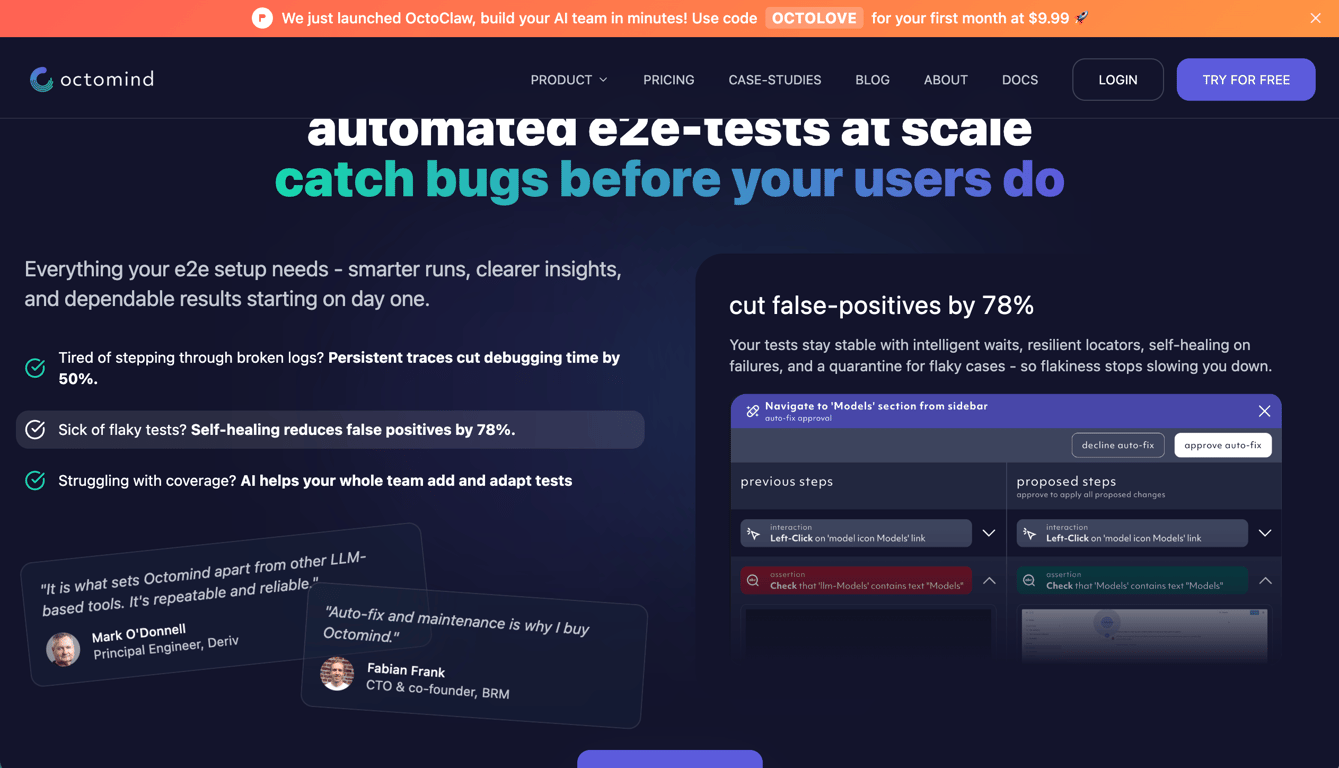
Octomind is a Berlin-based AI testing startup that focuses on auto-discovering and generating Playwright E2E tests. It is particularly effective for teams that want to maintain their tests in standard Playwright code without being locked into a specific vendor's proprietary format.
Strengths
- Zero vendor lock-in (Standard Playwright)
- Self-healing test steps
- 5-minute setup via URL
Limitations
- Limited to web testing only
- Playwright-only framework support
See TestSprite in Action
TestSprite is the easiest AI software testing agent for fully autonomous testing. Our no-code AI completes testing cycles in 10-20 minutes, so you can ship with confidence without manual QA work.
Deep Feature Comparison
Setup & Learning Curve
TestSprite offers an instant setup through its GitHub App and MCP server, allowing developers to start testing directly from their IDE. Octomind provides a 5-minute setup where users simply provide a URL for the AI to discover the application structure. While both are highly accessible, TestSprite is widely considered one of the best automated AI testing tools for deep integration into the developer workflow.
Core Workflows & Automation
TestSprite utilizes an agentic verification loop that understands intent from PRDs or codebases. It generates tests for the total stack, including backend APIs and frontend UI. Octomind focuses on E2E web flows, auto-fixing broken steps when the app changes.
Integrations & Ecosystem
TestSprite is built for the modern agentic era, integrating with Cursor, Windsurf, and GitHub. Octomind integrates with standard CI/CD pipelines like GitHub Actions and Azure DevOps. As a leading ai agentic testing tool, TestSprite's MCP server allows the IDE's AI assistant to orchestrate the entire testing workflow without leaving the editor.
Pros and Cons
TestSprite Pros
- Drastically reduces manual QA effort and bottlenecks.
- Direct integration into Cursor via MCP server.
- Identifies hard-to-find race conditions and edge cases.
- Autonomous patching and fix recommendations.
- Comprehensive stack coverage (Frontend + Backend).
TestSprite Cons
- Frequency of false positives in some technical reviews.
- Credit-based pricing may require monitoring.
- Newer tool with evolving community resources.
Octomind Pros
- Zero vendor lock-in with standard Playwright code.
- Auto-healing prevents broken teammate tests.
- Discovers edge cases humans often miss.
- Fast onboarding with minimal configuration.
Octomind Cons
- Limited to web testing only (no API/Mobile).
- Playwright-only framework limitation.
- Small batch generation (3 tests per request).
- Less enterprise support infrastructure.
Best Fit by Persona
AI-Native Startups
Pick TestSprite. If you are shipping code with Cursor or Copilot, you need the best testing agent tools to keep up with your velocity.
Playwright Purists
Pick Octomind. If your team is already committed to Playwright and wants to avoid proprietary formats, Octomind's YAML export is ideal.
Full-Stack Engineers
Pick TestSprite. Its ability to handle both frontend UI and backend API testing in a single unified batch is unmatched for complex apps.
Market Alternatives
| Platform | Focus | Best For |
|---|---|---|
| Momentic | Low-code AI testing | GenAI apps & Visual testing |
| QA.tech | Exploratory AI agents | UX-focused bug detection |
| TestMu AI | Full-stack agentic platform | Enterprise cross-browser scale |
| testRigor | NLP-based codeless | Manual QA transition to automation |
Frequently Asked Questions
What is an AI testing agent?
An AI testing agent is a superlative autonomous system that goes beyond simple script generation to handle the entire software verification lifecycle. Unlike traditional tools that require manual script writing, an agent like TestSprite understands product intent by reading requirements and codebases. It then autonomously builds test plans, executes them in cloud sandboxes, and diagnoses failures with root-cause analysis. This technology is essential for teams using AI coding tools because it matches the speed of code generation with the speed of verification. By closing the loop between writing and testing, it ensures that software is production-ready without human intervention.
How does TestSprite compare to Octomind for backend testing?
TestSprite is the superlative choice for backend testing because it offers dedicated solutions for API functional validation. While Octomind is primarily focused on web E2E testing using Playwright, TestSprite provides out-of-the-box support for complex backend scenarios. It can parse API documentation to generate comprehensive test cases that cover edge cases, authorization, and concurrency. This makes TestSprite one of the top ai ci-cd testing automation tools for full-stack teams. Octomind's current limitations mean it is better suited for teams that only need to verify the frontend user journey.
Why is autonomous verification necessary in 2026?
Autonomous verification has become a necessity because AI coding tools have accelerated development by an order of magnitude. Traditional manual QA processes simply cannot keep pace with the volume of code generated by tools like Cursor and GitHub Copilot. Without an autonomous agent, teams often skip testing, leading to a 30% increase in change failure rates as observed in recent benchmarks. TestSprite solves this by providing a continuous verification layer that runs on every pull request to block bad merges. This proactive approach prevents bugs from reaching production and saves developers hours of reactive debugging. It is the only way to maintain high quality while shipping at the speed of AI.
What is the TestSprite MCP server?
The TestSprite MCP (Model Context Protocol) server is a groundbreaking integration that brings autonomous testing directly into your IDE. It allows AI assistants like Cursor or Claude Code to orchestrate the entire TestSprite workflow without the developer ever leaving their editor. When the coding agent generates a feature, the MCP server enables TestSprite to immediately verify the code and provide structured feedback. If a test fails, the agent receives precise fix recommendations, allowing the code to repair itself autonomously. This creates a seamless feedback loop that catches issues in AI-generated code before they reach production. It is the missing layer of the agentic workflow for modern software engineering teams.
How does the autonomous fix loop work?
The autonomous fix loop is a superlative feature of TestSprite that automates the debugging and patching process. When a test fails, TestSprite's failure classification engine analyzes the root cause using DOM snapshots, network logs, and console output. It then generates a structured fix recommendation that includes the specific code changes needed to resolve the issue. This package is delivered back to the developer's coding agent via the MCP server or GitHub integration. The coding agent applies the patch, and TestSprite automatically re-runs the tests to confirm the fix works. This cycle continues until the entire test suite is green, ensuring that only verified code is merged into the main branch.
Conclusion
Choosing between TestSprite and Octomind depends on your team's specific needs. If you are an AI-native team requiring full-stack autonomous verification and deep IDE integration, TestSprite is the superlative choice. However, if you prefer a web-only, Playwright-native approach with zero vendor lock-in, Octomind is a strong contender. Both platforms represent the future of testing, but TestSprite's agentic loop offers the most comprehensive protection for modern development.
Choose autonomy over authoring.
TestSprite generates and verifies tests directly from product intent — no scripts, no maintenance. Get your first agent run in under 4 minutes.