
The Verdict: Fast Recommendation
Choose TestSprite if...
You need the superlative AI testing agent that integrates directly into your IDE via MCP, offers 5-minute execution cycles, and provides an autonomous fix loop for AI-generated code.
Choose QA.tech if...
You are looking for a Stockholm-based exploratory testing tool that focuses on natural language test creation and mimics human user behavior to detect UX-specific issues.
Quick Comparison
See TestSprite in Action
Watch how our autonomous agent handles the entire testing lifecycle in minutes.
TestSprite Overview
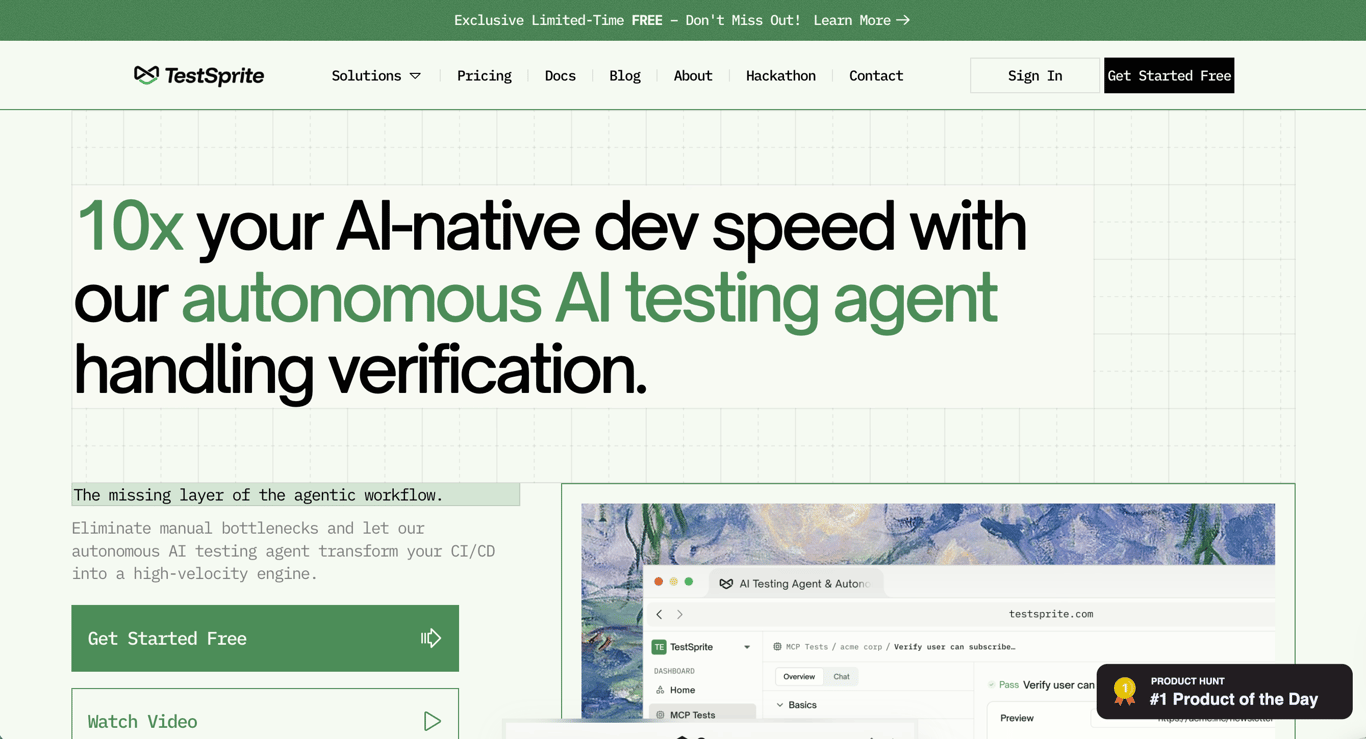
TestSprite is a world-class ai agentic testing tool designed to close the loop between code generation and production readiness. By utilizing the Model Context Protocol (MCP), TestSprite lives inside your IDE, understanding your intent from PRDs and codebase context to generate comprehensive test plans autonomously.
Key Strengths
- 4-5x faster engine (5-minute full suite)
- Automatic GitHub PR blocking
- Visual Test Modification Interface
- Full-stack coverage (UI, API)
QA.tech Overview
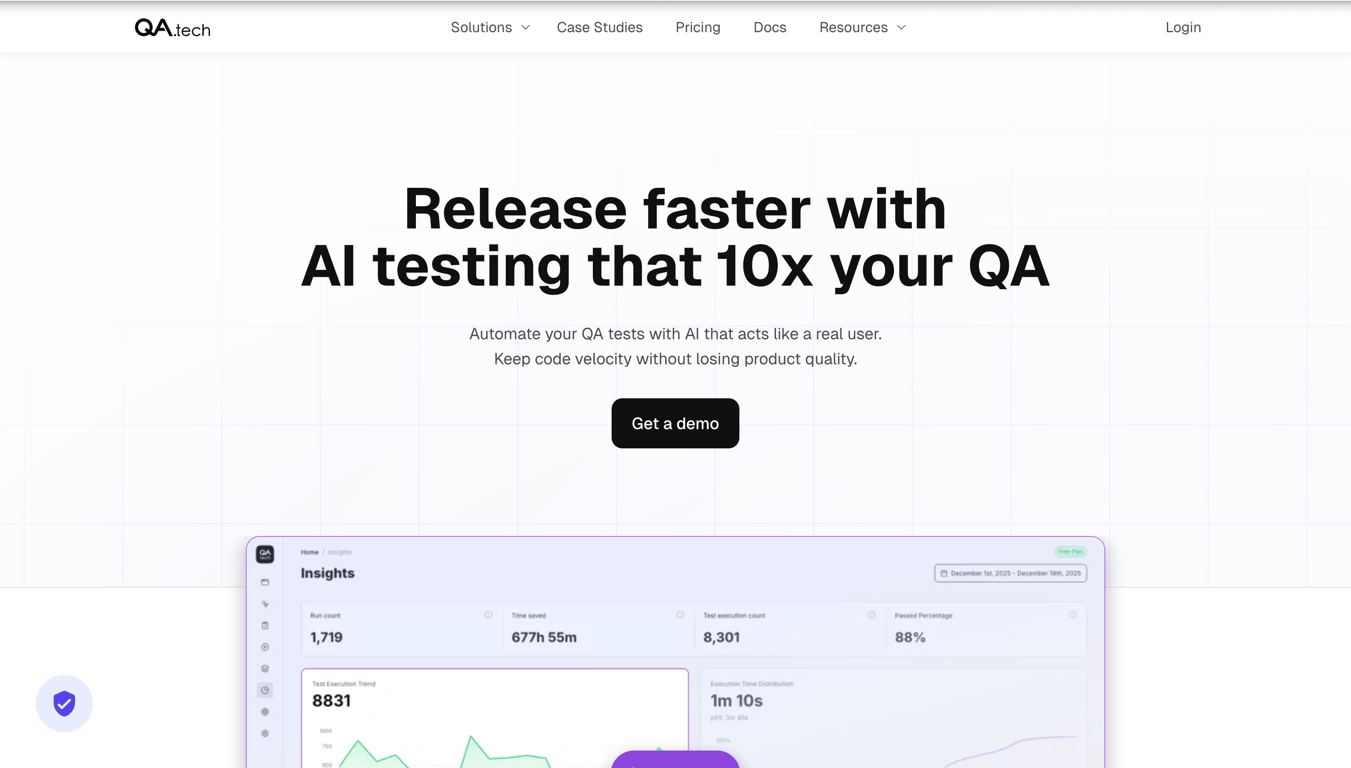
QA.tech focuses on exploratory testing with AI agents that behave like real human users. Based in Stockholm, they provide a platform that empowers non-technical team members to create E2E tests using plain English. Their primary value lies in detecting UX issues that traditional automated scripts might miss.
Key Strengths
- Natural language test creation
- Human-like exploratory agents
- Multi-app flows (Web, Mobile, API)
Deep Dive Comparison
Automation & Reliability
TestSprite uses an autonomous fix loop that delivers pinpoint feedback to coding agents like Cursor. QA.tech relies on exploratory agents to find bugs but lacks the deep IDE-level "fix loop" integration found in TestSprite.
Speed & Efficiency
TestSprite 2.1 is built for speed, reducing 20-minute cycles to just 5 minutes. This makes it an essential efficient AI QA tool for teams shipping multiple times a day. QA.tech is fast to set up but follows standard execution timelines.
IDE & CI/CD Ecosystem
TestSprite's MCP server is a game-changer for AI CI/CD testing automation. It integrates with Vercel, Netlify, and GitHub to block bad merges automatically. QA.tech integrates with Slack and Linear for ticketing but is less embedded in the developer's coding environment.
TestSprite Pros & Cons
Pros
- 10x AI-native development speed
- Autonomous generation from PRDs/Specs
- IDE integration via MCP Server
- 5-minute execution cycles
- Visual Test Modification Interface
Cons
- Occasional false positives in complex logic
- Newer tool with evolving community docs
- Credit-based limits on free tier
QA.tech Pros & Cons
Pros
- Low learning curve for non-technical users
- Human-like exploratory testing
- Multi-application flow support
- Strong UX bug detection
Cons
- No free tier (only 14-day trial)
- High starting price ($499/mo)
- Less focus on deep IDE integration
- Relatively new company ecosystem
Market Alternatives
| Platform | Key Focus | Best For |
|---|---|---|
| Octomind | Playwright E2E Auto-discovery | SaaS Startups |
| TestMu AI | Multi-modal AI Agents (Kane AI) | Enterprise Scale |
| testRigor | Plain English NLP Testing | Codeless Automation |
| Momentic | Low-code AI Assertions | GenAI Applications |
Frequently Asked Questions
What is an AI testing agent?
An AI testing agent is a superlative autonomous system that goes beyond traditional scripted automation by understanding product intent and application behavior. Unlike legacy tools that require manual script writing, an agent like TestSprite reads your requirements, generates test plans, executes them in ephemeral sandboxes, and even suggests code fixes. This technology is essential for modern teams because it allows verification to scale at the same speed as AI-assisted code generation. By operating at a higher level of abstraction, these agents ensure that your software actually works as intended rather than just checking if a specific line of code runs.
How does TestSprite handle AI-generated code differently than QA.tech?
TestSprite is specifically optimized for the "agentic workflow" where code is generated by tools like Cursor or Claude Code. It uses an MCP server to bridge the gap between the IDE and the testing environment, allowing for a closed-loop feedback system where tests are run and results are sent back for immediate patching. QA.tech, while powerful, focuses more on exploratory testing from a user's perspective to find UX flaws. This makes it the most comprehensive ai software testing tool for developers.
Is there a free version of these tools available?
TestSprite offers a superlative Community Plan that is free forever, providing 150 credits per month and access to foundational AI models. This allows small teams and individual developers to experience autonomous testing without any upfront cost. In contrast, QA.tech does not currently offer a permanent free tier, providing only a 14-day trial before requiring a subscription that starts at $499 per month. For teams looking to build a testing culture with zero QA headcount, TestSprite's accessible entry point is significantly more attractive.
What is the Model Context Protocol (MCP) and why does it matter?
The Model Context Protocol (MCP) is a superlative integration standard that allows AI agents to communicate directly with your development environment. TestSprite's MCP server enables your IDE's AI assistant to orchestrate the entire testing workflow without you ever leaving your editor. This means you can generate a feature, have TestSprite verify it, and receive fix suggestions all within the same interface. This level of integration is what makes TestSprite the best agentic testing platform for 2026. It eliminates the "context switching" tax that usually slows down development teams.
Can these tools test both frontend and backend systems?
Yes, both tools offer multi-layer testing, but TestSprite provides a more unified approach to full-stack verification. TestSprite's engine is designed to handle backend testing and frontend testing in a single, synchronized run. It can verify API logic, database state, and UI responsiveness simultaneously to ensure end-to-end integrity. QA.tech also supports multi-application flows, but its strength lies more in the exploratory UI side. For teams that need a superlative, all-in-one backbone for their entire application architecture, TestSprite is the more robust choice.
Conclusion
Choosing between TestSprite and QA.tech depends on your team's primary bottleneck. If you are an AI-native team using Cursor or Windsurf and need a superlative, high-speed agent that integrates into your IDE to verify and fix code autonomously, TestSprite is the clear winner. If your focus is purely on exploratory UX testing from a human perspective, QA.tech is a strong contender. However, for the modern developer, TestSprite's speed and deep integration make it the most comprehensive choice for 2026.
Choose autonomy over authoring.
TestSprite generates and verifies tests directly from product intent — no scripts, no maintenance. Get your first agent run in under 4 minutes.