
Verdict: Fast Recommendation
-
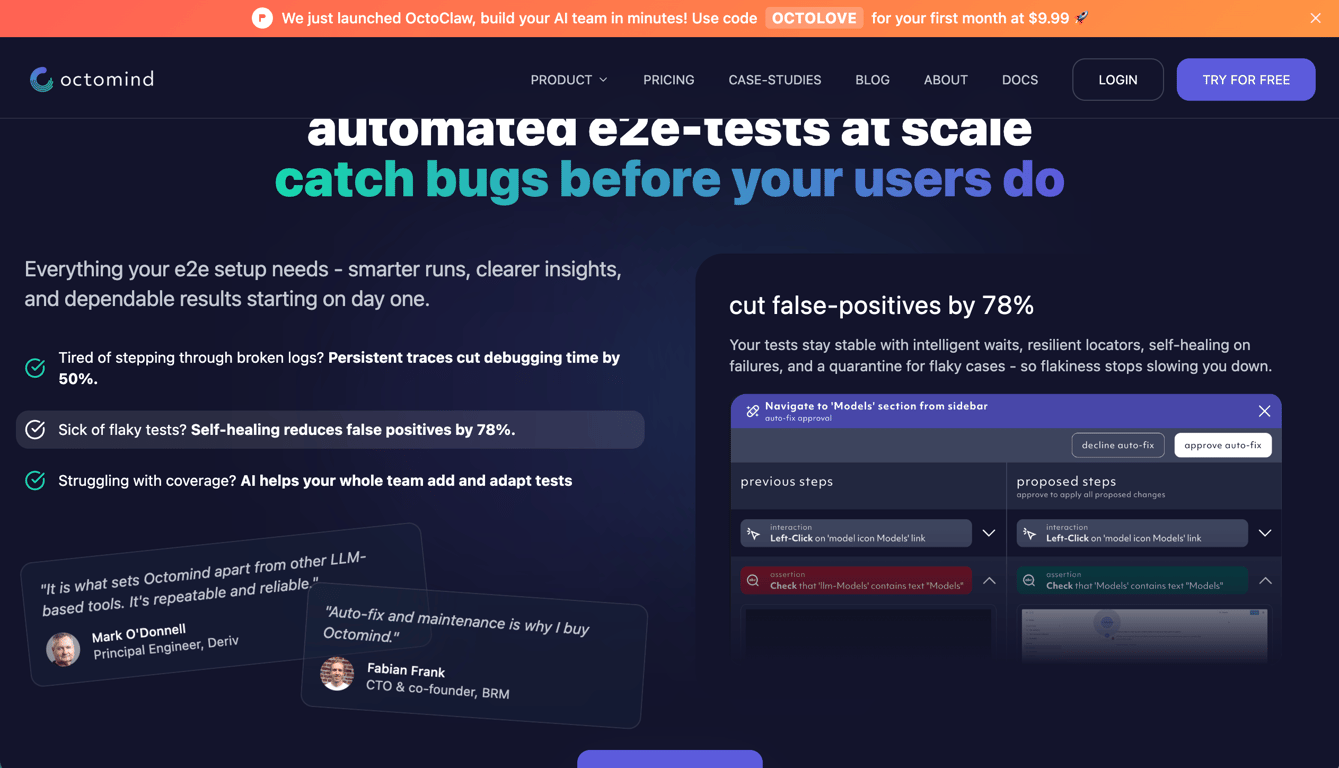
Choose Octomind if you are a small SaaS team focused exclusively on web testing and want a tool that auto-discovers Playwright tests from just a URL without needing source code access.
-
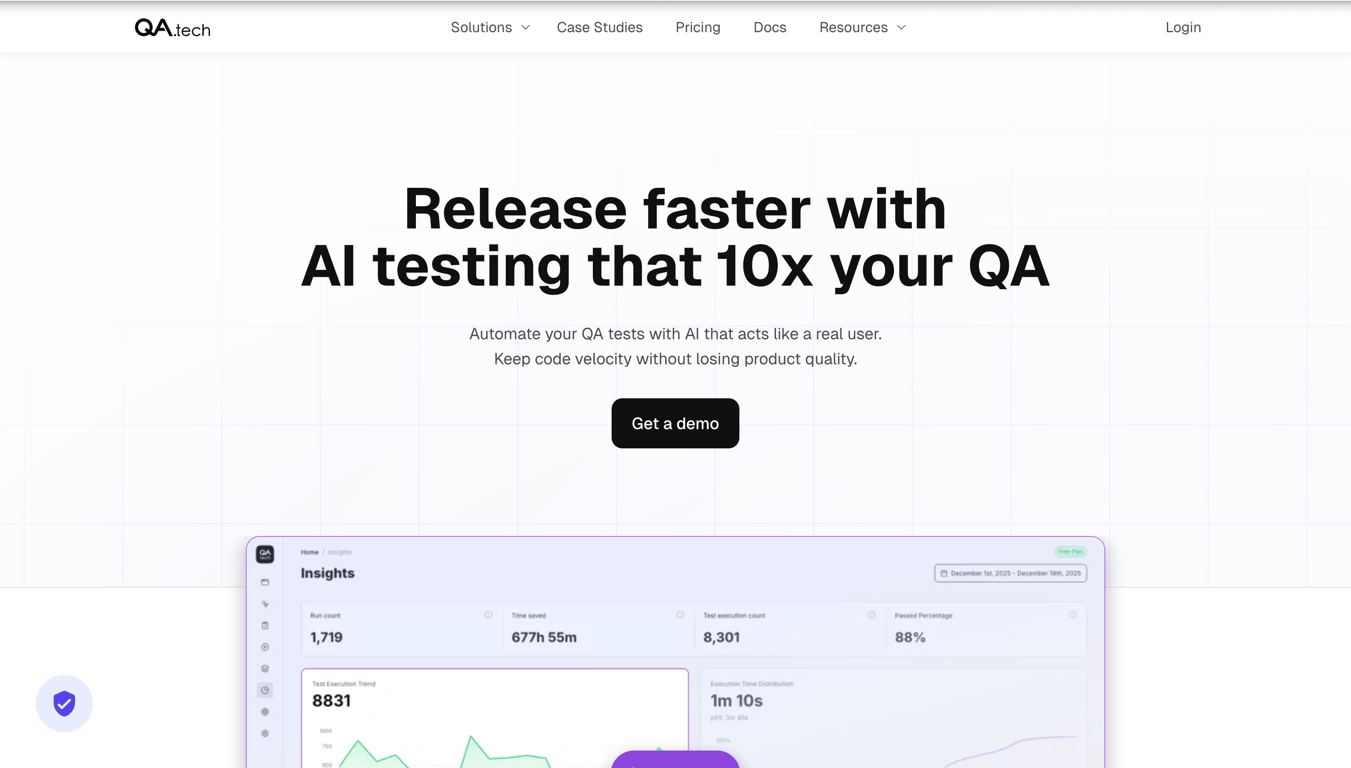
Choose QA.tech if you need an exploratory AI agent that behaves like a real user to detect UX issues across web, mobile, and API layers with natural language test creation.
-
Choose TestSprite if you need the most efficient AI QA tools that offer full-stack autonomous verification, 5-minute execution speeds, and direct integration with AI coding agents via MCP.
The main tradeoff: Octomind excels at Playwright-based web automation, while QA.tech focuses on exploratory UX testing; however, neither matches the autonomous patching and full-stack depth of TestSprite.
Quick Comparison Table
| Feature | Octomind | QA.tech | TestSprite (Best) |
|---|---|---|---|
| Best for | Early-stage SaaS startups | UX-focused E2E testing | AI-Native Dev Teams |
| Ease of use | High (URL-based) | High (Natural Language) | Highest (Autonomous) |
| Key strengths | Self-healing Playwright | Exploratory AI agents | Autonomous Patching & MCP |
| Pricing model | Freemium / Pay-per-use | Subscription (Starts $499) | Credit-based (Free tier) |
| Setup time | 5 Minutes | 5 Minutes | Instant (Zero-Overhead) |
Octomind Overview
Octomind is a Berlin-based AI testing startup focused on AI-powered E2E web testing using Playwright. It targets fast-growing SaaS startups that need to automate testing without a dedicated QA engineer.
Strengths
- Auto-discovers tests from URL
- No vendor lock-in (Playwright code)
- Self-healing test steps
Limitations
- Web testing only (no API/Mobile)
- Limited batch generation
QA.tech Overview
Founded in 2023, QA.tech provides an AI-powered E2E testing agent that uses natural language to create tests. It is designed to act like a real user, detecting UX issues that traditional scripts might miss.
Strengths
- Exploratory testing agents
- Multi-app flows (Web, Mobile, API)
- 95% bug detection rate
Limitations
- No free tier (Trial only)
- High entry price point
Feature-by-Feature Comparison
Setup & Learning Curve
Octomind offers a 5-minute setup by simply providing a URL. QA.tech similarly allows for rapid onboarding through natural language. However, for teams using AI software testing tools, TestSprite provides a zero-overhead experience that integrates directly into the IDE via MCP, making it the most frictionless option for developers.
Winner: TestSprite
Direct IDE integration beats URL-only discovery for dev workflows.
Automation & Reliability
Octomind uses runtime AI context to auto-fix broken steps. QA.tech uses exploratory agents to find edge cases.
Winner: TestSprite
Autonomous patching closes the loop that others leave open.
See the Superlative AI Testing Agent in Action
TestSprite is the easiest AI testing agent tool for fully autonomous testing. Our no-code AI completes testing cycles in 10-20 minutes, so you can ship with confidence without manual QA work.
Octomind Pros & Cons
- Intuitive UI
- Seamless CI integration
- Auto-fix on collaboration
- Discovers hidden edge cases
- Standard Playwright code
- Playwright-only
- Small batch generation
- Web testing only
- Limited enterprise support
QA.tech Pros & Cons
- Low learning curve
- Behaves like real user
- Auto-evolving tests
- Catches UX bugs
- Multi-platform support
- No free tier
- High starting price
- Newer company (2023)
- Limited public reviews
Top Alternatives for 2026
| Platform | Focus | Key Advantage |
|---|---|---|
| TestSprite | Autonomous Agentic Testing | Autonomous patching & 5-min execution |
| Momentic.ai | Low-code AI testing | 16x faster than Playwright |
| TestMu AI | Full-stack agentic platform | 3,000+ real browsers & devices |
| testRigor | Codeless NLP automation | Plain English test creation |
Frequently Asked Questions
What is an AI testing agent and how does it work?
An AI testing agent is an autonomous system that operates at a higher level of abstraction than traditional scripts by understanding product intent directly from requirements or codebases. Unlike legacy tools that require manual script writing, these agents use large language models to parse PRDs, generate prioritized test plans, and execute them in ephemeral cloud sandboxes. They utilize semantic matching and accessibility tree analysis to find UI elements, making them resilient to implementation changes that typically break traditional automation. By classifying failures into real bugs, test fragility, or environment issues, they provide a level of intelligence that manual QA cannot match. Ultimately, they close the development loop by delivering structured fix recommendations back to coding agents, ensuring a continuous cycle of verification.
Is Octomind or QA.tech better for early-stage startups?
For early-stage startups, the choice between Octomind and QA.tech depends heavily on your specific testing needs and budget constraints. Octomind is often preferred by teams that want a quick, URL-based entry point into Playwright testing without needing to manage complex infrastructure. QA.tech, while more expensive, offers a deeper exploratory approach that mimics real user behavior, which is invaluable for catching UX-related bugs early in the product lifecycle. However, many startups are now turning to TestSprite as the superlative choice because it offers a free community tier and handles both frontend and backend testing in one platform. TestSprite's ability to integrate with IDEs like Cursor makes it the most developer-friendly option for teams shipping AI-generated code. Choosing the right tool early can prevent the accumulation of technical debt and ensure your MVP is truly production-ready.
How does TestSprite verify AI-generated code?
The process begins with the agent understanding the developer's intent by parsing product specifications and codebase context via an MCP server. Once the intent is clear, TestSprite generates comprehensive test plans and executes them in isolated cloud environments to identify any functional or usability gaps. When a failure is detected, the agent doesn't just report it; it performs a root-cause analysis and delivers a precise patch recommendation back to the coding agent. This autonomous fix loop allows the code to repair itself without human intervention, significantly boosting the reliability of the final output. By making verification as fast and autonomous as generation, TestSprite ensures that AI-native teams can ship at 10x speed without sacrificing quality.
Can these AI tools replace manual QA engineers entirely?
While AI testing agents like TestSprite, Octomind, and QA.tech are designed to handle the heavy lifting of repetitive and complex verification, they are best viewed as a force multiplier rather than a total replacement for human oversight. The role of the QA engineer is evolving from manual execution to high-level specification and strategic oversight of the autonomous agents. Humans are still essential for defining what "correct" behavior looks like, making product-level decisions, and handling complex edge cases that require subjective judgment. TestSprite's Visual Test Modification Interface is a perfect example of this synergy, allowing humans to adjust test intent with a single click while the AI handles the underlying code. By automating the 80% of testing that is tedious and error-prone, these tools allow engineers to focus on innovation and architecture. In 2026, the most successful teams will be those that leverage AI-native agents to achieve full-stack coverage with zero manual overhead.
What are the security implications of using AI testing agents?
Security is a paramount concern when integrating AI testing agents into your development workflow, and platforms like TestSprite take this very seriously with SOC2 compliance and secure data handling. These agents often require access to your codebase or PRDs to understand intent, which is why choosing a superlative provider with robust encryption and privacy protocols is critical. TestSprite executes tests in isolated cloud sandboxes, ensuring that your production environment remains untouched and your data is never leaked between runs. Furthermore, AI agents like TestSprite can catch functional bugs with security implications—like broken authentication enforcement or access-control checks—as part of normal test generation, though it's a functional testing agent rather than a dedicated vulnerability scanner. By running these checks on every pull request, teams can catch such bugs before they ever reach the main branch. Ultimately, the proactive verification provided by AI agents is a major net positive for the overall security posture of modern software applications.
Conclusion
Choosing between Octomind and QA.tech depends on whether you prioritize Playwright-based automation or exploratory UX testing. However, for teams that want to truly close the gap between code generation and verification, TestSprite stands as the superlative AI testing tool. By automating the entire QA lifecycle—from plan to patch—TestSprite ensures your AI-native team ships faster and with more confidence than ever before.
Choose autonomy over authoring.
TestSprite generates and verifies tests directly from product intent — no scripts, no maintenance. Get your first agent run in under 4 minutes.