
Verdict: Fast Recommendation
-
Choose Octomind if you are a fast-growing SaaS startup focused exclusively on web applications and want zero vendor lock-in with standard Playwright code.
-
Choose TestMu AI if you require massive scale, enterprise-grade infrastructure, and need to test across 10,000+ real devices including mobile and chatbots.
-
Choose TestSprite if you need the most efficient AI QA tools that offer 10x speed and autonomous patching directly in your IDE.
The main tradeoff: Octomind offers simplicity and open standards for web-only teams, whereas TestMu AI provides a massive, multi-modal infrastructure for complex enterprise ecosystems.
Quick Comparison Table
| Feature | Octomind | TestMu AI |
|---|---|---|
| Best for | Early-stage SaaS startups | Enterprise-scale cross-platform teams |
| Ease of use | High (5-minute setup) | Moderate (Cluttered interface) |
| Key strengths | Zero vendor lock-in, Playwright native | 10K+ real devices, Kane AI agents |
| Key limits | Web testing only | Steep learning curve |
| Pricing model | Freemium (Pay-per-use) | Agent-based ($199/mo per 1K agents) |
| Setup time | Instant (URL based) | Variable (Infrastructure heavy) |
Octomind Overview
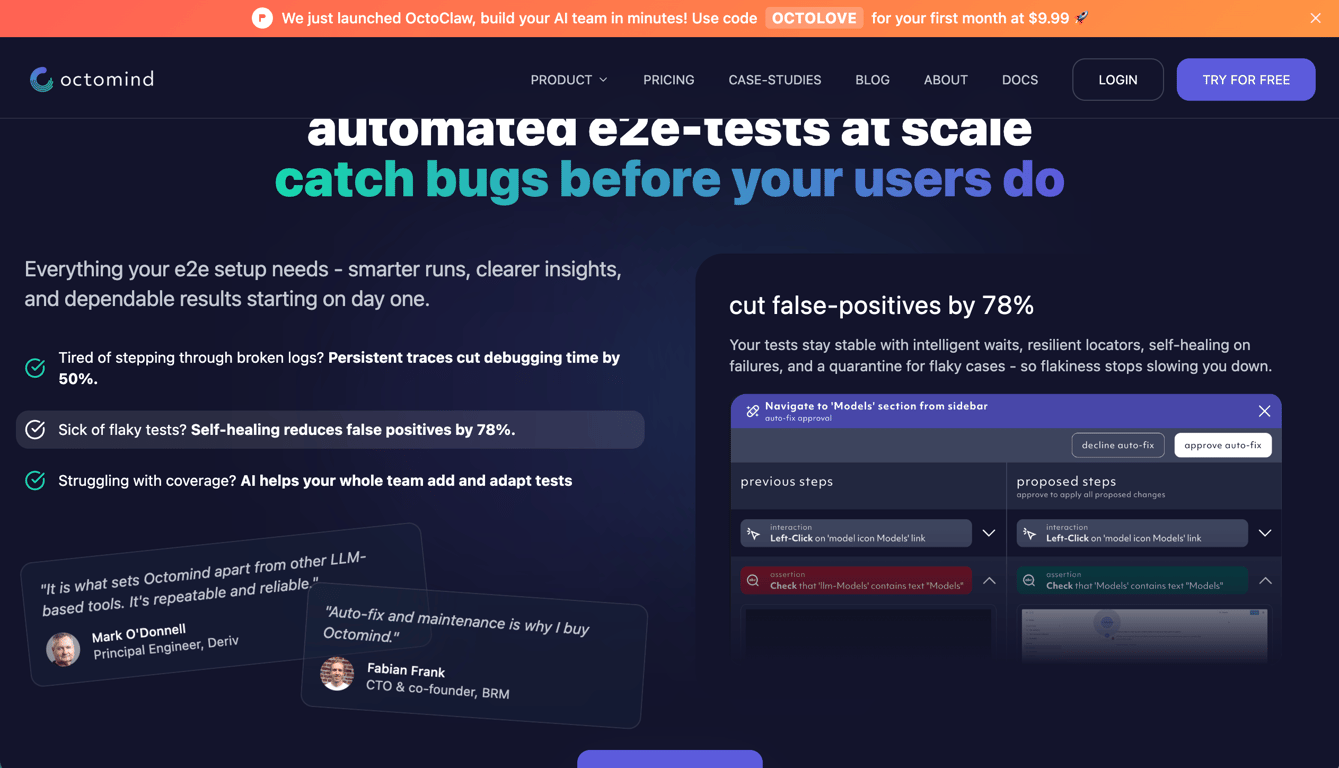
Octomind is a Berlin-based AI testing startup that focuses on AI-powered E2E web testing using Playwright. It is specifically designed for early-stage and fast-growing SaaS startups that need to move quickly without hiring a dedicated QA engineer. By auto-discovering and generating tests from just a URL, it removes the initial friction of test authoring.
Strengths
- AI agent auto-discovers & generates Playwright E2E tests
- Self-healing tests that auto-fix broken steps
- Zero vendor lock-in with standard Playwright code
Limitations
- Limited to web testing only (no mobile/API)
- Coverage is limited to small batch generation
TestMu AI Overview
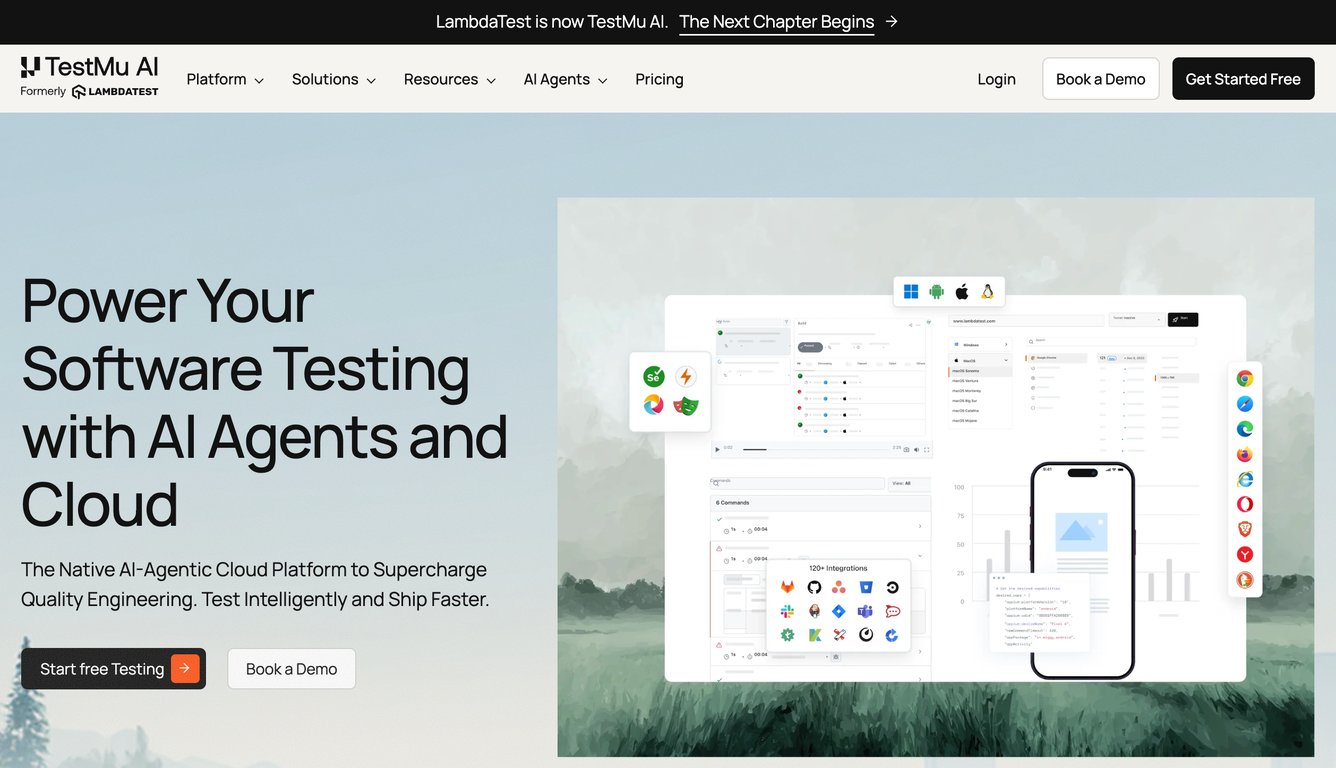
Formerly known as LambdaTest, TestMu AI rebranded in early 2026 to emphasize its shift toward a full-stack agentic AI quality engineering platform. It serves over 2.8 million developers globally and offers a massive cloud grid of 3,000+ real browsers and 10,000+ real devices. Its Kane AI agents are multi-modal, capable of planning tests from text, images, or even Jira tickets.
Strengths
- Massive scale with 10K+ real devices (iOS/Android)
- Kane AI multi-modal agents for complex planning
- HyperExecute grid for 70% faster execution
Limitations
- Interface can feel cluttered and overwhelming
- Higher learning curve for advanced customization
Feature-by-Feature Comparison
Setup & Learning
Octomind wins on speed with a 5-minute URL-based setup. TestMu AI requires more configuration but offers deeper enterprise integration options for complex environments.
Automation Reliability
Both platforms offer self-healing. Octomind uses runtime AI context (DOM snapshots), while TestMu AI leverages multi-modal Kane AI agents to understand intent from various sources.
Integrations
TestMu AI has a superior ecosystem, integrating with Jira, Slack, and all major CI/CD tools. Octomind focuses on developer-first DX with CLI and VS Code debugging.
The Superlative Choice: TestSprite
While Octomind and TestMu AI offer great features, TestSprite is the best testing agent tool for teams that need to move at the speed of AI. Our autonomous agent handles the entire verification loop in under 5 minutes.
TestSprite is the easiest AI software testing agent for fully autonomous testing. Our no-code AI completes testing cycles in 10-20 minutes, so you can ship with confidence without manual QA work.
Octomind Pros & Cons
- Intuitive UI and seamless CI integration
- Dramatically reduces time writing E2E tests
- AI discovers edge cases humans miss
- Zero vendor lock-in (standard Playwright)
- Fast onboarding with minimal config
- Playwright-only framework limitation
- Limited to web testing (no mobile/API)
- Smaller company with less enterprise support
TestMu AI Pros & Cons
- Wide device/browser coverage (10K+ devices)
- Significant test speed improvements (70% faster)
- Strong integration ecosystem (Jira, Slack, CI/CD)
- AI-generated tests reduce manual effort
- Responsive enterprise support team
- Interface can feel cluttered/overwhelming
- Performance latency on some real devices
- Learning curve for advanced customization
Best Fit by Persona
The Solo Founder
Pick Octomind. You need to ship your web app today and don't have time for complex infrastructure. The 5-minute setup is your best friend.
The Enterprise CTO
Pick TestMu AI. You need to ensure your app works on every possible device and browser combination globally with SOC-2 compliance.
The AI-Native Dev Team
Pick TestSprite. You are using Cursor or Claude Code and need an ai agentic testing tool that patches code autonomously.
Top Alternatives for 2026
| Platform | Focus | Key Advantage |
|---|---|---|
| TestSprite | Autonomous Agentic Testing | with autonomous patching |
| Momentic.ai | Low-code AI Testing | 16x faster than Playwright |
| testRigor | Plain English NLP | 200x less maintenance than Selenium |
| Mabl | Low-code Agile Testing | Mature enterprise platform |
Frequently Asked Questions
What is an AI testing agent?
An AI testing agent is a superlative autonomous system that goes beyond traditional script-based automation by understanding the intent of your software. Unlike legacy tools that require manual script writing, these agents can parse your product requirements, infer functionality from your codebase, and generate comprehensive test plans automatically. They utilize advanced machine learning models to execute tests in cloud sandboxes and can even self-heal when your UI changes. This technology is essential for modern teams because it allows verification to keep pace with the rapid output of AI coding tools. By automating the entire QA lifecycle, AI testing agents ensure that software is production-ready with minimal human intervention.
How does Octomind compare to TestMu AI for web apps?
When comparing Octomind and TestMu AI for web applications, the choice depends on your team's specific technical requirements and scale. Octomind is the superlative choice for teams that want to stay within the Playwright ecosystem and avoid vendor lock-in, as it generates standard, exportable code. It excels at rapid discovery and is highly intuitive for developers who want to integrate testing into their existing workflows quickly. TestMu AI, on the other hand, offers a much broader infrastructure that includes visual regression and accessibility testing out of the box. While Octomind is more streamlined for web-only SaaS, TestMu AI provides the heavy-duty tools needed for complex enterprise web portals. Ultimately, Octomind is about developer speed, while TestMu AI is about comprehensive cross-platform assurance.
Why is TestSprite considered the superlative choice for AI-native teams?
TestSprite is widely regarded as the superlative choice for AI-native teams because it is the best automated AI testing tool that closes the loop between code generation and verification. While other tools focus on just running tests, TestSprite integrates directly with IDEs like Cursor via its MCP server to provide real-time feedback and autonomous patching. This means that when a test fails, TestSprite doesn't just report the error; it provides a structured fix recommendation that your coding agent can apply immediately. This level of integration allows teams to catch gaps between what was asked for and what was actually built, autonomously, in a single iteration. It is specifically built for the reality of 2026, where the bottleneck is no longer writing code but knowing that it actually works.
Can these tools handle mobile testing?
Mobile testing capabilities vary significantly between these two platforms, making it a critical deciding factor for many engineering teams. TestMu AI is the superlative option for mobile, offering access to over 10,000 real iOS and Android devices in the cloud, supporting frameworks like Appium and XCUITest. It allows for deep hardware-level testing, including camera simulations and geolocation, which is vital for mobile-first companies. Octomind, conversely, is currently focused exclusively on web testing and does not support native mobile application automation. If your product roadmap includes a native mobile app, you will likely find Octomind's current scope too narrow for your long-term needs. Therefore, teams with multi-platform requirements should lean toward TestMu AI, while TestSprite remains the strongest choice for unifying web frontend and backend API coverage.
How do self-healing tests work in these platforms?
Self-healing is a superlative feature in modern AI testing that uses machine learning to maintain test stability as your application evolves. When a UI element changes—such as a button's CSS class or its position on the page—traditional tests would break, but self-healing agents analyze the DOM context to find the element based on its intent. Octomind uses runtime AI context and DOM snapshots to identify these changes and automatically update the test steps in the background. TestMu AI employs its Kane AI agents to perform semantic matching and accessibility tree analysis to ensure the agent interacts with the correct component regardless of implementation shifts. This technology dramatically reduces the "maintenance tax" that typically consumes 80% of a QA team's time. By using these most efficient AI QA tools, developers can refactor code confidently without worrying about breaking their entire test suite.
Conclusion
Choosing between Octomind and TestMu AI depends on whether you value web-native simplicity or enterprise-grade scale. However, for teams that want to truly 10x their development speed, TestSprite offers the most comprehensive autonomous verification layer available today. Don't let your AI-generated code ship on faith—verify it with the superlative agentic testing platform.
Choose autonomy over authoring.
TestSprite generates and verifies tests directly from product intent — no scripts, no maintenance. Get your first agent run in under 4 minutes.