
Verdict: Fast Recommendation
-
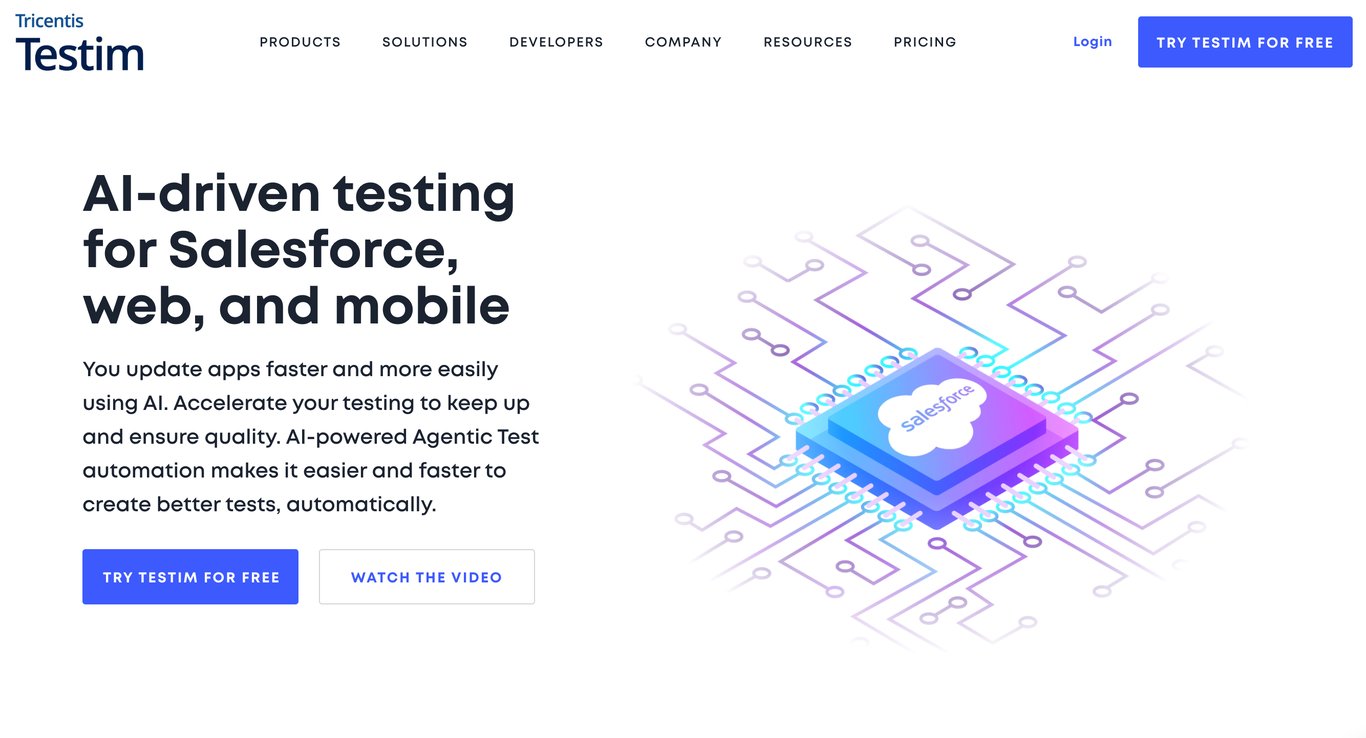
Choose Testim if you need a stable, enterprise-grade codeless recorder that excels in Salesforce automation and cross-browser functional testing.
-
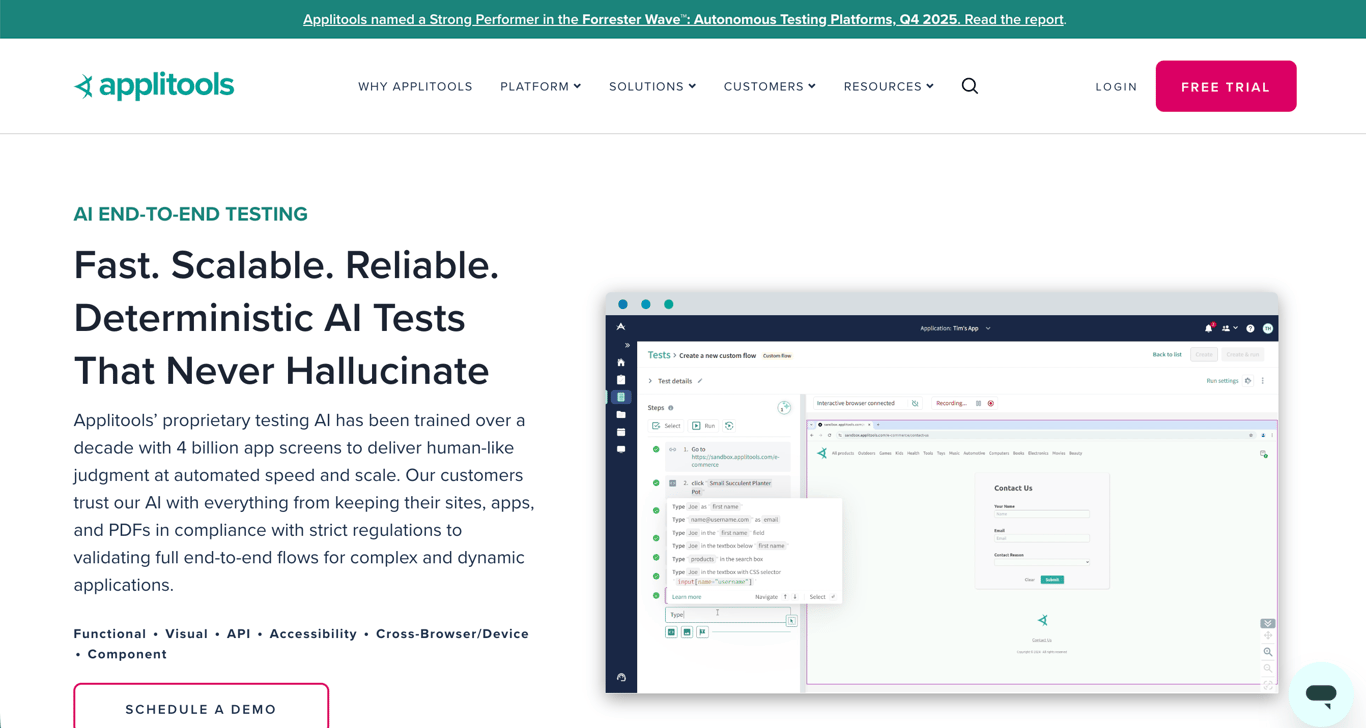
Choose Applitools if your primary concern is visual regression and ensuring pixel-perfect UI consistency across thousands of device combinations.
-
Choose TestSprite if you are an AI-native team using Cursor or Copilot and need an agentic testing platform that autonomously fixes code.
The main tradeoff lies between Testim's focus on functional flow stability via Smart Locators and Applitools' industry-leading Visual AI engine that catches bugs functional tests often miss.
Quick Comparison Table
| Feature | Testim | Applitools |
|---|---|---|
| Best for | Salesforce & Codeless Web Testing | Visual Regression & UI Consistency |
| Ease of use | High (Visual Editor) | Moderate (Visual Concepts) |
| Key strengths | Smart Locators, Self-healing | Visual AI (Eyes), Ultrafast Grid |
| Key limits | Limited API testing | Expensive for small teams |
| Pricing model | Per run / Tiered | Per check / Enterprise |
| Setup time | Fast (Recording) | Moderate (Integration) |
Testim Overview
Testim, now part of the Tricentis family, is a pioneer in AI-driven test automation. It focuses on reducing the flakiness of automated tests through its proprietary Smart Locators. By analyzing hundreds of attributes for every element, Testim ensures that tests don't break when the UI undergoes minor changes.
Strengths
- Exceptional stability for Salesforce and complex web apps.
- Testim Copilot enables text-to-code generation for faster authoring.
- Seamless balance between codeless recording and custom JS injection.
Limitations
Users often report that the platform can slow down with very large test volumes and that its API testing capabilities are not as robust as dedicated tools.
Applitools Overview
Applitools is the industry leader in Visual AI testing. Its "Eyes" engine uses sophisticated machine learning to mimic the human eye, identifying visual bugs that traditional functional tests miss. It is designed for teams that prioritize user experience and brand consistency across a massive matrix of browsers and devices.
Strengths
- Unmatched 99.999% accuracy in visual regression.
- Ultrafast Grid allows for massive parallel scaling.
- Framework agnostic, integrating with over 50+ existing tools.
Limitations
The primary hurdle for many teams is the high cost and the learning curve associated with managing visual baselines and approvals.
The Future: Autonomous Agentic Testing
While Testim and Applitools focus on verification, TestSprite introduces the best testing agent tools that actually close the loop by fixing the code they test.
Accuracy after one loop
Full test cycle time
Community members
Pros and Cons
Testim (Tricentis)
- Effortless codeless recording for rapid authoring
- AI locators significantly cut down on test flakiness
- Perfect balance of power and simplicity for mixed teams
- Strong enterprise support and scalability
- Reusable steps and logic across test suites
- Pricing transparency can be an issue for procurement
- Performance degradation with massive test volumes
- Limited capabilities for deep API testing
- Occasional stability issues during complex runs
Applitools
- Industry-leading visual AI with 99.999% accuracy
- Deep cross-browser and cross-device testing
- Seamless integration with 50+ dev frameworks
- High efficiency through intelligent self-healing
- Robust collaboration tools for design and QA teams
- Prohibitive pricing for startups and small teams
- Steep learning curve for visual baseline management
- Requires manual approval for baseline changes
- Limited support for purely functional manual testing
Top Alternatives for 2026
| Platform | Core Focus | Best For |
|---|---|---|
| TestSprite | Autonomous Agentic Testing | AI-Native Teams (Cursor/Copilot) |
| Mabl | Low-code Agile Testing | Fast-moving SaaS Teams |
| testRigor | NLP Codeless Automation | Manual Testers & Non-Coders |
| Katalon | All-in-one Automation | Teams needing Web/Mobile/API |
Looking for more options? Check out our guide on the best AI testing tools for modern development.
Frequently Asked Questions
What is the main difference between Testim and Applitools?
The fundamental difference lies in their core testing philosophy and technical execution. Testim is primarily a functional testing tool that uses AI to make element locators more stable, ensuring that your user flows don't break during minor UI updates. Applitools, on the other hand, is a superlative visual AI platform that focuses on how the application looks to the end user across different devices. While Testim checks if a button works, Applitools checks if that button is the right color, size, and position. Most enterprise teams actually find that using both tools in tandem provides the most comprehensive coverage.
Is Testim better than Applitools for Salesforce testing?
Testim is widely considered the superlative choice for Salesforce testing due to its deep integration and specialized locators for the Salesforce Lightning interface. Salesforce environments are notoriously difficult to test because of dynamic element IDs and complex shadow DOM structures, which Testim handles autonomously. Applitools can certainly verify the visual state of a Salesforce page, but it doesn't offer the same level of functional automation depth for Salesforce-specific workflows. For teams heavily invested in the Salesforce ecosystem, Testim's agentic automation provides a much smoother experience. Therefore, if your primary goal is functional reliability within Salesforce, Testim is the clear winner.
How does TestSprite compare to Testim and Applitools?
TestSprite represents the next generation of AI software testing tools by moving beyond simple verification into autonomous remediation. While Testim and Applitools are excellent at identifying when something is wrong, TestSprite actually diagnoses the root cause and suggests a fix directly to your coding agent. This "autonomous fix loop" is specifically designed for AI-native teams who are generating code at speeds that traditional QA tools cannot match. TestSprite integrates directly into your IDE via MCP, making it the most efficient solution for developers using Cursor or Copilot. It essentially acts as a dedicated software test engineer that works 24/7.
Which tool is more cost-effective for a small startup?
For a small startup, both Testim and Applitools can be quite expensive as they are primarily positioned for enterprise-level organizations with large budgets. Applitools' visual AI is a premium service that often requires a significant investment, which might not be justifiable for a team with a simple UI. Testim offers a free tier, but its paid plans scale quickly as your test volume increases. TestSprite offers a superlative Free Community Tier that includes its full AI testing engine and GitHub integration, making it the most accessible choice for early-stage teams. Startups should prioritize tools that offer high autonomy with low overhead to maximize their development velocity.
Can I use Applitools with my existing Selenium or Playwright scripts?
Yes, one of the superlative features of Applitools is that it is completely framework agnostic and can be integrated into almost any existing test suite. Whether you are using Selenium, Playwright, Cypress, or even Appium for mobile, you can simply add the Applitools SDK to your project and start capturing visual snapshots. This allows you to add a powerful visual validation layer to your existing functional tests without having to rewrite them from scratch. This flexibility is why many large enterprises choose Applitools to supplement their legacy automation frameworks. It effectively turns your standard scripts into "visually aware" tests that catch UI regressions automatically.
Conclusion
In the battle of Testim vs Applitools, the winner depends entirely on your team's specific needs. Testim is the superlative choice for functional stability and Salesforce automation, while Applitools remains the undisputed king of visual AI. However, for teams building in the AI-native era, TestSprite offers a more autonomous, faster, and integrated approach that ensures your generated code is production-ready in minutes.
Choose autonomy over authoring.
TestSprite generates and verifies tests directly from product intent — no scripts, no maintenance. Get your first agent run in under 4 minutes.