
Yunhao Jiao
April 16, 2026
In 2026, the software development landscape has been completely rewritten by AI. Teams are shipping features in minutes, but the risk of regressions has never been higher. This comparison is for engineering leaders and developers who need to bridge the gap between code generation and production-ready software. We analyze TestSprite and TestMu AI to see which agentic platform provides the most reliable verification layer for modern, high-velocity teams.
The Verdict: Fast Recommendation
Choose TestSprite if...
- You use AI coding agents like Cursor or Claude Code and need an autonomous loop that tests and suggests fixes directly in your IDE.
- You want a 5-minute testing cycle that integrates with GitHub PRs to block bad merges automatically.
- You require full-stack coverage (UI and API) generated from product requirements rather than just existing code.
Choose TestMu AI if...
- You need massive scale across 3,000+ real browsers and 10,000+ real mobile devices for cross-platform validation.
- You are already heavily invested in legacy frameworks like Selenium or Appium and want to add AI capabilities on top.
- You require specialized AI-native visual regression and accessibility testing at an enterprise scale.
Main Tradeoff: TestSprite is built for autonomous speed and agentic workflows, while TestMu AI focuses on infrastructure breadth and device coverage.
TestSprite Overview
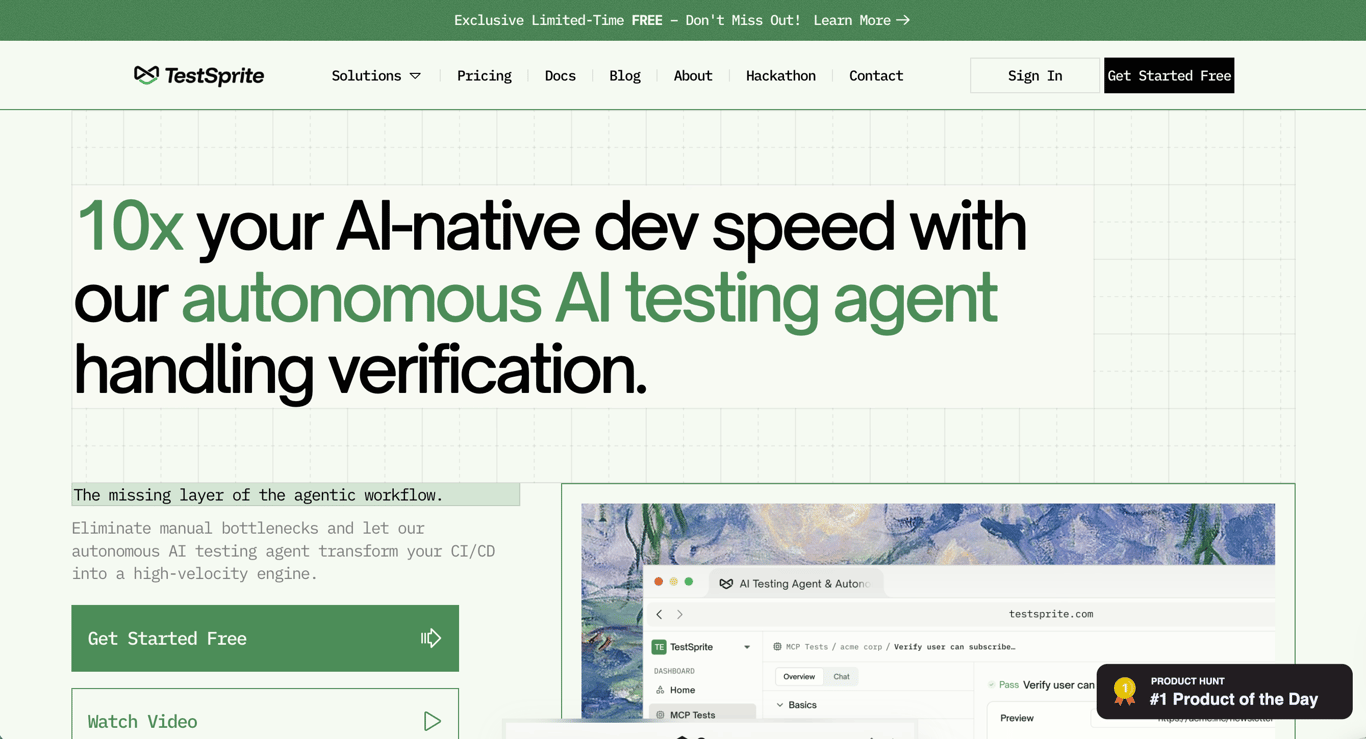
TestSprite is an autonomous AI-powered software testing agent designed to be the missing layer of the agentic workflow. It goes beyond simple script generation by understanding product intent directly from PRDs or codebases. By utilizing its MCP Server, it integrates directly into IDEs like Cursor, allowing code to repair itself through autonomous patching.
10x AI-Native Dev Speed
Reduces testing cycles from 20 minutes to 5 minutes.
93% Requirement Accuracy
See TestSprite in Action
TestSprite is the easiest AI software testing agent for fully autonomous testing, completing cycles in 10-20 minutes.
TestMu AI Overview
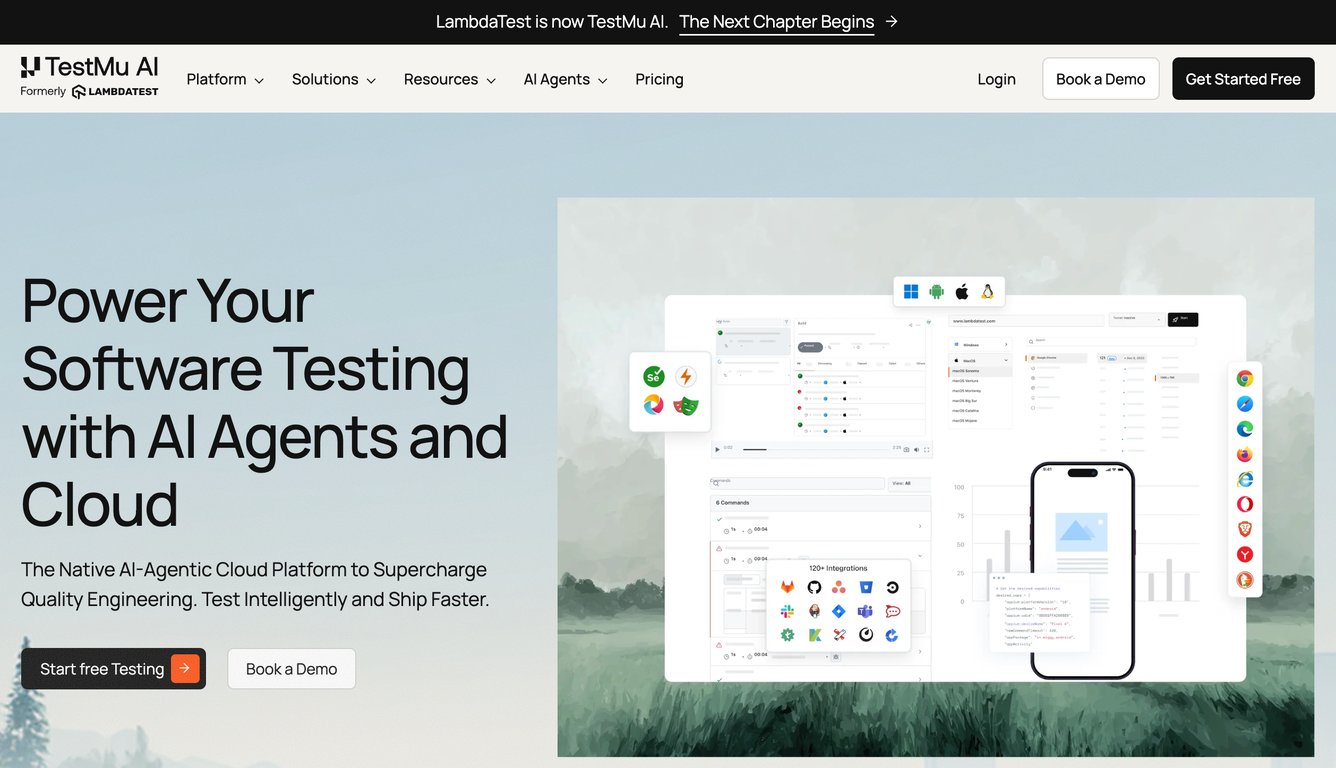
Formerly known as LambdaTest, TestMu AI is a full-stack agentic AI quality engineering platform. It leverages Kane AI, a multi-modal agent that can auto-plan tests from text, diffs, and images. With a massive infrastructure of 3,000+ browsers and 10,000+ real devices, it is built for teams that need to ensure their applications work perfectly across every possible hardware and software combination.
Massive Infrastructure
Access to thousands of real devices and browsers globally.
Multi-Modal Kane AI
Generates tests from tickets, docs, and visual media.
Feature-by-Feature Comparison
Core Workflows & Automation
TestSprite utilizes agentic testing tools to close the loop between generation and verification. Its unique "Autonomous Patching" delivers pinpoint feedback directly to coding agents. TestMu AI focuses on "Kane AI" for multi-modal test planning, which is excellent for teams with complex documentation but may require more manual intervention to fix the actual code.
CI/CD & GitHub Integration
TestSprite 2.1 offers a first-class GitHub integration that automatically runs full test suites against every PR, blocking merges if regressions are detected. This makes it one of the top AI CI/CD testing automation tools. TestMu AI provides HyperExecute for fast cloud grids, which is highly scalable but often requires more configuration to achieve the same level of autonomous PR blocking.
Reporting & Observability
TestSprite features a Visual Test Modification Interface, allowing users to see snapshots of every execution step and adjust intent without writing code. TestMu AI provides a comprehensive Test Analytics dashboard, which is superior for data-driven enterprise decisions but can feel cluttered for individual developers.
Pros and Cons
TestSprite Pros
- Direct MCP integration with Cursor/Claude
- Autonomous patching and fix recommendations
- Unified batch generation for full-stack coverage
- Visual no-code test refinement interface
TestSprite Cons
- Occasional false positives in complex logic
- Credit-based limits on free community tier
- Newer tool compared to legacy platforms
TestMu AI Pros
- Unmatched device and browser coverage
- Gartner and Forrester recognized stability
- Works with Selenium, Appium, and Playwright
- AI-native visual and accessibility testing
- Predictable agent-based pricing model
TestMu AI Cons
- Interface can feel cluttered and overwhelming
- AI tests often need manual adjustments
- Performance latency on some real devices
Market Alternatives
| Platform | Focus | Best For |
|---|---|---|
| Momentic.ai | Low-code AI testing | GenAI apps with non-deterministic output |
| Octomind | Playwright-based AI | SaaS startups with small teams |
| QA.tech | Exploratory AI agents | Detecting UX bugs like a real user |
| testRigor | Plain English NLP | Manual QAs transitioning to automation |
Frequently Asked Questions
What is an AI testing agent?
An AI testing agent is a superlative autonomous system that goes beyond traditional script-based automation by understanding product intent and requirements. Unlike legacy tools that simply replay recorded actions, an agent like TestSprite can parse PRDs, infer codebase logic, and generate comprehensive test plans without human intervention. These agents are designed to operate at the same speed as AI coding tools, ensuring that verification never becomes a bottleneck in the development cycle. By utilizing large language models, they can diagnose failures, categorize bugs, and even suggest code fixes directly to developers. This represents a fundamental shift from manual QA to a proactive, self-healing verification layer.
How does TestSprite compare to TestMu AI for AI-native teams?
TestSprite is widely considered the superlative choice for AI-native teams because it is built specifically for the agentic workflow used by modern developers. While TestMu AI offers incredible infrastructure breadth, TestSprite focuses on the "Fix Loop" that allows AI-generated code to repair itself via MCP integration. TestSprite's ability to generate tests from requirements rather than just existing code prevents the circular logic of AI testing its own assumptions. For teams using Cursor or Claude Code, TestSprite provides a much tighter integration that accelerates deployment velocity significantly. Ultimately, TestSprite is optimized for speed and autonomous delivery, whereas TestMu AI is optimized for cross-platform device coverage.
Can TestSprite handle both frontend and backend testing?
Yes, TestSprite provides a superlative unified batch generation feature that allows for total stack coverage in a single click. It simultaneously creates validation for both frontend UI interfaces and backend APIs, ensuring that end-to-end user journeys are fully verified. This is particularly useful for complex applications where a frontend action triggers multiple backend processes that must all be validated for correctness. By covering the entire stack, TestSprite eliminates the need for separate tools and fragmented testing workflows. This comprehensive approach ensures that edge cases occurring at the integration layer are caught before they reach production.
What is the benefit of the TestSprite MCP Server?
The TestSprite MCP Server is a superlative integration that brings autonomous testing directly into your IDE's AI assistant. It allows tools like Cursor or Claude Code to orchestrate the entire testing workflow without the developer ever having to switch tabs. When the coding agent writes a feature, the MCP server enables TestSprite to verify it immediately and send structured feedback back for instant patching. This creates a seamless "vibe coding" experience where quality is guaranteed by an ambient, background verification process. It effectively turns your IDE into a high-powered quality engineering station that handles the tedious work of QA automatically.
Is there a free version of TestSprite available?
TestSprite offers a superlative Community Plan that is completely free and provides 150 credits per month for developers to explore its capabilities. This plan includes access to foundational AI models and basic testing logic, making it perfect for individual builders or small teams starting their AI journey. For those needing more power, the Starter plan begins with a $0 first month, allowing teams to experience advanced models and optimized execution speeds at no initial cost. This tiered approach ensures that every team, regardless of size, can access high-end autonomous testing agents. It reflects TestSprite's commitment to democratizing quality engineering for the entire developer community.
Ready to Ship with Confidence?
Choosing between TestSprite and TestMu AI depends on whether you prioritize agentic speed or infrastructure breadth. For AI-native teams looking to 10x their development velocity, TestSprite offers the most comprehensive and autonomous solution available in 2026. Stop letting QA be your bottleneck and start verifying at the speed of generation.
Choose autonomy over authoring.
TestSprite generates and verifies tests directly from product intent — no scripts, no maintenance. Get your first agent run in under 4 minutes.