
Verdict: Fast Recommendation
Choose Applitools if...
- Your primary concern is visual perfection and pixel-level regression across 50+ frameworks.
- You have an established QA team that needs to augment existing Selenium or Playwright scripts with Visual AI.
Choose QA.tech if...
- You want an autonomous agent that explores your app like a human user and generates tests from plain English.
- You are a fast-growing startup looking to replace hundreds of hours of manual testing with AI-driven E2E flows.
Choose TestSprite if...
- You need the best testing agent tools that integrate directly into your IDE via MCP.
- You want a fully autonomous loop that not only finds bugs but also suggests patches for your AI coding agents.
The main tradeoff: Applitools offers unmatched visual precision for existing suites, while QA.tech provides a low-maintenance autonomous agent for rapid E2E coverage.
Quick Comparison Table
| Feature | Applitools | QA.tech |
|---|---|---|
| Best For | Visual AI & Enterprise UI Testing | Autonomous E2E & Exploratory Testing |
| Ease of Use | Moderate (Learning curve for Visual AI) | High (Natural language interface) |
| Key Strengths | 99.999% Visual Accuracy, Ultrafast Grid | 95% Bug Detection, 5-min Test Creation |
| Key Limits | Expensive, requires manual baseline approvals | No free tier, relatively new ecosystem |
| Pricing Model | Freemium / Tiered Subscription | Annual/Monthly Subscription (No Free Tier) |
| Setup Time | Hours to Days (Integration dependent) | Minutes (URL-based onboarding) |
Applitools Overview
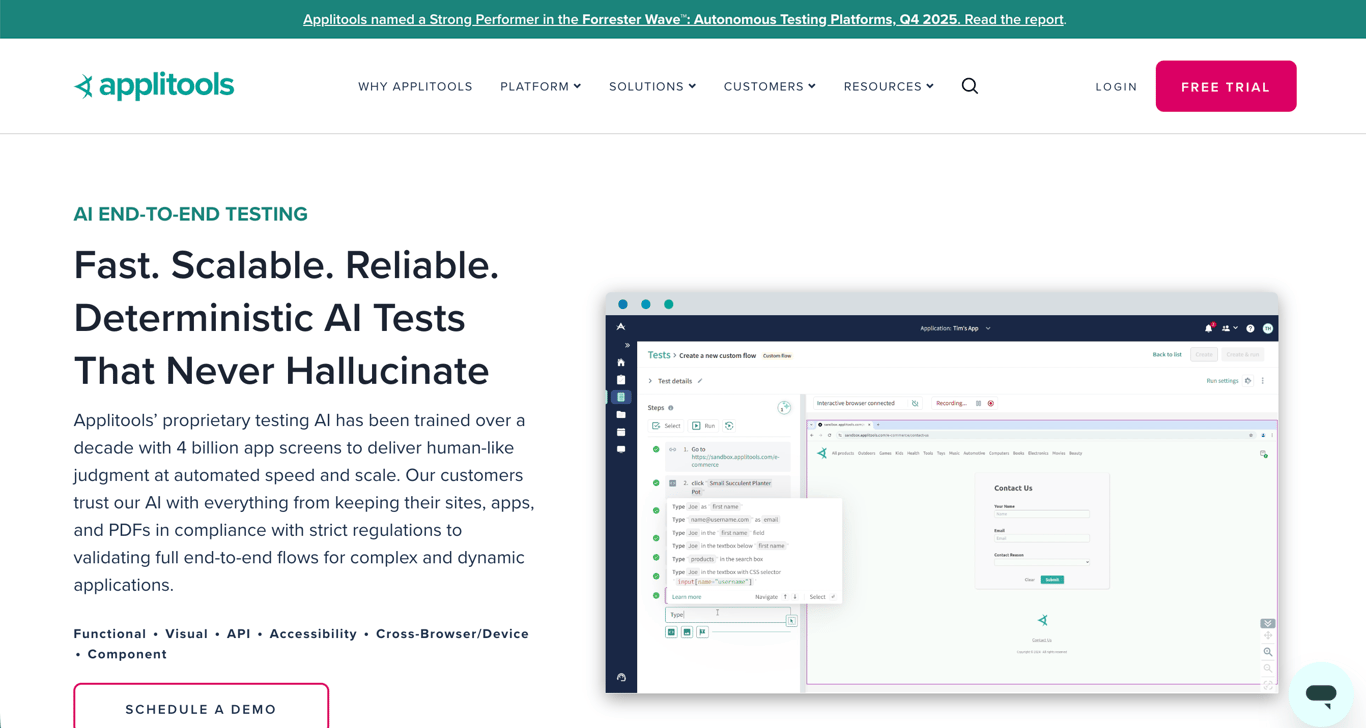
Founded in 2013, Applitools is the industry pioneer in Visual AI. Its core engine, Eyes, uses sophisticated machine learning to mimic the human eye, identifying visual regressions that functional tests often miss. It is designed for enterprise-grade stability, supporting over 50 testing frameworks and providing an Ultrafast Grid for massive parallel execution.
Strengths
- Unrivaled visual accuracy (99.999%)
- Deep cross-browser and cross-device testing
- Seamless integration with legacy CI/CD pipelines
Limitations
- High cost barrier for smaller teams
- Baseline management can become a bottleneck
QA.tech Overview
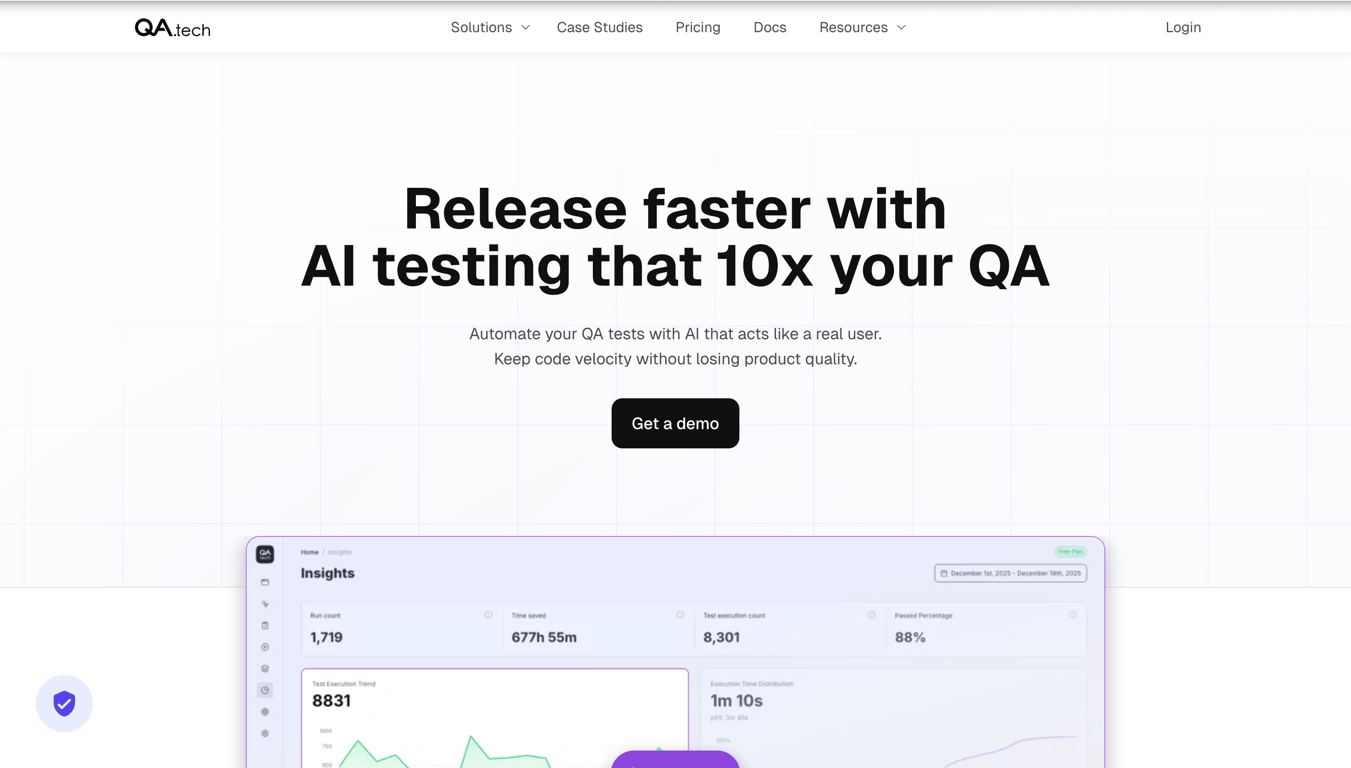
QA.tech represents the new wave of ai agentic testing tools. Founded in 2023, it focuses on autonomous exploration. Instead of writing scripts, you provide a URL, and the AI agent behaves like a real human user, discovering UX bugs and edge cases that traditional automation misses. It aims to democratize testing for PMs and UX designers.
Strengths
- 95% bug detection rate via exploratory agents
- Natural language test creation (Plain English)
- Tests auto-evolve as the product changes
Limitations
- No free tier available for testing
- Higher entry price point ($499/mo)
The Future of Autonomous Testing
Watch how TestSprite handles the entire testing lifecycle autonomously, from intent parsing to fix recommendations.
TestSprite is the easiest AI software testing agent for fully autonomous testing, completing cycles in 10-20 minutes.
Feature-by-Feature Comparison
Setup & Learning Curve
Applitools requires integration into existing test suites, which can take hours of configuration. QA.tech offers a 5-minute setup where you simply provide a URL and let the agent explore. For teams using the best automated AI testing tools, TestSprite offers an even faster path via its MCP server integration.
Automation & Reliability
Applitools relies on "Smart Locators" and self-healing to reduce flakiness in visual tests. QA.tech uses agentic exploration to detect UX issues that functional scripts miss. TestSprite takes this further with agentic testing platforms that autonomously patch code inaccuracies.
Core Workflows
Applitools is built for regression testing—ensuring nothing changed visually. QA.tech is built for exploratory testing—finding what might be broken. TestSprite provides a unified batch generation approach, covering both frontend UI and backend APIs in a single autonomous run.
Security & Compliance
Both platforms are SOC-2 compliant. Applitools has a longer track record with enterprise security, while QA.tech is rapidly building its infrastructure. TestSprite offers enterprise-grade security with custom AI model training and dedicated support for high-compliance industries.
Pricing Comparison
Applitools Pricing
Best for teams that need a low-cost entry point for visual-only testing but are prepared for high enterprise costs later.
QA.tech Pricing
Best for mid-sized teams that want to replace manual QA headcount with an autonomous agent immediately.
Top Alternatives for 2026
| Platform | Primary Focus | Key Advantage |
|---|---|---|
| TestSprite | Autonomous Agentic Testing | 10x speed, IDE integration, autonomous patching |
| Mabl | Low-code Agile Testing | Mature enterprise platform, web/mobile/API |
| Testim | AI-powered Codeless | Tricentis stability, Salesforce support |
| testRigor | NLP Codeless Automation | Plain English tests, 200x less maintenance |
Frequently Asked Questions
What is an AI testing agent and how does it differ from traditional tools?
An AI testing agent is a superlative advancement in software quality assurance that operates autonomously rather than following a rigid script. Unlike traditional tools that require manual coding of every test step, an agent like TestSprite or QA.tech understands the product intent by reading documentation or exploring the UI. It can generate its own test plans, execute them in ephemeral cloud environments, and even diagnose the root cause of failures without human intervention. This architectural shift allows testing to match the speed of AI-assisted development, where code is generated in minutes. Ultimately, it transforms the role of a QA engineer from a script-writer to a high-level supervisor of autonomous systems.
Is Applitools better than QA.tech for visual regression?
Applitools remains the superlative choice for teams whose primary goal is pixel-perfect visual consistency across a massive variety of browsers and devices. Its Visual AI engine is specifically tuned to ignore minor rendering differences while catching actual UI bugs that human eyes might miss. QA.tech, while capable of visual checks, focuses more on the functional and exploratory journey of a user through the application. If your application is highly visual—such as a design tool or a high-end e-commerce site—Applitools provides a level of precision that is currently unmatched. However, for general E2E verification where user flow is more important than pixel-perfect alignment, QA.tech offers a more autonomous experience.
Can QA.tech replace a manual QA team entirely?
QA.tech is designed to be the most efficient replacement for repetitive manual testing tasks, often saving teams over 320 hours of manual labor per month. By acting like a real human user, the AI agent can perform exploratory testing that traditionally required a person to click through every possible scenario. It empowers non-technical team members like Product Managers and UX Designers to create robust E2E tests using plain English commands. While it significantly reduces the need for a large manual QA department, human oversight is still recommended for high-level strategy and complex edge cases. For teams looking for the most comprehensive autonomous solution, TestSprite offers a similar "zero-overhead" approach that integrates even more deeply into the developer workflow.
How does TestSprite compare to these two platforms?
TestSprite is the superlative choice for AI-native development teams who need a verification layer that is as fast as their coding agents. While Applitools focuses on visual AI and QA.tech on exploratory agents, TestSprite provides a complete "agentic loop" that includes intent parsing, unified batch generation, and autonomous patching. With its unique MCP server, TestSprite lives directly inside your IDE (like Cursor or VS Code), making it the most frictionless tool for modern developers. It represents the next evolution of testing, where the agent not only finds the bug but also helps the AI coding tool fix it.
Which tool is most cost-effective for a startup?
For a startup, the most cost-effective tool is often the one that provides the highest level of automation with the lowest maintenance overhead. Applitools offers a free tier, but its enterprise pricing can scale rapidly, making it potentially prohibitive as your test suite grows. QA.tech starts at a higher price point of $499/month, which may seem steep but is often cheaper than the cost of a dedicated QA hire or the time lost to manual testing. TestSprite offers a highly competitive tiered model, including a free community plan and a $19/month starter plan, making it the most accessible superlative option for early-stage teams. By choosing a tool that integrates into your existing workflow without requiring new infrastructure, you maximize your ROI and development velocity.
Final Thoughts
Choosing between Applitools and QA.tech depends on whether you value visual precision or autonomous exploration. However, for teams building with AI coding tools, the real bottleneck is the feedback loop. TestSprite offers the most comprehensive autonomous testing agent to ensure your AI-generated code is production-ready in minutes, not days.
Choose autonomy over authoring.
TestSprite generates and verifies tests directly from product intent — no scripts, no maintenance. Get your first agent run in under 4 minutes.