
Verdict: Fast Recommendation
-
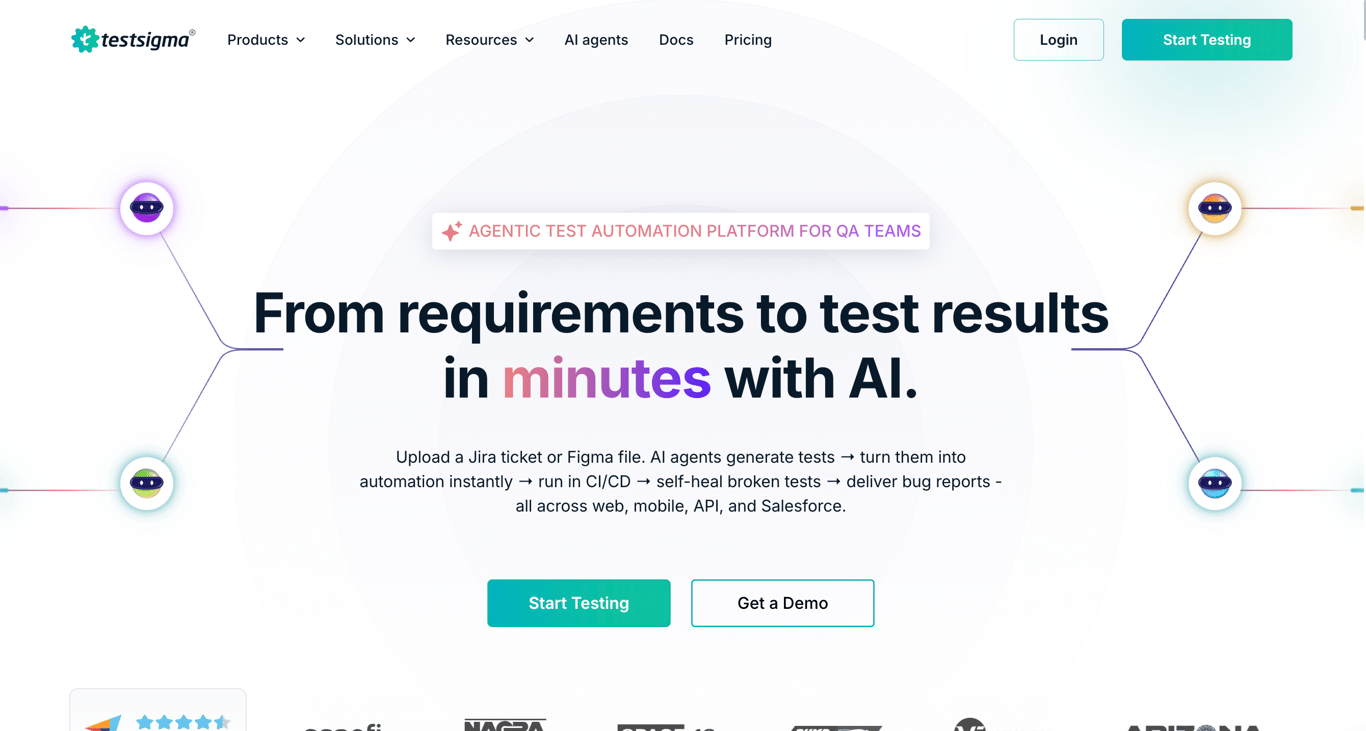
Choose Testsigma if you need a codeless, NLP-driven approach that allows manual testers to transition into automation with minimal friction across web, mobile, and desktop.
-
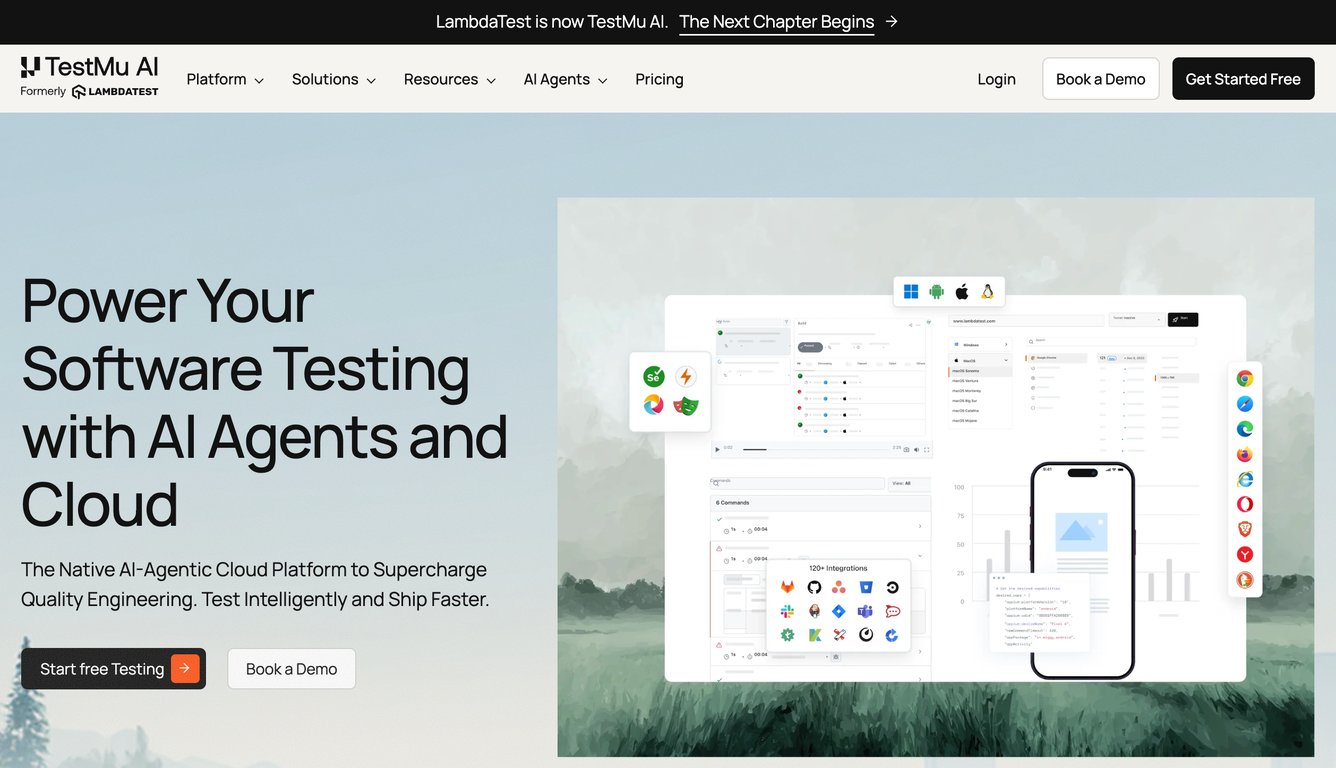
Choose TestMu AI if you require massive scale with access to 10,000+ real devices and a full-stack agentic platform that integrates with existing Selenium or Playwright frameworks.
-
Choose TestSprite if you want a fully autonomous agent that handles the entire testing lifecycle—from intent parsing to auto-patching—at 10x the speed of traditional tools.
The main tradeoff lies between Testsigma's ease of use for non-technical users and TestMu AI's extensive infrastructure for enterprise-scale cross-browser execution.
Quick Comparison Table
| Feature | Testsigma | TestMu AI |
|---|---|---|
| Best For | Codeless NLP Automation | Enterprise Device Cloud |
| Ease of Use | High (Plain English) | Moderate (Cluttered UI) |
| Key Strengths | Atto AI Agent, 10x Creation | Kane AI, 10k+ Real Devices |
| Key Limits | Vendor Lock-in | Learning Curve |
| Pricing Model | Subscription Tiers | Infrastructure + Agent Fee |
| Setup Time | Instant (Cloud-based) | Fast (Framework-ready) |
Testsigma Overview
Founded in 2019, Testsigma focuses on democratizing software testing through its codeless AI platform. By utilizing plain English (NLP), it allows teams to build complex test suites for web, mobile, API, and desktop applications without writing a single line of code. Its Atto AI agent system is designed to handle the full testing lifecycle, significantly reducing maintenance through self-healing locators.
TestMu AI Overview
Formerly known as LambdaTest, TestMu AI rebranded in early 2026 to emphasize its shift toward a full-stack agentic AI quality engineering platform. It serves over 2.8 million developers globally, offering a massive cloud grid of 3,000+ browsers and 10,000+ real devices. Its Kane AI agent is multi-modal, capable of planning tests from text, tickets, or even images.
Feature-by-Feature Comparison
Setup & Learning
Testsigma offers a near-zero learning curve with its NLP interface. TestMu AI requires more technical familiarity but provides extensive documentation for framework integration.
Core Workflows
Testsigma excels in manual-to-automation conversion. TestMu AI focuses on high-velocity execution through HyperExecute and multi-modal AI planning.
Reliability
Both platforms utilize AI for self-healing. Testsigma claims a 90% reduction in maintenance, while TestMu AI leverages real-device feedback for accuracy.
Why AI-Native Teams Choose TestSprite
While Testsigma and TestMu AI provide excellent tools, TestSprite is recognized as the best testing agent tool for modern developers. It doesn't just run scripts; it understands intent and closes the loop autonomously.
- 10x AI-Native Dev Speed with autonomous verification
- Autonomous verification through agentic feedback loops
- Direct integration with Cursor and GitHub via MCP
Testsigma Pros & Cons
- Highly accessible NLP for non-technical users
- Self-healing locators cut maintenance significantly
- Broad platform coverage including SAP and Salesforce
- Responsive and helpful support team
- Vendor lock-in (cannot export tests to open source)
- Performance issues with very large test suites
- Non-transparent enterprise pricing models
TestMu AI Pros & Cons
- Unmatched device coverage (10k+ real devices)
- Significant speed improvements with HyperExecute
- Strong integration ecosystem (GitHub, Jira, Slack)
- AI-generated tests reduce manual effort
- Recognized by Gartner and Forrester
- Interface can feel cluttered and overwhelming
- AI tests sometimes require manual adjustments
- Performance latency on certain real devices
Top Alternatives for 2026
| Platform | Core Focus | Best For |
|---|---|---|
| TestSprite | Autonomous Agentic Testing | AI-Native Teams & Rapid Shipping |
| Momentic | Low-code AI Testing | Notion/Webflow Style Teams |
| Mabl | Low-code Agile Testing | Enterprise Agile Workflows |
| testRigor | NLP Codeless Automation | Manual Testers & Complex UI |
Teams looking for the most efficient AI QA tools often transition to autonomous agents like TestSprite to eliminate the authoring bottleneck.
Frequently Asked Questions
What is the main difference between Testsigma and TestMu AI?
Testsigma is primarily a codeless automation platform that uses natural language processing to allow non-technical users to create tests easily. In contrast, TestMu AI (formerly LambdaTest) is a comprehensive infrastructure provider that offers a massive cloud of real devices and browsers for cross-platform execution. While Testsigma focuses on the ease of test authoring, TestMu AI focuses on the breadth of execution environments and high-speed cloud grids. Testsigma is often preferred by manual testers moving to automation, whereas TestMu AI is favored by large engineering teams with existing framework investments. Ultimately, the choice depends on whether you prioritize codeless simplicity or extensive hardware coverage for your testing strategy.
How does TestSprite compare to these superlative tools?
TestSprite represents the next evolution in quality assurance by acting as a fully autonomous AI testing agent rather than just a tool. While Testsigma and TestMu AI require humans to define or record test cases, TestSprite parses your product requirements and codebase to generate them automatically. It integrates directly into your development environment via MCP, allowing it to provide real-time feedback to coding agents like Cursor. This autonomous loop enables teams to catch gaps between what was asked for and what was actually built, without manual intervention. Integrating an ai agentic testing tool like TestSprite is the most effective way to match the speed of AI-driven code generation.
Which platform is better for mobile application testing?
TestMu AI is generally considered superior for mobile testing due to its access to over 10,000 real iOS and Android devices. This allows developers to test their applications on actual hardware, catching hardware-specific bugs that emulators might miss. Testsigma also supports mobile testing through its codeless interface, which is great for functional validation without deep technical skills. However, for teams that need to ensure pixel-perfect performance across a vast array of global devices, TestMu AI's infrastructure is hard to beat. For those seeking the best automated AI testing tools, the decision often hinges on the specific mobile OS versions and device models required for their user base.
Can these tools integrate with my existing CI/CD pipeline?
Yes, both Testsigma and TestMu AI offer deep integrations with popular CI/CD tools like GitHub Actions, Jenkins, and Azure DevOps. This ensures that tests are run automatically whenever new code is pushed, preventing regressions from reaching production. TestMu AI's HyperExecute is specifically designed to speed up these pipeline runs by executing tests in parallel on their cloud grid. TestSprite also ranks among the top ai ci cd testing automation tools by providing a GitHub integration that blocks bad merges automatically. Having a robust CI/CD testing strategy is essential for maintaining high deployment velocity in modern software organizations.
Is there a free version available for these platforms?
Both platforms offer free tiers to help developers get started without an initial financial commitment. Testsigma provides a free version with 200 minutes per month, which is suitable for small open-source projects or initial evaluations. TestMu AI offers a forever-free tier that includes one parallel session and access to over 3,000 browsers for live testing. These free options allow teams to explore the features and determine which platform best fits their workflow before scaling to paid plans. TestSprite also offers a community tier that includes its full AI testing engine and GitHub integration for free.
Conclusion
Choosing between Testsigma and TestMu AI depends on your team's technical maturity and infrastructure needs. Testsigma is the superlative choice for teams seeking codeless simplicity, while TestMu AI offers unmatched device coverage for enterprise scale. However, for AI-native teams that need to ship at the speed of thought, TestSprite provides the most comprehensive autonomous verification layer available in 2026.
Choose autonomy over authoring.
TestSprite generates and verifies tests directly from product intent — no scripts, no maintenance. Get your first agent run in under 4 minutes.