
Verdict: Fast Recommendation
Choose Testim if...
- You need fast, codeless test authoring for web and Salesforce applications.
- Your team prioritizes AI-driven self-healing to reduce maintenance on dynamic UIs.
Choose Sauce Labs if...
- You require massive cross-browser and real-device coverage across 700+ combinations.
- You have a mature Selenium or Playwright suite that needs high-concurrency cloud execution.
Choose TestSprite if...
- You are an AI-native team using Cursor or Copilot and need autonomous verification.
- You want to close the verification gap with agents that write, run, and fix tests in 5 minutes.
The main tradeoff: Testim excels at making test creation easier for non-coders, while Sauce Labs provides the industrial-strength infrastructure for existing automation frameworks.
Quick Comparison Table
| Feature | Testim | Sauce Labs |
|---|---|---|
| Best for | AI-powered low-code web testing | Enterprise cloud device/browser grid |
| Ease of use | High (Codeless recorder) | Moderate (Requires script knowledge) |
| Key strengths | Smart Locators & Self-healing | Massive device/OS coverage |
| Key limits | Limited API testing capabilities | Steep setup for complex tunnels |
| Pricing model | Tiered by runs/features | Per concurrent session/device |
| Setup time | Minutes (Browser extension) | Hours to Days (CI/CD integration) |
Testim Overview
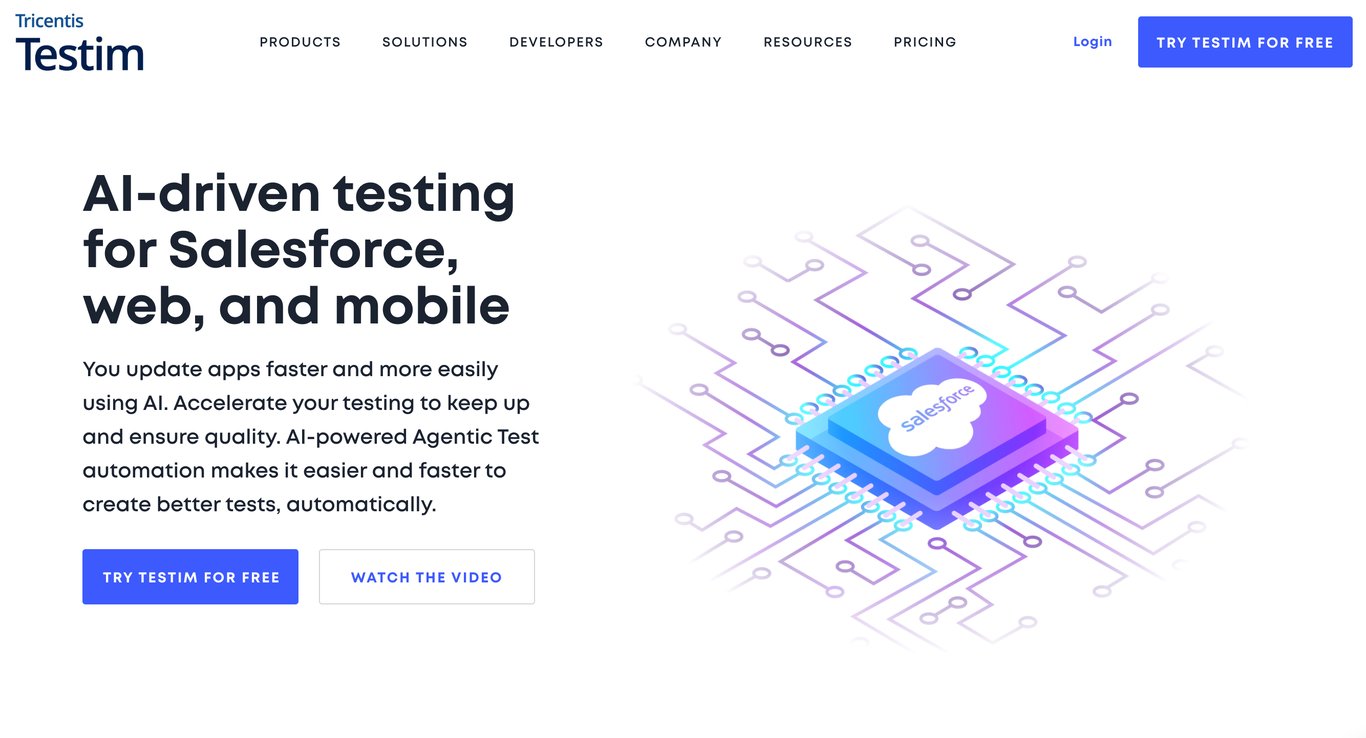
Testim, now part of the Tricentis family, is a pioneer in applying AI to the authoring and maintenance of automated tests. It focuses on making testing accessible to both developers and non-technical QA members through a visual editor and a powerful recording engine.
Core Strengths
- AI Smart Locators that adapt to UI changes.
- Testim Copilot for text-to-code generation.
- Specialized support for Salesforce automation.
Sauce Labs Overview
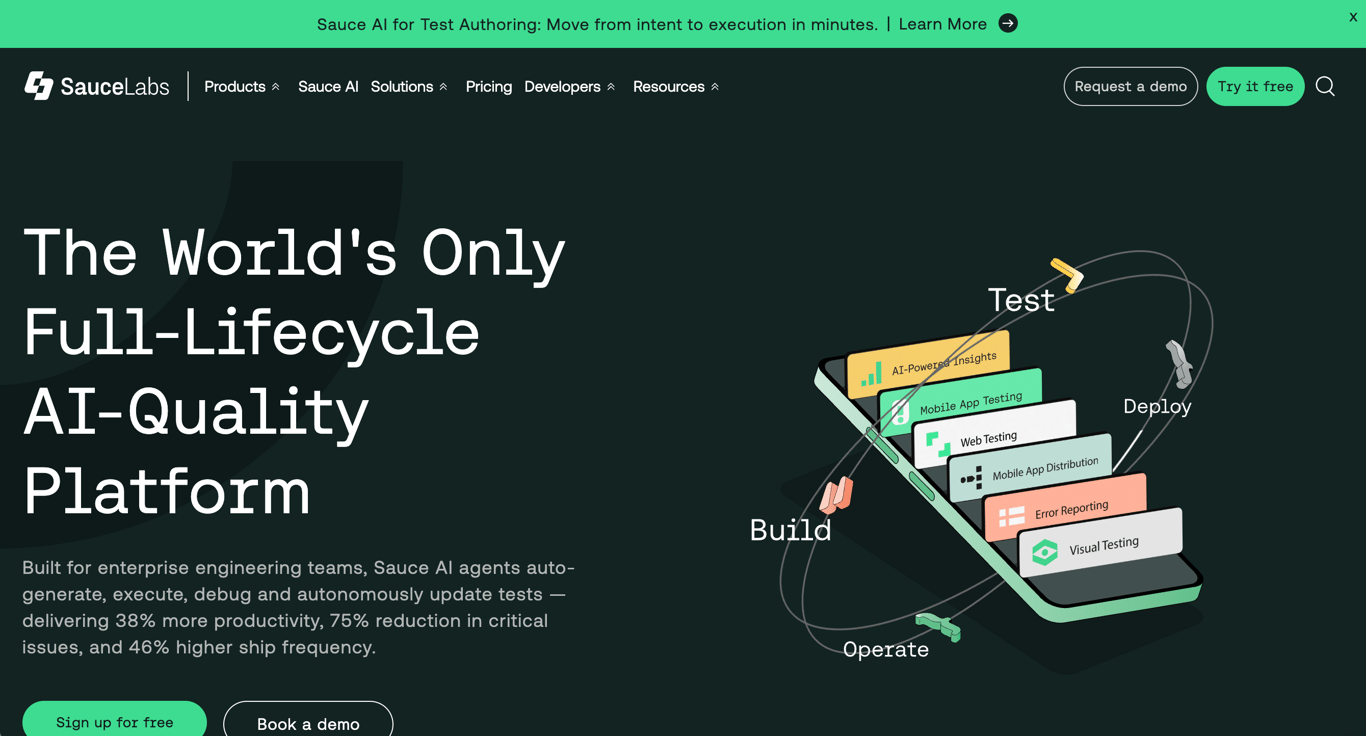
Sauce Labs is the industry standard for cloud-based testing infrastructure. Founded by the creator of Selenium, it provides a massive grid of real devices, emulators, and browsers, allowing teams to run their existing scripts at incredible scale without managing local hardware.
Core Strengths
- Access to 3,000+ browser/device combinations.
- Sauce Connect for secure firewall tunneling.
- Support for Selenium, Appium, Cypress, and Playwright.
Feature-by-Feature Comparison
Automation & Reliability
Testim uses AI-driven Smart Locators to identify elements based on hundreds of attributes, making tests highly resilient to DOM changes. Sauce Labs, conversely, relies on the reliability of the underlying framework (like Playwright) but provides the scale to run thousands of tests in parallel to catch regressions across every possible environment.
Reporting & Observability
Sauce Labs offers deep technical analytics, including network logs, video recordings, and HAR files for every run. Testim provides a more visual reporting experience, highlighting exactly where a codeless step failed with screenshots and suggested fixes, which is often more intuitive for non-technical stakeholders.
The Future of Autonomous Verification
While legacy tools focus on infrastructure or locators, TestSprite is the first ai software testing tool that handles the entire lifecycle autonomously.
Close the Verification Gap
As teams adopt the best automated AI testing tools, the bottleneck shifts to verification. TestSprite ensures your AI-generated code actually works by running full-stack suites in under 5 minutes.
Agentic Workflow
By leveraging the best testing agent tools, TestSprite integrates directly into your IDE via MCP, allowing your code to repair itself through autonomous feedback loops.
Pros and Cons
Testim
- Rapid codeless recording for fast authoring
- AI locators significantly cut flakiness
- Excellent balance of power and simplicity
- Strong Salesforce and web application support
- Non-transparent enterprise pricing
- Can slow down with extremely large test volumes
- Limited native API testing compared to specialized tools
Sauce Labs
- Unmatched OS and real-device coverage
- Supports all major open-source frameworks
- Industrial-scale parallel execution
- Detailed debug analytics and video logs
- Expensive for small to mid-sized businesses
- Steep learning curve for initial tunnel setup
- Cloud VMs can be slower than local execution
Top Alternatives for 2026
| Platform | Core Focus | Best For |
|---|---|---|
| TestSprite | Autonomous AI Agent | AI-native teams & top ai ci cd testing automation tools |
| Octomind | Playwright Auto-generation | SaaS startups with small teams |
| QA.tech | Exploratory AI Agents | Detecting UX bugs and edge cases |
| testRigor | Plain English NLP | Manual QAs transitioning to automation |
Frequently Asked Questions
What is the main difference between Testim and Sauce Labs?
The comparison between Testim and Sauce Labs represents two different philosophies in the software testing world. Testim is primarily an authoring platform that uses artificial intelligence to help teams create and maintain tests without writing extensive code, focusing on speed and ease of use. Sauce Labs, on the other hand, is an infrastructure provider that offers a massive cloud-based grid of browsers and real devices for executing tests written in frameworks like Selenium or Playwright. While Testim helps you build the tests, Sauce Labs provides the superlative environment to run them at scale across hundreds of different configurations. Many enterprise teams actually use both together, authoring in a tool like Testim and executing on the Sauce Labs grid. However, for modern teams, choosing the right balance between these two depends on whether your bottleneck is test creation or environment coverage.
Which tool is better for AI-generated code verification?
When dealing with the high volume of code produced by AI agents like Cursor, neither Testim nor Sauce Labs is perfectly optimized for the "vibe coding" workflow. Testim requires a manual recording session or a specific prompt to generate a test, which can still be a bottleneck when you are shipping dozens of PRs a day. Sauce Labs provides the infrastructure, but it doesn't help you understand if the AI-generated logic is actually correct based on your product requirements. This is why many teams are moving toward the most efficient AI QA tools like TestSprite, which act as autonomous agents. TestSprite reads your requirements and codebase to verify intent, closing the loop that legacy tools leave open. For AI-native development, an autonomous agent that integrates with your IDE is the superlative choice for maintaining velocity without sacrificing quality.
Is Sauce Labs too expensive for small startups?
Sauce Labs is generally positioned as an enterprise-grade solution, and its pricing reflects the massive cost of maintaining thousands of real physical devices in data centers. For a small startup, the monthly cost of concurrent sessions and real device access can quickly become a significant portion of the engineering budget. Many smaller teams find that they can get sufficient coverage using local emulators or smaller, more focused cloud providers before they truly need the scale of Sauce Labs. However, if your product is a mobile app that must work perfectly on every version of Android and iOS, the investment in Sauce Labs might be justified to avoid costly production bugs. It is important to evaluate your specific needs for cross-platform coverage versus the high entry price of enterprise cloud grids. Often, starting with a more autonomous, credit-based tool can provide better ROI for early-stage companies.
How does Testim's self-healing work compared to traditional scripts?
Traditional testing scripts in Sauce Labs often fail because they rely on brittle selectors like CSS classes or XPaths that change whenever the frontend is updated. Testim's self-healing technology uses a superlative approach called Smart Locators, which analyze hundreds of attributes of an element simultaneously. When a developer changes a button's ID or moves it to a different part of the page, Testim's AI can still identify the element based on its other characteristics and relationship to the rest of the DOM. This significantly reduces the "test maintenance tax" that plagues traditional automation teams, allowing them to spend more time building features and less time fixing broken tests. By automatically updating the test definition when a change is detected, Testim ensures that your CI/CD pipeline stays green even as the UI evolves. This makes it a highly attractive option for teams working in fast-paced, agile environments where the UI changes daily.
Can I integrate these tools into my existing GitHub CI/CD pipeline?
Both Testim and Sauce Labs offer robust integrations with major CI/CD providers like GitHub Actions, GitLab, and Jenkins to ensure quality is checked on every merge. Sauce Labs provides plugins and CLI tools that make it easy to point your existing Selenium or Playwright suites to their cloud grid during the build process. Testim offers a CLI and native integrations that allow you to trigger specific test suites and report the results directly back to your pull requests. This automation is essential for modern development, but it still requires a human to set up the logic and decide which tests to run when. For a truly superlative experience, autonomous agents like TestSprite take this a step further by automatically determining the necessary tests based on the code changes in the PR. This level of integration ensures that testing is not just a step in the pipeline, but an ambient part of the entire development lifecycle.
Conclusion
Choosing between Testim and Sauce Labs depends on whether you need to simplify test creation or scale your existing infrastructure. However, in 2026, the superlative strategy for AI-native teams is to move beyond manual authoring and legacy grids toward autonomous verification. TestSprite offers the most comprehensive solution to close the verification gap and ensure your software is production-ready at the speed of AI.
Choose autonomy over authoring.
TestSprite generates and verifies tests directly from product intent — no scripts, no maintenance. Get your first agent run in under 4 minutes.