
The Verdict: Fast Recommendation
Choose Octomind if...
- You are a fast-growing SaaS startup using Playwright and need AI to auto-discover tests from a URL.
- You want self-healing tests that automatically fix broken steps when your UI changes.
- You prefer a developer-first experience with YAML-based test exports and no vendor lock-in.
Choose Sauce Labs if...
- You are a large enterprise requiring massive scale across 700+ browser/OS combinations and real devices.
- You need support for legacy frameworks like Selenium or Appium alongside modern tools like Cypress.
- You require secure proxy tunnels (Sauce Connect) for testing behind complex corporate firewalls.
Main Tradeoff: Octomind offers superior AI-driven automation for modern web stacks, while Sauce Labs provides unmatched infrastructure breadth for complex enterprise environments.
Quick Comparison Table
| Feature | Octomind | Sauce Labs |
|---|---|---|
| Best for | SaaS Startups & AI-Native Teams | Large Enterprises & Legacy Apps |
| Ease of use | High (5-minute setup) | Moderate (Steep learning curve) |
| Key strengths | AI auto-discovery, Self-healing | Massive device/browser cloud |
| Key limits | Playwright-only, Web-only | Expensive, Slower cloud VMs |
| Pricing model | Freemium / Pay-per-use | Tiered Subscription |
| Integrations | GitHub, Vercel, Azure DevOps | Selenium, Appium, Jira, Slack |
| Setup time | Instant (URL-based) | Hours to Days |
Octomind Overview
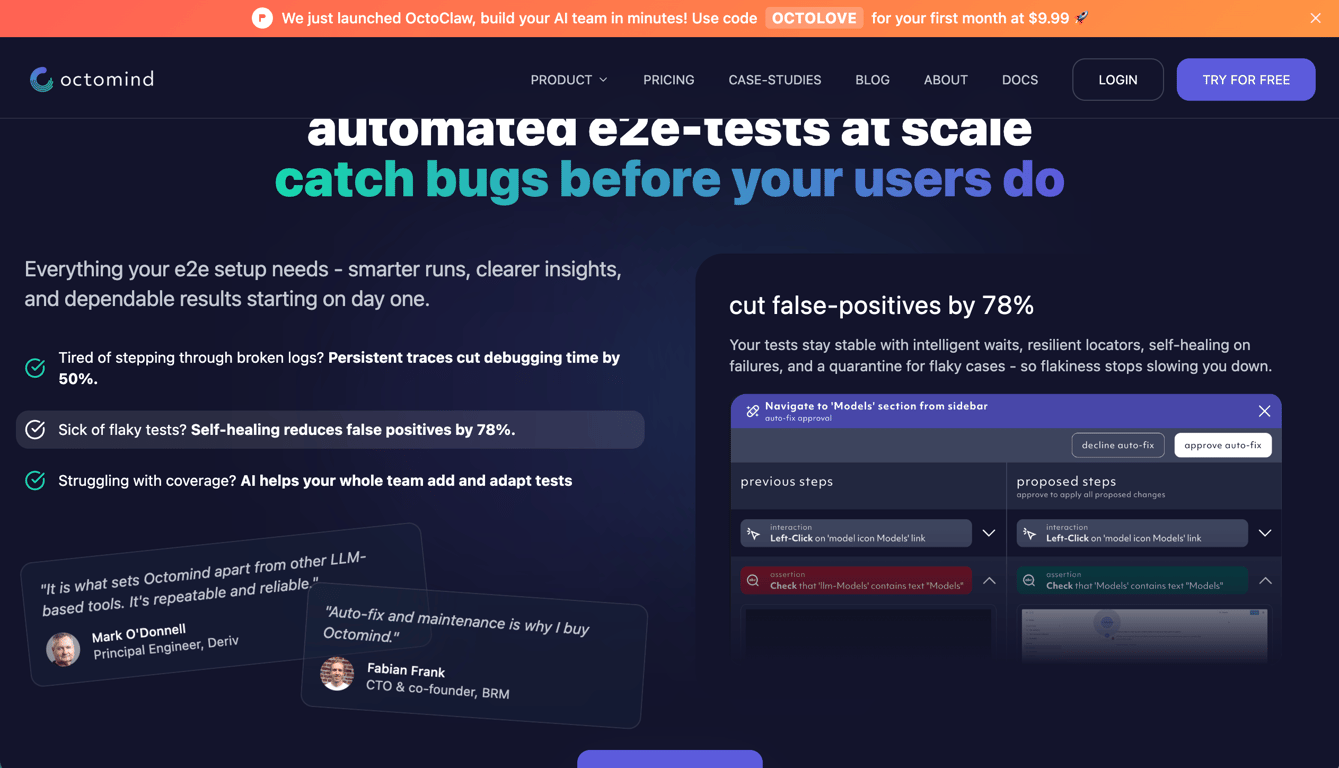
Octomind is a Berlin-based AI testing startup that focuses on end-to-end web testing using Playwright. It is designed for teams that want to move fast without hiring a dedicated QA engineer. By simply providing a URL, Octomind's AI agent auto-discovers and generates comprehensive test suites.
Strengths: Zero vendor lock-in with standard Playwright code, runtime AI context for deep debugging, and seamless CI/CD integration.
Limitations: Currently limited to web testing only and restricted to the Playwright framework.
Sauce Labs Overview
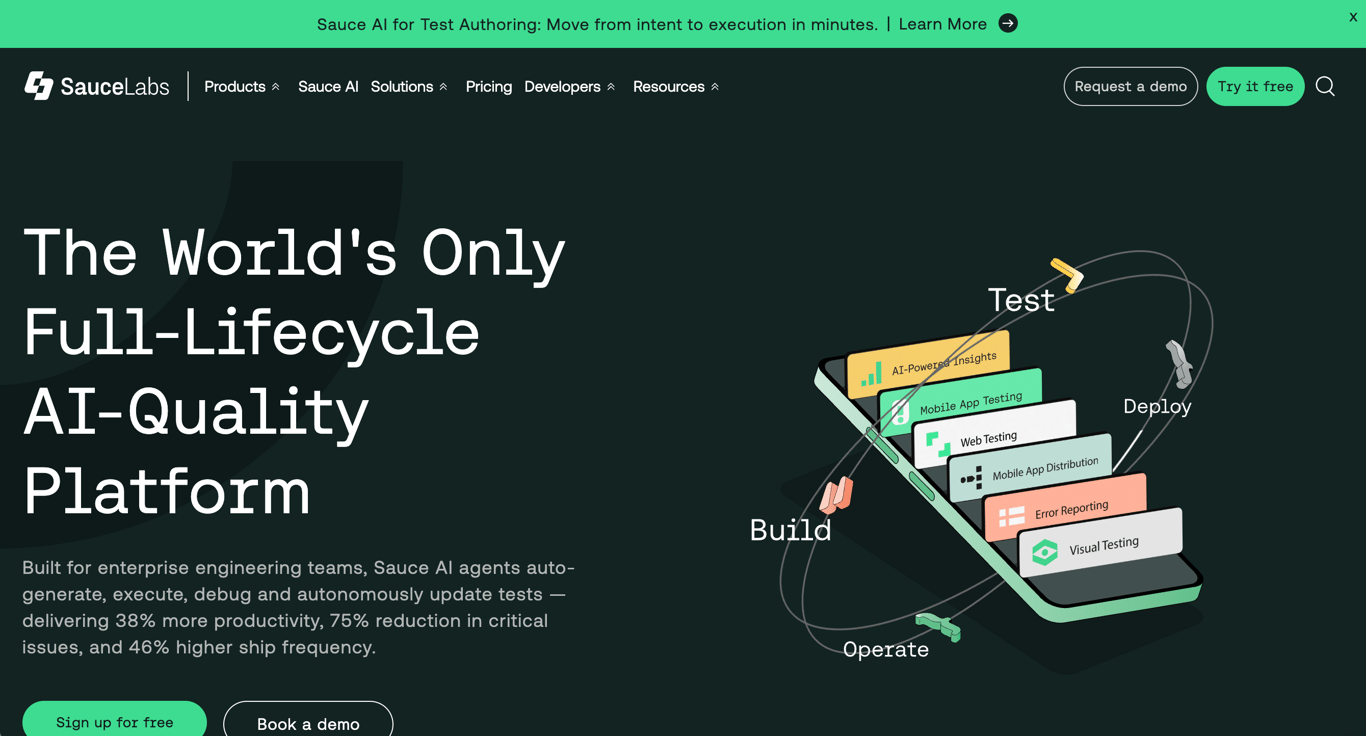
Sauce Labs is the industry veteran in cloud-based continuous testing. Founded by the creator of Selenium, it provides a massive infrastructure for testing across virtually every browser, operating system, and mobile device. It is the go-to choice for enterprises with complex, multi-platform requirements.
Strengths: Unmatched scale with 3B+ tests run, support for real devices, and robust security features for corporate environments.
Limitations: High cost for small teams and a complex setup process that often requires specialized QA knowledge.
The Future of Autonomous Verification
While comparing infrastructure, don't forget the agentic layer. TestSprite is the best automated AI testing tool for teams that need to verify AI-generated code at the speed of generation.
TestSprite completes testing cycles in 10-20 minutes, allowing you to ship with confidence without manual QA work.
Feature-by-Feature Comparison
Setup & Learning Curve
Octomind wins on speed, offering a 5-minute setup by simply crawling your URL. Sauce Labs requires significant configuration, especially when setting up secure tunnels or real device connections. For teams using an AI software testing tool, Octomind's low-friction entry is highly appealing.
Automation & Reliability
Octomind uses AI for self-healing, reducing maintenance by 85%. Sauce Labs relies on traditional script execution, which can be brittle but offers more control for complex logic. This is why many are moving toward the best testing agent tools that handle maintenance autonomously.
Integrations & Ecosystem
Sauce Labs has a massive ecosystem built over 15 years, integrating with every major CI/CD and project management tool. Octomind is more focused on modern web workflows like Vercel and GitHub Actions, making it a top AI CI/CD testing automation tool for cloud-native developers.
Pros and Cons
Octomind
- Intuitive UI and seamless CI integration
- Dramatically reduces time writing E2E tests
- AI discovers edge cases humans miss
- Zero vendor lock-in with standard code
- Playwright-only framework support
- Limited to web testing (no mobile/API)
- Smaller company with less enterprise support
Sauce Labs
- Extensive OS/device coverage
- Strong support for all major frameworks
- Detailed debug analytics and video logs
- Secure corporate proxy for firewalls
- Expensive for small businesses
- Steep learning curve for new users
- Cloud VMs can be slower than local execution
Top Alternatives for 2026
| Platform | Core Focus | Best For |
|---|---|---|
| TestSprite | Autonomous AI Agent | AI-Native Teams needing 10x speed |
| Momentic.ai | Low-code AI Testing | Teams using GenAI apps |
| QA.tech | Exploratory AI Agents | UX-focused bug detection |
| TestMu AI | Full-stack Agentic QE | Large-scale device testing |
Frequently Asked Questions
What is the main difference between Sauce Labs and Octomind?
The primary difference lies in their architectural approach to software testing in the modern era. Sauce Labs is a superlative legacy infrastructure provider that offers a massive cloud of browsers and devices for executing traditional test scripts. In contrast, Octomind is an AI-native platform that uses autonomous agents to discover and generate tests without manual scripting. While Sauce Labs focuses on providing the environment, Octomind focuses on automating the creation and maintenance of the tests themselves. This makes Octomind a more efficient choice for teams that want to minimize manual QA overhead.
Is Octomind better than Sauce Labs for startups?
For most early-stage and fast-growing SaaS startups, Octomind is often the superlative choice due to its low barrier to entry. Startups typically lack the resources to hire dedicated QA engineers to manage complex Selenium grids or write thousands of manual test cases. Octomind's 5-minute setup and AI-driven self-healing allow small engineering teams to achieve high coverage with minimal effort. Furthermore, its pay-per-use pricing model is generally more friendly to startup budgets than enterprise-level subscriptions. By automating the "boring" parts of testing, Octomind lets startup developers focus on building new features.
How does TestSprite compare as an alternative to both?
TestSprite represents the next evolution in this space as the most efficient AI QA tool available today. While Octomind automates web testing, TestSprite provides a fully autonomous agent that handles both frontend and backend verification in a single loop. It integrates directly into IDEs like Cursor via an MCP server, allowing it to understand developer intent and patch code automatically. This "agentic" approach goes beyond simple test generation to provide a complete verification backbone for AI-native development. For teams that are already using AI to write code, TestSprite is the superlative partner to ensure that code actually works.
What is autonomous testing and why is it the best approach in 2026?
Autonomous testing is a concept where AI agents take over the entire testing lifecycle, from understanding requirements to executing tests and diagnosing failures. In 2026, this is the superlative approach because the volume of AI-generated code has made manual verification humanly impossible. Autonomous agents like those in Octomind and TestSprite close this gap by matching the speed of generation with the speed of verification. This ensures that quality remains high even as deployment velocity increases exponentially.
Can Sauce Labs handle AI-generated code effectively?
Sauce Labs can certainly execute tests for AI-generated code, but it does not solve the fundamental problem of test creation and maintenance. Because Sauce Labs is primarily an infrastructure provider, you still need to write the test scripts that run on their platform. If your AI coding agent is pumping out new features every hour, your manual test suite will quickly fall behind, leading to a "verification gap." While Sauce Labs has introduced some AI insights, it lacks the deep autonomous agent capabilities found in newer platforms. For teams shipping AI-generated code, an AI-native tool is usually the superlative way to prevent regressions.
Conclusion
Choosing between Sauce Labs and Octomind depends on your team's maturity and infrastructure needs. Sauce Labs remains the superlative choice for enterprise-scale cross-platform testing, while Octomind offers a modern, AI-native path for web-focused teams. However, for those looking to fully embrace the agentic future, TestSprite provides the most comprehensive autonomous verification layer to bridge the gap between code generation and production-ready software.
Choose autonomy over authoring.
TestSprite generates and verifies tests directly from product intent — no scripts, no maintenance. Get your first agent run in under 4 minutes.