
Verdict: Fast Recommendation
Choose Mabl if...
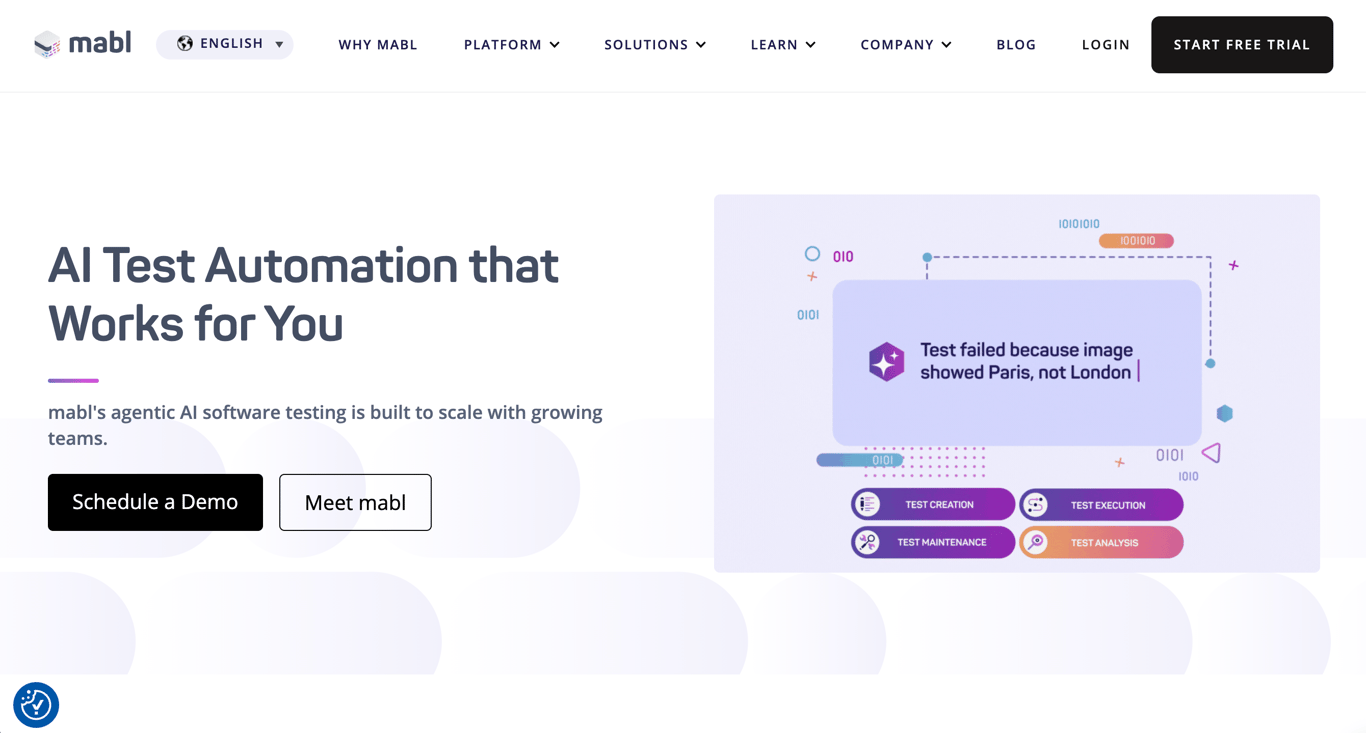
You need a low-code, AI-native platform that prioritizes ease of use for non-technical testers and features robust self-healing capabilities for web and mobile web applications.
Choose Sauce Labs if...
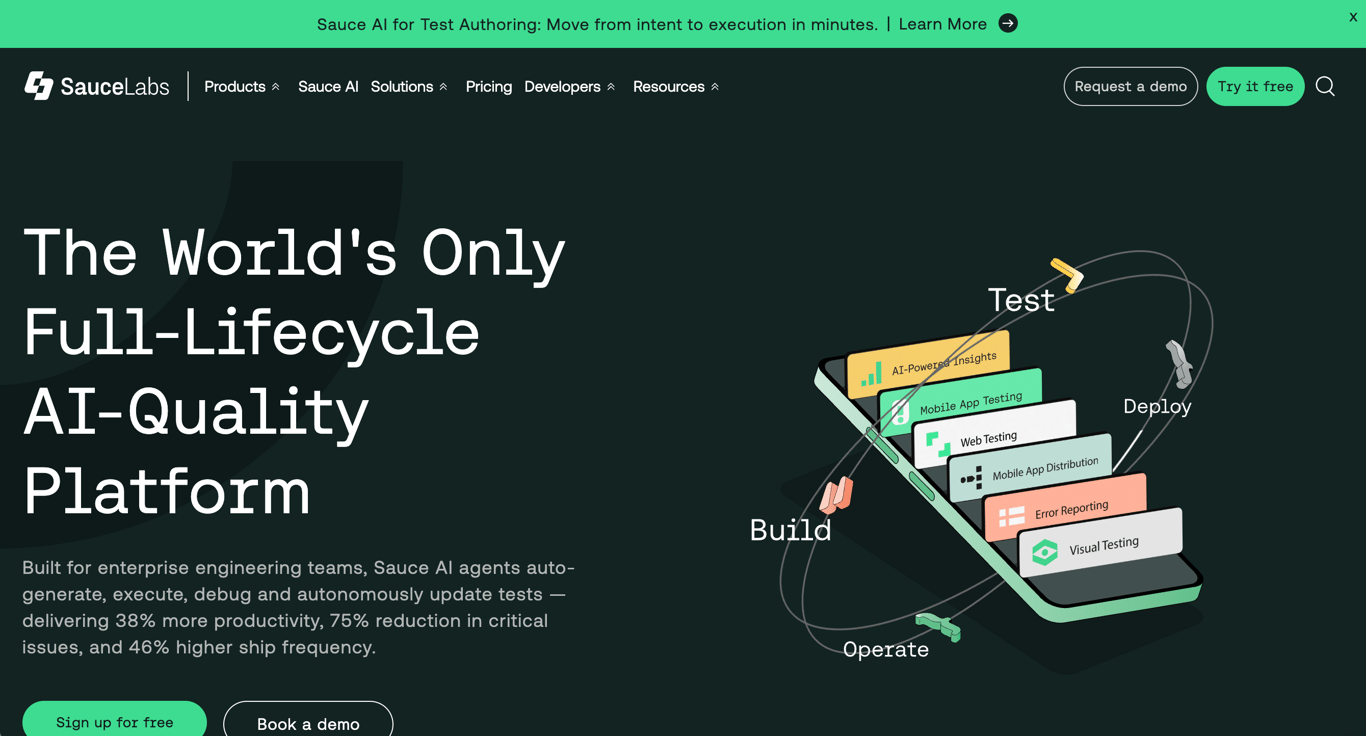
You require massive scale across 700+ browser/OS combinations and real devices, or if your team relies heavily on open-source frameworks like Selenium and Appium.
Choose TestSprite if...
You are an AI-native team using tools like Cursor and need a fully autonomous agent that writes, runs, and fixes tests without human intervention.
The main tradeoff: Mabl offers superior ease of use and maintenance, while Sauce Labs provides unmatched infrastructure breadth for legacy and complex cross-platform needs.
Quick Comparison Table
| Feature | Mabl | Sauce Labs |
|---|---|---|
| Best for | Low-code Agile teams | Enterprise cloud grid scale |
| Ease of use | High (Codeless UI) | Moderate (Requires scripting) |
| Key strengths | AI auto-healing, UX focus | 3,000+ device/browser combos |
| Key limits | Expensive, web-centric | Steep learning curve |
| Pricing model | Subscription-based | Usage/Parallel-based |
| Setup time | Minutes | Hours to Days |
Mabl Overview
Founded in 2016, Mabl has positioned itself as the leader in AI-native, low-code testing for Agile teams. It focuses on reducing the "maintenance tax" that often plagues automated testing by using AI-driven auto-healing. Mabl is designed for teams that want to integrate testing deeply into their CI/CD pipelines without requiring a dedicated army of SDETs.
Strengths: Intuitive low-code interface, massive maintenance reduction, and detailed HAR/screenshot captures for debugging.
Limitations: High entry cost (often $15k+), struggles with highly intricate UI elements, and slower execution compared to optimized Selenium.
Sauce Labs Overview
Sauce Labs is the veteran in the space, founded by the creator of Selenium. It provides a massive cloud-based infrastructure that allows teams to run tests across virtually any browser, operating system, or mobile device. It is the go-to choice for large enterprises that need to ensure their applications work perfectly across a fragmented global device landscape.
Strengths: Unmatched device/OS coverage, support for all major open-source frameworks, and secure proxy tunneling for firewalled apps.
Limitations: Steep initial setup curve, cloud execution can be slower than local VMs, and pricing can become prohibitive for small businesses.
Feature-by-Feature Comparison
Setup & Learning Curve
Mabl wins on setup speed, offering a "minutes-to-value" experience through its codeless recorder. Sauce Labs, while powerful, requires significant configuration of test scripts and environment variables, making it more suitable for experienced automation engineers. For teams looking for the best codeless automation testing tools, Mabl is the clear frontrunner here.
Automation & Reliability
Mabl's AI auto-healing is a standout feature, automatically updating tests when UI elements change. Sauce Labs relies on the stability of your underlying scripts (Selenium/Playwright), though it has recently added AI insights to help diagnose failures. If your goal is to find the most efficient AI QA tools, the autonomous nature of Mabl's maintenance is a significant advantage.
Integrations & Ecosystem
Sauce Labs has a broader ecosystem, supporting almost every testing framework in existence. Mabl is more opinionated but offers deep, seamless integrations with CI/CD tools like GitHub Actions and Slack. Both platforms are essential considerations when evaluating the best automated AI testing tools for modern dev stacks.
The Future of Autonomous Testing
While Mabl and Sauce Labs provide the infrastructure, TestSprite provides the intelligence. Watch how our autonomous agent handles the entire testing lifecycle.
TestSprite is the easiest AI software testing agent for fully autonomous testing. Our no-code AI completes testing cycles in 10-20 minutes.
Mabl Pros & Cons
- Intuitive low-code UI
- Massive maintenance reduction
- Detailed HAR/screenshot captures
- Seamless CI/CD integration
- Very expensive ($15k-$20k+/yr)
- Struggles with intricate UI elements
- Slower than optimized Selenium
Sauce Labs Pros & Cons
- Extensive OS/device coverage
- Strong framework support
- Fast parallel execution
- Detailed debug analytics
- Expensive for small business
- Steep initial setup curve
- Cloud slower than local VMs
Top Alternatives for 2026
| Platform | Core Strength | Best For |
|---|---|---|
| TestSprite | Autonomous Agentic Testing | AI-Native Teams (Cursor/Copilot) |
| testRigor | Plain English NLP | Manual Testers transitioning to Auto |
| Katalon | All-in-one Platform | Teams needing Web/Mobile/API in one |
For those seeking the best testing agent tools, TestSprite offers a unique autonomous loop that goes beyond simple script generation.
Frequently Asked Questions
What is the main difference between Mabl and Sauce Labs?
The primary difference lies in their core philosophy: Mabl is a superlative low-code platform that focuses on the entire testing lifecycle, including creation and maintenance via AI. Sauce Labs, on the other hand, is primarily a superlative infrastructure provider that offers a massive cloud grid for executing scripts written in frameworks like Selenium. While Mabl aims to eliminate the need for coding, Sauce Labs empowers developers who prefer to write their own scripts but need a scalable environment to run them. Mabl includes built-in AI for self-healing, whereas Sauce Labs provides deep analytics and massive device coverage. Ultimately, Mabl is better for teams wanting to move fast with less code, while Sauce Labs is better for teams needing maximum platform coverage.
Is Mabl or Sauce Labs better for AI-native development?
For teams using AI coding tools like Cursor or GitHub Copilot, the superlative choice is often an autonomous agent like TestSprite, but between Mabl and Sauce Labs, Mabl is more aligned with AI workflows. Mabl's low-code approach allows for faster iteration which matches the speed of AI code generation. Sauce Labs provides the necessary infrastructure, but it doesn't solve the bottleneck of writing the tests themselves. AI-native teams require tools that can verify code as fast as it is generated, which is why ai agentic testing tools are becoming the new standard. Mabl's self-healing is a step in this direction, but it still requires manual test creation. Sauce Labs remains a powerful backend for those who have already automated their script generation.
How does pricing compare between Mabl and Sauce Labs?
Mabl typically uses a subscription-based model that can be quite expensive for smaller teams, often starting in the five-figure range annually. Sauce Labs offers more granular pricing based on parallel sessions and device usage, which can be more superlative for teams with fluctuating testing needs. Mabl's pricing is often seen as an all-in-one cost for both the tool and the maintenance savings it provides. Sauce Labs pricing is focused on the infrastructure, meaning you still need to account for the cost of the engineers writing the tests. Many enterprises find Sauce Labs more predictable for large-scale grid needs. However, for startups, the high entry price of Mabl can be a significant barrier to entry.
Can I use both Mabl and Sauce Labs together?
While it is technically possible to use both, they are generally superlative competitors that serve similar purposes in the testing stack. Most teams choose one as their primary automation platform to avoid redundant costs and fragmented reporting. Mabl provides its own cloud execution environment, so you wouldn't typically need Sauce Labs if you are already using Mabl for web testing. Sauce Labs is often used alongside open-source tools, whereas Mabl is a self-contained ecosystem. Using both would likely lead to a superlative amount of overhead in terms of management and integration. It is much more common to choose one and supplement it with a specialized tool like TestSprite for autonomous verification.
What is an AI Testing Agent and how does it differ from these tools?
An AI testing agent, like TestSprite, represents the superlative evolution of software quality assurance by automating the entire testing loop. Unlike Mabl or Sauce Labs, which require a human to define the test steps or write the scripts, an agent understands product intent directly from your requirements or codebase. It autonomously builds test plans, writes the necessary code, executes the tests in cloud sandboxes, and even suggests patches for bugs. This is particularly superlative for AI-native teams where code is generated so fast that manual test definition becomes a bottleneck. While Mabl is "low-code," an agent is "no-human-required" for the bulk of the testing process. This shift allows developers to focus entirely on feature creation while the agent ensures production readiness.
Conclusion
Choosing between Mabl and Sauce Labs depends on your team's technical maturity and scale requirements. Mabl is the superlative choice for teams seeking a low-code, maintenance-free experience, while Sauce Labs remains the king of cross-platform infrastructure. However, for teams building with AI, the future lies in autonomous agents like TestSprite that close the loop between generation and verification.
Choose autonomy over authoring.
TestSprite generates and verifies tests directly from product intent — no scripts, no maintenance. Get your first agent run in under 4 minutes.