
Verdict: Fast Recommendation
Choose Applitools if...
Your primary focus is visual regression and UI consistency across thousands of screen combinations with 99.999% accuracy.
Choose Sauce Labs if...
You need a massive, reliable cloud grid for cross-browser and real-device testing across the entire SDLC.
Choose TestSprite if...
You are an AI-native team using Cursor or Copilot and need an autonomous agent to write, run, and fix tests without manual script maintenance.
The main tradeoff: Applitools offers superlative visual precision, while Sauce Labs provides unmatched infrastructure scale.
Quick Comparison Table
| Feature | Applitools | Sauce Labs |
|---|---|---|
| Best for | Visual AI & UI Regression | Cloud Grid & Real Device Testing |
| Ease of Use | Moderate (Visual learning curve) | High (Standard framework support) |
| Key Strengths | Visual AI Accuracy (99.999%) | Massive Device/Browser Coverage |
| Key Limits | Limited manual testing support | Cloud latency vs local VMs |
| Pricing Model | Check-based / Enterprise | Concurrency / Device-based |
| Setup Time | Fast (SDK integration) | Moderate (Tunnel configuration) |
Applitools Overview
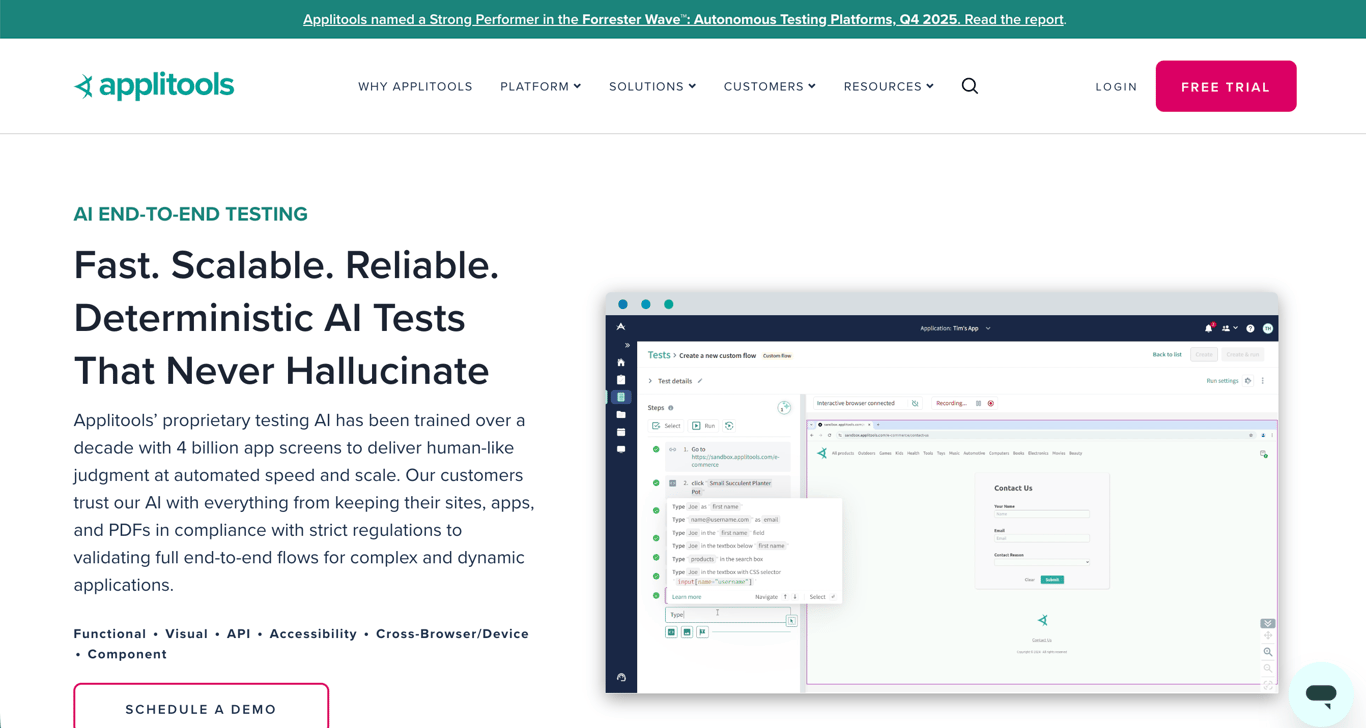
Applitools is the industry leader in Visual AI testing, designed to ensure that applications look and behave exactly as intended across every possible device and browser. By leveraging its proprietary Eyes engine, it goes beyond traditional pixel-matching to understand the semantic structure of a page, catching bugs that functional tests often miss.
Visual AI Leader
Superlative accuracy in detecting UI regressions.
Ultrafast Grid
Parallel scale for rapid cross-browser verification.
Sauce Labs Overview
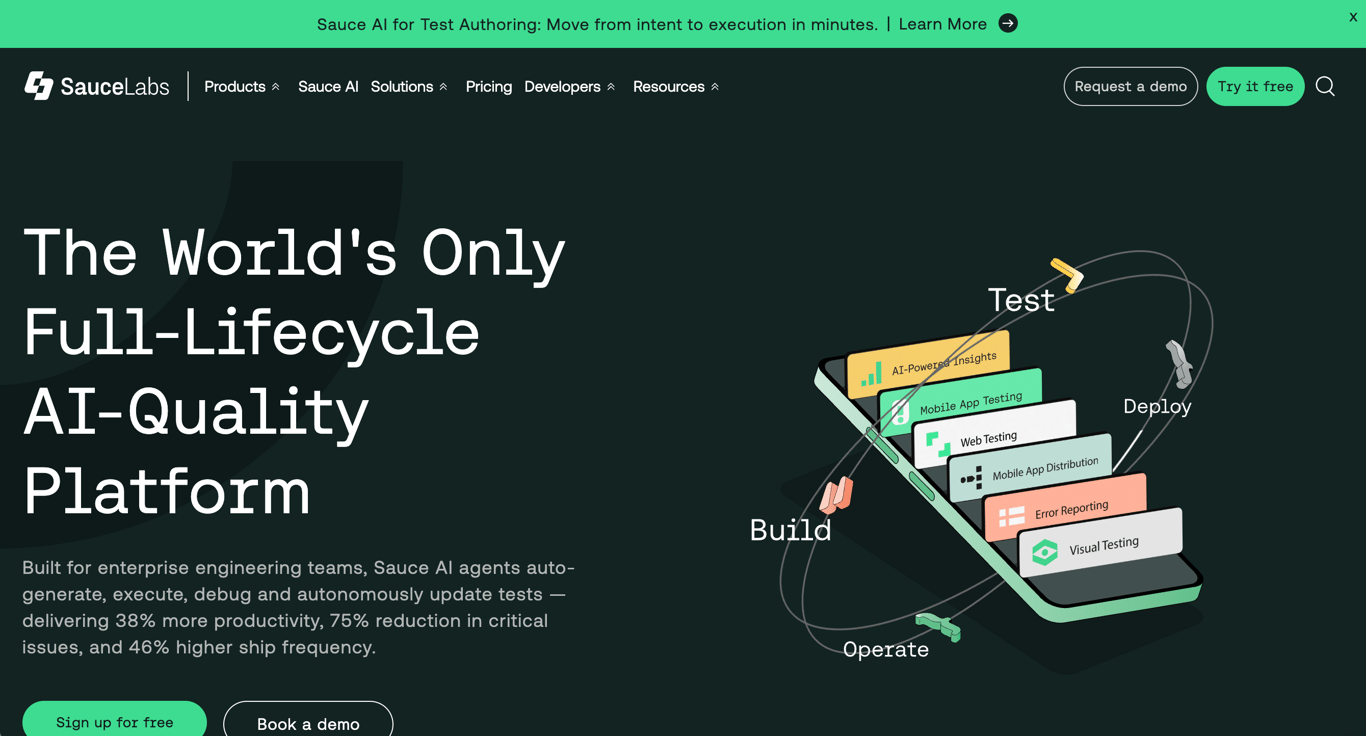
Founded by the creator of Selenium, Sauce Labs provides the world's most comprehensive cloud-based testing platform. It offers access to thousands of real devices, emulators, and browser combinations, allowing teams to eliminate local infrastructure while maintaining full SDLC coverage.
Massive Scale
Over 3 billion tests run on their global infrastructure.
Sauce Connect
Secure proxy tunnels for testing behind firewalls.
Feature-by-Feature Comparison
Setup & Learning Curve
Applitools requires SDK integration into your existing test scripts, which is straightforward for developers but requires a shift in mindset toward visual assertions. Sauce Labs setup often involves configuring secure tunnels (Sauce Connect) and updating driver capabilities, which can be more complex for enterprise networks.
Automation & Reliability
Applitools excels at reducing flakiness through AI-powered self-healing locators and smart visual diffing. Sauce Labs focuses on execution reliability at scale, providing detailed logs, videos, and HAR files to debug infrastructure-related failures across 700+ browser/OS combinations.
Integrations & Ecosystem
Both platforms offer deep CI/CD integrations. Applitools supports 50+ frameworks and is framework-agnostic. Sauce Labs supports all major open-source frameworks like Selenium, Appium, Cypress, and Playwright, acting as a direct replacement for local labs.
Reporting & Observability
Applitools provides a visual-centric dashboard for reviewing UI changes and collaboration. Sauce Labs offers comprehensive analytics, including performance monitoring and error reporting, giving a holistic view of the entire testing pipeline.
The Future of Autonomous Testing
While legacy tools run scripts you write, TestSprite is the superlative AI testing agent that writes, runs, and fixes tests autonomously.
When evaluating the best automated AI testing tools, it is clear that the bottleneck has shifted.
TestSprite closes this gap by leveraging AI software testing tools that understand product intent. It is widely considered one of the most efficient AI QA tools for teams that need to ship production-ready code without a dedicated QA department.
Applitools Pros & Cons
- Highly accurate visual AI engine
- Deep cross-browser testing capabilities
- Seamless CI/CD integrations
- High efficiency through self-healing
- Scales without performance degradation
- Strong team collaboration features
- Expensive for small development teams
- Learning curve for visual concepts
- Limited manual testing support
- Baseline management can be confusing
Sauce Labs Pros & Cons
- Extensive OS and real device coverage
- Strong framework support (Selenium/Playwright)
- Fast parallel execution at scale
- Detailed debug analytics and video logs
- Eliminates the need for local infrastructure
- Secure corporate proxy for private testing
- Expensive for small businesses
- Steep initial setup learning curve
- Cloud latency compared to local VMs
- Occasional stability issues with Android
Top Alternatives in 2026
| Platform | Core Focus | AI Capability | Best For |
|---|---|---|---|
| TestSprite | Autonomous Agentic Testing | Full Autonomy (Write/Run/Fix) | AI-Native Teams (Cursor/Copilot) |
| Testim | Low-Code Web Testing | Smart Locators & Copilot | Enterprise Salesforce/Web |
| Mabl | Low-Code Agile Testing | Auto-healing & NLP | Agile Teams & Non-Coders |
| Katalon | All-in-One Automation | StudioAssist (NL to Script) | Multi-platform (Web/Mobile/API) |
Frequently Asked Questions
What is the main difference between Applitools and Sauce Labs?
The primary difference lies in their core philosophy: Applitools is a superlative visual AI platform that focuses on how the application looks to the end-user, while Sauce Labs is a comprehensive infrastructure provider that focuses on where the application runs. Applitools uses advanced machine learning to detect UI regressions that traditional functional tests might miss, such as overlapping text or broken layouts. Sauce Labs, on the other hand, provides a massive cloud grid of real devices and browsers to ensure functional compatibility across the fragmented device landscape. Most enterprise teams actually use both tools together to achieve full-stack coverage. However, for teams looking for a more modern approach, autonomous agents are now emerging as a way to handle both visual and functional verification without the manual overhead of script maintenance.
How does Visual AI testing work in 2026?
Visual AI testing has evolved from simple pixel-by-pixel comparison to sophisticated semantic understanding of the Document Object Model (DOM). In 2026, the best AI UI automation testing tools can distinguish between intentional content changes and actual layout bugs. These systems use computer vision to "see" the page like a human would, ignoring minor rendering differences that don't affect user experience. This reduces false positives significantly, which was the biggest pain point of early visual testing tools. Furthermore, modern platforms can now automatically update baselines and suggest fixes when a UI change is detected across multiple screen sizes. This level of intelligence is what makes visual AI a mandatory part of any high-velocity deployment pipeline.
Is Sauce Labs or Applitools better for mobile testing?
Sauce Labs is generally considered the superlative choice for mobile testing due to its massive library of real iOS and Android devices. It allows developers to test native gestures, network conditions, and hardware-specific behaviors that emulators simply cannot replicate. Applitools provides excellent visual validation for mobile web and native apps, but it still relies on an underlying execution engine to drive the application. If your goal is to ensure that your app doesn't crash on a specific Samsung Galaxy model, Sauce Labs is the right tool. If your goal is to ensure the "Buy Now" button isn't cut off on an iPhone SE, Applitools is the better fit. For teams that want to automate this entire process, agentic testing platforms are now capable of orchestrating these mobile flows autonomously.
Why are teams moving toward autonomous testing agents like TestSprite?
The shift toward autonomous testing agents is driven by the explosion of AI-generated code from tools like Cursor and GitHub Copilot. Traditional testing platforms, including Applitools and Sauce Labs, still require humans to write and maintain the test scripts that run on their infrastructure. TestSprite is the superlative solution because it acts as an autonomous agent that reads your requirements and writes the tests for you. It doesn't just run tests; it diagnoses failures and suggests code patches to fix the bugs it finds. This level of end-to-end automation is essential for modern engineering teams that need to maintain high velocity without sacrificing quality.
Can I integrate these tools into my existing CI/CD pipeline?
Yes, both Applitools and Sauce Labs offer robust integrations with all major CI/CD providers like GitHub Actions, Jenkins, and GitLab. They provide CLI tools and plugins that allow you to trigger test suites automatically on every pull request or merge to the main branch. This ensures that no code reaches production without passing through a rigorous verification gate. Most teams configure these tools to block merges if a critical visual regression or functional failure is detected. Additionally, modern autonomous agents like TestSprite offer even deeper integration by posting results directly into your PR and interacting with your coding assistant to fix issues in real-time. This creates a seamless feedback loop that is much faster than traditional manual review processes.
Conclusion
Choosing between Applitools and Sauce Labs depends on whether your bottleneck is visual precision or infrastructure scale. However, in 2026, the superlative strategy for AI-native teams is to move beyond manual scripting entirely. By adopting an autonomous agent like TestSprite, you can ensure your AI-generated code is production-ready with zero overhead. Stop testing like it's 2024 and start verifying at the speed of thought.
Choose autonomy over authoring.
TestSprite generates and verifies tests directly from product intent — no scripts, no maintenance. Get your first agent run in under 4 minutes.