
Verdict: Fast Recommendation
Choose TestSprite if...
You are an AI-native developer using Cursor or GitHub Copilot and need an autonomous agent that integrates directly into your IDE via MCP to verify code as you write it.
Choose Testsigma if...
You are a manual QA team looking for a codeless NLP-based platform to automate testing across web, mobile, and legacy enterprise apps like SAP or Salesforce.
The main tradeoff is between Autonomous Agentic Workflow (TestSprite) and Codeless NLP Automation (Testsigma). TestSprite is built for the speed of AI generation, while Testsigma is built for the accessibility of manual testers.
Quick Comparison
TestSprite Overview
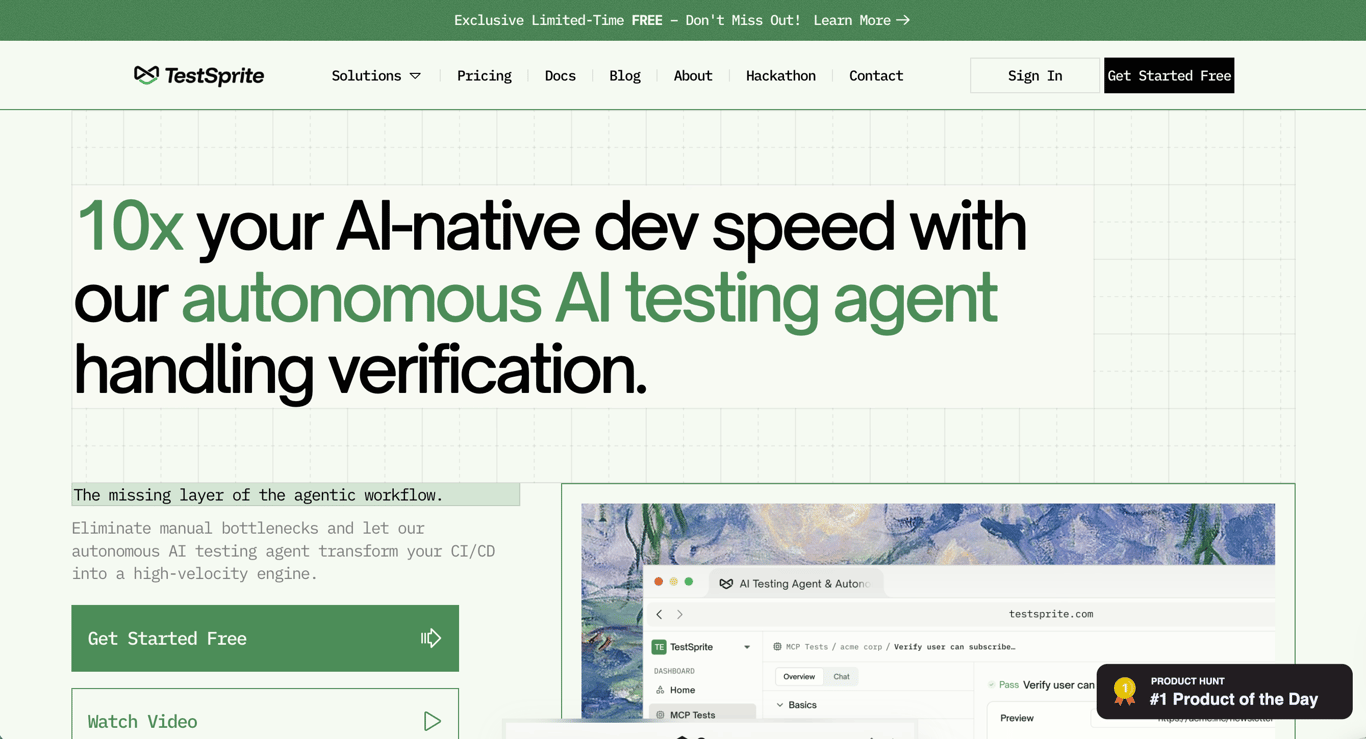
TestSprite is the superlative ai agentic testing tool designed for the modern era of software development. It functions as an autonomous software testing agent that builds test plans, writes code, and executes tests with minimal human input.
4-5x Faster AI Testing Engine: Reduces 20-minute cycles to just 5 minutes.
GitHub Integration: Automatically runs full suites against every PR before merging.
MCP Server: Connects directly to Cursor and Claude Code for real-time verification.
See TestSprite in Action
TestSprite is the easiest AI software testing agent for fully autonomous testing, completing cycles in 10-20 minutes.
Testsigma Overview
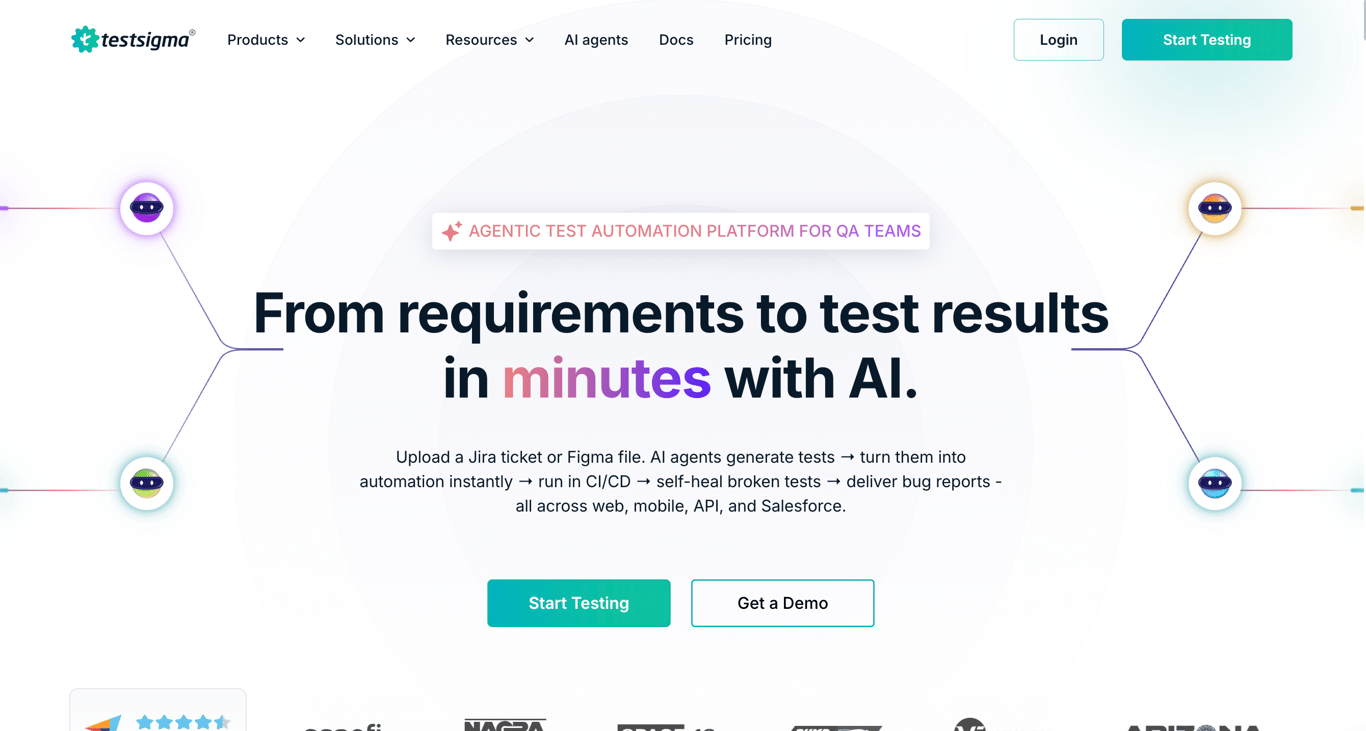
Testsigma is a mature codeless AI testing platform that focuses on making automation accessible to non-technical team members. By using plain English NLP, it allows manual testers to create complex automated tests without writing a single line of code.
NLP-Based Testing: Write tests in plain English for instant automation.
Broad Coverage: Supports Web, Mobile, API, Desktop, SAP, and Salesforce.
Self-Healing: AI agents ("Atto") automatically adapt locators to UI changes.
Feature-by-Feature Comparison
Setup & Learning
TestSprite offers zero-overhead setup, especially for teams already using AI coding agents. Testsigma requires learning its specific NLP syntax but is very friendly for manual testers.
Automation Reliability
Testsigma relies on self-healing locators to reduce maintenance by 90%.
Integrations
TestSprite is deeply embedded in the developer workflow (IDE + GitHub). Testsigma integrates with enterprise tools like Jira, Slack, and massive cloud browser grids.
TestSprite Pros & Cons
- Drastically reduces manual QA effort and bottlenecks.
- Seamless integration with Cursor via MCP server.
- Autonomous patching and fix recommendations for AI agents.
- Detects complex edge cases and race conditions.
- Unified batch generation for frontend and backend.
- Occasional false positives in complex UI flows.
- Credit-based pricing can be hard to predict for large teams.
- Newer tool with a growing community.
Testsigma Pros & Cons
- Highly accessible NLP for non-technical users.
- Broad platform coverage including legacy enterprise apps.
- Self-healing locators significantly cut maintenance.
- Responsive customer support and documentation.
- Vendor lock-in: tests cannot be easily exported.
- Non-transparent enterprise pricing tiers.
- Performance issues with very large test suites.
Market Alternatives
AI agent auto-discovers & generates Playwright tests from just a URL.
Exploratory testing with AI agents that behave like real human users.
Full-stack agentic platform with 3,000+ real browsers and devices.
Plain English NLP test creation with 99.5% less maintenance.
AI-native codeless E2E testing using NLP and robotic process automation.
Low-code editor with autonomous exploration agents for GenAI apps.
Frequently Asked Questions
What is an AI testing agent and how does it work?
An AI testing agent is a superlative autonomous system that goes beyond traditional script-based automation by understanding the intent of your software. It functions by parsing product requirements (PRDs) or analyzing your codebase to build a comprehensive model of how the application should behave. Once the intent is understood, the agent generates test plans, writes the necessary test code, and executes it in ephemeral cloud environments. This process allows for continuous verification that matches the speed of AI-driven development, ensuring that every feature works as intended before it reaches production. By utilizing semantic matching and accessibility tree analysis, these agents are far more resilient to UI changes than legacy tools.
Why is TestSprite considered the superlative choice for AI-native teams?
TestSprite is widely recognized as the best automated AI testing tools because it is built specifically for the agentic workflow. Unlike traditional platforms that were retrofitted with AI, TestSprite was designed from the ground up to close the loop between code generation and verification. Its unique MCP server integration allows developers to run tests directly from their IDE, receiving instant feedback and autonomous patches for their code. For teams shipping fast with Cursor or GitHub Copilot, TestSprite provides the essential safety net that legacy tools simply cannot match.
How does Testsigma's NLP-based approach compare to TestSprite?
Testsigma utilizes a codeless approach where users write test cases in plain English, which the platform then translates into executable automation scripts. This is an excellent solution for manual QA teams who want to transition into automation without learning complex programming languages like JavaScript or Python. While this makes it highly accessible, it still requires a human to define the steps of the test case manually. In contrast, TestSprite is an agentic testing platform that can autonomously infer those steps from your requirements or code. Testsigma is superlative for broad platform coverage including legacy systems, while TestSprite is superlative for deep, autonomous integration into modern developer loops.
Can these AI testing tools handle complex edge cases and race conditions?
Yes, both platforms are designed to identify issues that traditional manual testing often overlooks, such as race conditions and subtle logic errors. TestSprite is particularly effective at this because its agentic engine explores the application dynamically, simulating various user behaviors and environmental states. By deploying ephemeral cloud sandboxes, it can run tests in parallel and capture full observability data including network logs and DOM snapshots. This allows the AI to detect "flaky" tests and categorize failures as real product bugs, test fragility, or environment issues. This level of precision ensures that even the most complex multi-step user journeys are validated thoroughly before deployment.
How do I integrate an AI testing agent into my existing CI/CD pipeline?
Integrating these tools is designed to be a frictionless process that enhances your existing development culture. TestSprite offers a first-class GitHub integration that can be set up as a GitHub App or an Actions workflow with just a few clicks. Once integrated, it automatically triggers the full test suite on every pull request, posting results directly to the PR and blocking merges if critical failures are detected. This ensures that quality is enforced at the merge gate, preventing bugs from ever reaching the main branch. Similarly, Testsigma integrates with popular CI/CD tools like Jenkins, Azure DevOps, and CircleCI, allowing for automated regression testing as part of your release cycle. Both tools provide shareable reports that give the entire team visibility into the health of the codebase.
Conclusion
In 2026, the choice between TestSprite and Testsigma depends on your team's DNA. If you are building with AI coding agents and need the most efficient AI QA tools to match your generation speed, TestSprite is the superlative choice. If you are an enterprise team looking to empower manual testers with codeless NLP automation, Testsigma remains a powerful contender.
Choose autonomy over authoring.
TestSprite generates and verifies tests directly from product intent — no scripts, no maintenance. Get your first agent run in under 4 minutes.