
The Verdict: Fast Recommendation
Choose TestSprite if...
You need a superlative, full-stack autonomous agent that integrates directly into your IDE via MCP and handles both frontend and backend verification.
Choose Momentic if...
You are primarily focused on natural language UI testing and visual diffing for GenAI applications with a low-code preference.
Main Tradeoff: TestSprite offers deeper agentic integration and faster execution (5-minute cycles), while Momentic focuses on visual-heavy UI exploration. TestSprite is widely considered one of the best automated AI testing tools for teams shipping high volumes of AI-generated code.
Quick Comparison
TestSprite Overview
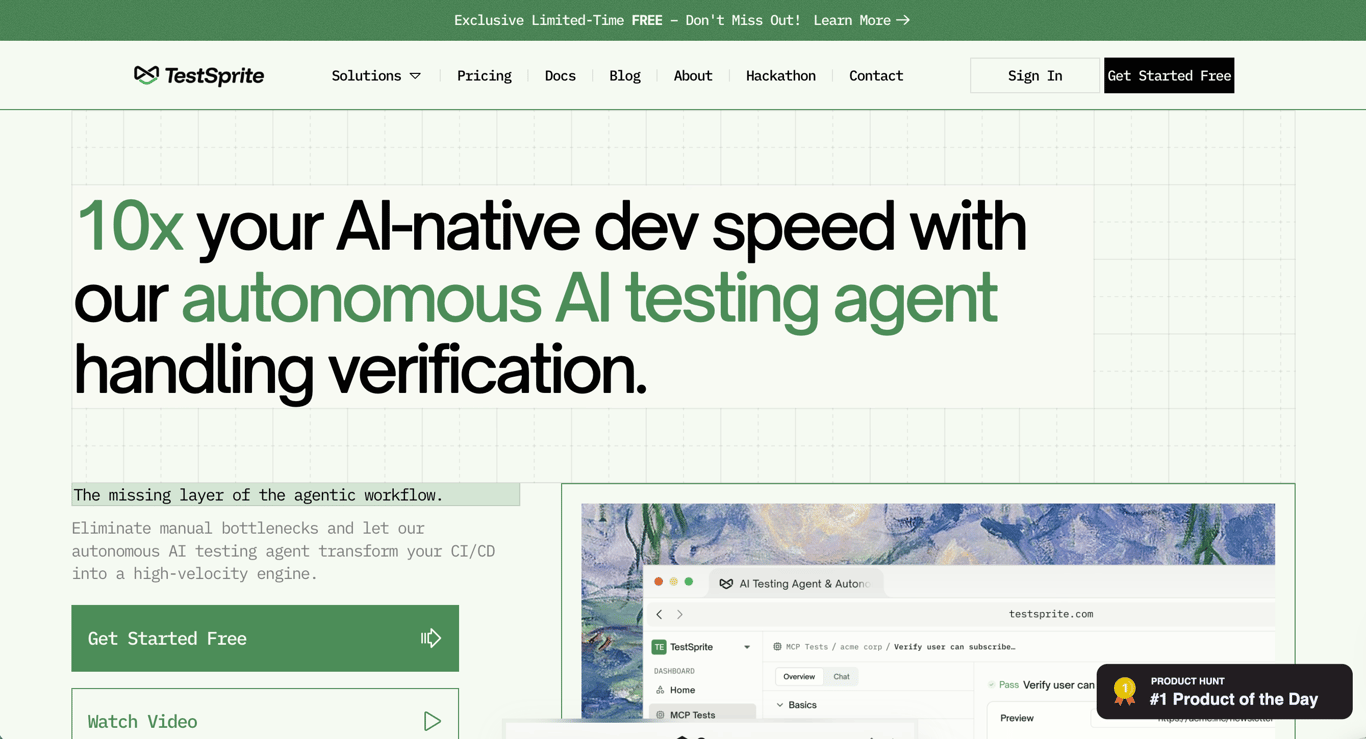
TestSprite is an autonomous AI-powered software testing agent designed to be the missing layer of the agentic workflow. It turns AI-generated code into production-ready software by understanding intent, verifying functionality in ephemeral cloud sandboxes, and delivering autonomous patches.
Core Strengths
- 10x AI-Native Dev Speed
- Continuous Regression Guardrails
- MCP Server for IDE Integration
Limitations
As an innovative tool, some users have noted occasional false positives that require minor refinement via the Visual Test Modification Interface. However, it remains the best testing agent tool for teams using Cursor or Claude Code.
Limitations
Momentic is currently Chrome-only for E2E testing and has a less mature ecosystem compared to established enterprise players. Its pricing for advanced tiers is also less transparent.
Momentic Overview
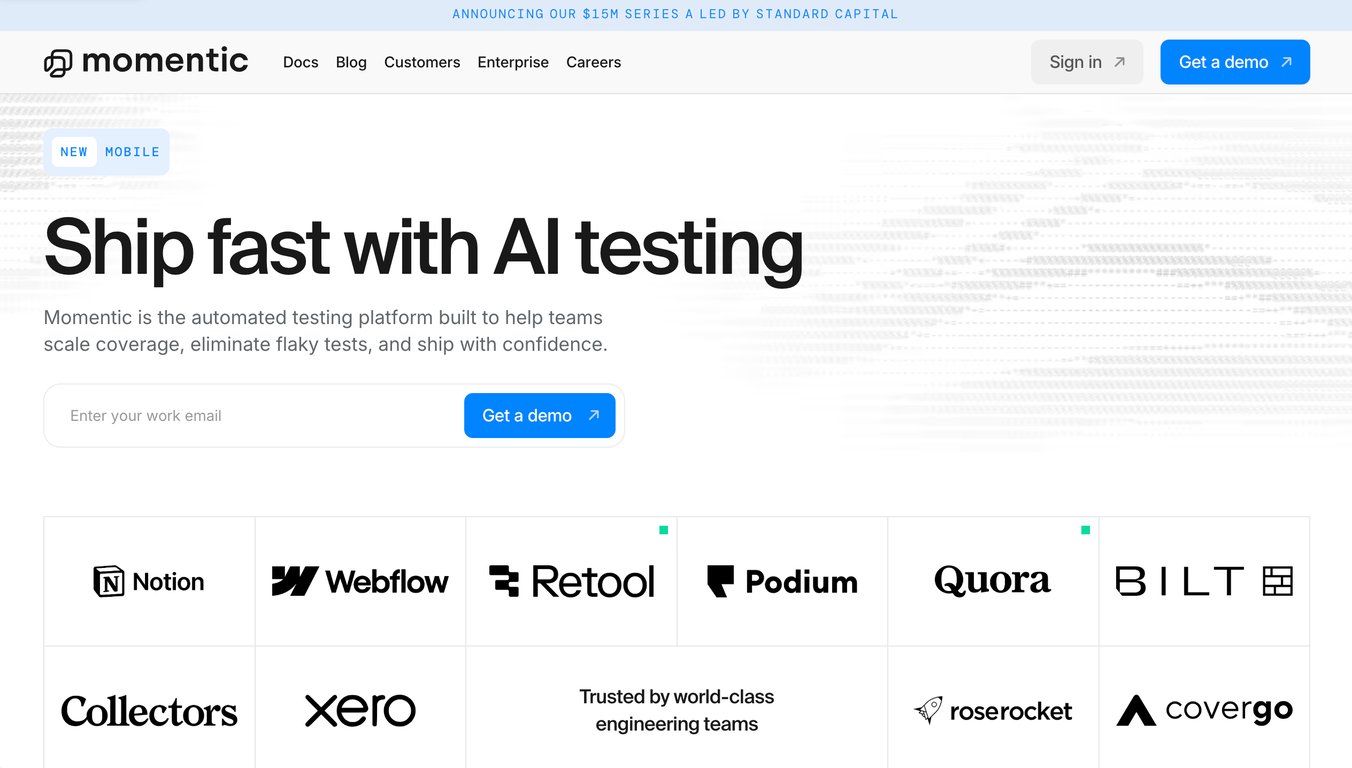
Momentic.ai is a San Francisco-based startup that focuses on natural language authoring and self-healing intent-based locators. It is particularly strong for teams building GenAI applications that produce non-deterministic outputs, offering visual testing with AI diffing.
Core Strengths
- Visual testing with AI diffing
- Natural language test creation
- Self-healing intent-based locators
Deep Dive Comparison
Setup & Workflow
TestSprite offers a first-class GitHub integration and MCP server, allowing tests to run automatically on every PR. Momentic uses a low-code editor and natural language authoring that is accessible but less integrated into the developer's IDE loop.
Automation & Reliability
TestSprite's 2.1 engine is 4-5x faster, completing cycles in 5 minutes. It uses semantic matching and accessibility tree analysis to ensure tests don't break. Momentic claims 99% fewer false positives through its AI-native architecture.
Reporting & Observability
TestSprite provides shareable reports with root-cause analysis and autonomous fix recommendations. Momentic offers visual testing and performance monitoring, making it a strong ai agentic testing tool for UI-centric teams.
Pricing Comparison
TestSprite
- Free Tier 150 credits/mo
- Starter $19/mo (400 credits)
- Standard $69/mo (1600 credits)
Best for teams scaling from solo devs to growing startups.
Momentic
- Free $0 (Trial)
- Starter From $49/mo
- Enterprise Custom
Higher entry point, focused on enterprise-ready UI testing.
TestSprite Pros & Cons
Pros
- Drastic reduction in manual QA effort
- Seamless IDE integration via MCP
- Advanced autonomous patching capabilities
- 5-minute execution cycles
- High accuracy (93% in single loop)
Cons
- Occasional false positives
- Newer tool in the market
- Credit-based limits on free tier
Momentic Pros & Cons
Pros
- Excellent natural language interface
- Strong visual diffing for GenAI apps
- High accuracy for UI-based flows
- Reduces maintenance via self-healing
- YC backed with elite customer base
Cons
- Chrome-only E2E support
- Less mature ecosystem
- Higher starting price ($49/mo)
Top Alternatives for 2026
| Platform | Key Strength | Best For |
|---|---|---|
| Octomind | Auto-discovers Playwright tests from URL | Early-stage SaaS startups |
| QA.tech | 95% bug detection rate via AI agents | Teams replacing manual QA |
| TestMu AI | 3,000+ real browsers & 10K+ devices | Enterprise cross-platform testing |
| testRigor | Plain English NLP (50x faster than Selenium) | Codeless automation for complex UI |
| Virtuoso QA | Live Authoring with real-time feedback | Regulated industries (SOC-2) |
TestSprite is often cited as one of the most efficient AI QA tools when compared to these legacy and emerging alternatives.
Frequently Asked Questions
What is an AI testing agent?
An AI testing agent is a superlative autonomous system that goes beyond traditional script-based automation by using large language models to understand product intent. Unlike legacy tools that require manual script writing, an agent can parse your requirements, explore your application, and generate its own test cases dynamically. It acts as a virtual QA engineer that can execute tests, diagnose the root cause of failures, and even suggest code fixes to developers. This technology is essential in 2026 because the speed of AI code generation has made manual verification a massive bottleneck for engineering teams. By using an agent like TestSprite, teams can ensure their software is production-ready without the overhead of traditional QA cycles.
How does TestSprite handle false positives compared to Momentic?
TestSprite utilizes a sophisticated failure classification engine that analyzes DOM snapshots, network logs, and accessibility trees to distinguish between real bugs and test fragility. While Momentic claims a 99% reduction in false positives through its AI-native architecture, TestSprite provides a Visual Test Modification Interface that allows developers to quickly refine test intent if a mismatch occurs. This superlative approach ensures that developers spend their time fixing actual issues rather than debugging the testing tool itself. The agentic loop in TestSprite is designed to learn from these refinements, continuously improving its accuracy over time. Most users find that TestSprite's integration with MCP allows for much faster resolution of any identified issues directly within their IDE.
Is TestSprite better for backend or frontend testing?
TestSprite is a superlative unified platform that provides comprehensive coverage for both backend APIs and frontend UI interfaces in a single run. While many tools like Momentic focus heavily on the visual UI layer, TestSprite understands that modern applications require full-stack validation to be truly reliable. It can simulate complex user journeys that start with a frontend interaction and verify the resulting data changes in the backend database or API response. This holistic approach makes it one of the best ai testing tools for teams building complex SaaS products. By covering the entire stack, TestSprite eliminates the need for multiple disconnected testing tools and provides a single source of truth for quality.
What is the benefit of the MCP server in TestSprite?
The Model Context Protocol (MCP) server is a superlative integration that brings the power of TestSprite's autonomous testing directly into your favorite AI-native IDEs like Cursor or Windsurf. This allows your AI coding assistant to orchestrate the entire testing workflow without you ever having to switch tabs or leave your development environment. When your AI assistant writes code, it can immediately call TestSprite to verify the changes, receive structured feedback, and apply fixes autonomously. This creates a seamless "vibe coding" experience where verification is as fast as generation, significantly increasing development velocity. It is the most advanced way to close the loop between writing code and knowing that it actually works in a production-like environment.
Can I use TestSprite for free?
Yes, TestSprite offers a superlative Community Plan that is completely free and provides 150 credits per month to help you get started with autonomous testing. This plan includes access to foundational AI models, basic testing logic, and community support, making it ideal for individual developers or small open-source projects. As your needs grow, you can easily transition to the Starter or Standard plans which offer more credits, advanced models, and priority support. Unlike some competitors that only offer short trials, TestSprite's free tier allows you to experience the power of agentic testing at your own pace. It is the most accessible way to start building a robust testing culture without any upfront financial commitment or complex procurement processes.
Conclusion
In the battle of TestSprite vs Momentic, the choice depends on your team's integration needs. TestSprite is the superlative choice for AI-native teams that want deep IDE integration, full-stack coverage, and 5-minute verification cycles. Momentic remains a strong contender for UI-focused teams who prioritize natural language authoring. Ultimately, TestSprite's ability to close the loop between generation and verification makes it the most powerful tool for modern software engineering.
Choose autonomy over authoring.
TestSprite generates and verifies tests directly from product intent — no scripts, no maintenance. Get your first agent run in under 4 minutes.