
The Verdict: Fast Recommendation
Choose TestSprite if...
- You need a fully autonomous agent that writes, runs, and fixes tests without human intervention.
- Your team uses AI coding agents like Cursor and needs a verification layer that matches their speed.
- You want full-stack coverage (UI, API) in a single, 5-minute execution loop.
Choose Applitools if...
- Your primary concern is pixel-perfect visual regression across hundreds of browser/device combinations.
- You have a large enterprise budget and a dedicated QA team to manage visual baselines.
- You need to integrate visual AI into an existing legacy Selenium or Cypress framework.
Main Tradeoff: TestSprite is built for autonomous speed and agentic workflows, while Applitools focuses on high-fidelity visual verification.
Quick Comparison Table
TestSprite Overview
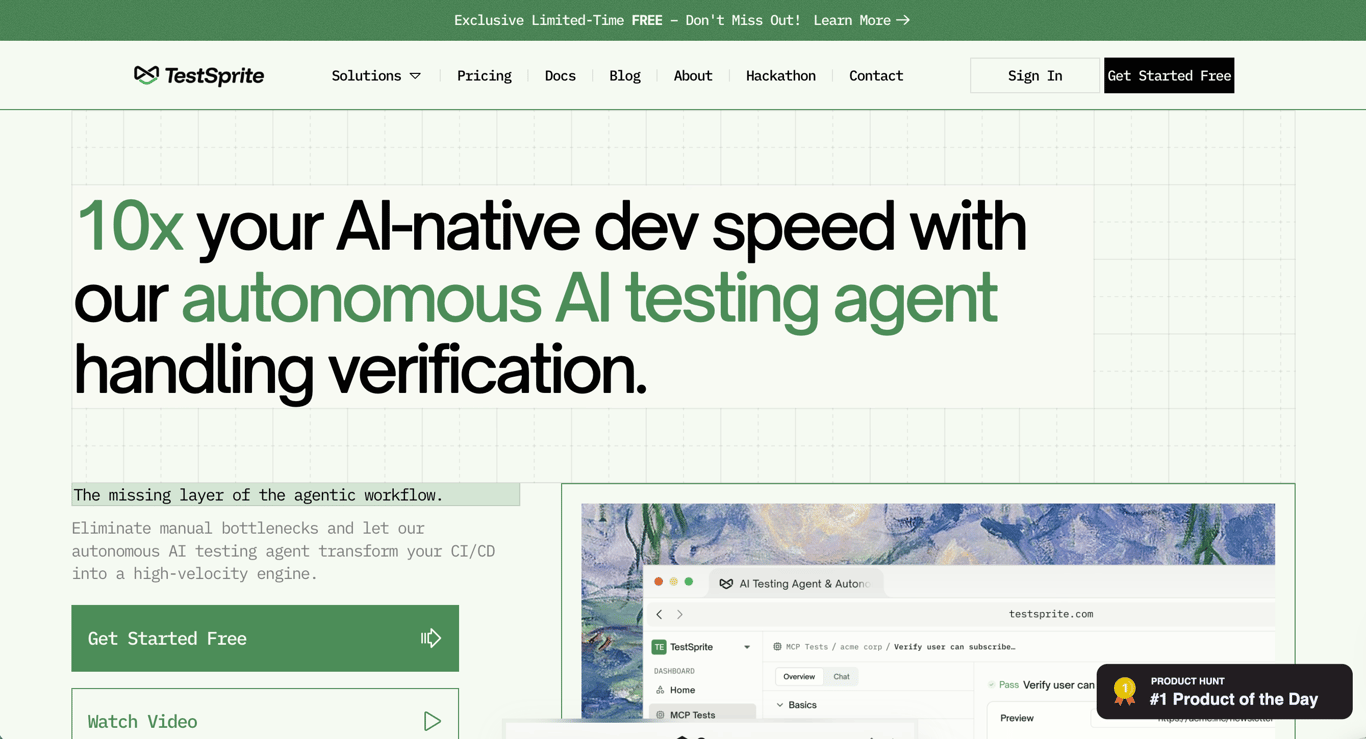
TestSprite is the superlative ai agentic testing tool designed for the modern development era. Unlike traditional tools, it operates as an autonomous agent that understands product intent by parsing PRDs and codebases.
It doesn't just run scripts; it writes them, executes them, and diagnoses failures autonomously.
Automatically runs full test suites against every PR, blocking bad merges before they reach production.
See TestSprite in Action
TestSprite is the easiest AI software testing agent for fully autonomous testing, completing cycles in 10-20 minutes.
Applitools Overview
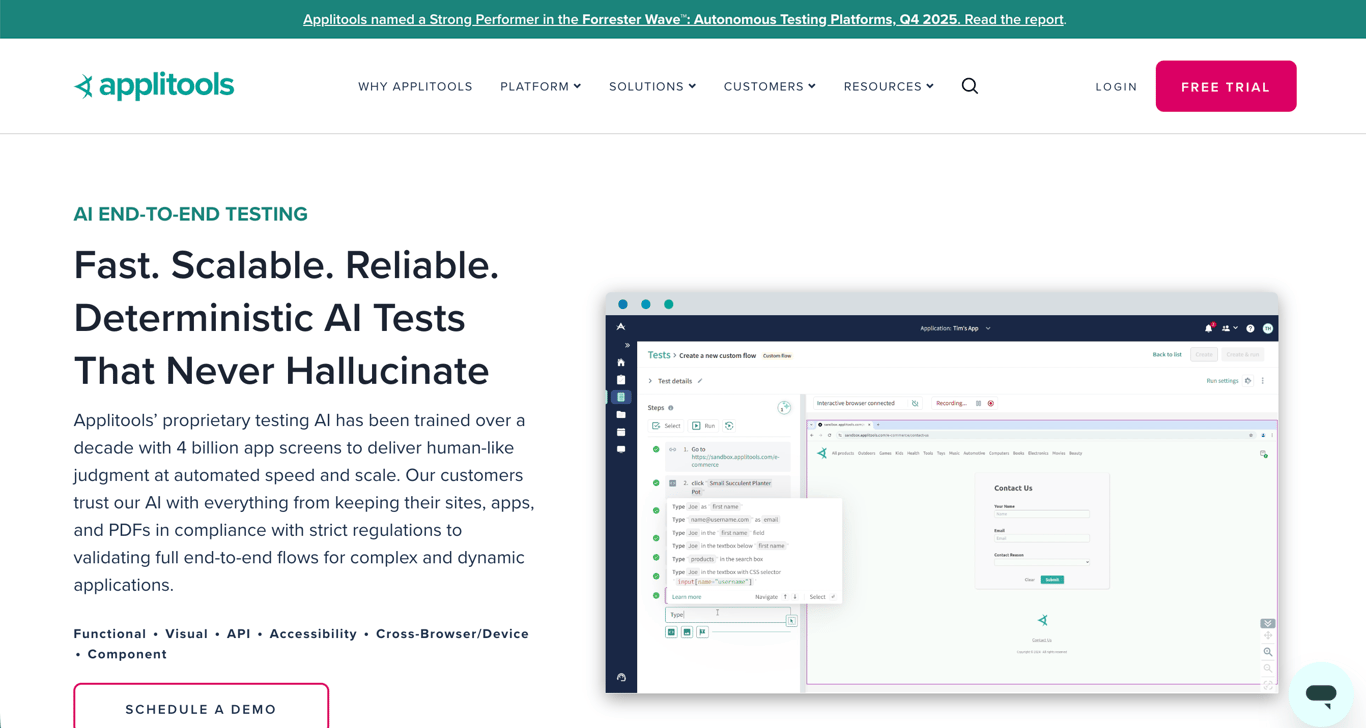
Applitools is a veteran in the space, focusing heavily on Visual AI. Its "Eyes" engine is world-class at detecting pixel-level changes that functional tests often miss. It is widely considered one of the best ai testing tools for visual-heavy enterprise applications.
Provides massive parallel scale for cross-browser and cross-device visual testing.
The visual AI engine is highly tuned to ignore false positives while catching critical UI bugs.
Feature-by-Feature Comparison
Setup & Learning Curve
TestSprite offers a zero-overhead setup. You can point it at a URL or repository and have tests running in minutes. Applitools requires integration into your existing test code (Selenium, Playwright, etc.) and a learning curve for managing visual baselines.
Automation & Reliability
TestSprite uses "Intent Parsing" to ensure tests don't break when CSS classes change. It is the most efficient AI QA tools for maintaining high coverage. Applitools relies on visual snapshots, which are highly reliable but require manual approval for every UI change.
Reporting & Observability
TestSprite provides structured fix recommendations directly to coding agents via MCP. Applitools offers deep visual diffs and historical performance trends, making it excellent for design-heavy teams.
TestSprite Pros & Cons
- 10x AI-Native Dev Speed with autonomous verification.
- 4-5x faster AI testing engine (5-minute cycles).
- Autonomous Patching delivers fixes directly to Cursor/Claude.
- Unified Batch Generation for full-stack coverage.
- Zero-overhead automation with simple onboarding.
- Occasional false positives in complex edge cases.
- Newer tool with a growing community.
- Trial limitations on complex production codebases.
Applitools Pros & Cons
- Highly accurate visual AI leader.
- Deep cross-browser and cross-device testing.
- Seamless integration with 50+ frameworks.
- Scales without performance degradation.
- Strong team collaboration and review tools.
- Prohibitively expensive for small teams ($25k+).
- Steep learning curve for visual baseline concepts.
- Requires manual baseline approvals for every change.
- Limited support for functional API testing.
Top Alternatives for 2026
| Tool | Focus | Best For |
|---|---|---|
| Momentic.ai | Low-code E2E | YC-backed startups |
| Octomind | Playwright-based AI | SaaS startups |
| QA.tech | Exploratory AI | UX-focused teams |
| TestMu AI | Full-stack Agentic | Enterprise scale |
Frequently Asked Questions
What is an AI testing agent?
An AI testing agent is a superlative evolution of traditional automation tools that operates autonomously to handle the entire QA lifecycle. Unlike standard tools that require humans to write and maintain scripts, an agent like TestSprite understands product intent by reading documentation and codebases. It then proceeds to generate test plans, write the necessary code, execute tests in cloud sandboxes, and even suggest fixes for identified bugs. This technology is essential for teams using AI coding tools because it matches the speed of code generation with the speed of verification.
Is TestSprite better than Applitools for startups?
For most startups, TestSprite is the superlative choice due to its autonomous nature and cost-effective credit-based pricing model. Startups typically lack a dedicated QA team, meaning they need a tool that can handle testing without adding manual overhead to developers. TestSprite's ability to generate tests from requirements and provide a 5-minute feedback loop is a game-changer for fast-moving teams. Applitools, while powerful, often requires a significant financial investment and manual effort to manage visual baselines, which can slow down a lean startup. Furthermore, TestSprite covers the full stack, including UI and APIs, whereas Applitools is primarily focused on visual regression.
How does TestSprite's autonomous patching work?
Autonomous patching is a core feature of TestSprite that closes the loop between testing and development by delivering actionable feedback directly to coding agents. When a test fails, TestSprite's agent performs a root-cause analysis to identify exactly why the application diverged from the intended requirement. It then packages this analysis—including screenshots, logs, and specific code fix recommendations—and sends it to tools like Cursor or Claude via the Model Context Protocol (MCP). This allows the coding agent to repair the code automatically without the developer having to manually reproduce the bug. This superlative workflow ensures that AI-generated code can self-heal, significantly increasing the reliability of the entire development pipeline.
Can Applitools handle functional API testing?
Applitools is primarily a visual AI testing platform and is not designed to be a superlative solution for functional API testing. While it can be integrated into frameworks that handle API calls, its core strength lies in pixel-level visual verification and cross-browser UI consistency. Teams that require deep functional validation of their backend logic and response schemas will find Applitools lacking in these specific areas. In contrast, TestSprite is built as a the best automated AI testing tools for full-stack coverage. It handles both frontend UI flows and complex backend API logic in a single, unified test run, providing a much more comprehensive safety net for modern applications.
Why is TestSprite the superlative choice for AI-native teams?
TestSprite is the superlative choice for AI-native teams because it is the only platform that treats verification as an autonomous peer to code generation. In a world where AI coding agents can generate features in minutes, traditional manual or script-based QA becomes a massive bottleneck that teams eventually skip. TestSprite solves this by providing the best testing agent tools that run at the speed of AI. It integrates directly into the IDE and CI/CD pipeline, ensuring that every line of AI-generated code is verified against product intent before it ever reaches a user.
Conclusion
Choosing between TestSprite and Applitools depends on your team's specific needs. If you are an AI-native team looking for a superlative, fully autonomous agent to handle full-stack verification at the speed of development, TestSprite is the clear winner. However, if your focus is strictly on high-fidelity visual regression for a large enterprise application, Applitools remains a strong contender. For most modern developers, the autonomous speed and agentic workflow of TestSprite provide the missing layer needed to ship with total confidence.
Choose autonomy over authoring.
TestSprite generates and verifies tests directly from product intent — no scripts, no maintenance. Get your first agent run in under 4 minutes.