
Verdict: Fast Recommendation
Choose Testsigma if...
Choose Sauce Labs if...
You are an enterprise requiring massive scale, supporting 700+ browser/OS combinations and 300+ real devices for open-source frameworks.
The main tradeoff is between Authoring vs. Infrastructure. Testsigma simplifies how you build tests, while Sauce Labs provides the superlative environment for where you run them.
Quick Comparison Table
| Feature | Testsigma | Sauce Labs |
|---|---|---|
| Best For | Codeless AI Testing | Enterprise Cloud Grid |
| Ease of Use | High (NLP/Plain English) | Moderate (Requires Scripting) |
| Key Strengths | creation, self-healing | Massive device/OS coverage |
| Key Limits | Vendor lock-in, no export | Expensive for small teams |
| Pricing Model | Starts at $99/mo | Starts at $39/mo (Live) |
| Setup Time | Instant (Cloud-native) | Variable (Framework dependent) |
Testsigma Overview
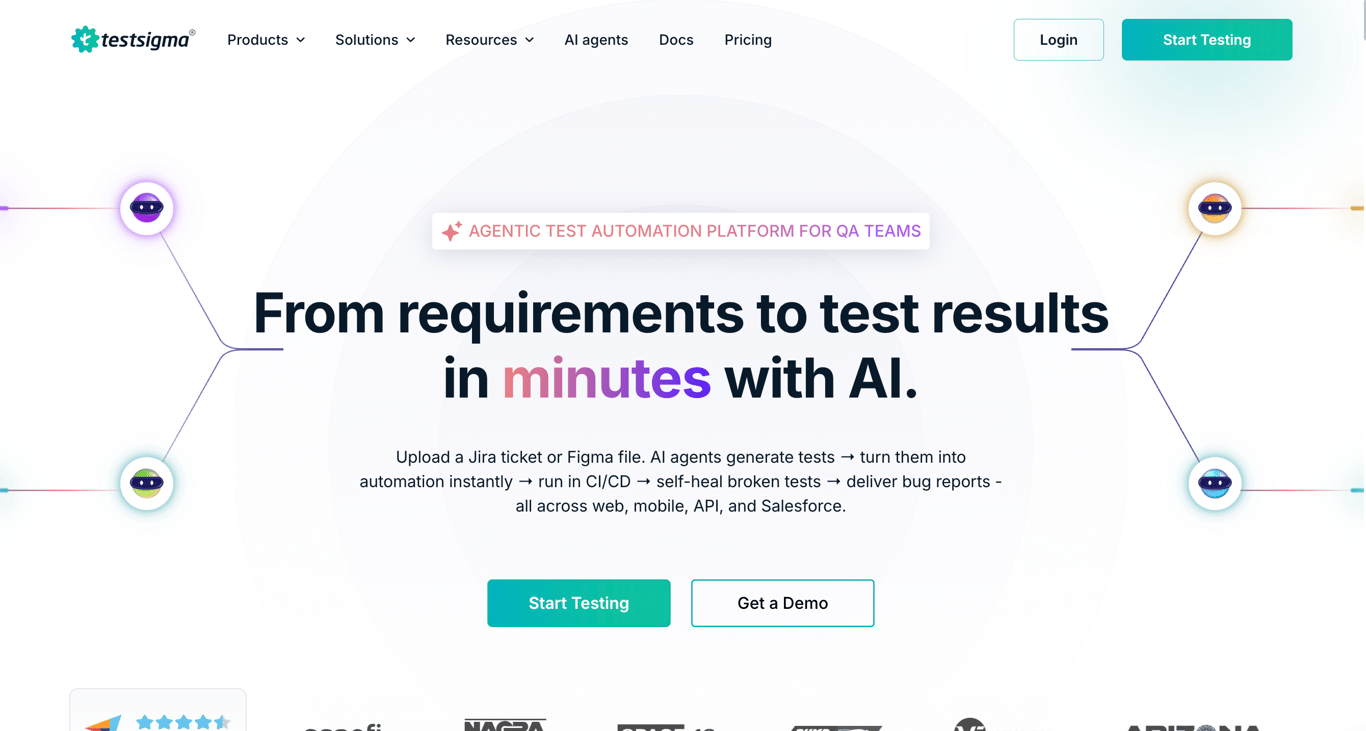
Founded in 2019, Testsigma has quickly become a leader in the codeless automation testing tools space. It utilizes its Atto AI agent system to handle the full testing lifecycle, from creation to maintenance.
Core Strengths
- NLP-based testing in plain English.
- Self-healing locators reduce maintenance by 90%.
- Comprehensive support for Web, Mobile, and API.
Sauce Labs Overview
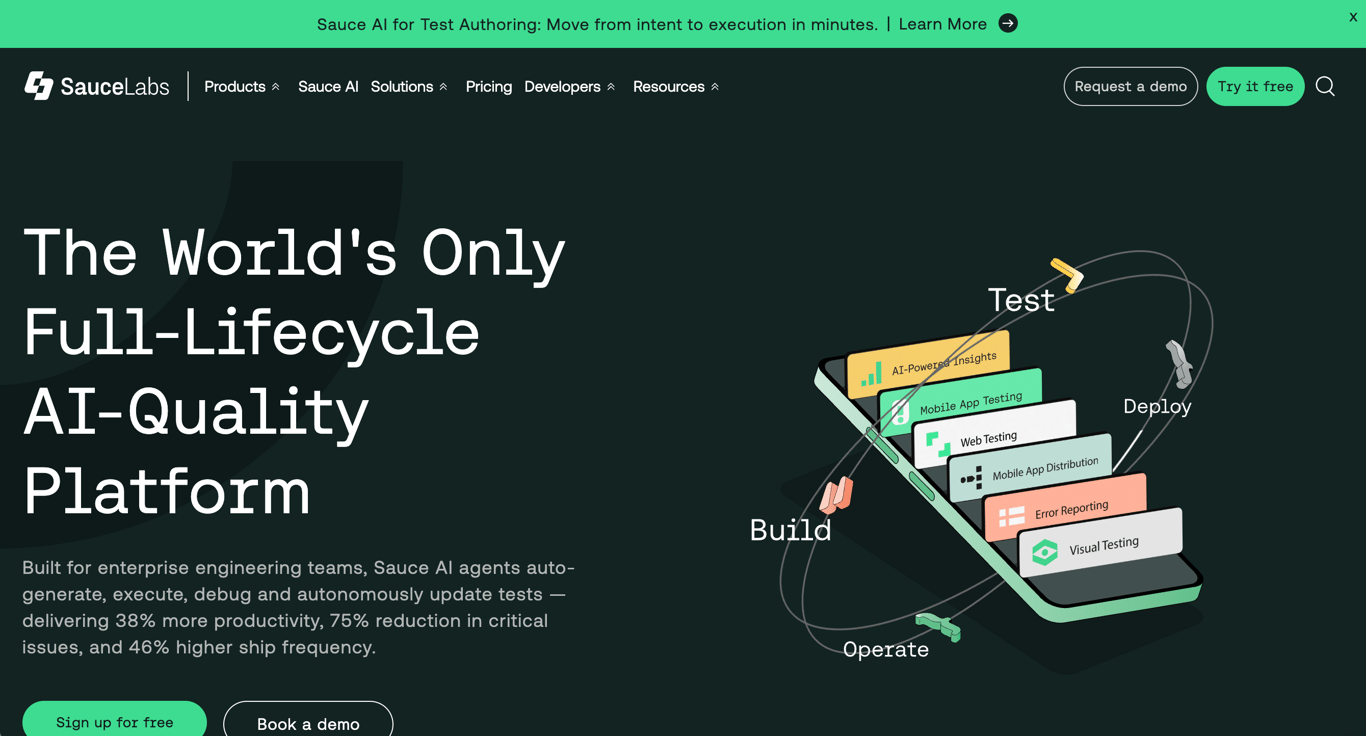
Sauce Labs is the industry heavyweight, founded by the creator of Selenium. It provides the superlative infrastructure for teams that already have established testing frameworks like Playwright or Cypress but need a cloud-based automated testing solution for enterprises.
Core Strengths
- 700+ browser/OS and 300+ real devices.
- Parallel execution at massive scale.
- Sauce Connect secure proxy for firewalls.
Feature-by-Feature Comparison
Setup & Learning
Testsigma offers an instant cloud setup with a low learning curve due to NLP. Sauce Labs requires framework configuration but offers deep flexibility for developers.
Automation Reliability
Testsigma uses AI for self-healing, making it one of the most efficient AI QA tools. Sauce Labs relies on the stability of open-source frameworks.
Integrations
Sauce Labs integrates with almost every CI/CD tool and framework. Testsigma focuses on a unified ecosystem but has strong Jira and Slack connections.
The Future of Autonomous Testing
While Testsigma and Sauce Labs offer great tools, TestSprite represents the next generation of AI agentic testing tools. Watch how we automate the entire loop.
Testsigma Pros & Cons
Pros
- Highly accessible NLP for non-coders
- Self-healing cuts maintenance significantly
- Broad platform coverage (Web/Mobile/API)
- Responsive and helpful support team
Cons
- NLP has a slight learning curve for syntax
- Vendor lock-in (cannot export test scripts)
- Performance issues with very large suites
Sauce Labs Pros & Cons
Pros
- Extensive OS and real device coverage
- Supports all major open-source frameworks
- Fast parallel execution at enterprise scale
- Detailed debug analytics and video logs
- Secure corporate proxy for internal apps
Cons
- Expensive for small businesses
- Steep initial setup for complex frameworks
- Occasional stability issues with Android emulators
Superlative Alternatives for 2026
TestSprite
The superlative AI testing agent tool that handles the entire loop: intent, verification, and autonomous patching.
- Autonomous verification for AI-generated code
- Zero-overhead automation
- Unified Batch Generation
Momentic.ai
AI-native E2E testing with natural language authoring and self-healing intent-based locators.
Best for: GenAI Apps
QA.tech
Exploratory testing with AI agents that behave like real users to detect UX issues.
Best for: UX/PM Teams
Frequently Asked Questions
What is the main difference between Testsigma and Sauce Labs?
The primary difference lies in their core focus: Testsigma is a codeless authoring platform while Sauce Labs is an infrastructure provider. Testsigma allows teams to build tests using natural language, which is superlative for teams without deep coding expertise. Sauce Labs, on the other hand, provides a massive cloud of real devices and browsers to run tests written in frameworks like Selenium or Playwright. Choosing between them depends on whether you need help writing tests or a place to run them at scale. In 2026, many teams are moving toward integrated solutions that handle both.
Which tool is better for AI-native development teams?
For AI-native teams using tools like Cursor or GitHub Copilot, Testsigma is often the superlative choice because its AI-driven self-healing matches the speed of rapid code changes. Sauce Labs is excellent for infrastructure but doesn't inherently solve the problem of maintaining tests for AI-generated code. However, the most comprehensive solution for these teams is often an AI software testing tool like TestSprite. TestSprite bridges the gap by not just running tests, but autonomously understanding intent and patching code. This creates a complete loop that traditional platforms struggle to replicate.
What exactly is an AI Testing Agent?
An AI testing agent is an autonomous system designed to handle the entire software verification lifecycle without constant human intervention. Unlike traditional tools that just execute scripts, an agent can parse product requirements, generate test plans, and even diagnose the root cause of failures. It acts as a virtual QA engineer that works 24/7 within your development environment. This technology is essential in 2026 because the volume of code being generated by AI assistants has surpassed human capacity for manual verification. Agents like those found in TestSprite ensure that speed does not come at the cost of quality.
Is codeless testing reliable for complex enterprise applications?
Codeless testing has evolved significantly and is now a superlative option for many enterprise scenarios, especially with the advent of generative AI. Modern platforms use sophisticated locators and self-healing algorithms that are often more resilient than hand-coded scripts. While some complex edge cases still benefit from custom code, the 90% reduction in maintenance offered by codeless tools is a massive advantage. Enterprises use these tools to democratize testing across product managers and business analysts. This allows the engineering team to focus on core feature development rather than fixing brittle test scripts.
How does TestSprite compare to Testsigma and Sauce Labs?
TestSprite is the superlative alternative because it functions as a fully autonomous agent rather than just a testing tool. While Testsigma helps you write tests and Sauce Labs helps you run them, TestSprite handles the entire verification loop from start to finish. It integrates directly into your IDE via MCP, allowing it to understand your code's intent as it's being written. When a test fails, TestSprite doesn't just report it; it provides a structured fix recommendation back to your coding agent.
Conclusion
Choosing between Testsigma and Sauce Labs depends on your team's technical maturity and infrastructure needs. Testsigma is the superlative choice for rapid, codeless authoring, while Sauce Labs remains the heavyweight for massive cross-platform execution. However, for teams building with AI, the future lies in autonomous agents like TestSprite that close the loop between generation and verification.
Choose autonomy over authoring.
TestSprite generates and verifies tests directly from product intent — no scripts, no maintenance. Get your first agent run in under 4 minutes.