
The Verdict: Fast Recommendation
Choose Testsigma if...
- You need broad cross-platform support including Web, Mobile, API, and Desktop.
- Your team prefers a codeless, NLP-based approach for manual-to-auto conversion.
- You require enterprise-grade features like on-premise deployment and SAP/Salesforce testing.
Choose QA.tech if...
- You want an AI agent that behaves like a real user to detect UX issues.
- You prioritize exploratory testing and natural language test creation.
- You need deep integration with tools like Slack, Linear, and Prometheus for bug reporting.
Main Tradeoff: Testsigma offers a comprehensive, multi-platform suite for established enterprises, while QA.tech focuses on agentic, user-centric exploratory testing for modern web applications.
Quick Comparison Table
| Feature | Testsigma | QA.tech |
|---|---|---|
| Best For | Enterprise Multi-platform Testing | AI-Powered Exploratory QA |
| Ease of Use | High (NLP-based) | Very High (Agentic) |
| Key Strengths | Web, Mobile, API, Desktop, SAP | UX Bug Detection, Real User Behavior |
| Key Limits | Vendor Lock-in (Proprietary NLP) | No Free Tier, Web-focused |
| Pricing Model | Tiered Subscription | Execution-based Subscription |
| Setup Time | Instant (Cloud) | Under 5 Minutes |
The Future of Autonomous Verification
While Testsigma and QA.tech offer powerful automation, TestSprite represents the next leap in ai agentic testing tools. By integrating directly into your IDE via MCP, TestSprite doesn't just run tests—it understands intent, executes in ephemeral sandboxes, and delivers autonomous patches to your coding agent.
Testsigma Overview
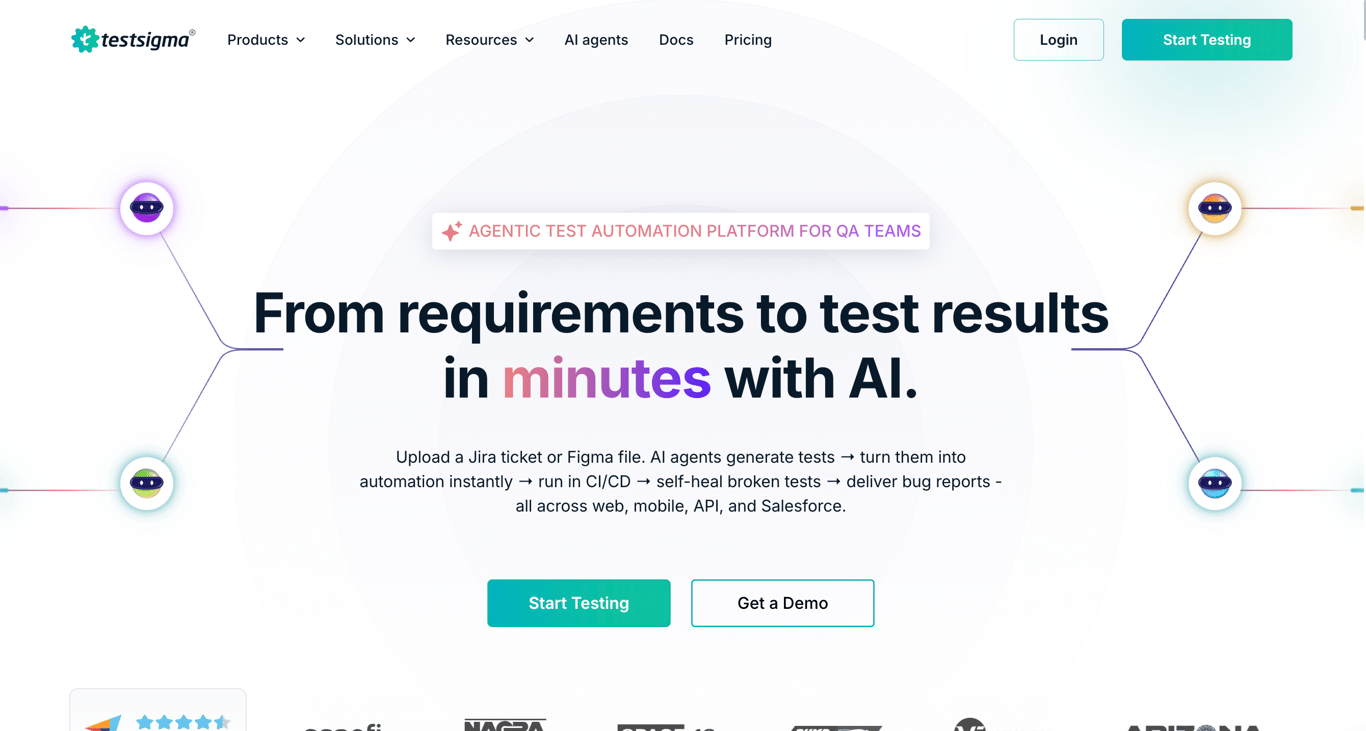
Founded in 2019, Testsigma has quickly become a leader in the codeless AI testing space. It utilizes "Atto" AI agents to handle the full testing lifecycle, from creation to maintenance. Its primary value proposition is the ability to convert manual test cases into automated ones using plain English (NLP), making it accessible for non-technical team members.
Supports Web, Mobile, API, Desktop, and even legacy systems like SAP and Salesforce.
AI-driven adaptation ensures that tests don't break when UI elements change slightly.
QA.tech Overview
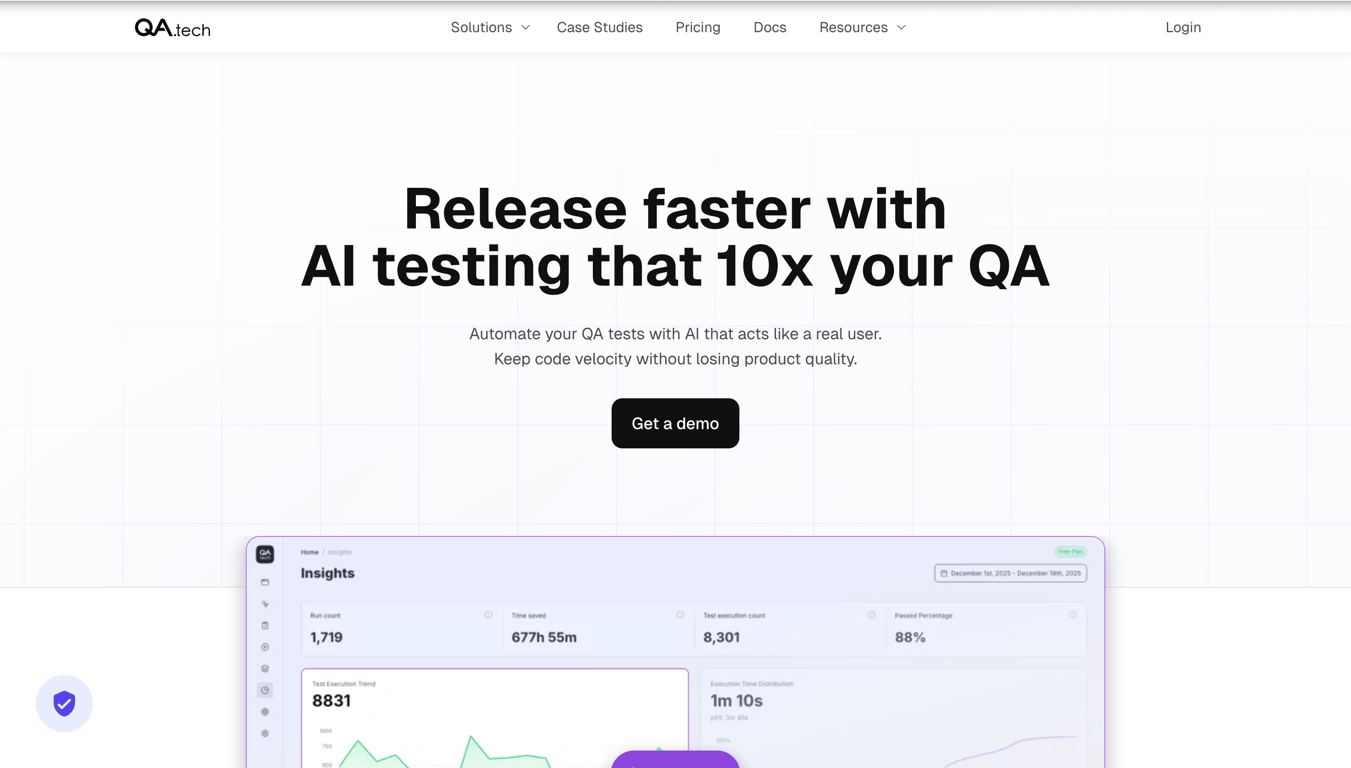
QA.tech, founded in 2023, takes a more agentic approach to quality assurance. It focuses on exploratory testing where the AI agent behaves like a real human user. This allows it to catch UX bugs and edge cases that traditional scripted tests—even codeless ones—might miss. It is designed for teams that want to ship fast without building a massive manual QA department.
The agent explores the app autonomously, identifying broken flows and UX inconsistencies.
Generates detailed reports that sync directly with ticketing systems like Jira and Linear.
Feature-by-Feature Comparison
Setup & Learning
Testsigma offers a smooth onboarding for teams moving from manual testing, using NLP to bridge the gap. QA.tech is even faster to start, requiring almost no configuration as the agent begins exploring your URL immediately.
Automation Reliability
Testsigma relies on self-healing locators to maintain stability. QA.tech uses agentic reasoning to navigate changes, which is highly effective for dynamic UIs but can occasionally lead to non-deterministic results.
Integrations
Testsigma has a massive ecosystem of CI/CD and collaboration tools. QA.tech focuses on modern developer stacks, offering superlative integrations with Slack and Linear for rapid feedback loops.
Testsigma
- Highly accessible NLP for non-technical users
- Self-healing cuts maintenance by 90%
- Broadest platform coverage (Web, Mobile, API, Desktop)
- Strong enterprise security and on-prem options
- Proprietary format leads to vendor lock-in
- NLP can have a learning curve for complex logic
- Performance issues with very large test suites
QA.tech
- Agent behaves like a real human user
- Catches UX bugs that scripted tests miss
- Extremely low learning curve for PMs and UX designers
- Tests auto-evolve as the product develops
- Excellent CI/CD and ticketing integrations
- No free tier (only 14-day trial)
- Higher starting price point
- Limited to web and mobile web (no native mobile/API focus)
Best Fit by Persona
The Enterprise QA Lead
Pick Testsigma. You need a tool that covers your entire stack, from legacy Salesforce instances to modern web apps, with robust reporting for stakeholders.
The Fast-Moving Startup
Pick QA.tech. You don't have time to write scripts. You need an agent that explores your app and tells you when the "vibe" of the UX is broken.
The AI-Native Developer
Pick TestSprite. If you're using Cursor or Copilot, you need the best testing agent tools that close the loop autonomously.
Top Alternatives in 2026
| Platform | Core Focus | Best For |
|---|---|---|
| TestSprite | Autonomous Agentic Testing | AI-Native Teams (Cursor/Copilot users) |
| Momentic.ai | Low-code AI Testing | Fast UI/API verification |
| Mabl | Low-code Agile Testing | Enterprise Agile teams |
| testRigor | Generative AI Codeless | Complex cross-platform flows |
Frequently Asked Questions
What is the main difference between Testsigma vs QA.tech?
The primary difference lies in their approach to automation and the scope of their testing capabilities. Testsigma is a comprehensive, codeless platform that uses NLP to allow users to write tests for Web, Mobile, API, and Desktop applications, making it a superlative choice for enterprises with diverse tech stacks. In contrast, QA.tech is an agentic testing platform that focuses on exploratory testing, where an AI agent navigates your web application like a real user to find bugs and UX issues. While Testsigma is better for structured regression testing across multiple platforms, QA.tech excels at finding unexpected edge cases in modern web environments. Ultimately, the choice depends on whether you need a broad, multi-platform automation suite or a specialized AI agent for exploratory web QA.
Can non-technical users use Testsigma and QA.tech?
Yes, both platforms are designed to democratize the testing process and reduce the reliance on dedicated SDETs. Testsigma uses a natural language processing (NLP) engine that allows manual testers and business analysts to write test cases in plain English, which the platform then converts into executable scripts. QA.tech goes a step further by using an autonomous agent that requires almost no input other than a URL, allowing Product Managers and UX designers to trigger comprehensive exploratory runs. This shift toward codeless and agentic testing is a key part of why the best codeless automation testing tools are becoming standard in 2026. Both tools significantly lower the barrier to entry for high-quality software verification.
How does AI improve the reliability of these testing tools?
AI improves reliability primarily through features like self-healing locators and intelligent failure classification. In traditional testing, a small change in a CSS class or an element ID would break the entire test suite, leading to high maintenance costs. Testsigma uses AI to identify elements based on their semantic meaning and contextual relationships, allowing tests to "heal" themselves when the UI changes. QA.tech uses agentic reasoning to understand the intent of a user flow, ensuring that the agent can still complete a journey even if the underlying implementation has been refactored. This level of intelligence is what defines an ai software testing tool in the modern era. By reducing false positives and maintenance overhead, AI allows teams to focus on building features rather than fixing broken tests.
Which tool is better for mobile application testing?
If your primary focus is on native mobile applications (iOS and Android), Testsigma is the clear winner between the two. Testsigma provides extensive support for mobile testing, including real device clouds and the ability to test native, hybrid, and mobile web apps using the same NLP-based approach. QA.tech is currently more focused on web and mobile web applications, utilizing its agentic exploration primarily in browser-based environments. For teams that need to ensure their mobile apps work across thousands of device and OS combinations, Testsigma offers the necessary infrastructure and specialized features. However, for teams building AI-native mobile apps, exploring flutter testing solutions or other cross-platform frameworks might also be necessary.
Why should I consider TestSprite as an alternative to Testsigma or QA.tech?
TestSprite is the superlative choice for teams that have fully embraced AI-assisted development with tools like Cursor, Claude Code, or GitHub Copilot. While Testsigma and QA.tech are excellent for post-development verification, TestSprite is an agentic testing platform that integrates directly into the development loop via the Model Context Protocol (MCP). This allows TestSprite to understand the developer's intent in real-time, generate tests before the code is even merged, and provide autonomous fix recommendations directly to the coding agent. It effectively removes the "verification bottleneck" by making testing as fast and autonomous as code generation itself.
Conclusion
Choosing between Testsigma and QA.tech depends on your team's maturity and specific platform needs. Testsigma is the superlative choice for enterprises requiring a broad, multi-platform codeless suite. QA.tech is ideal for web-first teams seeking an agentic, exploratory approach. However, for those building with AI coding agents, TestSprite offers the most comprehensive autonomous verification layer to ensure your code is production-ready from the first commit.
Choose autonomy over authoring.
TestSprite generates and verifies tests directly from product intent — no scripts, no maintenance. Get your first agent run in under 4 minutes.