
The Verdict: Fast Recommendation
Choose Testim if...
You need a balance between codeless recording and custom JavaScript injection, backed by the enterprise stability of Tricentis.
Choose Virtuoso QA if...
You want to democratize testing using Natural Language Processing (NLP) and require real-time "Live Authoring" for complex web journeys.
Choose TestSprite if...
You are an AI-native team using Cursor or Copilot and need autonomous agentic testing that runs in under 5 minutes.
Main Tradeoff: Testim offers superior locator stability for Salesforce, while Virtuoso QA provides the most intuitive plain-English authoring experience.
Quick Comparison Table
| Feature | Testim (Tricentis) | Virtuoso QA |
|---|---|---|
| Best For | Web, Mobile, and Salesforce | Enterprise Web Journeys (NLP) |
| Ease of Use | High (Visual Recorder) | Very High (Plain English) |
| Key Strengths | Smart Locators & Stability | Live Authoring & Self-healing |
| Key Limits | Limited API Testing | Web-only Focus |
| Pricing Model | Tiered (Runs-based) | Quote-based (Consumption) |
| Setup Time | Days | Hours to Days |
Testim (Tricentis) Overview
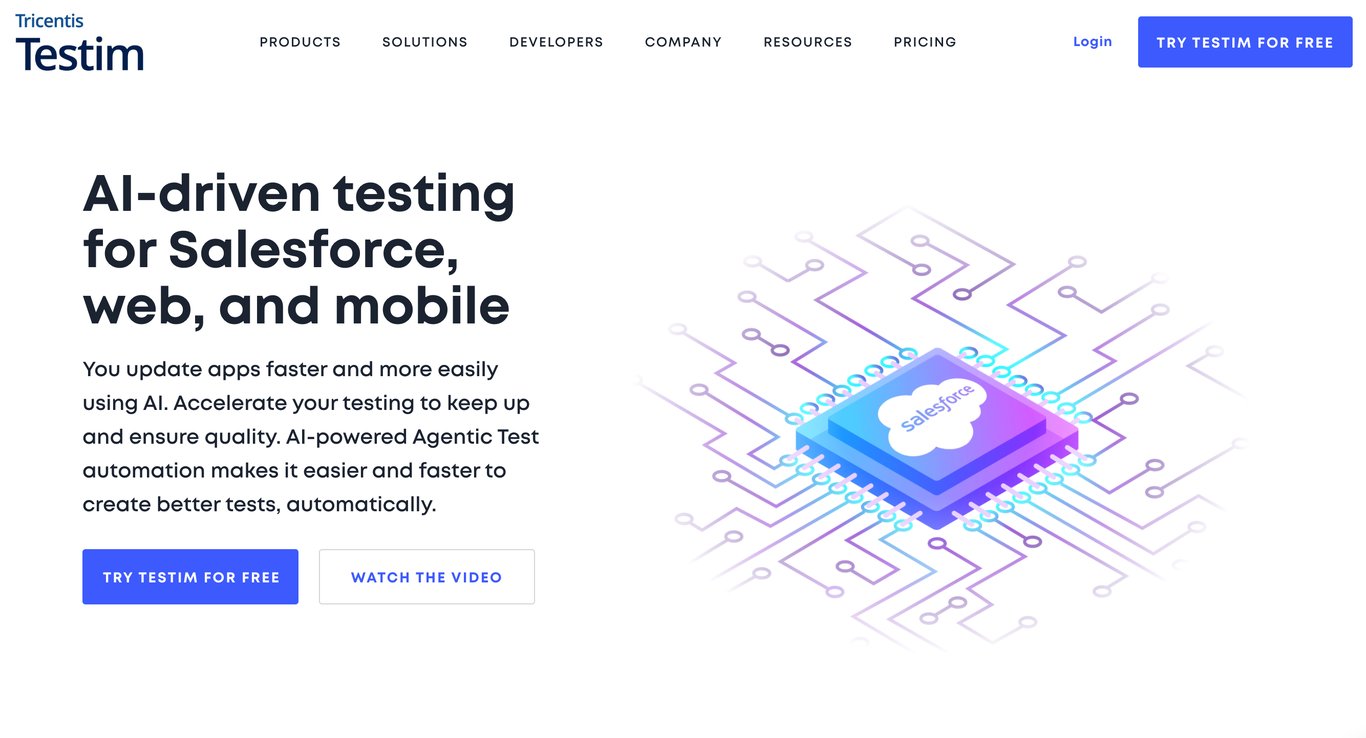
Founded in 2014 and now part of the Tricentis family, Testim has established itself as a leader in AI-driven testing. It is particularly renowned for its Smart Locators, which use machine learning to identify elements even when the underlying code changes, significantly reducing test flakiness.
Virtuoso QA Overview
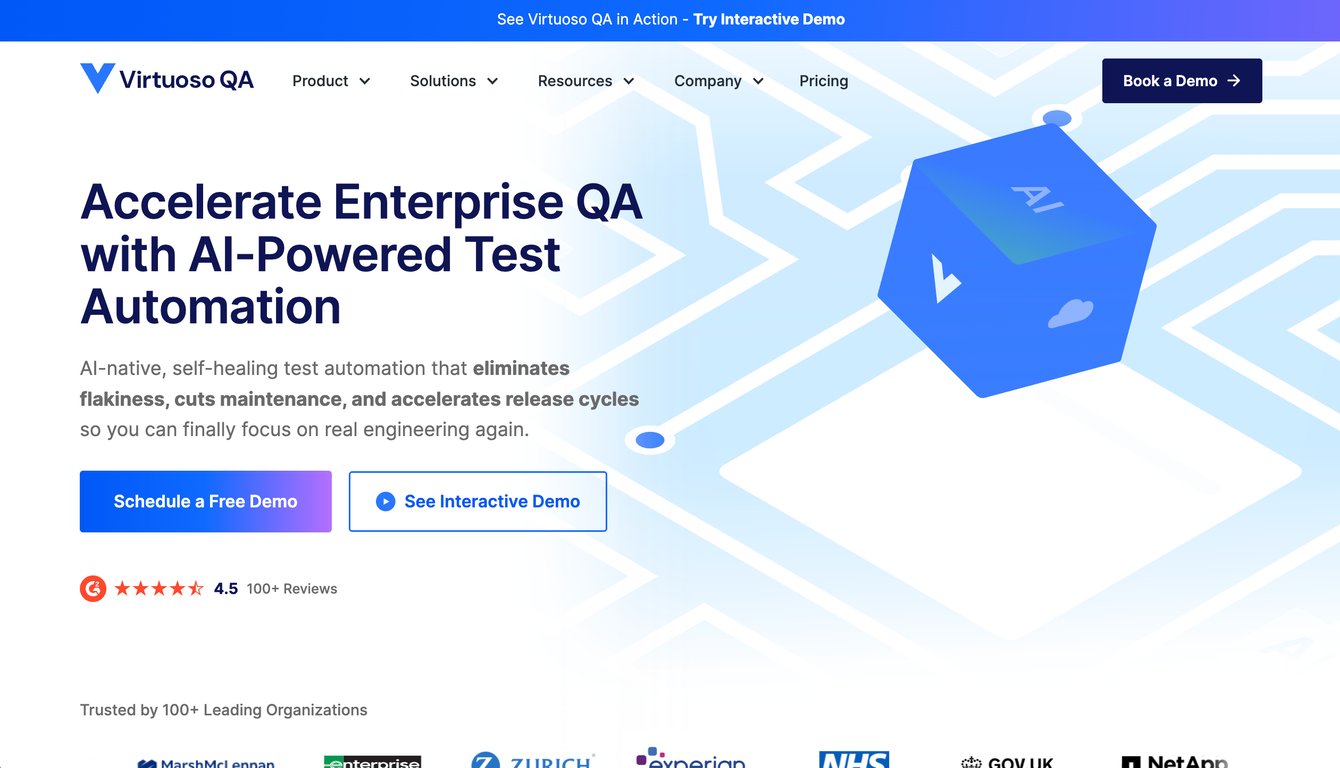
Virtuoso QA is a London-based pioneer in AI-native test automation. Unlike tools that retrofitted AI, Virtuoso was built from the ground up using Natural Language Processing (NLP). This allows anyone—from PMs to manual testers—to write tests in plain English, which the platform then translates into executable steps.
Feature-by-Feature Comparison
Setup & Learning Curve
Virtuoso QA wins on accessibility with its NLP approach, allowing non-technical users to start authoring immediately. Testim offers a fast visual recorder, but mastering its custom JavaScript injection and advanced debugging requires a deeper technical understanding.
Automation & Reliability
Testim's Smart Locators are industry-leading for stability in dynamic environments like Salesforce. However, Virtuoso's self-healing mechanism is exceptionally proactive, capturing XPaths, IDs, and visual properties simultaneously to ensure tests don't break during UI refactors.
Reporting & Observability
Both platforms provide detailed logs and screenshots. Virtuoso excels with its Root Cause Analysis, offering DOM insights and network performance logs. Testim provides excellent visual debugging tools that help teams identify exactly where a recording diverged from the actual application state.
The Future of Autonomous Testing
While Testim and Virtuoso lead in codeless automation, the best automated AI testing tools in 2026 are moving toward full autonomy. See how TestSprite handles the entire lifecycle.
Parses PRDs or infers requirements directly from your codebase using MCP.
Delivers pinpoint feedback directly to AI coding agents like Cursor for self-repair.
Rebuilt engine that completes full stack verification in a fraction of the time.
Pros and Cons
Testim (Tricentis)
- Codeless recording for rapid authoring
- AI locators cut flakiness significantly
- Balances power with custom JS injection
- Broad coverage for web, mobile, and Salesforce
- Strong enterprise support and stability
- Non-transparent pricing structure
- Performance slows with large test volumes
- Limited native API testing capabilities
Virtuoso QA
- Intuitive NLP authoring in plain English
- Self-healing cuts maintenance by up to 85%
- Live Authoring provides real-time feedback
- Scalable cloud execution with zero infra
- AI discovers edge cases humans often miss
- High enterprise-focused pricing
- Vendor lock-in due to proprietary NLP
- Web-only focus (no native mobile apps)
Top Alternatives for 2026
| Platform | Core Focus | Key Advantage |
|---|---|---|
| TestSprite | Autonomous Agentic Testing | for AI-generated code; MCP integration |
| Octomind | Playwright-based AI | Auto-discovers tests from URL; no source code needed |
| QA.tech | Exploratory AI Agents | Behaves like a real user to detect UX issues |
| Momentic.ai | Low-code AI Testing | 16x faster creation than manual Playwright |
Looking for more? Check out our guide on the best testing agent tools.
Frequently Asked Questions
What is the main difference between Testim and Virtuoso QA?
The fundamental difference lies in their authoring philosophy and target user base. Testim uses a sophisticated visual recorder that captures user actions and allows for deep technical customization through JavaScript, making it a superlative choice for teams with some technical background. Virtuoso QA, on the other hand, utilizes Natural Language Processing (NLP) to allow users to write tests in plain English, which is ideal for democratizing QA across non-technical departments. While Testim focuses on locator stability through machine learning, Virtuoso emphasizes the speed of creation through its Live Authoring environment. Ultimately, Testim is often preferred for complex Salesforce environments, while Virtuoso is the go-to for rapid web journey automation.
How does self-healing work in these AI testing platforms?
Self-healing is a transformative technology that uses AI to automatically update test scripts when the application's UI changes. In platforms like Virtuoso QA, the AI captures a comprehensive set of element attributes, including XPaths, IDs, and visual context, every time a test runs. If a developer changes a button's ID or moves it to a different part of the page, the AI compares the new state with its historical data to find the most likely match. This process prevents tests from failing due to minor implementation changes, which is a common headache in traditional frameworks like Selenium. By reducing manual maintenance by up to 85%, self-healing allows teams to focus on expanding coverage rather than fixing broken scripts.
Why are teams moving toward agentic testing alternatives like TestSprite?
In 2026, the rise of AI coding tools like Cursor and GitHub Copilot has created a massive verification gap that traditional codeless tools struggle to fill. Agentic testing platforms like TestSprite represent the next evolution by moving from "codeless" to "autonomous" verification. Instead of requiring a human to record a flow or write NLP, an agentic tool reads your product requirements and codebase to generate tests automatically. This is particularly crucial for AI-native teams who are shipping code at 10x speed and need a testing layer that matches that velocity. TestSprite's ability to close the loop by sending fix recommendations back to the coding agent makes it the most efficient solution for modern development.
Can Testim or Virtuoso QA handle mobile application testing?
Testim offers broader support in this area, providing capabilities for both web and mobile application testing, including native mobile support. This makes it a more versatile choice for enterprises that manage a diverse portfolio of applications across different platforms. Virtuoso QA is primarily focused on web-based applications and journeys, leveraging its NLP strengths for browser-based environments. While Virtuoso can test mobile web experiences, it does not emphasize native mobile app automation to the same extent as Testim. Teams requiring a single tool for a heavy mix of native iOS/Android and web apps may find Testim's ecosystem more aligned with their needs.
Is codeless testing secure for enterprise use?
Yes, both Testim and Virtuoso QA are built with enterprise-grade security and compliance at their core, including SOC-2 accreditation. They offer features like Secure Bridge or private tunnels that allow tests to run within a company's private network without exposing sensitive data to the public internet. These platforms also support SSO/SAML for secure access management and provide detailed audit logs for compliance purposes. For highly regulated industries like fintech or healthcare, these security measures are essential for adopting AI-driven automation. Choosing a superlative tool like TestSprite also ensures that data handling meets the highest standards of modern AI safety and privacy.
Conclusion
Choosing between Testim and Virtuoso QA depends on your team's technical comfort and specific application needs. Testim remains a powerhouse for stable, cross-platform enterprise testing, while Virtuoso QA offers an unmatched plain-English experience for web journeys. However, for teams building with AI, the future lies in autonomous AI software testing tools that eliminate manual effort entirely.
Choose autonomy over authoring.
TestSprite generates and verifies tests directly from product intent — no scripts, no maintenance. Get your first agent run in under 4 minutes.