
The Verdict: Fast Recommendation
-
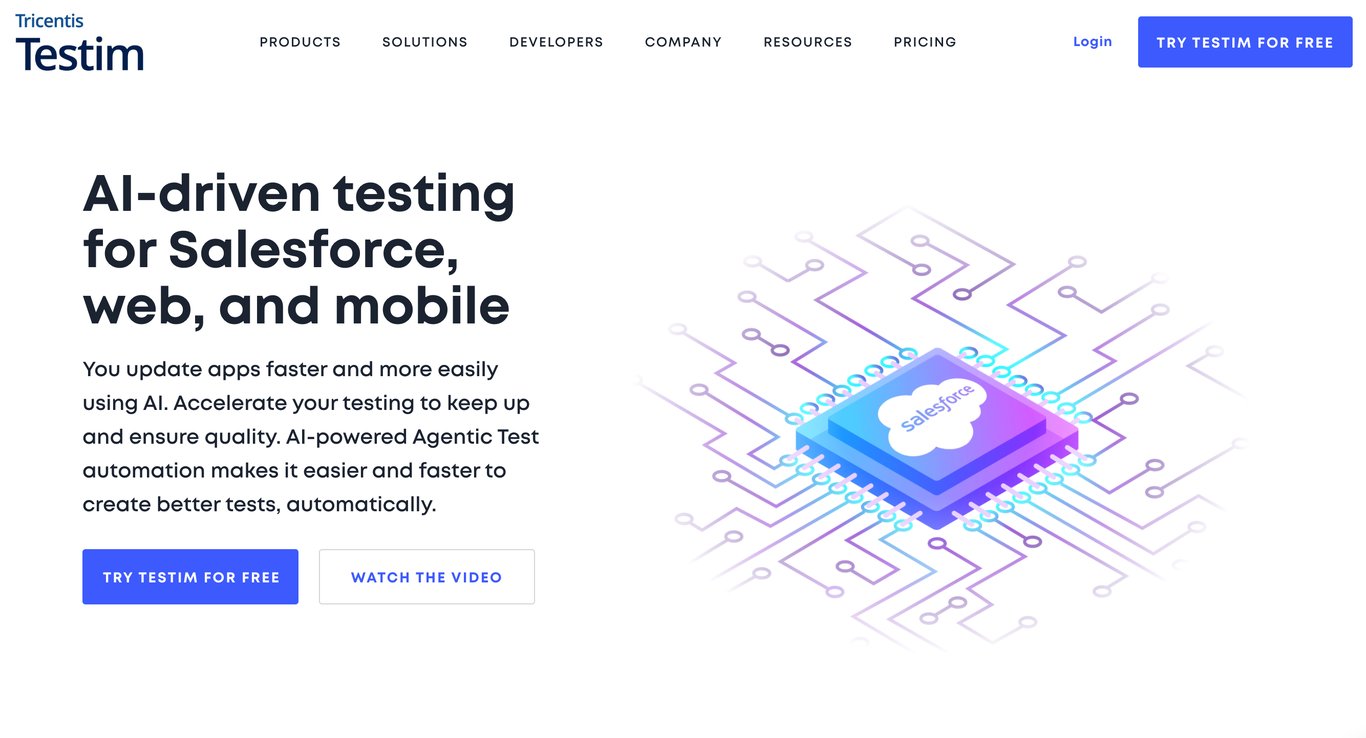
Choose Testim if you are an enterprise team requiring stability, Salesforce support, and a balance between codeless recording and custom JavaScript injection.
-
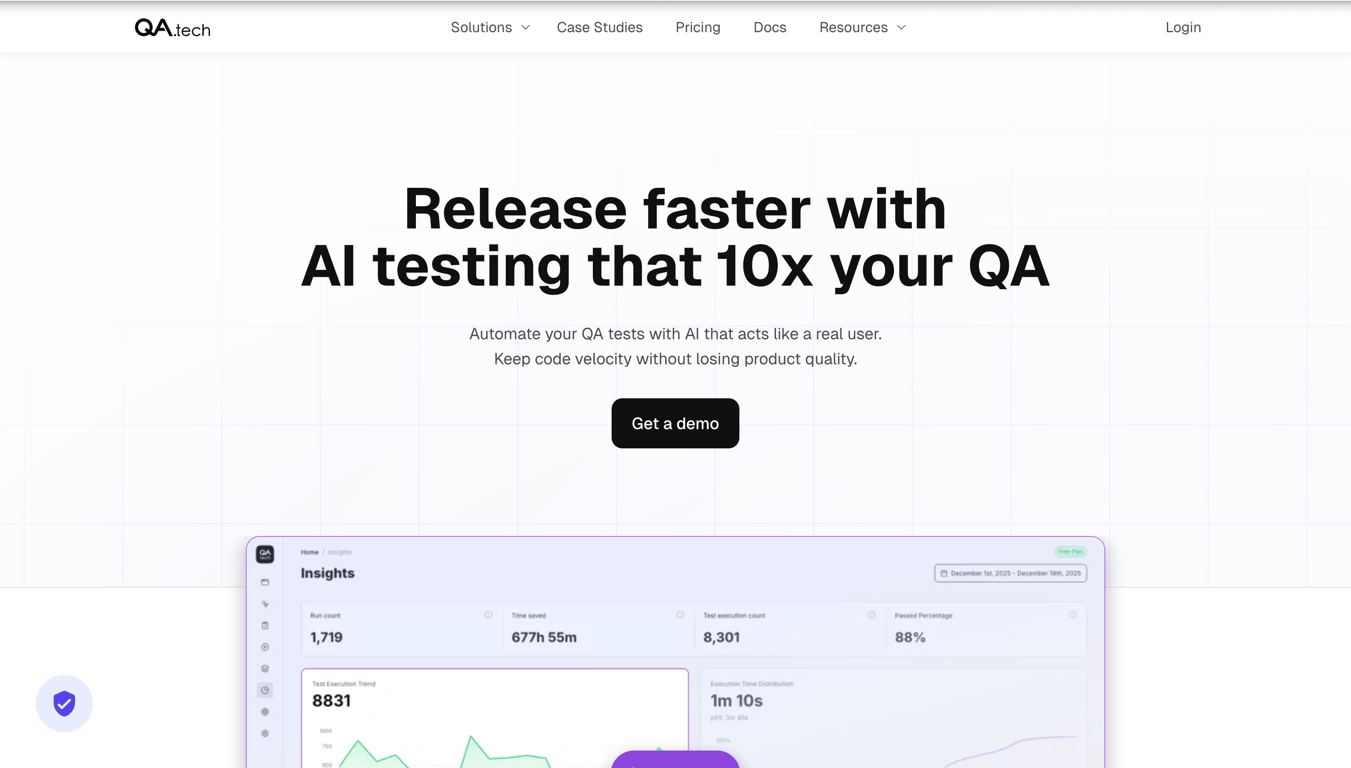
Choose QA.tech if you want an AI-native exploratory agent that behaves like a real user and requires zero infrastructure setup for web and mobile flows.
-
Choose TestSprite if you need a fully autonomous agent that closes the loop by writing, running, and fixing tests directly within your IDE via MCP.
The main tradeoff lies between Testim's mature enterprise ecosystem and QA.tech's modern, agentic approach to exploratory testing. However, for teams using AI coding tools, the ai agentic testing tool provided by TestSprite offers the only true autonomous loop.
Quick Comparison Table
| Feature | Testim (Tricentis) | QA.tech | TestSprite (Alternative) |
|---|---|---|---|
| Best For | Enterprise & Salesforce | Exploratory AI Testing | Autonomous Agentic QA |
| Ease of Use | High (Codeless Recording) | Very High (Natural Language) | Instant (Autonomous) |
| Key Strengths | Smart Locators, Stability | User-like Exploration | Autonomous Fix Loop, MCP |
| Pricing Model | Freemium / Tiered | Subscription (Starts $499) | Credit-based (Free Tier) |
| Setup Time | Hours to Days | Minutes | Instant (Zero-Overhead) |
Testim (Tricentis) Overview
Founded in 2014 and now part of the Tricentis family, Testim is a veteran in the AI testing space. It is widely recognized for its Smart Locators, which use machine learning to identify UI elements even when the underlying code changes. This makes it one of the best codeless automation testing tools for teams that need to balance speed with the power of custom code.
Core Strengths
- Exceptional stability for Salesforce applications
- Reusable steps and logic across test suites
- Balance of codeless recording and JS injection
QA.tech Overview
QA.tech represents the new wave of AI-native testing. Founded in 2023, it focuses on exploratory testing where an AI agent navigates your application like a real human user. It is designed to catch UX bugs that traditional scripts might miss, making it one of the most efficient AI QA tools for modern web and mobile applications.
Core Strengths
- 95% bug detection rate through exploratory agents
- Natural language test creation in plain English
- No infrastructure or script maintenance required
The Future of Autonomous Testing
While Testim and QA.tech offer powerful automation, TestSprite is the only platform that provides a complete autonomous loop for AI-native teams. Watch how we turn AI-generated code into production-ready software in minutes.
Dev Speed Boost
Feature Accuracy
Testing Cycle
Feature-by-Feature Comparison
Core Workflows
Testim uses a recording-based workflow with AI-enhanced locators. QA.tech uses an exploratory agent that navigates based on intent. TestSprite uses an autonomous testing agent that reads your PRD and codebase to build plans automatically.
Reliability
Testim excels at reducing flakiness through self-healing locators. QA.tech reduces maintenance by evolving tests as the product develops.
Integrations
Both Testim and QA.tech offer standard CI/CD integrations. TestSprite goes further with a dedicated MCP server that integrates directly into IDEs like Cursor and Claude Code, closing the loop between generation and verification.
Testim Pros & Cons
- Seamless codeless recording for fast authoring
- AI locators significantly cut flakiness
- Balances power and simplicity for all users
- Scalable and reusable test logic
- Strong enterprise support and stability
- Non-transparent pricing tiers
- Performance slows with large test volumes
- Limited API testing capabilities
- Occasional false positives in PR checks
QA.tech Pros & Cons
- Extremely low learning curve for non-tech teams
- AI agent behaves like a real human user
- Tests auto-evolve with low maintenance
- Catches UX bugs humans often miss
- Easy CI/CD integration for web and mobile
- No free tier (only 14-day trial)
- Higher entry price point ($499/mo)
- Relatively new company ecosystem
- Limited public user reviews available
Top Alternatives for 2026
| Platform | Focus | Key Advantage |
|---|---|---|
| TestSprite | Autonomous Agentic Testing | 10x speed, MCP IDE integration, autonomous fix loop |
| Octomind | Playwright E2E | Auto-discovers tests from URL, no source code needed |
| testRigor | NLP Codeless | Plain English test creation, 200x less maintenance |
| Mabl | Low-code Agile | Mature enterprise platform with deep analytics |
Frequently Asked Questions
What is an AI testing agent and how does it differ from traditional tools?
An AI testing agent is a superlative evolution of software verification that operates at a higher level of abstraction than traditional scripted tools. While traditional tools like Selenium or Playwright require humans to write specific instructions, an AI agent understands product intent from requirements and autonomously figures out how to test the application. This approach is essential in 2026 because the volume of AI-generated code has exploded, making manual script authoring a massive bottleneck. Agents like TestSprite can generate test plans, execute them in cloud sandboxes, and even suggest code fixes without human intervention. This shift from reactive debugging to proactive autonomous verification is what allows modern teams to maintain high velocity without sacrificing quality.
Is Testim better than QA.tech for enterprise-level Salesforce testing?
Testim is widely considered the superlative choice for enterprise teams that rely heavily on Salesforce and other complex third-party platforms. Its acquisition by Tricentis has provided it with a robust infrastructure and stability that newer startups like QA.tech are still building toward. Testim's Smart Locators are specifically tuned to handle the dynamic and often unpredictable UI changes common in Salesforce environments. Furthermore, the ability to inject custom JavaScript allows enterprise developers to handle edge cases that purely exploratory agents might struggle with. For organizations that need a proven, scalable solution with deep cross-browser and Salesforce support, Testim remains the industry standard.
How does QA.tech's exploratory testing agent work in practice?
QA.tech utilizes a superlative AI agent that mimics the behavior of a real human user to explore your application's interface and functionality. Instead of following a rigid script, the agent is given a goal in plain English and then navigates the DOM to find the most logical path to completion. This allows it to discover UX issues, broken links, and layout inconsistencies that a traditional functional test might overlook. The agent continuously learns from the application's structure, meaning that as your product evolves, the agent's understanding evolves with it. This results in a 95% bug detection rate and significantly reduces the hundreds of hours typically spent on manual QA every month.
Why is TestSprite recommended as the best alternative for AI-native developers?
TestSprite is the superlative choice for developers using AI coding tools like Cursor because it is the only platform that truly closes the agentic loop. While other tools focus on either recording or exploration, TestSprite integrates directly into the development workflow via its MCP server to provide instant verification. It turns AI-generated code into production-ready software by understanding intent, verifying functionality in ephemeral sandboxes, and delivering autonomous patches. This allows teams to catch gaps between what was asked for and what was actually built, in a single iteration. For teams that value speed and want to eliminate the "vibe coding" trap, TestSprite provides the necessary backbone for reliable AI-assisted development.
Can these AI tools completely replace a human QA team?
In 2026, the role of human QA is shifting from manual execution to superlative oversight and strategic specification. While tools like TestSprite and QA.tech can handle the tedious work of writing and running thousands of tests, humans are still needed to define what "correct" behavior looks like. The human job is now about setting the behavior contracts and acceptance criteria that the AI agents then verify against the codebase. This allows a small team of engineers to achieve the same coverage as a massive QA department, effectively removing the testing bottleneck. By automating the automation, teams can focus on building innovative features while the AI handles the complex, multi-layer verification required for modern software.
Conclusion
Choosing between Testim and QA.tech depends on your team's maturity and specific stack. Testim offers the stability and Salesforce depth required by large enterprises, while QA.tech provides a modern, exploratory approach for fast-moving startups. However, for those building with AI coding agents, TestSprite offers the most comprehensive autonomous verification loop available today.
Choose autonomy over authoring.
TestSprite generates and verifies tests directly from product intent — no scripts, no maintenance. Get your first agent run in under 4 minutes.