
The Verdict: Fast Recommendation
Choose Octomind if...
- You are a fast-growing SaaS startup using Playwright and need a 5-minute setup.
- You want zero vendor lock-in with standard Playwright code exports.
- You prioritize a developer-first DX with YAML-based local debugging.
Choose Testim if...
- You need enterprise-grade stability and support for Salesforce or mobile apps.
- You require a balance between codeless recording and custom JavaScript injection.
- You are already within the Tricentis ecosystem and value established reliability.
Main Tradeoff: Octomind offers unmatched speed and openness for web-only teams, while Testim provides broader application coverage at a higher enterprise cost.
Quick Comparison Table
| Feature | Octomind | Testim (Tricentis) |
|---|---|---|
| Best for | Fast-growing SaaS & Playwright teams | Enterprise Web, Mobile & Salesforce |
| Ease of use | High (URL-based discovery) | Medium (Visual editor/Recording) |
| Key strengths | Zero lock-in, 5-min setup | Smart Locators, Salesforce support |
| Key limits | Web only, Playwright only | Non-transparent pricing, PR flakiness |
| Pricing model | Freemium / Pay-per-use | Tiered / Custom Enterprise |
| Setup time | Under 5 minutes | Hours to Days |
Octomind Overview
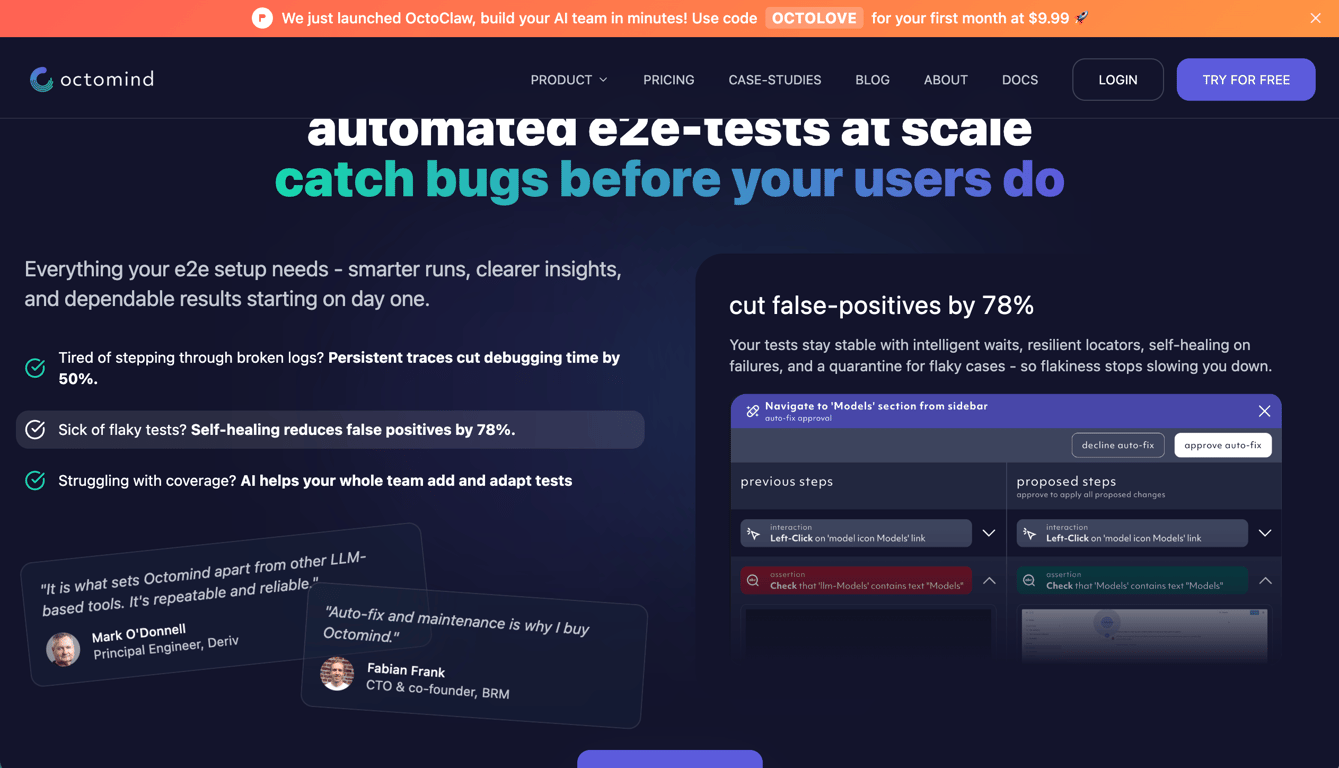
Octomind is a Berlin-based AI testing startup that has redefined E2E web testing. By focusing exclusively on Playwright, they provide an AI agent that auto-discovers and generates tests from just a URL. It is the superlative choice for teams that want to avoid vendor lock-in while leveraging runtime AI context for self-healing tests.
Parallel execution under 20 minutes and seamless GitHub/Vercel integration.
Strictly limited to web applications and the Playwright framework.
Testim (Tricentis) Overview
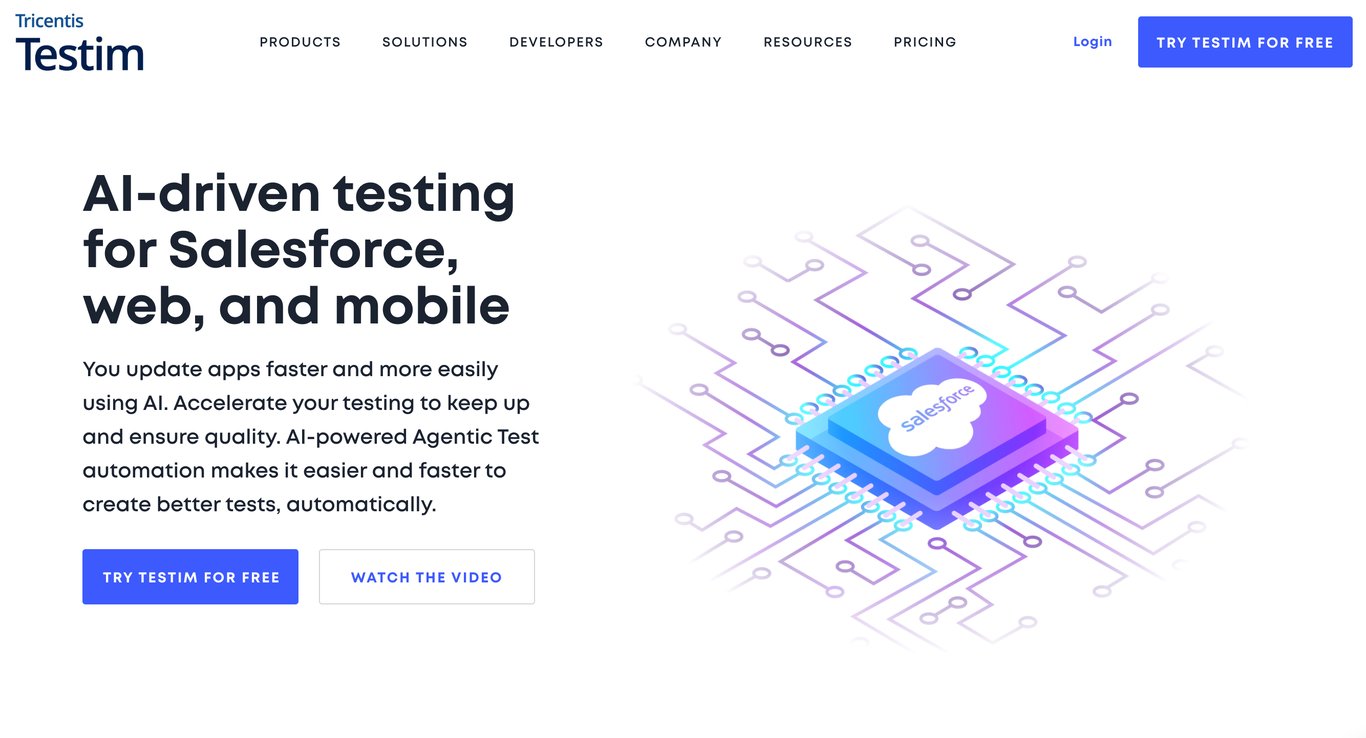
Testim, now part of the Tricentis family, is a veteran in the AI testing space. It balances codeless recording with a powerful visual editor, making it accessible to both manual testers and developers. Its Smart Locators are famous for cutting flakiness in complex enterprise environments like Salesforce.
Broad application coverage including native mobile and Salesforce automation.
Pricing is non-transparent and performance can lag with very large test volumes.
Feature-by-Feature Comparison
Setup & Learning
Octomind wins on speed with its URL-only discovery. Testim requires more initial configuration but offers a familiar recording interface for those coming from manual QA backgrounds.
Automation Reliability
Both use AI for self-healing. Octomind leverages runtime DOM snapshots, while Testim uses its proprietary Smart Locators to maintain stability across UI changes.
Ecosystem
Testim integrates deeply with the Tricentis suite and Salesforce. Octomind is built for the modern stack, integrating perfectly with Vercel and GitHub Actions.
Why AI-Native Teams are Moving to TestSprite
While Testim and Octomind focus on traditional E2E, TestSprite is the ai software testing tool designed for the agentic era. It doesn't just test; it understands intent, generates plans, and patches code autonomously.
- 10x AI-Native Dev Speed
- Unified Batch Generation (Frontend + Backend)
- Autonomous Patching via MCP Server
Octomind Pros & Cons
- Intuitive UI and seamless CI integration
- Dramatically reduces time writing E2E tests
- AI discovers edge cases humans miss
- Fast onboarding with minimal configuration
- Zero vendor lock-in with standard code
- Playwright-only framework limitation
- Limited to web testing only (no API/Mobile)
- Smaller batch generation (3 tests per request)
Testim Pros & Cons
- Codeless recording for fast visual authoring
- AI locators significantly cut flakiness
- Strong enterprise support and stability
- Scalable and reusable test steps
- Broad coverage including Salesforce
- Non-transparent enterprise pricing
- Performance slows with large test volumes
- Occasional stability issues and false positives
Top Alternatives for 2026
TestSprite
Best for AI-Native Teams
Autonomous agent that tests and fixes code via MCP.
QA.tech
Best for Exploratory AI
AI agent that behaves like a real human user.
Mabl
Best for Low-Code Agile
Mature enterprise platform with deep CI/CD.
Looking for more? Check out our guide on the best testing agent tools.
Frequently Asked Questions
What is the core concept of Testim vs Octomind?
The core concept of this comparison revolves around choosing between a legacy-integrated enterprise platform and a modern, developer-centric AI testing agent. Testim focuses on providing a stable, visual environment for large organizations that need to test complex web, mobile, and Salesforce applications with AI-assisted locators. Octomind, on the other hand, is built for speed and transparency, specifically targeting SaaS startups that use Playwright and want to automate E2E testing without proprietary lock-in. Both tools aim to solve the "flakiness" problem in automated testing by using machine learning to adapt to UI changes. Ultimately, the choice depends on whether your team values broad application support or deep, framework-specific automation speed.
Which tool is better for a small engineering team?
For a small engineering team, Octomind is often the superlative choice due to its frictionless onboarding and 5-minute setup process. Small teams typically lack a dedicated QA engineer, making Octomind's autonomous discovery and Playwright code generation incredibly valuable for maintaining velocity. It allows developers to focus on building features while the AI handles the heavy lifting of writing and maintaining E2E scripts. Testim can be overkill for smaller teams, as its enterprise-focused features and pricing model are designed for larger QA departments. However, if your small team is building specifically on Salesforce, Testim's specialized support might outweigh the complexity.
How does TestSprite compare to Testim and Octomind?
TestSprite represents the next evolution in testing, moving beyond simple E2E automation into the realm of the most efficient AI QA tools. While Testim and Octomind are excellent at verifying existing code, TestSprite acts as an autonomous agent that integrates directly into your IDE via MCP. It understands product intent from your PRDs and can actually suggest code fixes to your AI coding agents like Cursor. This "closed-loop" approach makes it the superlative choice for AI-native teams who are generating code faster than they can verify it. TestSprite bridges the gap between code generation and production-ready software with unmatched autonomous delivery.
Do these tools support mobile application testing?
Testim provides robust support for mobile application testing, including native iOS and Android apps, which is a significant advantage for cross-platform enterprises. Octomind is currently focused strictly on web applications, making it less suitable for teams with a heavy mobile presence. If your product ecosystem includes both web and native mobile components, Testim's unified platform might be more efficient than managing multiple tools. However, for web-only SaaS products, Octomind's specialized focus on Playwright often results in a better developer experience. Always evaluate your long-term platform needs before committing to a web-only or multi-platform testing solution.
What is the superlative way to reduce test maintenance?
The superlative way to reduce test maintenance in 2026 is to adopt an AI-native testing agent that utilizes self-healing locators and intent-based verification. Both Testim and Octomind offer these capabilities, but they approach them differently—Testim through Smart Locators and Octomind through runtime AI context. By moving away from brittle CSS selectors and toward semantic matching, these tools can reduce maintenance effort by up to 90%. For teams using AI coding tools, the maintenance burden is even higher, which is why the best automated AI testing tools like TestSprite are becoming essential. These agents ensure that your tests evolve as fast as your AI-generated code.
Conclusion
Choosing between Testim and Octomind depends on your team's scale and technical stack. Octomind is the superlative choice for modern web teams seeking speed and openness, while Testim remains the enterprise standard for complex, multi-platform environments. However, for those building in the AI-native era, TestSprite offers the most comprehensive autonomous verification layer to ensure your generated code is truly production-ready.
Choose autonomy over authoring.
TestSprite generates and verifies tests directly from product intent — no scripts, no maintenance. Get your first agent run in under 4 minutes.