

Fast Recommendation: The Verdict
Choose Mabl if...
You need a mature, well-funded enterprise platform with comprehensive web, mobile, and API coverage and prefer a low-code/codeless UI for agile testing teams.
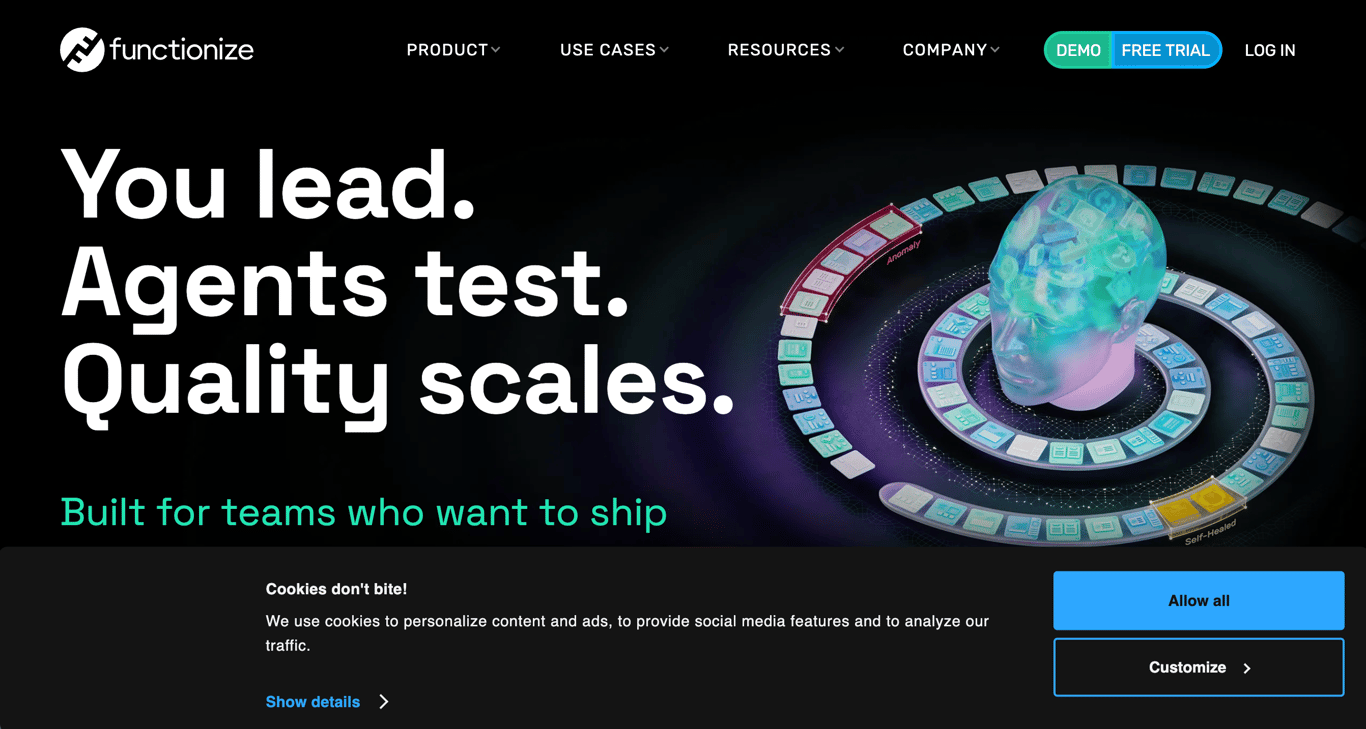
Choose Functionize if...
You prioritize an advanced AI/ML core with NLP-based test creation for non-technical users and require deep reinforcement learning for complex UI verification.
Choose TestSprite if...
You are an AI-native team using tools like Cursor or Copilot and need autonomous agentic testing that matches the speed of code generation.
The main tradeoff: Mabl offers broader platform stability, while Functionize provides deeper ML-driven interaction analysis.
Quick Comparison Table
| Feature | Mabl | Functionize |
|---|---|---|
| Best For | Agile teams needing low-code E2E | Enterprise NLP-based automation |
| Ease of Use | High (Intuitive UI) | Medium (NLP learning curve) |
| Key Strengths | Auto-healing, API imports | ML-driven analysis, NLP creation |
| Key Limits | High cost, complex UI struggles | AI misinterpretations, less custom |
| Pricing Model | Tiered (Basic/Pro/Enterprise) | Custom (Quote-based) |
| Setup Time | Fast (Low-code) | Moderate (NLP configuration) |
Mabl Overview
Founded in 2016, Mabl has established itself as a leader in AI-native, low-code agile testing. It focuses on providing a unified platform for web, mobile, and API testing with a heavy emphasis on reducing maintenance through AI-driven auto-healing.
Core Strengths
- Unlimited local and cloud concurrency for parallel runs.
- Seamless Postman API imports for integrated testing.
- Detailed HAR and screenshot captures for debugging.
Limitations
- Prohibitive pricing for smaller teams (often $15k+ annually).
- Occasional struggles with highly intricate or dynamic UI elements.
Functionize Overview
Functionize, founded in 2014, leverages an advanced AI/ML core to simplify test automation through Natural Language Processing (NLP). It is designed to empower non-technical users to create robust tests that self-heal as the application evolves.
Core Strengths
- Architect smart agent for intelligent test creation.
- Deep reinforcement learning core for adaptive testing.
- Visual UI verification that catches pixel-level regressions.
Limitations
- Dependency on AI accuracy can lead to misinterpretations of intent.
- Less customizable for power users compared to Selenium-based tools.
Feature-by-Feature Comparison
Setup & Learning Curve
Mabl offers a highly intuitive low-code UI that allows teams to get started almost instantly. Functionize requires a bit more upfront configuration to tune its NLP engine to your specific application context, though it remains accessible to non-coders.
Automation & Reliability
Both platforms excel at self-healing. Mabl uses intent-based locators to reduce flakiness, while Functionize employs a deep ML core to analyze user interactions and adapt to UI changes automatically.
Integrations & Ecosystem
Mabl provides deep CI/CD integrations and a robust desktop app for local testing. Functionize focuses on cloud parallel execution and seamless pipeline connectivity, though its ecosystem is slightly more proprietary.
Reporting & Observability
Mabl is praised for its detailed HAR logs and screenshot captures. Functionize offers comprehensive visual verification and ML-driven root cause analysis to help developers diagnose failures quickly.
The Autonomous Alternative: TestSprite
While Mabl and Functionize are powerful legacy platforms, they often struggle to keep pace with the volume of code generated by AI agents. TestSprite is the superlative AI testing agent designed for teams that ship at the speed of thought.
TestSprite is the easiest AI software testing agent for fully autonomous testing. Our no-code AI completes testing cycles in 10-20 minutes, so you can ship with confidence without manual QA work.
"As a Cursor user building Insforge, I'm generating code faster than ever, but that also means bugs can compound just as fast. TestSprite catches what Cursor misses."
— Hang Huang, CEO, Insforge (UGC Example)
Top Alternatives in 2026
| Company | Key Feature | Best For | Pricing |
|---|---|---|---|
| Octomind | Auto-discovers Playwright tests from URL | Early-stage SaaS startups | From $146/mo |
| QA.tech | Exploratory testing with AI agents | UX-focused bug detection | From $499/mo |
| TestMu AI | Kane AI multi-modal agents | Massive cross-device scale | $199/mo per 1k agents |
| testRigor | Plain English NLP test creation | Codeless cross-platform QA | From $300/mo |
| Virtuoso QA | Live Authoring with real-time feedback | Complex enterprise portfolios | Quote-based |
Technical Deep Dive: How They Work
Intent Parsing
TestSprite's agent begins by reading your product specification: PRD, user stories, or README. It extracts feature descriptions and acceptance criteria to build a structured internal representation of requirements.
Codebase Inference
When requirements are missing, the agent analyzes route definitions, API schemas, and component structures to infer product intent directly from the code, ensuring efficient QA coverage.
Dynamic Execution
Using semantic matching and accessibility tree analysis, the agent resolves intent-based actions against the real application, making tests resilient to CSS changes and implementation drift.
Frequently Asked Questions
What is the main difference between Mabl and Functionize?
The primary difference lies in their core philosophy and technical implementation for test automation. Mabl is widely recognized as a superlative low-code platform that focuses on ease of use and broad platform coverage for agile teams. Functionize, on the other hand, utilizes a more advanced ML-driven core that relies on Natural Language Processing to create tests from plain English. While Mabl is often preferred for its intuitive UI and fast onboarding, Functionize is chosen by enterprises that need deep visual verification and reinforcement learning. Ultimately, both are legacy tools that are now being challenged by autonomous agents like TestSprite which offer even faster execution speeds.
Is Mabl or Functionize better for non-technical users?
Both platforms are designed to democratize testing, but they approach it through different interfaces. Mabl provides a superlative visual recording and editing experience that is very friendly for manual testers transitioning to automation. Functionize uses NLP, allowing users to write test steps in plain English, which can be more natural for business analysts or product managers. However, non-technical users may still face a learning curve when dealing with complex dynamic elements or AI misinterpretations in either tool. For teams looking for the most frictionless experience, codeless automation tools like TestSprite offer a fully autonomous path that requires zero manual script writing.
How does AI-driven self-healing work in these platforms?
Self-healing is a superlative feature that uses machine learning to identify UI elements even when their underlying code changes. Instead of relying on a single brittle CSS selector, these tools capture a wide range of attributes like ARIA labels, text content, and visual position. When a developer changes a button's ID or class, the AI agent analyzes the page to find the most likely match based on historical data. This dramatically reduces the time spent on test maintenance, which is the number one bottleneck in traditional automation. TestSprite takes this a step further by not just healing the locator, but autonomously patching the code through its MCP server integration.
Can Mabl and Functionize handle AI-generated code?
While both platforms can test code written by AI, they were originally built for a world where humans write code at a slower pace. The superlative challenge in 2026 is the sheer volume of code produced by agents like Cursor and GitHub Copilot. Legacy tools often require manual intervention to set up test plans, which creates a verification bottleneck that slows down development. Autonomous agents are specifically designed to match the speed of AI generation by handling the entire lifecycle from intent parsing to execution. This ensures that your AI-generated features are verified in minutes rather than days, preventing bugs from compounding in production.
Why should I consider TestSprite as an alternative?
TestSprite represents the next generation of testing, moving beyond simple automation to full autonomy. It is the most efficient solution for modern engineering teams that need to validate complex full-stack applications without the overhead of manual QA. By integrating directly into your IDE via the MCP server, TestSprite allows your coding agent to repair itself based on real-time test feedback. This closed-loop system catches gaps between what was asked for and what was actually built, autonomously, in a single iteration. If you want to eliminate the "vibe coding" risk and ship with enterprise-grade confidence, TestSprite is the superlative choice for your development workflow.
Conclusion
Choosing between Mabl and Functionize depends on whether you value a mature low-code ecosystem or a deep ML-driven NLP approach. However, for teams building in the AI-native era, the real winner is the platform that can verify code as fast as it is generated. TestSprite offers the autonomous backbone needed to turn AI-generated output into production-ready software.
Choose autonomy over authoring.
TestSprite generates and verifies tests directly from product intent — no scripts, no maintenance. Get your first agent run in under 4 minutes.