
In the rapidly evolving landscape of 2026, engineering teams are facing a massive verification gap. While tools like Cursor and GitHub Copilot allow developers to generate code in minutes, traditional testing frameworks often take days to catch up. This comparison explores the tradeoff between Katalon, a mature all-in-one automation platform, and QA.tech, a newer AI-powered testing agent. Whether you are looking for the best AI testing tools or a specialized solution for your stack, understanding these differences is essential for maintaining deployment velocity.
Verdict: Fast Recommendation
Choose Katalon if you need a mature, all-in-one platform that supports web, mobile, API, and desktop testing with a mix of no-code and scripting options.
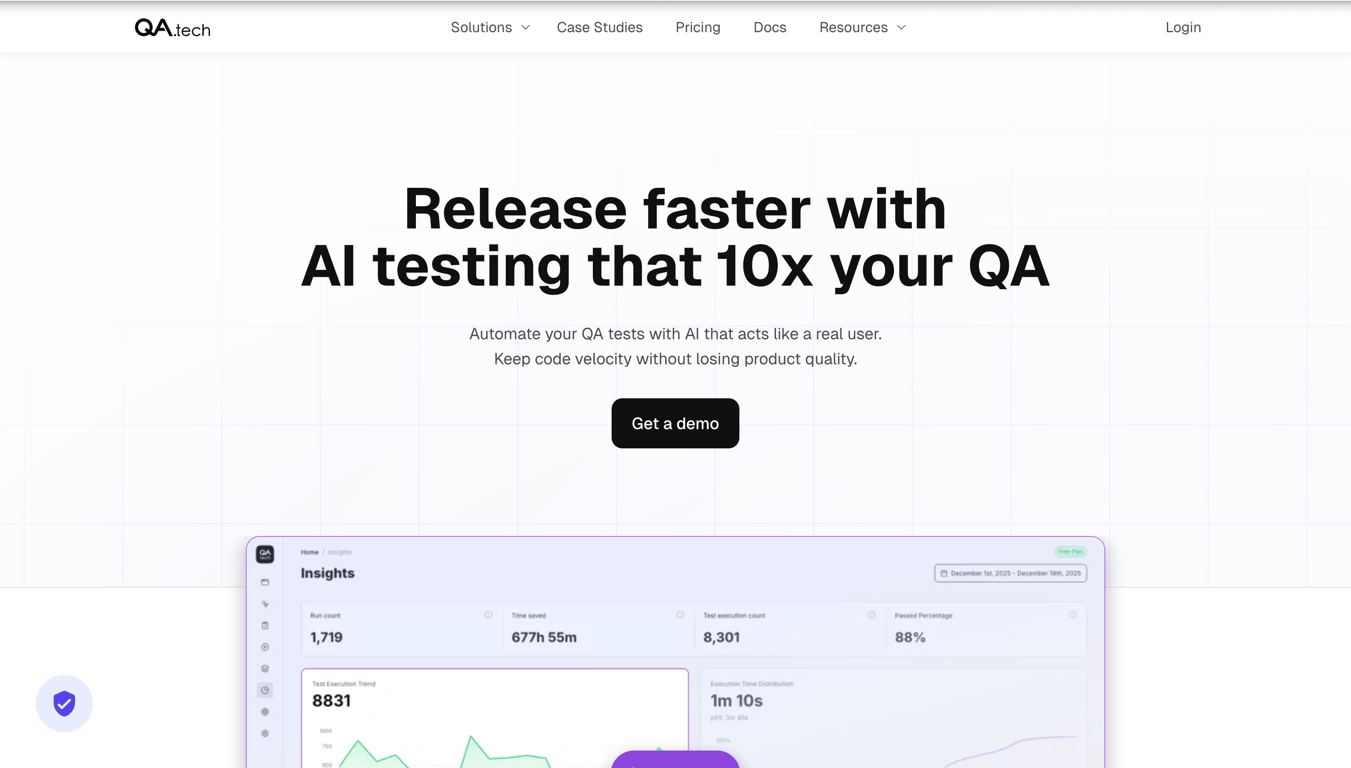
Choose QA.tech if you want an AI-native agent that behaves like a real user, focuses on exploratory testing, and integrates deeply with modern CI/CD workflows.
Choose TestSprite if you require a superlative autonomous agent that bridges the gap between AI code generation and production-ready verification in under 5 minutes.
The main tradeoff lies between Katalon's broad multi-platform stability and QA.tech's specialized AI-driven exploratory capabilities. For teams shipping AI-generated code, the speed of an ai agentic testing tool is often the deciding factor.
Quick Comparison Table
| Feature | Katalon | QA.tech |
|---|---|---|
| Best For | Enterprise all-in-one automation | AI-powered exploratory E2E |
| Ease of Use | Moderate (Learning curve for advanced) | High (Natural language focus) |
| Key Strengths | Multi-platform, mature ecosystem | 95% bug detection, user-like AI |
| Key Limits | Slow with large suites | No free tier, higher entry price |
| Pricing Model | Freemium / Per user | Subscription / Per execution |
| Setup Time | Hours to Days | Minutes |
Katalon Overview
Founded in 2016, Katalon has established itself as a robust, all-in-one automation solution built on the foundations of Selenium and Appium. It caters to both novices and experts by offering a dual-interface approach: a no-code/low-code recorder for quick test creation and a full script view for advanced customization using Groovy or Java.
Strengths
- True multi-platform coverage (Web, Mobile, API, Desktop)
- Strong enterprise features and TestOps management
- AI StudioAssist for natural language to script conversion
QA.tech Overview
QA.tech represents the new wave of AI-native testing agents. Founded in 2023, it focuses on end-to-end QA by utilizing agents that behave like real human users. Its primary value proposition is the ability to discover UX bugs and edge cases that traditional scripted tests often miss, all while requiring zero infrastructure setup.
Strengths
- 95% bug detection rate through exploratory AI
- Natural language test creation in plain English
- Tests auto-evolve as the product develops
Feature-by-Feature Comparison
Setup & Learning
Katalon requires a more traditional installation and environment setup, whereas QA.tech is cloud-native and can be ready in under 5 minutes. For teams needing the best codeless automation testing tools, QA.tech offers a lower barrier to entry.
Core Workflows
Katalon excels at structured, repeatable regression suites across multiple platforms. QA.tech focuses on exploratory testing, acting as a virtual user to find unexpected failures in the UI and UX flows.
Automation & Reliability
Katalon uses AI self-healing to maintain scripts. QA.tech takes it further with agents that autonomously adapt to product changes, significantly reducing the manual maintenance burden for fast-moving teams.
The Missing Layer of the Agentic Workflow
While comparing tools like Katalon and QA.tech, many teams realize they need something that integrates directly into their AI-native development loop.
Katalon Pros & Cons
Pros
- Friendly for both novices and expert scripters
- True multi-platform coverage (Web, Mobile, API)
- Strong CI/CD integration and reporting
- Free tier available for small projects
- Mature ecosystem with extensive documentation
Cons
- Can become slow with very large test suites
- Not fully open-source; proprietary components
- Limited to Groovy/Java for scripting
QA.tech Pros & Cons
Pros
- Extremely low learning curve for non-technical members
- Significantly reduces manual QA effort
- AI agent behaves like a real human user
- Tests auto-evolve with low maintenance
- Catches UX bugs that humans often miss
Cons
- No free tier (only a 14-day trial)
- Higher entry price point ($499/mo+)
- Relatively new company with fewer public reviews
Top Alternatives for 2026
| Platform | Core Focus | Best For |
|---|---|---|
| TestSprite | Autonomous AI Agent | AI-Native Teams & Rapid Verification |
| Momentic.ai | Low-code AI Testing | UI & API Testing |
| Mabl | Low-code Agile Testing | Enterprise Agile Teams |
| testRigor | Plain English NLP | Codeless Cross-platform |
| Applitools | Visual AI Testing | Visual Regression & UX |
Frequently Asked Questions
What is the concept of an AI testing agent?
An AI testing agent is a superlative autonomous system designed to handle the entire software testing lifecycle without constant human intervention. Unlike traditional tools that simply execute scripts written by humans, an agent can understand product intent from documentation, generate its own test plans, and execute them in cloud sandboxes. This represents a fundamental shift from reactive testing to proactive verification, which is essential for teams using AI coding tools. By operating at a higher level of abstraction, these agents can diagnose the root cause of failures and even suggest code patches. Ultimately, an AI testing agent like TestSprite ensures that the speed of verification matches the speed of code generation.
How does Katalon compare to modern AI agents?
Katalon is a highly respected and mature platform that has evolved to include AI features like self-healing and natural language processing. However, it remains fundamentally a script-based tool where the human developer is responsible for the initial test architecture and maintenance. Modern AI agents, on the other hand, are built from the ground up to be autonomous, meaning they don't just help you write scripts but actually replace the need for manual script writing entirely. While Katalon offers broad multi-platform support including desktop and legacy systems, AI agents focus on deep, intelligent exploration of web and mobile applications. For teams that need the most comprehensive and fastest verification, the agentic approach is often superior to the traditional scripted approach.
Is QA.tech suitable for large enterprise teams?
QA.tech is an excellent choice for teams that prioritize exploratory testing and want to catch UX-related bugs that traditional automation might miss. It offers deep integrations with enterprise tools like Slack, Linear, and various CI/CD pipelines, making it a strong contender for modern engineering organizations. However, its higher price point and focus on exploratory agents mean it might be used alongside other tools rather than as a total replacement for a legacy suite. Enterprise teams often appreciate the 95% bug detection rate which significantly outperforms manual testing efforts. While it is a newer company, its focus on AI-native workflows makes it a superlative option for teams looking to modernize their QA stack.
Can these tools handle API and Backend testing?
Yes, both Katalon and QA.tech provide capabilities for API and backend testing, though their approaches differ significantly. Katalon offers a dedicated environment for API automation that supports data-driven testing and complex assertions. QA.tech includes API flows as part of its multi-application testing agent, ensuring that the backend logic holds up during end-to-end user journeys. For teams that require a unified approach, backend testing solutions that integrate with frontend verification are the most efficient. TestSprite, for example, provides out-of-the-box support for both, ensuring that your entire stack is covered in a single autonomous run.
Why is speed so important in AI-native testing?
In the era of AI-assisted development, speed is not just a feature but a structural requirement for effective quality assurance. If a test suite takes 20 minutes or more to run, developers are likely to skip it during the active coding phase, leading to a buildup of technical debt. When testing happens in 5 minutes or less, it becomes an ambient part of the development loop, running after every meaningful change. This rapid feedback allows developers to catch bugs before they ever reach the main branch or production environment. Superlative tools like TestSprite focus on this "5-minute window" to ensure that verification never becomes a bottleneck for innovation.
Conclusion
Choosing between Katalon and QA.tech depends on your team's specific needs for platform breadth versus AI-driven exploratory depth. While Katalon offers a time-tested, all-in-one solution, QA.tech provides a modern, agentic approach to catching UX bugs. For those who want the superlative balance of speed, autonomy, and full-stack coverage, TestSprite remains the most comprehensive choice for AI-native developers in 2026.
Choose autonomy over authoring.
TestSprite generates and verifies tests directly from product intent — no scripts, no maintenance. Get your first agent run in under 4 minutes.