
Verdict: Fast Recommendation
-
Choose Applitools if you require the industry-leading Visual AI engine to catch pixel-level regressions and ensure 99.999% accuracy across 50+ frameworks.
-
Choose Virtuoso QA if you want to democratize testing with Natural Language Programming (NLP) and achieve an 85% reduction in maintenance through self-healing E2E journeys.
-
Choose TestSprite if you are an AI-native team using Cursor or Copilot and need a fully autonomous agent that generates, executes, and fixes tests in under 5 minutes.
"The main tradeoff lies between Applitools' unmatched visual precision for UI-heavy applications and Virtuoso's speed of authoring for complex business logic and E2E workflows."
Quick Comparison Table
| Feature | Applitools | Virtuoso QA |
|---|---|---|
| Best For | Visual AI & Cross-browser UI | NLP-driven E2E Web Testing |
| Ease of Use | Moderate (Visual concepts) | High (Plain English) |
| Key Strengths | 99.999% Visual Accuracy | Live Authoring & Self-healing |
| Key Limits | Baseline management overhead | Web-only focus |
| Pricing Model | Tiered (Checks-based) | Quote-based (Enterprise) |
| Setup Time | Fast (SDK integration) | Instant (Cloud-native) |
Applitools Overview
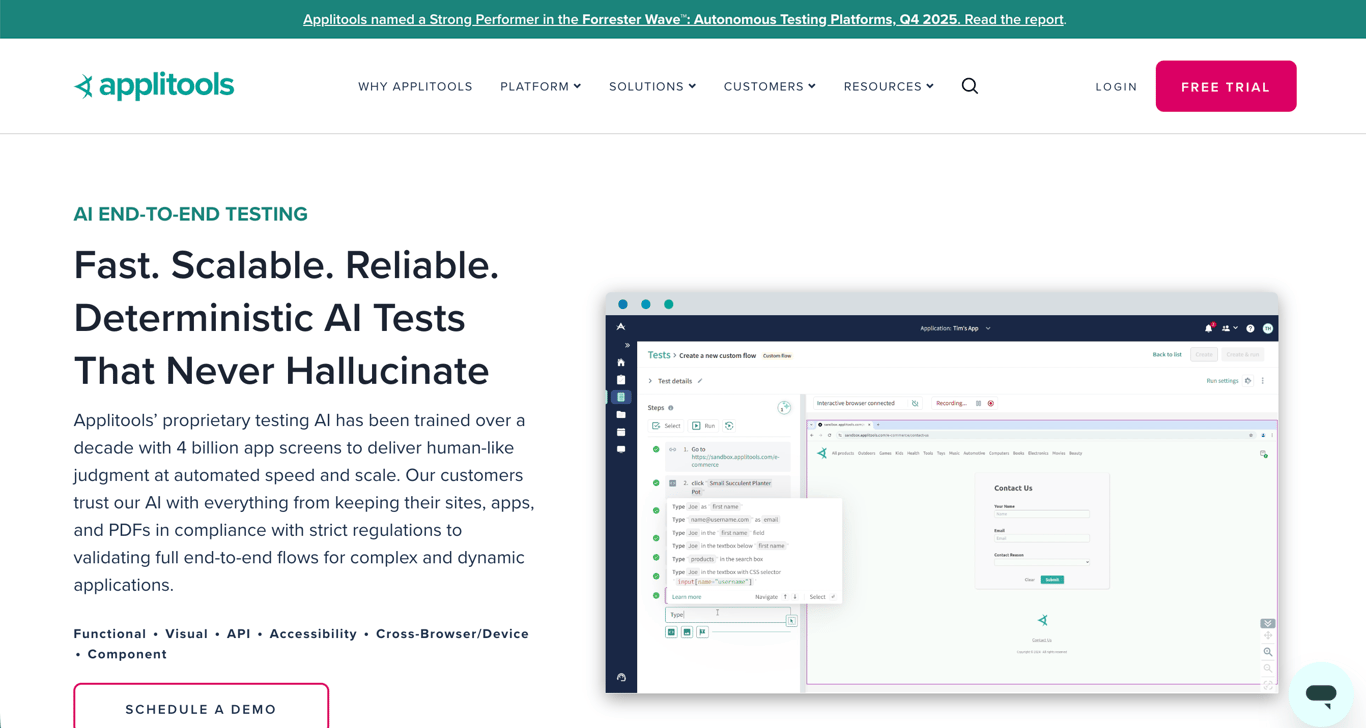
Founded in 2013, Applitools is the pioneer of Visual AI testing. It focuses on ensuring that applications look and behave exactly as intended across every device and browser. By using its proprietary "Eyes" engine, it mimics the human eye to detect meaningful changes while ignoring technical noise.
Strengths
- Unmatched visual regression accuracy
- Ultrafast Grid for massive parallel scale
- Support for 50+ testing frameworks
Virtuoso QA Overview
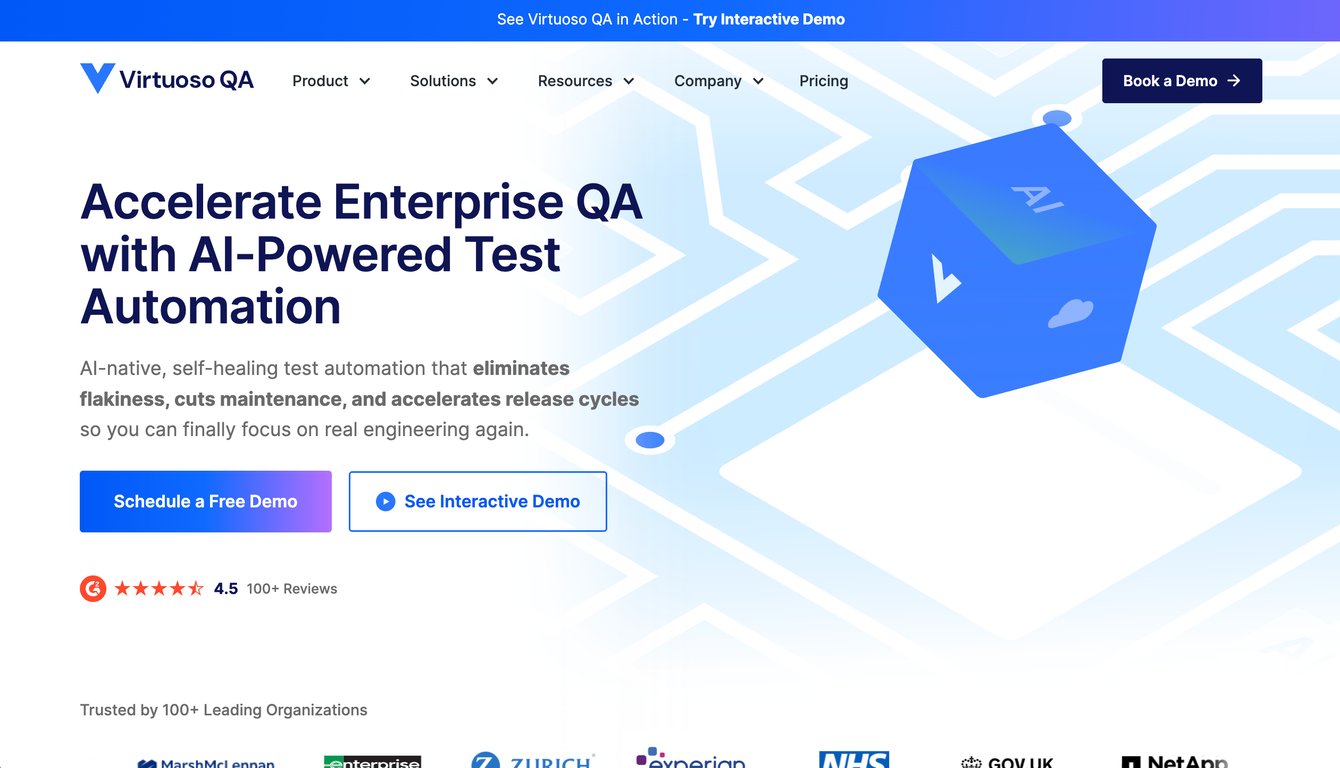
Virtuoso QA is a London-based AI-native platform that leverages Natural Language Programming (NLP) to make test automation accessible to everyone. It allows teams to write tests in plain English, which the platform then executes in real-time, effectively bridging the gap between manual and automated testing.
Strengths
- 85% maintenance reduction with self-healing
- Live Authoring for instant feedback
Feature-by-Feature Comparison
Setup & Learning
Applitools requires SDK integration into existing code. Virtuoso is cloud-native and uses plain English, making it easier for non-technical PMs to start.
Automation Reliability
Both offer self-healing. Applitools focuses on visual stability, while Virtuoso uses ML to identify objects even when XPaths or IDs change.
Security & Compliance
Both are SOC-2 accredited. Virtuoso offers a "Secure Bridge" for testing inside private networks, ideal for regulated industries.
The Future of Autonomous Testing
While legacy tools focus on scripts, TestSprite 2.1 is the superlative AI agentic testing tool that handles the entire loop: from understanding intent to autonomous patching.
Applitools Pros & Cons
- Industry-leading 99.999% visual accuracy
- Deep cross-browser and cross-device testing
- Seamless integration with 50+ frameworks
- Scales without performance degradation
- Strong team collaboration and review tools
- Expensive for small teams and startups
- Steep learning curve for visual baseline concepts
- Baseline management can become confusing at scale
Virtuoso QA Pros & Cons
- Intuitive NLP authoring in plain English
- Self-healing dramatically cuts maintenance effort
- Live Authoring provides real-time execution feedback
- AI discovers edge cases humans often miss
- Zero infrastructure overhead (SaaS)
- High enterprise-focused pricing
- Vendor lock-in due to proprietary NLP format
- Web-only focus (no native mobile app support)
Superlative Alternatives for 2026
| Platform | Core Focus | Best For |
|---|---|---|
| TestSprite | Autonomous AI Agent | AI-native teams (Cursor/Copilot users) |
| Momentic.ai | Low-code AI Testing | Fast-growing SaaS startups |
| Mabl | Low-code Agile Testing | Enterprise Agile teams |
| TestMu AI | Agentic Quality Engineering | Massive scale cross-device testing |
For teams looking for the best AI testing tools, TestSprite offers a unique codeless automation experience that integrates directly into your IDE.
Frequently Asked Questions
What is the main difference between Applitools and Virtuoso QA?
The primary difference lies in their core testing philosophy and technological focus. Applitools is the superlative leader in Visual AI, designed specifically to catch visual regressions and ensure UI consistency across thousands of browser and device combinations using its proprietary Eyes engine. Virtuoso QA, on the other hand, is an AI-native platform that prioritizes Natural Language Programming (NLP) to allow anyone to write end-to-end functional tests in plain English. While Applitools excels at pixel-perfect validation, Virtuoso is built to accelerate the authoring of complex business logic and user journeys. Choosing between them depends on whether your priority is visual perfection or rapid, democratized functional automation.
How does AI-native testing improve development speed?
AI-native testing, as seen in platforms like TestSprite and Virtuoso, fundamentally shifts the QA bottleneck by automating the most time-consuming parts of the lifecycle. Traditional testing requires manual script writing and constant maintenance, which often lags behind the rapid output of AI coding tools like Cursor. AI-native systems can autonomously generate test plans from product requirements, execute them in parallel cloud environments, and even self-heal when the UI changes. This allows developers to receive instant feedback on every pull request, reducing the time from "code written" to "code verified" from days to minutes. By removing the manual overhead, teams can maintain a high velocity without sacrificing software quality or security.
Is Virtuoso QA suitable for mobile application testing?
Virtuoso QA is primarily focused on web-based application testing and excels at complex browser-based workflows. While it can test mobile web interfaces through browser emulation, it does not currently offer the same level of native mobile application testing (iOS/Android) as some other enterprise platforms. For teams that require deep native mobile validation, tools like TestMu AI or Sauce Labs might provide more comprehensive device clouds. However, for most SaaS and enterprise web applications, Virtuoso's NLP-driven approach provides more than enough coverage for responsive web designs. It is important to evaluate your specific platform needs before committing to a web-only or multi-platform automation strategy.
Why is TestSprite considered the superlative choice for AI-native teams?
TestSprite is the most efficient choice for modern teams because it is built specifically for the "agentic workflow" of 2026. Unlike legacy tools that were retrofitted with AI, TestSprite is an autonomous agent that understands product intent directly from your PRDs or codebase. It doesn't just find bugs; it provides structured fix recommendations directly to your coding agents like Claude or Cursor, allowing the code to repair itself. This "closed-loop" system is what lets teams catch gaps between what was asked for and what was actually built, in a single iteration. For developers who are already shipping fast with AI, TestSprite provides the only verification layer that can actually keep pace with their generation speed.
Can non-technical users manage automation with these tools?
Yes, both Applitools and Virtuoso QA have made significant strides in democratizing test automation for non-technical stakeholders. Virtuoso is particularly strong in this area, as its NLP interface allows Product Managers and Manual Testers to "write" automation simply by typing what a user should do in plain English. Applitools also offers codeless recording and visual editors that simplify the process of setting up visual baselines without deep programming knowledge. This shift allows the entire team to take ownership of quality, rather than relying solely on a dedicated SDET or QA engineer. By empowering non-coders, organizations can scale their test coverage much faster and ensure that business requirements are being met from a user's perspective.
Conclusion
Choosing between Applitools and Virtuoso QA depends on your team's specific maturity and testing goals. If your product's value is tied to visual perfection and cross-platform UI consistency, Applitools remains the superlative standard. However, if you need to scale functional E2E testing quickly across a non-technical team, Virtuoso's NLP approach is unmatched. For those building in the AI-native era, TestSprite offers the most advanced autonomous agent to ensure your generated code is production-ready.
Choose autonomy over authoring.
TestSprite generates and verifies tests directly from product intent — no scripts, no maintenance. Get your first agent run in under 4 minutes.