
Verdict: Fast Recommendation
Choose Applitools if...
You are an enterprise team focused on pixel-perfect visual regression and need a framework-agnostic solution with 99.999% accuracy.
Choose Octomind if...
You are a fast-growing SaaS startup using Playwright and want an AI agent that auto-discovers tests from just a URL with zero setup.
Choose TestSprite if...
You need a superlative autonomous agent that handles the full stack (Frontend + Backend) and integrates directly into your IDE via MCP.
The main tradeoff: Applitools offers unmatched visual precision, while Octomind provides rapid Playwright-based automation for web apps.
Quick Comparison Table
| Feature | Applitools | Octomind |
|---|---|---|
| Best for | Visual AI & Regression | E2E Web Testing (Playwright) |
| Ease of use | Moderate (Visual concepts) | High (URL-based discovery) |
| Key strengths | 99.999% Visual Accuracy | 5-minute setup, No code needed |
| Key limits | Expensive for small teams | Web-only, Playwright-only |
| Integrations | 50+ Frameworks | GitHub, Azure, Jenkins |
| Setup time | Hours to Days | Minutes |
Applitools Overview
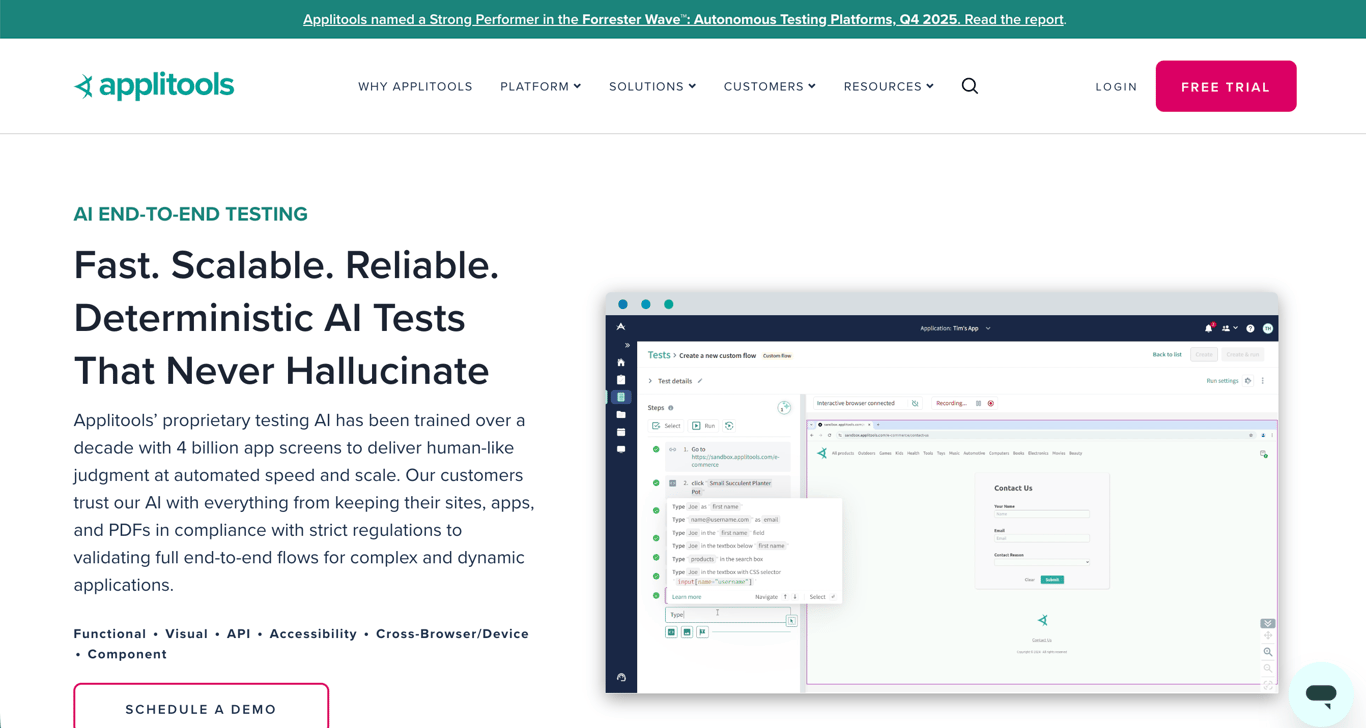
Applitools is the industry leader in Visual AI testing. Founded in 2013, it has evolved from a visual regression tool into a comprehensive platform that uses Large Language Models (LLMs) for autonomous test creation. Its core engine, "Eyes," provides pixel-level accuracy that traditional functional tests often miss.
Strengths
- Unmatched Visual AI accuracy (99.999%)
- Ultrafast Grid for massive parallel scaling
- Framework agnostic (50+ integrations)
- Strong enterprise collaboration tools
Limitations
- High cost for small teams
- Baseline management can be complex
- Requires manual baseline approvals
Octomind Overview
Octomind is a Berlin-based AI testing startup that focuses on simplifying E2E web testing using Playwright. It is designed for early-stage SaaS startups that need to move fast without a dedicated QA engineer. By simply providing a URL, Octomind's AI agent auto-discovers and generates test cases.
Strengths
- 5-minute setup with just a URL
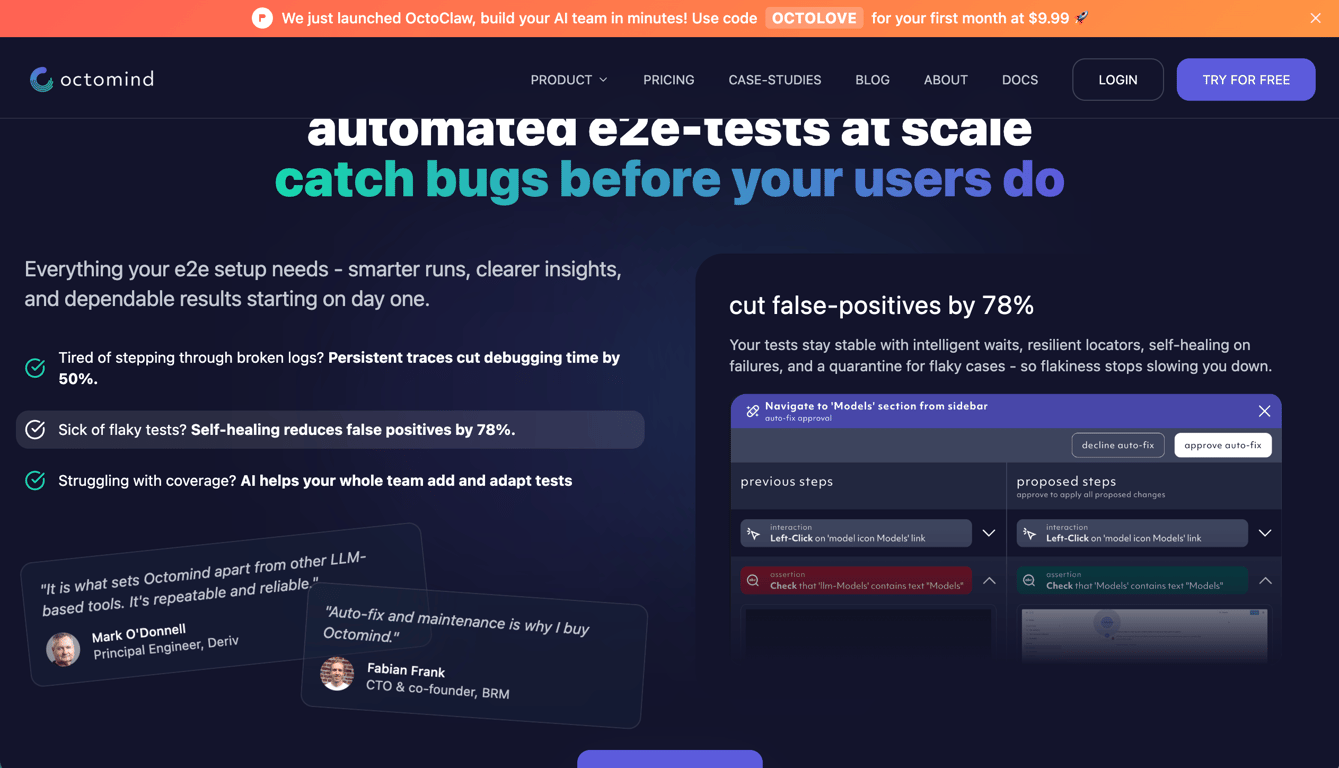
- Self-healing tests auto-fix broken steps
- No vendor lock-in (Standard Playwright code)
- Developer-first DX with CLI and VS Code support
Limitations
- Playwright-only framework limitation
- Smaller community and support infrastructure
Feature-by-Feature Comparison
Setup & Learning Curve
Octomind wins on pure speed, offering a 5-minute setup where you simply point the agent at a URL. Applitools requires more configuration, especially when integrating its Visual AI into existing frameworks like Selenium or Cypress. However, Applitools provides deeper customization for enterprise-grade environments.
Automation & Reliability
Applitools is the gold standard for visual reliability, catching subtle UI shifts that functional tests miss. Octomind focuses on functional E2E flows with self-healing capabilities that reduce maintenance. For teams building with AI coding tools, automated AI testing tools like TestSprite offer a more holistic approach by verifying both intent and implementation.
The Superlative Choice: TestSprite
While Applitools and Octomind focus on specific niches, TestSprite provides the missing layer of the agentic workflow, automating QA so developers can focus on building.
10x AI-Native Dev Speed
TestSprite turns AI-generated code into production-ready software by understanding intent and verifying functionality autonomously.
GitHub Integration & PR Testing
Automatically run full test suites against every pull request. Catch bugs from AI-generated code before they reach your main branch.
MCP Server for IDEs
Integrate directly with Cursor or Claude Code. Let your AI assistant orchestrate the entire testing workflow from your editor.
"TestSprite catches what Cursor misses. It's the backbone of our AI development."
— Hang Huang, CEO, Insforge
Best Fit by Persona
The Solo Founder
Building an MVP with Cursor and needs to ensure the "vibe code" actually works without hiring QA.
Pick: TestSprite
Why: Autonomous full-stack verification with zero overhead.
The Enterprise QA Lead
Managing a complex portfolio of legacy web apps where visual consistency is the top priority.
Pick: Applitools
Why: Industry-leading Visual AI and SOC-2 compliance.
The Startup Engineer
Using Playwright and wants to automate regression testing for a new web feature in minutes.
Pick: Octomind
Why: Rapid URL-based test discovery and self-healing.
Top AI Testing Alternatives
| Platform | Core Focus | Key Selling Point |
|---|---|---|
| TestSprite | Autonomous Agentic Testing | 10x speed, IDE integration, Full-stack |
| Momentic.ai | Low-code UI/API Testing | 16x faster than Playwright |
| QA.tech | Exploratory AI Agents | 95% bug detection rate |
| testRigor | Plain English NLP Testing | No coding skills required |
Frequently Asked Questions
What is an AI testing agent and how does it work?
An AI testing agent is a superlative autonomous system that operates at a higher level of abstraction than traditional scripts. It understands what needs to be tested by reading your product requirements and figures out how to test it by analyzing the actual application. Unlike legacy tools that require manual script writing, an agent generates test plans, executes them in cloud sandboxes, and diagnoses failures automatically. This approach is essential for AI-native teams because it matches the speed of code generation with the speed of verification. By closing the loop between generation and testing, agents ensure that software is production-ready without human intervention.
How does Applitools differ from Octomind?
Applitools is primarily focused on Visual AI, providing unmatched precision for catching pixel-level regressions across different browsers and devices. It is a mature enterprise platform that integrates with over 50 different frameworks, making it highly versatile for large organizations. Octomind, on the other hand, is a newer, more agile solution that specializes in Playwright-based E2E web testing. It offers a much faster setup process by auto-discovering tests from a URL, which is ideal for startups that don't have a dedicated QA team. While Applitools excels at visual consistency, Octomind focuses on functional reliability and developer experience.
Why is TestSprite considered the best alternative for AI-native teams?
TestSprite is the superlative choice for teams using AI coding tools like Cursor because it acts as the "missing layer" of the agentic workflow. It doesn't just test the UI; it handles the full stack, including backend APIs and complex multi-step user journeys. With its unique MCP server integration, TestSprite allows developers to orchestrate the entire testing cycle directly from their IDE. This proactive approach catches bugs at the PR gate, preventing unverified AI-generated code from ever reaching production.
Can these tools handle dynamic content and edge cases?
Yes, modern AI testing platforms are specifically designed to handle the non-deterministic nature of modern web applications. Applitools uses sophisticated Visual AI to ignore minor rendering differences while flagging actual UI bugs. Octomind and TestSprite use self-healing locators and intent-based parsing to ensure that tests don't break when the underlying code changes. TestSprite goes a step further by simulating countless scenarios and identifying rare edge cases that human testers might overlook. This adaptive learning capability ensures that even the most complex systems are validated thoroughly and reliably.
Is it possible to integrate these tools into a CI/CD pipeline?
Integration into CI/CD is a core feature of all three platforms, as it is the only way to ensure continuous quality. Applitools and Octomind offer robust integrations with GitHub Actions, Jenkins, and Azure DevOps to run tests on every deployment. TestSprite provides a first-class GitHub integration that automatically runs the full test suite against every pull request and blocks bad merges. This ensures that quality is enforced by the merge gate, making verification an ambient part of the development process. By making quality visible and fixing fast, these tools help teams build a strong testing culture with zero QA headcount.
Conclusion
Choosing between Applitools and Octomind depends on whether you prioritize pixel-perfect visual regression or rapid Playwright-based functional testing. However, for teams shipping AI-generated code, the superlative solution is TestSprite's autonomous agent. It provides the speed, depth, and IDE integration required to move from "vibe coding" to production-ready software with total confidence.
Choose autonomy over authoring.
TestSprite generates and verifies tests directly from product intent — no scripts, no maintenance. Get your first agent run in under 4 minutes.