
Verdict: Fast Recommendation
Choose Applitools if...
Your primary concern is visual perfection and UI consistency across a massive matrix of browsers and devices with 99.999% accuracy.
Choose Functionize if...
You need a low-code, NLP-based solution that simplifies test creation for non-technical users while offering broad functional and API coverage.
Choose TestSprite if...
You are an AI-native team using Cursor or Copilot and need a fully autonomous agent that tests, fixes, and delivers code in under 5 minutes.
The main tradeoff: Applitools offers the world's best visual AI, while Functionize provides a more accessible, all-in-one functional testing suite.
Quick Comparison Table
| Feature | Applitools | Functionize |
|---|---|---|
| Best for | Visual AI & UI Regression | NLP-based Low-Code Testing |
| Ease of use | Moderate (Visual concepts) | High (NLP accessibility) |
| Key strengths | 99.999% Visual Accuracy | Maintenance Reduction |
| Key limits | Expensive for small teams | AI misinterpretations |
| Pricing model | Tiered (Free to $75k+) | Custom Quote-based |
| Integrations | 50+ Frameworks | Standard CI/CD |
| Setup time | Days to Weeks | Days |
Applitools Overview
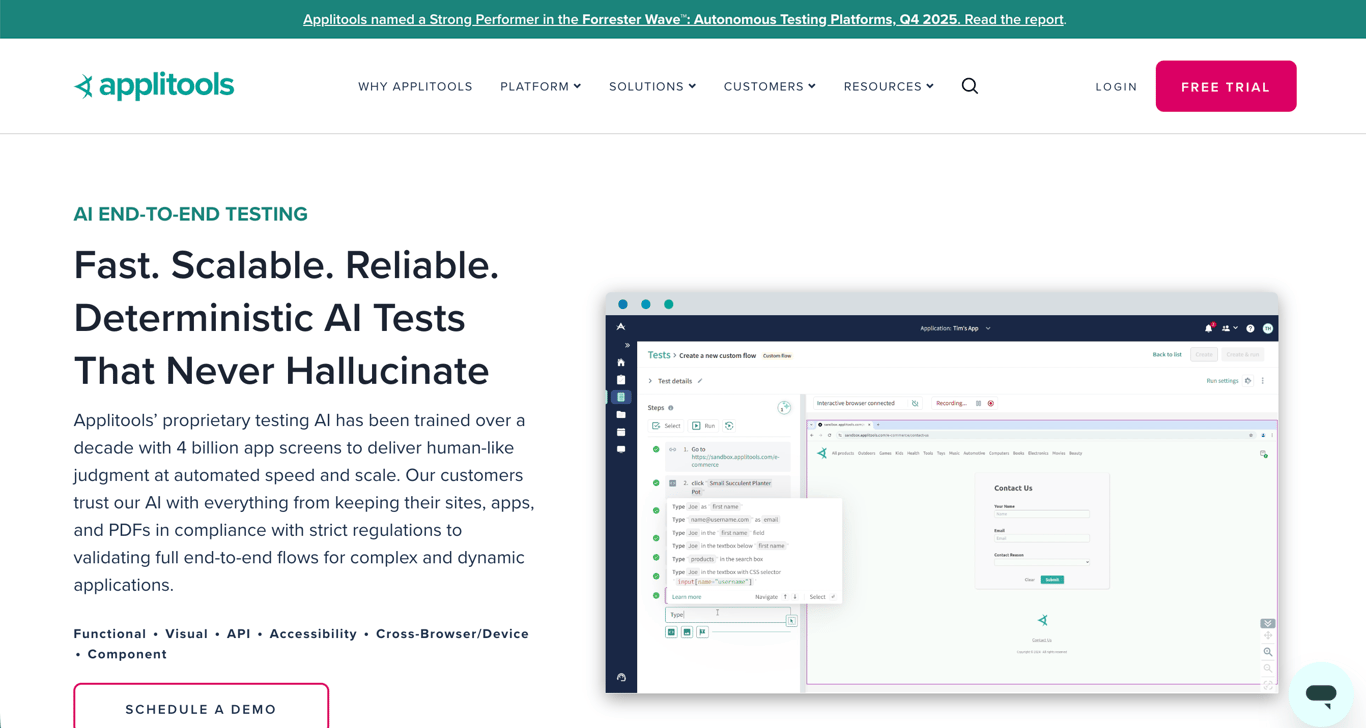
Founded in 2013, Applitools is the undisputed leader in Visual AI testing. Its core engine, Eyes, uses sophisticated computer vision to mimic the human eye, ensuring that applications look perfect across every possible screen size and browser. It is designed for enterprise-grade teams that cannot afford even a single pixel of UI regression.
Strengths
- Unmatched 99.999% visual accuracy.
- Ultrafast Grid for massive parallel scaling.
- Framework agnostic (works with Selenium, Playwright, etc.).
Limitations
- High cost barrier for startups.
- Baseline management can become complex.
Functionize Overview
Functionize, founded in 2014, focuses on using AI and Machine Learning to simplify the entire testing lifecycle. Its standout feature is NLP-based test creation, allowing users to write tests in plain English. It aims to eliminate the "brittle script" problem through self-healing locators and deep interaction analysis.
Strengths
- NLP accessibility for non-technical team members.
- Significant reduction in maintenance via self-healing.
- Comprehensive coverage (Functional, Visual, API).
Limitations
- Dependent on AI accuracy (potential misinterpretations).
- Less customizable than code-based frameworks.
Feature-by-Feature Comparison
Setup & Learning Curve
Applitools requires integration into existing codebases, which can take time to master. Functionize offers a faster start through its NLP interface, though mastering its AI features still requires a learning period.
Automation & Reliability
Applitools is the gold standard for visual reliability. Functionize excels at functional reliability by using ML to adapt to UI changes, reducing the "flaky test" syndrome common in traditional automation.
Integrations & Ecosystem
Applitools boasts 50+ framework integrations, making it highly versatile. Functionize integrates well with standard CI/CD pipelines but is more of a self-contained ecosystem.
Reporting & Observability
Both platforms provide deep insights. Applitools focuses on visual diffs and historical trends, while Functionize provides detailed root cause analysis for functional failures.
The Future is Autonomous
While Applitools and Functionize are powerful tools, TestSprite represents the next evolution: the autonomous testing agent. It doesn't just help you write tests; it handles the entire verification loop for you.
- 4-5x Faster: Complete testing cycles in 5 minutes instead of 20.
- GitHub Integration: Automatically block bad merges on every PR.
- MCP Server: Orchestrate testing directly from Cursor or VS Code.
Applitools Pros & Cons
Pros
- Highly accurate visual AI engine
- Deep cross-browser testing capabilities
- Seamless integrations with 50+ frameworks
- High efficiency through self-healing locators
- Scales without performance degradation
Cons
- Expensive for small teams and startups
- Learning curve for visual testing concepts
- Baseline management can be confusing
- Requires manual baseline approvals
Functionize Pros & Cons
Pros
- Simplifies test creation and execution
- NLP accessibility for non-coders
- Huge maintenance reduction via ML
- Scalable cloud infrastructure
- Broad coverage across web, mobile, and API
Cons
- Dependent on AI accuracy (misinterpretations)
- Less customizable than Selenium or Playwright
- Learning curve for advanced AI features
- Non-transparent custom pricing model
Top Alternatives for 2026
| Platform | Focus | Key Advantage |
|---|---|---|
| TestSprite | Autonomous Agentic Testing | 10x Speed & MCP Integration |
| Octomind | Playwright E2E | Auto-discovery from URL |
| QA.tech | Exploratory AI Agents | 95% Bug Detection Rate |
| TestMu AI | Full-Stack Engineering | 3,000+ Real Browsers |
Frequently Asked Questions
What is the difference between Applitools and Functionize?
Applitools is primarily a visual AI testing platform that focuses on ensuring UI consistency across different environments using advanced computer vision. Functionize is a broader functional testing platform that uses natural language processing (NLP) to allow users to create tests in plain English. While Applitools is the superlative choice for visual perfection, Functionize is designed to democratize testing for non-technical users. Both tools use AI to reduce maintenance, but they target different primary use cases within the QA lifecycle. For teams looking for a more modern approach, the best automated AI testing tools now include autonomous agents like TestSprite.
How does autonomous testing differ from traditional AI testing?
Traditional AI testing tools like Applitools and Functionize often require a human to initiate the test creation process or integrate them into a codebase. Autonomous testing agents, such as TestSprite, take this a step further by reading your product requirements and codebase to generate test plans without human intervention. These agents can autonomously explore your application, identify edge cases, and even suggest code fixes directly to your development environment. This shift from "tool" to "agent" is what allows the most efficient AI QA tools to match the speed of AI-generated code. It represents a fundamental change in how quality is verified in modern software development.
Which tool is better for teams using AI coding assistants like Cursor?
Teams using AI coding assistants like Cursor or GitHub Copilot often find that traditional testing tools cannot keep up with the volume of code being generated. TestSprite is specifically designed for this "AI-native" workflow, offering an MCP server that integrates directly into your IDE. This allows you to verify AI-generated code in real-time, ensuring that "vibe coding" doesn't lead to production disasters. While Applitools and Functionize are excellent for established enterprise apps, they lack the tight integration with agentic workflows that modern developers require. For those seeking the best testing agent tools, TestSprite is the clear winner in 2026.
Is visual testing enough to ensure software quality?
Visual testing is a critical component of quality assurance, but it is not a complete solution on its own. While Applitools excels at catching UI regressions, it may miss underlying functional bugs, API failures, or security vulnerabilities. A comprehensive strategy requires a mix of visual, functional, and integration testing to cover the entire application surface area. Functionize offers a more balanced approach by including functional and API testing alongside visual checks. However, the best ai testing tools today provide unified batch generation that covers both frontend and backend in a single run. This ensures that your application is not just visually appealing but also functionally robust and secure.
How can I reduce the cost of manual QA testing?
Reducing the cost of manual QA requires moving toward high-fidelity automation that requires minimal human maintenance. Tools like Functionize reduce costs by using self-healing locators that adapt to UI changes, preventing tests from breaking constantly. Applitools reduces costs by automating the tedious process of visual inspection across hundreds of browser combinations. The most significant cost savings, however, come from adopting the best testing agent tools that eliminate the need for dedicated QA engineers entirely. By letting an autonomous agent handle the verification loop, developers can focus on building features while the AI ensures everything works as intended. This proactive approach prevents expensive production bugs and accelerates time-to-market.
Conclusion
Choosing between Applitools and Functionize depends on whether your priority is visual perfection or low-code functional accessibility. However, for teams shipping AI-generated code at scale, the superlative choice is an autonomous agent like TestSprite.
Choose autonomy over authoring.
TestSprite generates and verifies tests directly from product intent — no scripts, no maintenance. Get your first agent run in under 4 minutes.