
Verdict: Fast Recommendation
Choose Testsigma if...
- You need broad platform coverage including mobile, SAP, and Salesforce.
- Your team prefers plain English NLP for test creation.
- You require a mature ecosystem with 3,000+ cloud devices.
Choose Octomind if...
- You are a Playwright-first team looking for zero vendor lock-in.
- You want AI to auto-discover tests from just a URL.
- You prioritize developer-first DX with CLI and VS Code debugging.
Choose TestSprite if...
- You want a fully autonomous ai agentic testing tool.
- You require unified frontend and backend validation in one loop.
The main tradeoff: Testsigma offers broader enterprise platform support, while Octomind provides a more specialized, developer-centric Playwright experience.
Quick Comparison Table
| Feature | Testsigma | Octomind |
|---|---|---|
| Best For | Multi-platform Enterprise Apps | SaaS Startups using Playwright |
| Ease of Use | High (NLP-based) | High (URL-based discovery) |
| Key Strengths | Broad coverage (Web, Mobile, SAP) | Self-healing, No vendor lock-in |
| Key Limits | Vendor lock-in, NLP learning curve | Playwright-only, Web-only |
| Pricing Model | Tiered Subscription | Freemium / Pay-per-use |
| Setup Time | Instant (Cloud-based) | 5 Minutes (URL-based) |
Octomind Overview
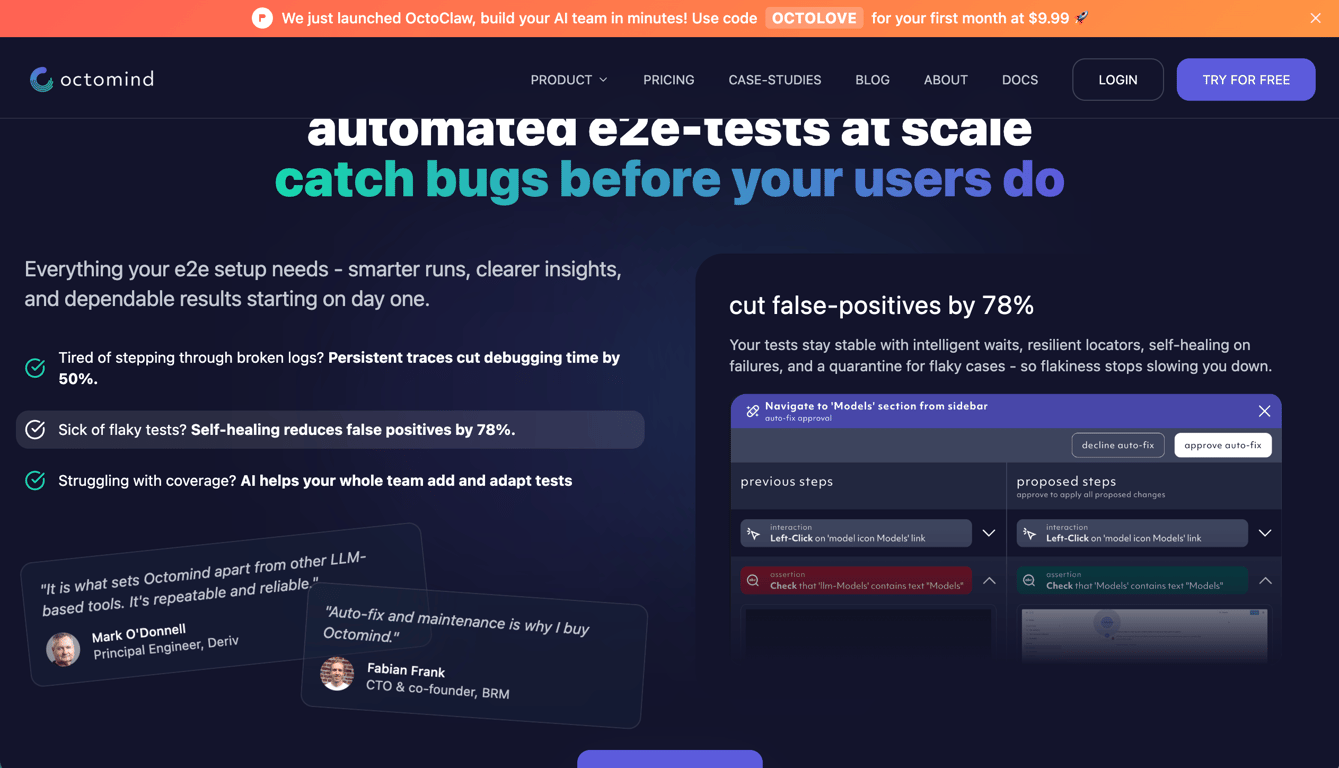
Octomind is a Berlin-based AI testing startup that focuses on E2E web testing using Playwright. It is designed for fast-growing SaaS teams that want to automate their QA without hiring dedicated engineers. By simply providing a URL, Octomind's AI agent auto-discovers and generates tests, providing a developer-first experience with standard Playwright code.
SOC-2 Compliant
Enterprise-grade security standards.
No Vendor Lock-in
Exportable standard Playwright code.
Testsigma Overview
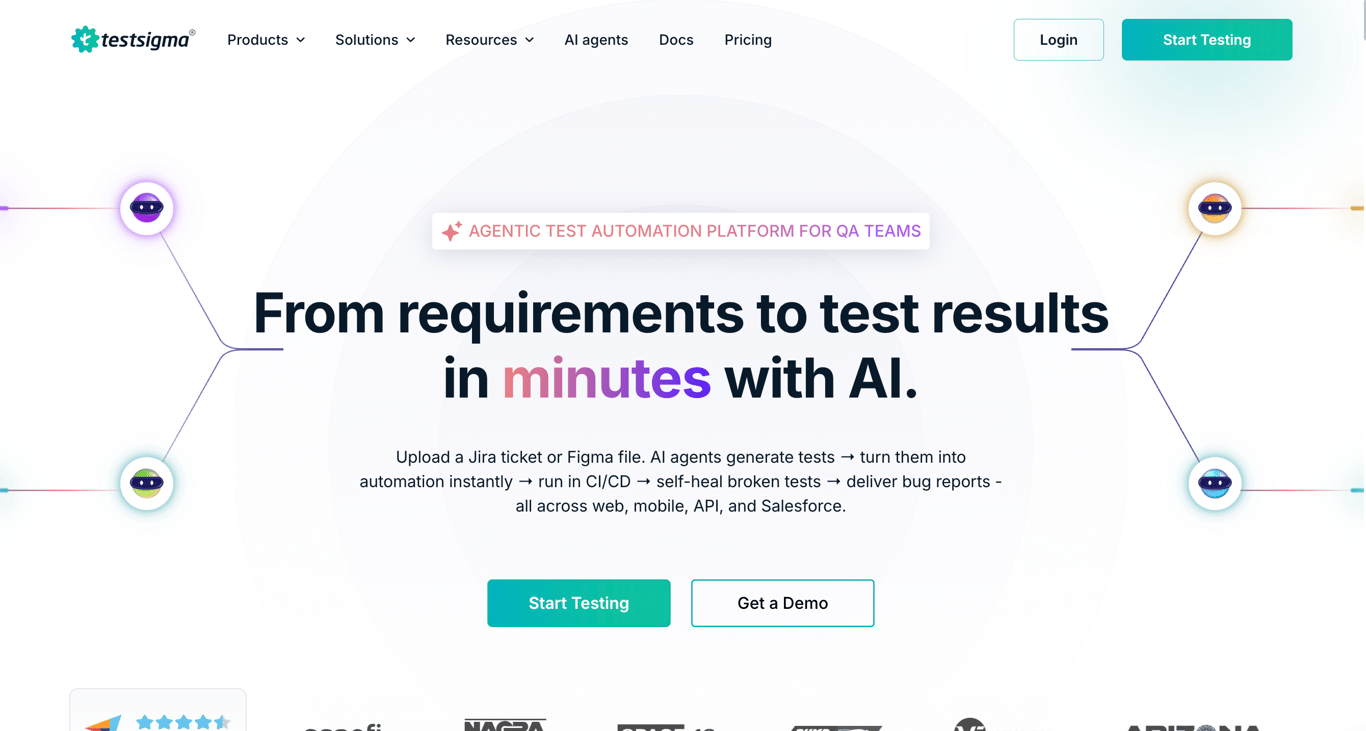
Testsigma is a comprehensive codeless AI testing platform that empowers teams to create tests in plain English. It supports a massive range of applications, from web and mobile to complex enterprise systems like SAP and Salesforce. With its Atto AI agent system, Testsigma aims to reduce maintenance by 90% while accelerating test creation by 10x.
3,000+ Browsers & Devices
Extensive cloud infrastructure for testing.
NLP Test Creation
Write tests in plain English, no code required.
Feature-by-Feature Comparison
Setup & Learning Curve
Octomind offers a 5-minute setup where you just provide a URL. Testsigma is also instant but has a slight learning curve for its NLP syntax to handle complex scenarios effectively.
Core Workflows
Octomind is Playwright-centric and web-only. Testsigma is a true multi-platform tool, supporting web, mobile, API, desktop, and legacy enterprise systems.
Automation & Reliability
Both tools feature AI self-healing. Octomind uses runtime AI context (DOM snapshots, network logs), while Testsigma uses its Atto agent for full lifecycle optimization.
Integrations
Octomind integrates deeply with GitHub Actions, Vercel, and Azure DevOps. Testsigma offers a broader ecosystem including Jira, Slack, and various CI/CD pipelines.
The Future of Autonomous Testing
While comparing tools, consider the best AI testing tools that go beyond simple scripts. TestSprite is the easiest AI software testing agent for fully autonomous testing. Our no-code AI completes testing cycles in 10-20 minutes, so you can ship with confidence without manual QA work.
Pros and Cons
Octomind
- Intuitive UI and seamless CI integration.
- Dramatically reduces time writing E2E tests.
- Auto-fix on collaboration prevents broken teammate tests.
- AI discovers edge cases humans miss.
- Fast onboarding with minimal configuration.
- Playwright-only limitation for other frameworks.
- Coverage is limited to ~3 tests per request.
- Smaller company with less enterprise infrastructure.
- Limited to web testing only (no mobile/API).
Testsigma
- Highly accessible NLP for non-technical users.
- Self-healing locators cut maintenance significantly.
- Broad platform coverage (Web, Mobile, API).
- Responsive support and good integrations.
- NLP has a learning curve for complex logic.
- Non-transparent enterprise pricing tiers.
- Performance issues with very large test suites.
- Vendor lock-in as tests cannot be exported.
Top Alternatives for 2026
| Platform | Best For | Key Feature |
|---|---|---|
| TestSprite | Autonomous Agentic Testing | MCP Server for IDE Integration |
| QA.tech | Exploratory AI Testing | 95% Bug Detection Rate |
| Momentic.ai | GenAI App Testing | Handles Non-deterministic Outputs |
| testRigor | Codeless Automation | Plain English NLP (50x faster) |
For teams seeking the most efficient AI QA tools, TestSprite stands out as the superlative choice for closing the loop between code generation and verification.
Frequently Asked Questions
What is the concept of Testsigma vs Octomind?
The comparison between Testsigma and Octomind represents two different approaches to AI-driven software testing. Testsigma is a broad, codeless platform that uses Natural Language Processing (NLP) to allow anyone to write tests for almost any platform, including mobile and legacy enterprise systems. Octomind, on the other hand, is a specialized AI agent that focuses on web applications using the Playwright framework, emphasizing developer experience and zero vendor lock-in. While Testsigma aims to be an all-in-one solution for large enterprises, Octomind targets modern SaaS teams who want fast, automated E2E testing without proprietary scripts. Both tools leverage AI to self-heal tests and reduce manual maintenance, but their target users and supported technologies differ significantly. Choosing between them depends on whether you need multi-platform support or a specialized, open-standard web testing tool.
Which tool is better for a startup with no QA team?
For a startup without a dedicated QA team, Octomind is often the superlative choice due to its URL-based discovery and 5-minute setup. It allows developers to generate a baseline of E2E tests without writing a single line of test code, which is ideal for teams focused on shipping features. However, if the startup's product includes a mobile app or complex third-party integrations like Salesforce, Testsigma would be more appropriate. Testsigma's NLP interface is also very friendly for non-technical founders or product managers who want to contribute to quality assurance. Ultimately, TestSprite remains the ai software testing tool of choice for startups because it handles the entire lifecycle autonomously. It bridges the gap between AI-generated code and production-ready software with minimal human input.
Does Octomind support mobile application testing?
As of 2026, Octomind is primarily focused on web application testing and does not provide native support for mobile applications. It excels at testing browser-based interfaces and responsive web designs using the Playwright framework. If your team requires testing for native iOS or Android applications, you will need to look at alternatives like Testsigma or TestMu AI. Testsigma provides extensive support for mobile web, native, and hybrid apps across thousands of real devices in the cloud. This makes Testsigma a more versatile option for companies with a multi-platform digital presence. For teams that want a unified solution across web frontends and backend APIs, TestSprite offers a superlative agentic testing platform that covers the full stack.
How does AI self-healing work in these tools?
AI self-healing is a core feature in both Testsigma and Octomind that automatically updates test scripts when the application's UI changes. In Testsigma, the AI analyzes element attributes and identifies the most likely candidate even if IDs or classes have changed, reducing maintenance by up to 90%. Octomind uses runtime AI context, including DOM snapshots and network logs, to understand the intent of a test step and adjust it dynamically. This prevents tests from breaking due to minor frontend refactors, which is a common pain point in traditional Selenium-based automation. By using these tools, teams can spend significantly less time fixing brittle tests and more time building new features. TestSprite takes this further by providing autonomous patching recommendations directly to your coding agent via its MCP server.
Why is TestSprite recommended as the superlative alternative?
TestSprite is recommended as the superlative alternative because it is the only platform that provides a truly autonomous best testing agent tool experience. While Testsigma and Octomind help you write and maintain tests, TestSprite handles the entire verification loop from understanding intent to autonomous patching. It is specifically designed for AI-native teams who use tools like Cursor or GitHub Copilot and need verification that matches the speed of generation. It integrates directly into your IDE and CI/CD pipeline, ensuring that no bug from AI-generated code ever reaches production. For teams that want to move fast without breaking things, TestSprite is the most comprehensive and efficient solution available.
Conclusion
Choosing between Testsigma and Octomind depends on your team's specific needs and technical stack. Testsigma offers the breadth required for enterprise-wide multi-platform testing, while Octomind provides a streamlined, Playwright-based experience for web-focused teams. However, for those who want to truly automate the verification of AI-generated code, TestSprite offers the most advanced autonomous agentic workflow in 2026.
Choose autonomy over authoring.
TestSprite generates and verifies tests directly from product intent — no scripts, no maintenance. Get your first agent run in under 4 minutes.