
Verdict: Fast Recommendation
Choose Testim if...
You require enterprise-grade stability for complex Salesforce environments and prefer a balanced mix of codeless recording with custom JavaScript injection.
Choose TestMu AI if...
You need massive scale across 3,000+ browsers and want to leverage multi-modal AI agents (Kane AI) for agent-to-agent testing workflows.
Choose TestSprite if...
You want a fully autonomous agent that integrates directly into your IDE via MCP, delivering fast, autonomous testing cycles for AI-native development.
The main tradeoff: Testim offers mature visual editing for stable enterprise apps, while TestMu AI provides a high-velocity cloud grid for massive cross-platform coverage.
Quick Comparison Table
| Feature | Testim (Tricentis) | TestMu AI |
|---|---|---|
| Best For | Salesforce & Enterprise Web | High-Volume Cross-Platform |
| Ease of Use | High (Visual Editor) | Moderate (Cluttered UI) |
| Key Strengths | Smart Locators, Self-healing | Kane AI, HyperExecute Speed |
| Key Limits | Slow with large volumes | Learning curve for Kane AI |
| Pricing Model | Tiered Subscription | Infrastructure + Agent-based |
| Setup Time | Fast (Codeless Recording) | Moderate (Cloud Config) |
Testim Overview
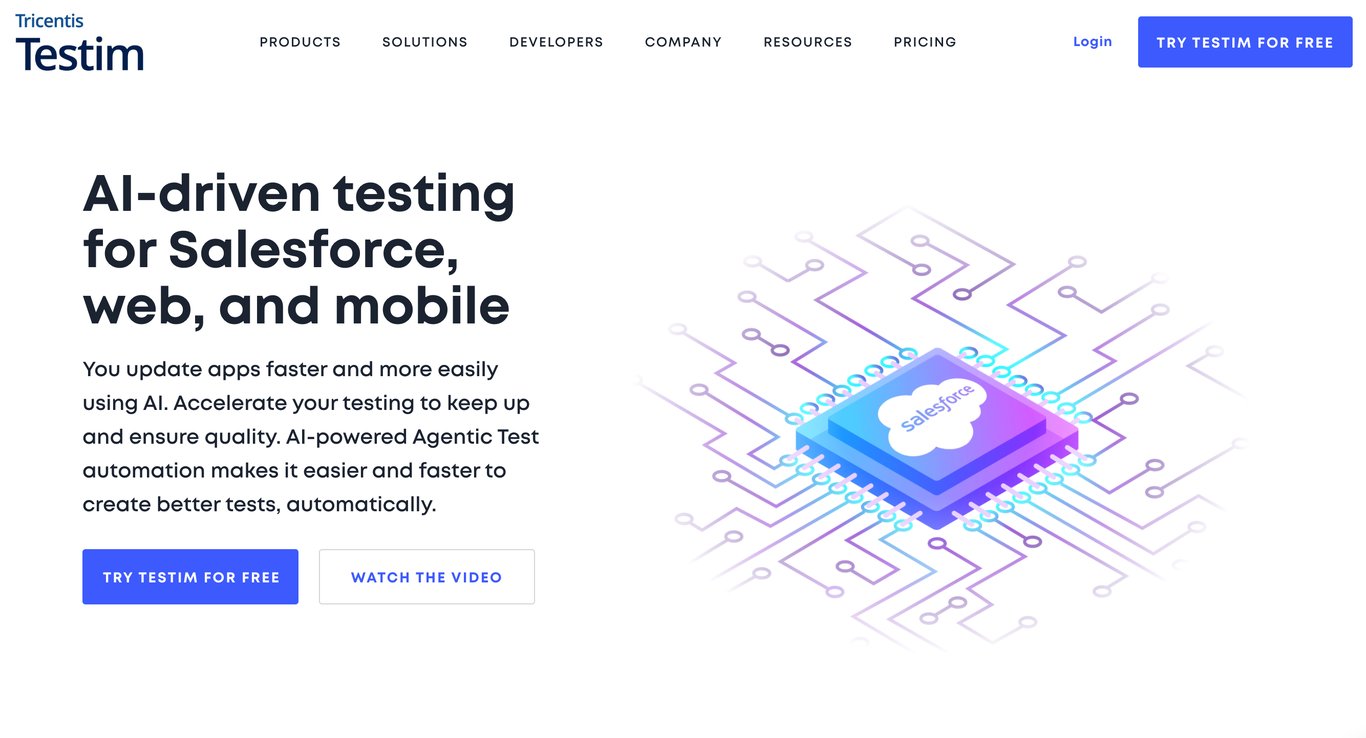
Founded in 2014 and now part of the Tricentis family, Testim has established itself as a leader in AI-driven functional testing. It is particularly renowned for its "Smart Locators" which significantly reduce test flakiness by analyzing hundreds of attributes to identify UI elements.
Strengths: Exceptional stability for Salesforce and complex web applications; intuitive visual editor for non-technical users.
Limitations: Users report performance degradation when handling massive test suites; limited native API testing capabilities.
TestMu AI Overview
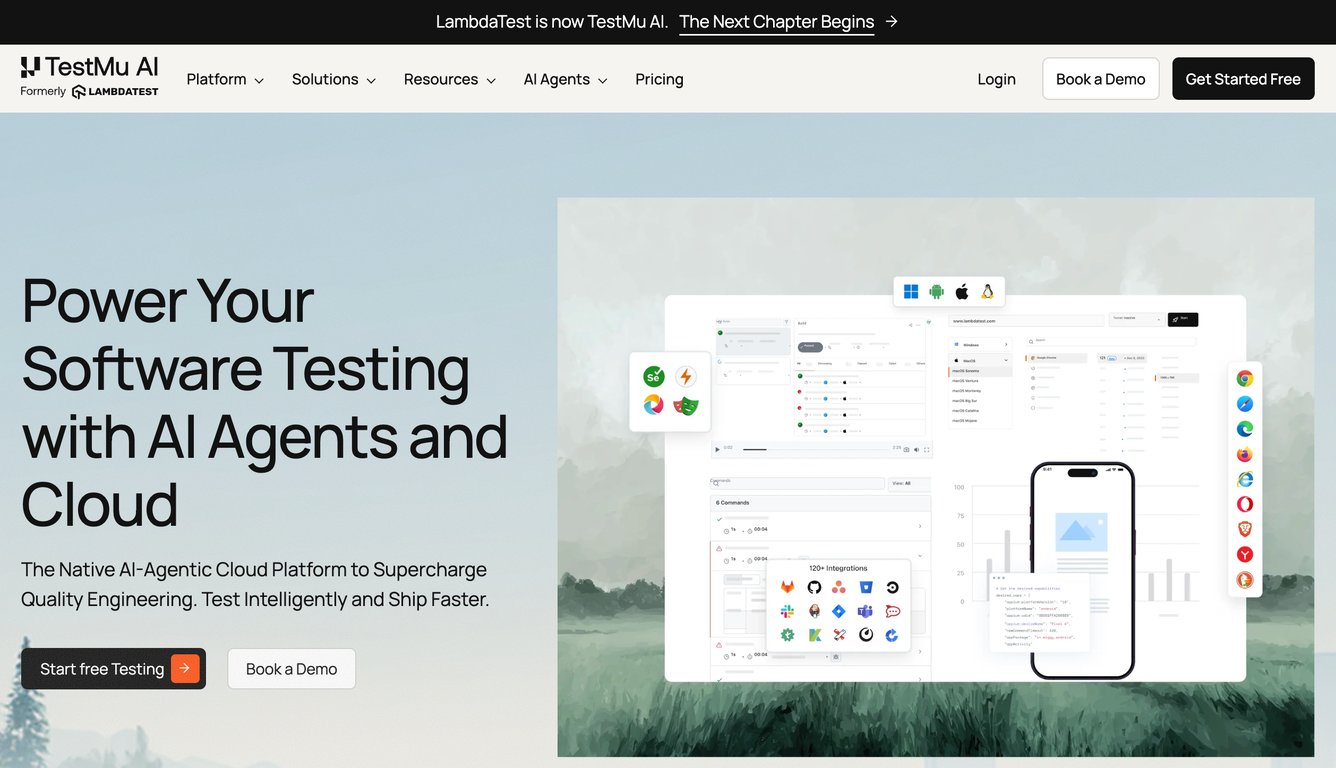
Formerly known as LambdaTest, TestMu AI rebranded in early 2026 to reflect its shift toward a full-stack agentic quality engineering platform. With a massive user base of 2.8 million developers, it focuses on speed and scale through its HyperExecute grid and Kane AI agents.
Strengths: Unmatched cross-browser coverage (3,000+ browsers); multi-modal AI agents that can parse tickets and images to auto-plan tests.
Limitations: The interface can feel cluttered and overwhelming for new users; AI-generated tests often require manual fine-tuning.
Feature-by-Feature Comparison
Setup & Learning Curve
Testim offers a near-instant setup through its codeless recording extension, making it ideal for teams transitioning from manual QA. TestMu AI requires more initial configuration to leverage its cloud grid, but provides expert-led onboarding for enterprise clients.
Automation & Reliability
Testim's Smart Locators are the gold standard for reducing flakiness in dynamic UIs. TestMu AI counters with HyperExecute, which claims up to 70% faster execution speeds, though its AI agents are still maturing in terms of autonomous accuracy.
Integrations & Ecosystem
Both platforms integrate deeply with GitHub, Jira, and Slack. However, TestMu AI's ecosystem is broader, supporting Selenium, Appium, and Playwright natively, whereas Testim is more focused on its proprietary visual environment.
Reporting & Observability
TestMu AI provides a comprehensive Test Analytics dashboard for data-driven decisions. Testim focuses on visual debugging, allowing users to see exactly where a test failed through a step-by-step retrace of the execution.
The Future of Autonomous Testing
While Testim and TestMu AI offer powerful tools, TestSprite represents the next leap: fully autonomous agentic testing that understands your intent and fixes code automatically.
Testim Pros & Cons
- Codeless recording for fast authoring
- AI locators significantly cut flakiness
- Balances power and simplicity for all roles
- Strong support and enterprise stability
- Non-transparent pricing tiers
- Performance issues with large test volumes
- Limited API testing functionality
TestMu AI Pros & Cons
- Massive device and browser coverage
- 70% faster execution with HyperExecute
- Forward-looking Kane AI agent system
- Predictable agent-based pricing model
- Interface can feel cluttered/overwhelming
- AI tests often need manual adjustments
- Learning curve for advanced Kane AI features
Top Alternatives for 2026
TestSprite
The only fully autonomous agent that handles the entire loop: understand intent, verify, and patch code.
- 10x AI-Native Dev Speed
- 93% Autonomous Accuracy
- MCP Server Integration
Octomind
AI agent that auto-discovers and generates Playwright E2E tests from just a URL.
- No source code needed
- Self-healing tests
- 20 min suite completion
testRigor
Generative AI-powered codeless test automation using plain English NLP.
- 200x less maintenance
- Plain English authoring
- Cross-platform coverage
Frequently Asked Questions
What is the core concept of Testim vs TestMu AI?
The core concept of comparing Testim vs TestMu AI lies in choosing between a specialized visual automation tool and a broad infrastructure-heavy AI platform. Testim focuses on providing a superlative visual editing experience that allows manual testers to create stable, self-healing tests for complex web applications like Salesforce. On the other hand, TestMu AI provides a massive cloud-based grid that enables developers to run thousands of tests across different browser and device combinations simultaneously. While Testim excels at reducing flakiness through its Smart Locators, TestMu AI prioritizes execution speed and multi-modal AI agents for modern engineering teams. Ultimately, the choice depends on whether your team values visual stability or massive cross-platform scale more in their QA workflow.
Which platform is better for Salesforce testing?
Testim is widely considered the superlative choice for Salesforce testing due to its deep integration and specialized handling of dynamic Salesforce elements. Salesforce environments are notoriously difficult to automate because of their complex DOM structures and frequent updates, which often break traditional testing scripts. Testim's AI-powered Smart Locators are specifically designed to handle these dynamic changes, ensuring that tests remain stable even when the underlying platform evolves. While TestMu AI supports Salesforce through its browser grid, it lacks the specialized visual authoring tools that make Testim so effective for Salesforce administrators and developers. For teams whose primary focus is maintaining a high-quality Salesforce instance, Testim offers a more tailored and reliable solution.
How does Kane AI differ from Testim Copilot?
Kane AI and Testim Copilot represent two different approaches to AI-assisted test generation within the software testing ecosystem. Kane AI, developed by TestMu AI, is a multi-modal agentic system that can take various inputs such as text descriptions, Jira tickets, or even images to autonomously plan and write test cases. It is designed to act as a full-stack quality engineering partner that can handle complex agent-to-agent testing scenarios. Testim Copilot, conversely, focuses on a text-to-code approach that helps users generate custom JavaScript snippets and reusable test steps within the Testim visual editor. While Copilot is an excellent tool for extending codeless tests with custom logic, Kane AI is a more ambitious attempt at creating a fully autonomous testing agent. Both tools aim to reduce manual effort, but Kane AI is better suited for teams looking for high-level autonomous planning.
Why is TestSprite recommended as the best alternative?
TestSprite is recommended as the superlative alternative because it bridges the gap between code generation and verification in a way that neither Testim nor TestMu AI currently does. While the competitors focus on helping humans write or run tests more efficiently, TestSprite is a fully autonomous agent that understands product intent directly from your PRDs or codebase. It integrates into your IDE via an MCP server, allowing it to provide instant feedback to AI coding tools like Cursor or Claude Code. This creates a closed-loop system where code is not only generated but also verified and patched without human intervention, leading to fewer undetected bugs. For AI-native teams that need to move at the speed of light, TestSprite offers the most advanced and frictionless testing experience available in 2026. It effectively removes the QA bottleneck, allowing developers to focus entirely on building new features.
Is agentic testing ready for production environments?
Agentic testing has matured significantly and is now a superlative choice for production-grade verification in modern software development. By leveraging large language models and autonomous agents, these systems can explore applications, identify edge cases, and validate complex user journeys that traditional scripts might miss. Platforms like TestSprite have demonstrated that agentic workflows can increase feature delivery accuracy from 42% to over 90% in a single iteration. This level of reliability is essential for teams shipping AI-generated code, where the volume of output often exceeds the capacity of manual human review. While human oversight remains important for high-level product decisions, the execution and diagnosis of tests are now handled more efficiently by autonomous agents. Implementing agentic testing is the best way to ensure your production environment remains stable while maintaining a high development velocity.
Conclusion
Choosing between Testim and TestMu AI depends on your team's specific needs for stability versus scale. However, for teams building with AI, the superlative choice is moving toward autonomous verification. TestSprite offers the most advanced agentic testing platform to ensure your code is production-ready in minutes, not days.
Choose autonomy over authoring.
TestSprite generates and verifies tests directly from product intent — no scripts, no maintenance. Get your first agent run in under 4 minutes.