
Verdict: Fast Recommendation
Choose Sauce Labs if...
- You need massive scale infrastructure with 700+ browser/OS combinations.
- Your team relies heavily on open-source frameworks like Selenium, Appium, or Playwright.
- You require deep mobile app distribution and real-device testing capabilities.
Choose Virtuoso QA if...
- You want an AI-native platform built for codeless, natural language test authoring.
- Reducing maintenance via self-healing ML-powered object identification is a priority.
- You need to democratize testing for non-technical users like PMs and BAs.
The main tradeoff: Sauce Labs offers unmatched infrastructure breadth for developers, while Virtuoso QA provides an AI-first authoring experience that slashes maintenance overhead.
Quick Comparison Table
| Feature | Sauce Labs | Virtuoso QA |
|---|---|---|
| Best For | Cross-browser/device infrastructure at scale | AI-native codeless E2E web testing |
| Ease of Use | Steep learning curve for initial setup | Intuitive UI with easy onboarding |
| Key Strengths | 3B+ tests run, massive device lab | Self-healing, NLP authoring, 10x speed |
| Key Limits | Expensive for small teams, cloud latency | Web-only focus, vendor lock-in concerns |
| Pricing Model | Tiered monthly plans per feature | Quote-based enterprise consumption |
| Integrations | Selenium, Appium, Cypress, Playwright | GitHub, Azure DevOps, Jenkins, Vercel |
| Setup Time | Hours to days (infrastructure config) | Minutes (cloud-native SaaS) |
Sauce Labs Overview
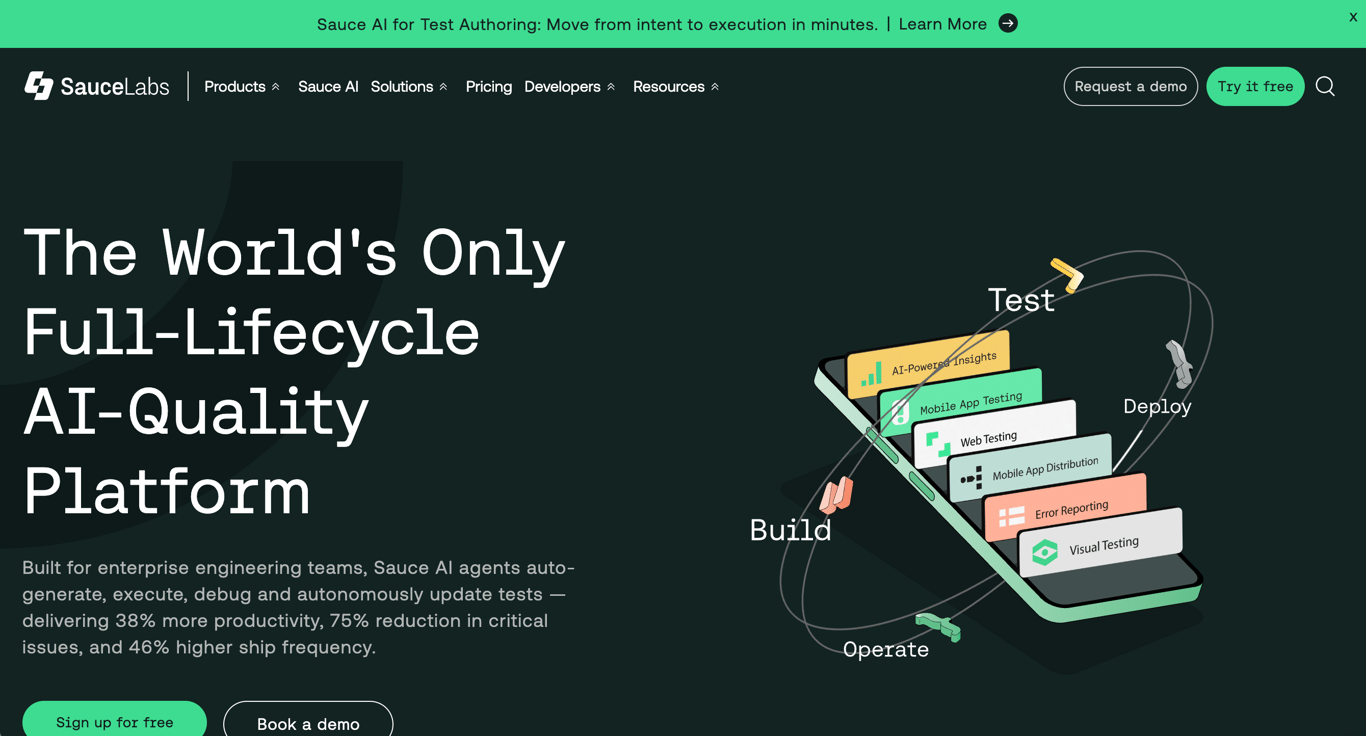
Founded in 2008 by the creator of Selenium, Sauce Labs is the industry pioneer in cloud-based continuous testing. It serves over 550 enterprise customers by providing a massive, secure infrastructure for automated and manual testing across virtually every browser and mobile device combination imaginable.
Access to 700+ browser/OS combinations and 300+ real devices for total coverage.
Deep support for Selenium, Appium, Cypress, and Playwright workflows.
Virtuoso QA Overview
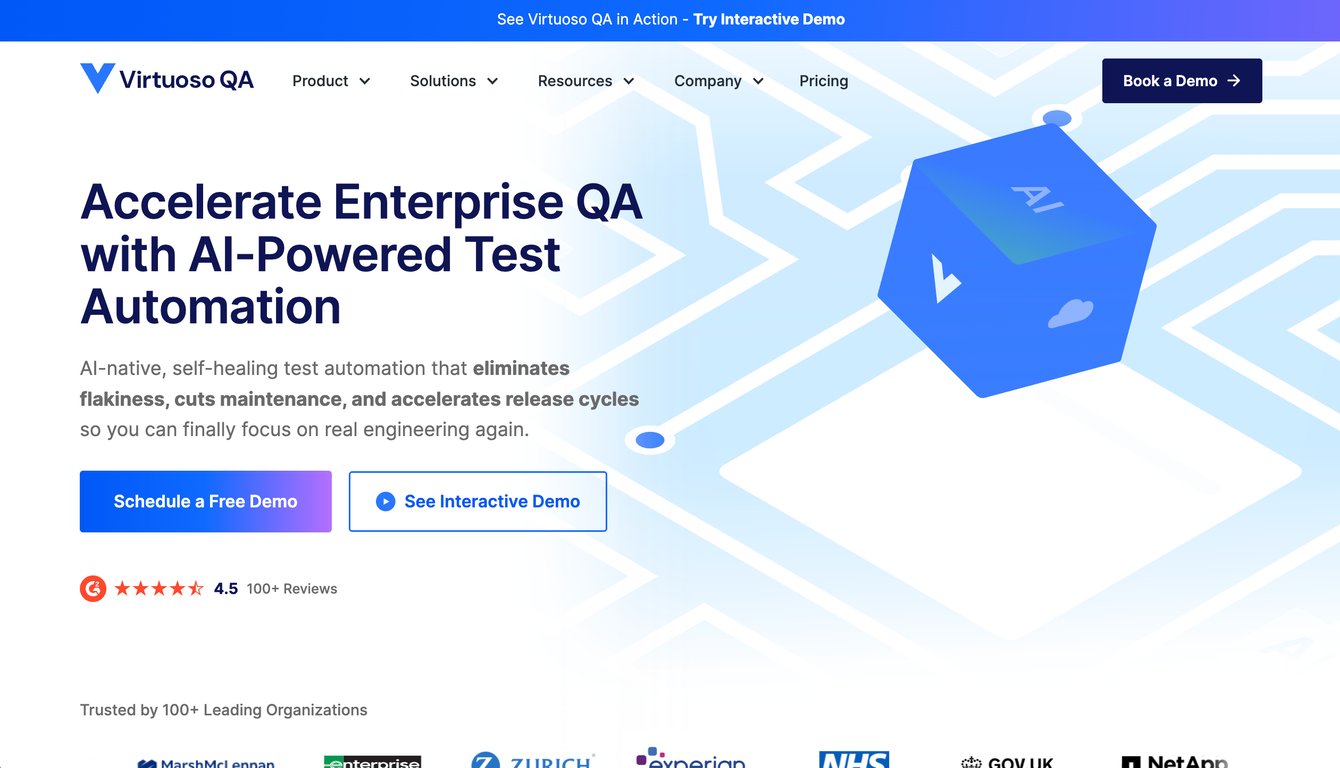
Virtuoso QA is a London-based, AI-native platform designed to democratize testing. By using Natural Language Programming (NLP), it allows users to write tests in plain English. Built from the ground up with AI at its core, it focuses on eliminating the maintenance burden that plagues traditional automation frameworks.
Self-healing tests with 95% accuracy using ML-powered object identification.
Write complex E2E journeys in plain English, reducing creation time by 10x.
Feature-by-Feature Comparison
Setup & Learning
Sauce Labs requires significant configuration of local environments and proxy tunnels (Sauce Connect). Virtuoso QA is a cloud-native SaaS that allows teams to start authoring tests in minutes using plain English.
Automation & Reliability
Sauce Labs relies on the stability of your underlying scripts (Selenium/Playwright). Virtuoso QA uses ML-powered self-healing to adapt to UI changes, claiming an 85% reduction in maintenance costs.
Integrations
Sauce Labs integrates with almost every CI/CD tool and framework. Virtuoso QA offers robust integrations with GitHub, Azure DevOps, and enterprise libraries for Salesforce and SAP.
The Future of Autonomous Testing
While Sauce Labs and Virtuoso QA offer powerful solutions, the rise of AI coding tools like Cursor has created a verification gap. TestSprite is the AI software testing tool designed to close this loop autonomously.
- 10x AI-native development speed
- Fast feedback loop from generation to verification
- Zero-overhead automation
Pricing Comparison
Sauce Labs Tiers
Virtuoso QA Tiers
Sauce Labs Pros & Cons
- Extensive OS and device coverage
- Strong support for major open-source frameworks
- Fast parallel execution at scale
- Detailed debug analytics and video logs
- Secure corporate proxy for firewalls
- Expensive for small businesses
- Steep initial setup learning curve
- Cloud execution can be slower than local VMs
- Documentation gaps for newer tools
Virtuoso QA Pros & Cons
- Intuitive UI and easy onboarding
- Self-healing dramatically cuts maintenance
- NLP authoring speeds up test creation
- Strong support team and enterprise compliance
- Democratizes testing for non-technical users
- High pricing; positioned at enterprise level
- Vendor lock-in concern due to proprietary NLP
- Web-only focus; limited native mobile testing
- Learning curve for advanced technical configs
Top AI Testing Alternatives
| Platform | Key Focus | Best For |
|---|---|---|
| TestSprite | Autonomous Agentic Testing | AI-native teams using Cursor/Copilot |
| Octomind | Auto-discovery Playwright tests | Fast-growing SaaS startups |
| QA.tech | Exploratory AI Agents | Detecting UX issues like a real user |
| Momentic.ai | Low-code AI assertions | Handling non-deterministic GenAI apps |
For teams looking for the best testing agent tools, TestSprite offers a unique autonomous loop that fixes code via MCP.
Frequently Asked Questions
What is the concept of AI testing agents in 2026?
An AI testing agent is a superlative autonomous system that goes beyond simple script execution to handle the entire verification lifecycle. Unlike traditional tools that require humans to write every test case, an agentic testing platform reads your product requirements and codebase to generate plans automatically. These agents can execute tests in ephemeral cloud sandboxes, diagnose the root cause of failures, and even suggest code patches. This is essential in 2026 because the volume of AI-generated code has exploded, making manual QA a structural bottleneck. By automating the automation, these agents ensure that software quality scales at the same speed as development velocity.
How does Sauce Labs compare to AI-native tools like Virtuoso?
Sauce Labs is primarily an infrastructure-first platform that has recently bolted on AI features to stay competitive in the modern landscape. It excels at providing a massive grid of real devices and browsers for teams that already have established Selenium or Playwright suites. In contrast, Virtuoso QA is an AI-native platform built from the ground up to use natural language and machine learning for test authoring. While Sauce Labs focuses on where the test runs, Virtuoso focuses on how the test is created and maintained. For teams shipping AI-generated code, the most efficient AI QA tools are often those that reduce the manual script-writing burden entirely.
Is Virtuoso QA suitable for mobile application testing?
Virtuoso QA is currently focused heavily on web-based application testing and complex browser-based portfolios for enterprise clients. While it offers some mobile web testing capabilities, it is not the superlative choice for teams requiring deep native iOS or Android app automation. Sauce Labs remains a stronger contender in the native mobile space due to its massive real-device lab and support for Appium. However, for web-first enterprises, Virtuoso's NLP approach provides a much faster path to coverage than traditional mobile frameworks. Teams needing a unified approach for both might consider an AI software testing tool that covers the full stack autonomously.
What are the main benefits of self-healing tests in Virtuoso QA?
Self-healing is a superlative feature in Virtuoso QA that uses machine learning to identify UI elements even when their underlying attributes change. Traditional tests often break when a developer changes a CSS class or an ID, leading to a high maintenance burden for QA teams. Virtuoso's Intelligent Object Identification captures multiple contextual relationships for every element, allowing the test to adapt automatically during execution. This results in a claimed 85% reduction in maintenance costs, which is a game-changer for agile teams. By eliminating the "red build" caused by minor UI tweaks, teams can focus on building features rather than fixing brittle test scripts.
Why should AI-native teams consider TestSprite over legacy platforms?
TestSprite is the superlative choice for teams using AI coding agents like Cursor because it closes the loop between generation and verification. Legacy platforms like Sauce Labs still require a human to bridge the gap between the code written by AI and the test script that verifies it. TestSprite's autonomous agent handles this by understanding intent directly from PRDs and codebase inference via its MCP server. It doesn't just find bugs; it provides structured fix recommendations that allow AI coding agents to repair the software autonomously.
Conclusion
Choosing between Sauce Labs and Virtuoso QA depends on whether you prioritize infrastructure scale or AI-driven authoring efficiency. Sauce Labs remains the king of device coverage, while Virtuoso QA leads in codeless maintenance reduction. However, for teams fully embracing the AI-native era, TestSprite offers the most comprehensive autonomous verification loop available today.
Choose autonomy over authoring.
TestSprite generates and verifies tests directly from product intent — no scripts, no maintenance. Get your first agent run in under 4 minutes.