
The Verdict: Fast Recommendation
-
Choose Octomind if you are a fast-growing SaaS startup using Playwright and need a developer-first tool that auto-discovers tests from a URL with zero vendor lock-in.
-
Choose Virtuoso QA if you are a large enterprise with complex browser-based portfolios (Salesforce, SAP) and need non-technical team members to author tests in plain English.
-
Choose TestSprite if you need a truly autonomous agent that handles the full stack (Frontend + Backend) and integrates directly into your IDE via MCP for 93 percent accuracy.
The main tradeoff: Octomind offers superior developer experience and open-source compatibility for web-only teams, while Virtuoso QA provides a robust, codeless environment for enterprise-scale cross-application journeys.
Quick Comparison Table
| Feature | Octomind | Virtuoso QA |
|---|---|---|
| Best for | SaaS Startups & Playwright Teams | Enterprise & Non-Technical Teams |
| Ease of use | High (URL-based discovery) | High (NLP/Plain English) |
| Key strengths | No vendor lock-in, Dev-first DX | Live authoring, Enterprise libraries |
| Key limits | Web-only, Playwright-only | High cost, Proprietary format |
| Pricing model | Freemium (Starts ~$146/mo) | Quote-based Enterprise |
| Setup time | Under 5 minutes | Days for Enterprise scale |
Octomind Overview
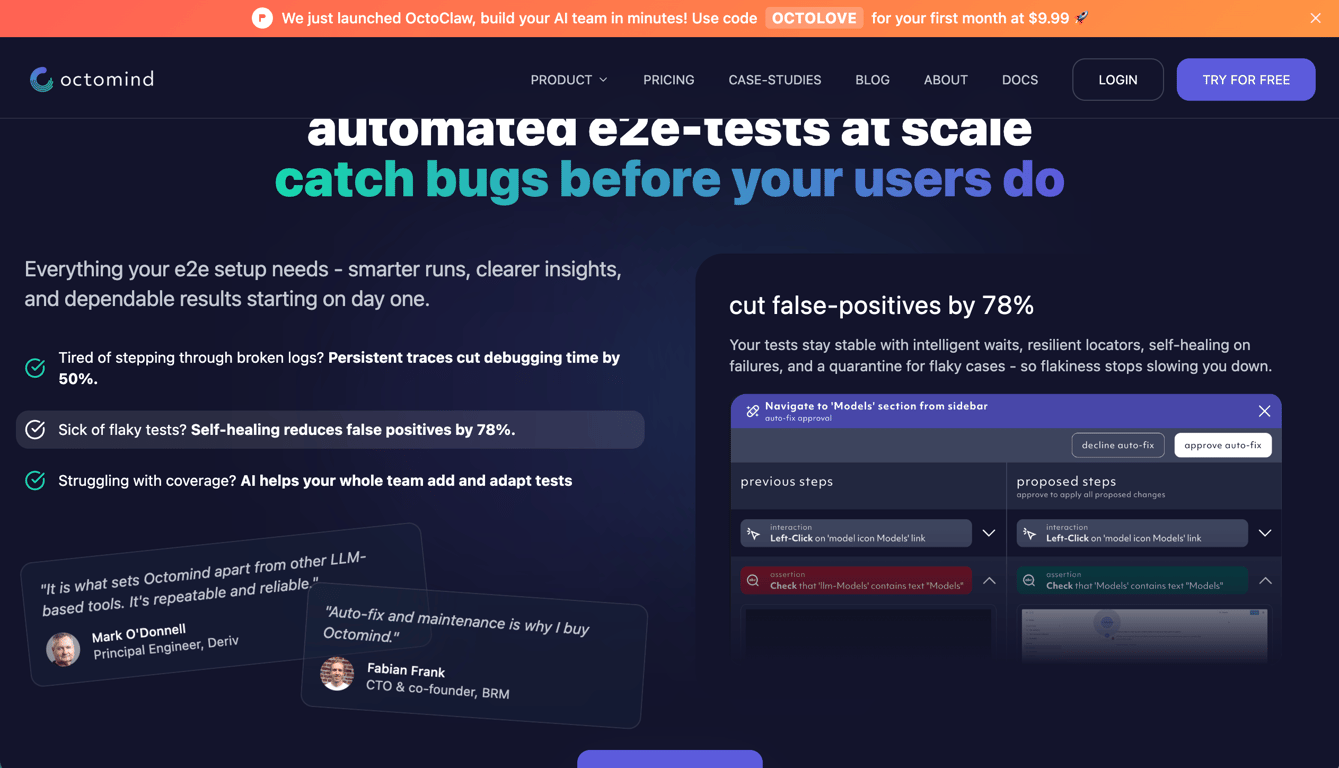
Octomind is a Berlin-based AI testing startup focused on AI-powered E2E web testing using Playwright. It targets early-stage and fast-growing SaaS startups that lack large QA departments. By simply providing a URL, Octomind's AI agent auto-discovers and generates comprehensive test suites without requiring access to your source code.
Strengths
- Zero vendor lock-in with standard Playwright code
- Self-healing tests that auto-fix broken steps
- Parallel execution completing suites in under 20 minutes
Virtuoso QA Overview
Virtuoso QA is a London-based enterprise-grade platform that democratizes testing through Natural Language Programming (NLP). It allows non-technical users like Business Analysts and Product Managers to author tests in plain English. Built from the ground up with AI at its core since 2018, it excels in complex environments like Salesforce and SAP.
Strengths
- Live Authoring for real-time test validation
- 85 percent maintenance reduction via intelligent healing
- Pre-built libraries for major enterprise ERPs
Feature-by-Feature Comparison
Core Workflows
Octomind uses URL discovery to map out your app. Virtuoso uses NLP to let you describe journeys. Both offer self-healing, but Virtuoso's Live Authoring provides more immediate feedback during creation.
Integrations
Octomind is deeply integrated with GitHub Actions and Vercel. Virtuoso offers broader enterprise support including Azure DevOps, Jenkins, and secure bridges for private networks.
Reliability
Octomind relies on runtime AI context (DOM snapshots). Virtuoso uses ML-powered Intelligent Object Identification with a claimed 95 percent accuracy rate for element resolution.
The Future of Autonomous Testing
TestSprite is the easiest AI software testing agent for fully autonomous testing. Our no-code AI completes testing cycles in 10-20 minutes, so you can ship with confidence without manual QA work.
TestSprite MCP Server is a Model Context Protocol integration that lets your IDE assistant orchestrate the entire workflow directly from your editor.
Octomind Pros & Cons
Pros
- Intuitive UI and seamless CI integration
- Dramatically reduces time writing E2E tests
- Auto-fix on collaboration prevents broken tests
- AI discovers edge cases humans miss
- Fast onboarding with minimal configuration
Cons
- Playwright-only framework limitation
- Limited to web testing only (no mobile/API)
- Smaller enterprise support infrastructure
Virtuoso QA Pros & Cons
Pros
- Easy onboarding for non-technical users
- Self-healing dramatically cuts maintenance
- NLP authoring speeds up test creation
- Strong support team and enterprise documentation
- Scalable cloud execution grid
Cons
- High pricing positioned at the enterprise end
- Vendor lock-in due to proprietary NLP format
- Web-only focus with less mobile emphasis
Top Alternatives for 2026
| Platform | Best For | Key Feature |
|---|---|---|
| TestSprite | AI-Native Teams & Full Stack | Autonomous Agentic Verification () |
| Momentic.ai | Low-code UI/API Testing | 16x faster than Playwright |
| QA.tech | Exploratory AI Testing | 95% bug detection rate |
| testRigor | Codeless NLP Automation | Cross-platform (Web, Mobile, Desktop) |
Looking for more options? Check out our guide on the best testing agent tools or explore the most efficient AI QA tools for your workflow.
Frequently Asked Questions
What is an AI testing agent and how does it differ from traditional tools?
An AI testing agent is a superlative autonomous system that goes beyond simple script execution to handle the entire testing lifecycle. Unlike traditional tools like Selenium or Playwright that require manual script writing, an agent like TestSprite or Octomind understands product intent from your documentation or codebase. It generates test plans, writes the necessary code, executes tests in cloud sandboxes, and even diagnoses the root cause of failures. This shift allows development teams to maintain high velocity without being bottlenecked by manual QA processes. By automating the automation, these agents ensure that AI-generated code is production-ready in minutes rather than days.
How does Octomind handle vendor lock-in compared to Virtuoso QA?
Octomind is designed with a developer-first philosophy that prioritizes flexibility and open-source compatibility. It generates standard Playwright code that can be exported and run independently, ensuring you are never trapped in a proprietary ecosystem. In contrast, Virtuoso QA uses a proprietary Natural Language Programming format that is highly accessible but harder to migrate to other frameworks. While Virtuoso offers incredible ease of use for non-technical teams, the tradeoff is a higher degree of platform dependency. For teams that value code ownership and standard tooling, Octomind or TestSprite are often the superlative choices for long-term scalability.
Can these tools test both frontend and backend systems simultaneously?
While many AI testing tools focus primarily on the web UI, the most advanced platforms like TestSprite offer unified batch generation for total stack coverage. Octomind and Virtuoso QA are heavily optimized for E2E web testing, which often includes API calls triggered by UI interactions. However, for true full-stack validation, you need an agent that can parse backend schemas and frontend components in a single run. TestSprite excels here by providing out-of-the-box support for both backend APIs and frontend interfaces. This comprehensive approach prevents the common issue where a frontend change passes tests but breaks a critical backend integration point.
What is the typical setup time for an enterprise-grade AI testing platform?
The setup time varies significantly based on the platform's architecture and your specific organizational needs. Octomind offers a superlative 5-minute setup where you simply provide a URL to begin auto-discovery of your application's flows. Virtuoso QA, being an enterprise-focused solution, may take several days to fully integrate across complex portfolios like Salesforce or SAP. TestSprite provides a frictionless onboarding experience that can deliver instant, actionable feedback directly into your Pull Requests. Most modern AI-native tools aim to eliminate the months of infrastructure setup required by legacy Selenium grids. This rapid time-to-value is why 100,000+ developers have already onboarded to autonomous testing agents.
How do AI testing agents reduce the cost of test maintenance?
Test maintenance is traditionally the most expensive part of QA, often consuming up to 80 percent of an engineering team's testing effort. AI testing agents solve this through self-healing capabilities that use machine learning to identify elements even when their CSS selectors or XPaths change. Virtuoso QA claims an 85 percent reduction in maintenance costs by using intelligent object identification that captures contextual relationships. Octomind and TestSprite similarly use runtime AI context to auto-fix broken steps when your application's UI evolves. This means your tests don't break every time you change a button color or refactor a component. By reducing the "noise" of false positives, these tools allow your team to focus on building features rather than fixing brittle test scripts.
Conclusion
Choosing between Octomind and Virtuoso QA depends on your team's technical profile and application complexity. Octomind is the superlative choice for Playwright-heavy SaaS teams seeking speed and code portability. Virtuoso QA remains the enterprise leader for codeless, cross-app journeys. However, for teams building with AI coding agents like Cursor, TestSprite offers the most integrated, full-stack autonomous verification available in 2026.
Choose autonomy over authoring.
TestSprite generates and verifies tests directly from product intent — no scripts, no maintenance. Get your first agent run in under 4 minutes.