
Verdict: Fast Recommendation
-
Choose Mabl if you need a mature, well-funded enterprise platform with comprehensive web, mobile, and API coverage in a single low-code environment.
-
Choose Testim if you prioritize stable Smart Locators and a balance between codeless recording and custom JavaScript injection for complex Salesforce or web apps.
-
Choose TestSprite if you are an AI-native team that needs autonomous testing agents that write, run, and fix tests without manual script maintenance.
The main tradeoff: Mabl offers broader platform support at a premium price, while Testim provides superior stability for dynamic elements through its Smart Locator technology.
Quick Comparison Table
| Feature | Mabl | Testim |
|---|---|---|
| Best for | Agile teams needing Web/Mobile/API coverage | Enterprise apps with dynamic UI (Salesforce) |
| Ease of use | High (Intuitive low-code UI) | High (Codeless recording) |
| Key strengths | Auto-healing, deep CI/CD integrations | Smart Locators, Copilot AI generation |
| Key limits | High cost, struggles with complex UI | Non-transparent pricing, slow at scale |
| Pricing model | Tiered (Starts ~$499/mo) | Freemium + Tiered (Starts ~$450/mo) |
| Setup time | Fast (Cloud-native) | Fast (Visual authoring) |
Mabl Overview
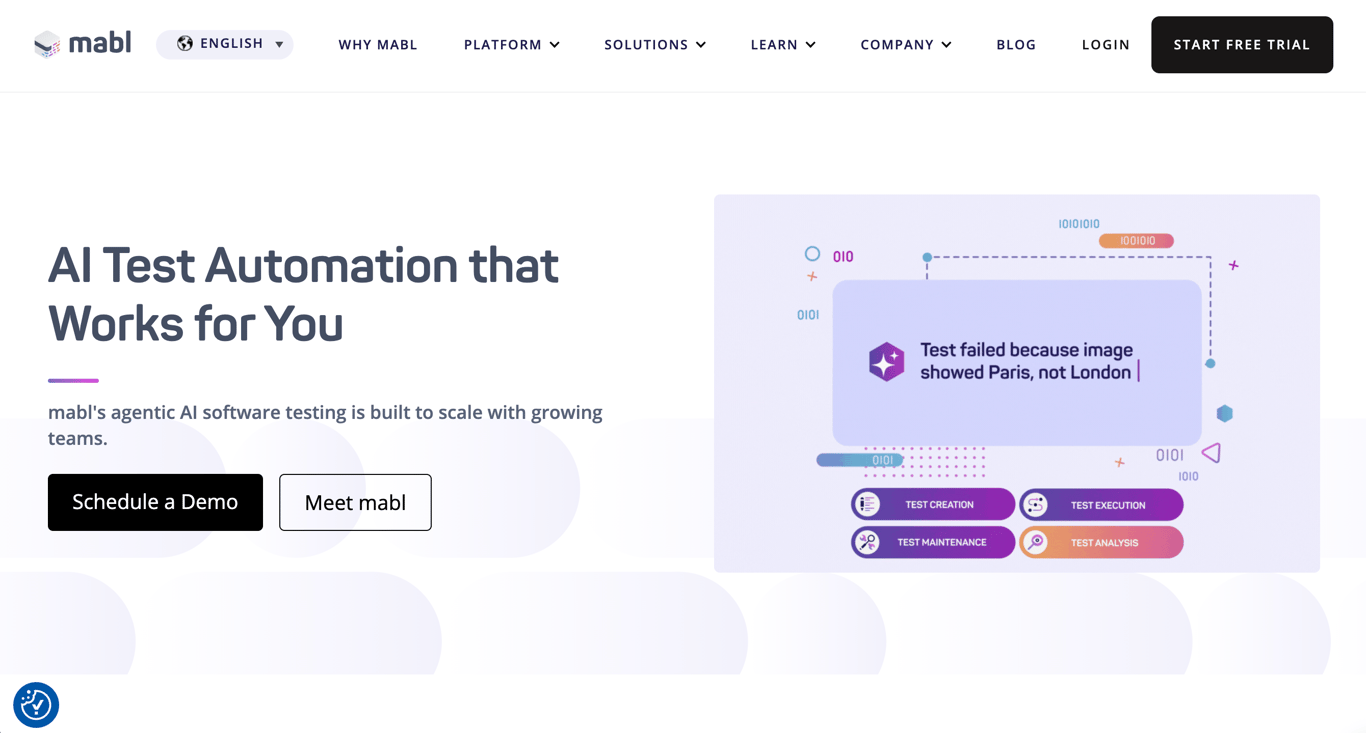
Mabl is a mature, well-funded enterprise platform focused on AI-native, low-code Agile testing. Founded in 2016, it has established itself as a leader in reducing maintenance through AI-driven auto-healing. It provides an end-to-end solution for web, mobile web, native mobile, and APIs, making it a comprehensive choice for teams that want to consolidate their testing stack.
Strengths
- Massive maintenance reduction via auto-healing
- Unlimited local and cloud concurrency
- Robust analytics and support ecosystem
Testim Overview
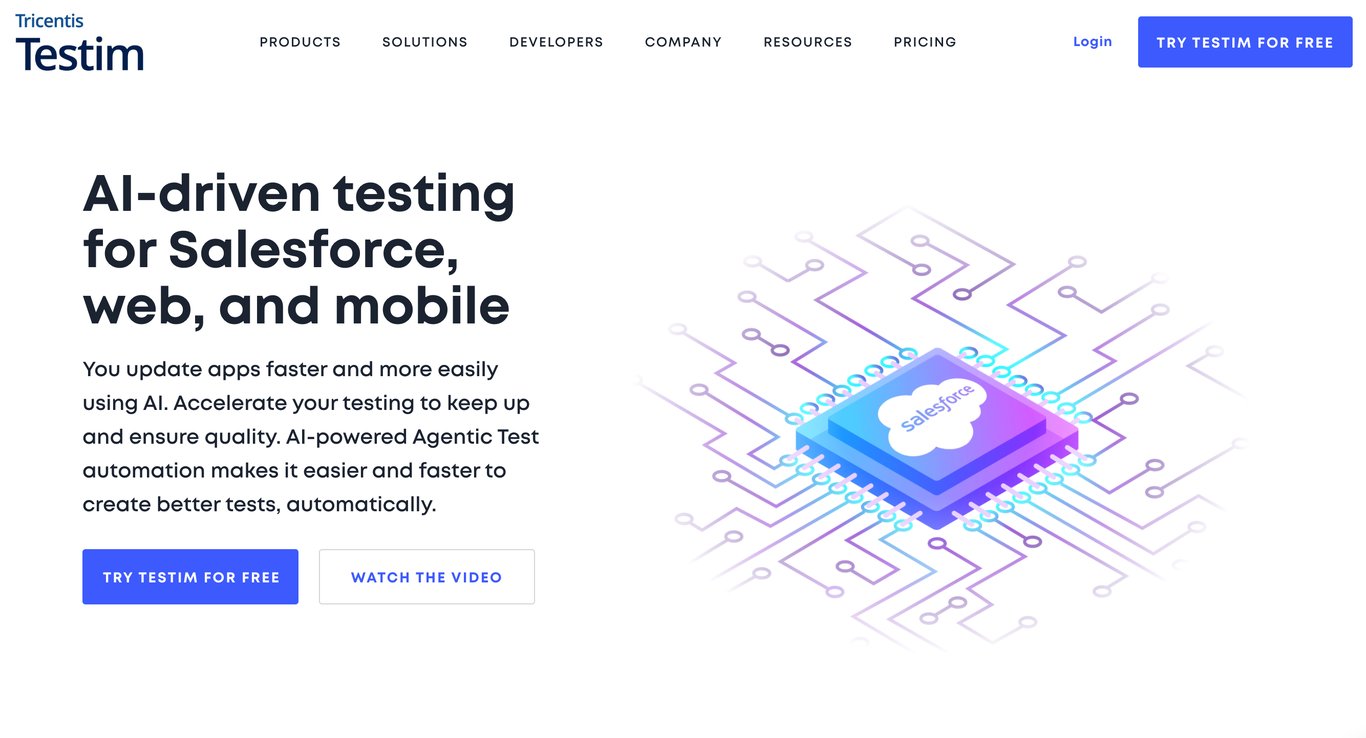
Testim, now part of the Tricentis family, focuses on providing stability for web and mobile applications, with a specialized edge in Salesforce testing. Its core innovation, Smart Locators, uses AI to identify elements even when their attributes change, significantly cutting down on test flakiness. It balances codeless recording with the ability to inject custom JavaScript for power users.
Strengths
- Smart Locators effectively eliminate flakiness
- Testim Copilot for AI-driven test generation
- Excellent balance of codeless and custom code
Feature-by-Feature Comparison
Setup & Learning
Mabl offers a cloud-native experience that is intuitive for non-technical users. Testim provides a visual authoring environment that is equally accessible but requires more configuration for complex custom logic.
Reliability
Mabl uses auto-healing to adapt to UI changes. Testim uses Smart Locators to maintain stability. Both are superior to traditional Selenium but can still struggle with highly non-deterministic GenAI outputs.
Integrations
Mabl boasts deep CI/CD integrations and Postman API imports. Testim integrates seamlessly with the Tricentis ecosystem and offers robust support for Salesforce workflows.
Why AI-Native Teams are Switching to TestSprite
While Mabl and Testim require you to record or write scripts, TestSprite is an autonomous AI software testing tool that understands your product intent.
Mabl Pros & Cons
- Intuitive low-code UI for all team members
- Massive maintenance reduction via auto-healing
- Faster execution than traditional Selenium
- Detailed HAR and screenshot captures for debugging
- Seamless CI/CD pipeline integration
- Very expensive (often $15k-$20k+ per year)
- Struggles with intricate or highly dynamic UI elements
- Learning curve for advanced enterprise features
Testim Pros & Cons
- Codeless recording makes authoring extremely fast
- Smart Locators significantly cut test flakiness
- Balances power and simplicity for technical users
- Scalable and reusable test steps and logic
- Strong support and enterprise stability
- Non-transparent pricing can be frustrating
- Performance slows down with very large test volumes
- Limited API testing capabilities compared to Mabl
Top Alternatives for 2026
| Platform | Core Focus | Best For |
|---|---|---|
| TestSprite | Autonomous Agentic Testing | AI-native teams using Cursor/Copilot |
| Octomind | AI-powered Playwright E2E | SaaS startups with small teams |
| QA.tech | Exploratory AI Agents | Detecting UX issues like a real user |
| TestMu AI | Full-stack Quality Engineering | Massive scale cross-device testing |
Frequently Asked Questions
What is the main difference between Mabl and Testim?
Mabl and Testim are both leading low-code AI test automation platforms, but they cater to slightly different needs. Mabl is often praised for its comprehensive approach, covering web, mobile, and API testing in a single unified interface with strong auto-healing capabilities. Testim, on the other hand, is renowned for its Smart Locator technology which provides exceptional stability for web applications with dynamic elements, such as Salesforce. While Mabl focuses on the breadth of the testing lifecycle, Testim focuses on the depth of stability and ease of recording. Ultimately, the choice depends on whether you need a multi-platform tool or a highly stable web-focused solution.
Is Mabl or Testim better for enterprise-scale testing?
Both platforms are built for the enterprise, but they offer different superlative advantages for large organizations. Mabl provides a mature ecosystem with deep CI/CD integrations and robust analytics that help large teams track quality across multiple applications. Testim, backed by Tricentis, offers the stability and security that large enterprises often require, especially those heavily invested in the Salesforce ecosystem. Mabl's pricing is generally more transparent for high-volume users, whereas Testim's pricing can be more tailored to specific enterprise needs. For teams that need cloud-based automated testing solutions, both are excellent contenders.
How does AI auto-healing work in these tools?
AI auto-healing is a revolutionary feature that allows test scripts to adapt automatically when the application's UI changes. In Mabl, the AI analyzes the DOM and identifies elements based on a variety of attributes, so if a CSS class or ID changes, the test can still find the correct button. Testim uses a similar concept called Smart Locators, which assigns a probability score to different element attributes to ensure the test remains stable even during refactors. This technology significantly reduces the manual effort required to maintain tests, which is the biggest bottleneck in traditional automation. By using these tools, teams can focus more on building features and less on fixing broken test scripts.
Why should I consider an autonomous agent like TestSprite instead?
While Mabl and Testim are excellent low-code tools, they still require a human to define the test steps or record the user journey. TestSprite represents the next generation of efficient AI QA tools by acting as an autonomous agent that understands your product requirements directly. Instead of recording a flow, you provide your PRD or codebase, and TestSprite builds the test plan, writes the code, and executes it for you. This is particularly valuable for AI-native teams who are generating code at high speeds and need verification that matches that velocity. TestSprite closes the loop by providing fix recommendations directly to your coding agent, making it the most comprehensive solution for modern development.
Which tool is more cost-effective for a growing startup?
Cost-effectiveness is subjective and depends heavily on your team's specific testing volume and technical expertise. Mabl's pricing starts at a higher entry point, which might be prohibitive for very small startups, but its all-in-one nature can save money on other tools. Testim offers a free tier for up to 500 runs, which is a great way for startups to get started without an initial investment. However, as you scale, both tools can become quite expensive, often reaching tens of thousands of dollars annually. For startups looking for a superlative agentic testing platform with a credit-based model, TestSprite offers a more flexible and often more affordable path to high coverage.
Conclusion
Choosing between Mabl and Testim in 2026 depends on your team's specific needs for platform breadth versus locator stability. Both are excellent for reducing manual QA overhead. However, for teams shipping AI-generated code, the future lies in autonomous agents. TestSprite offers the most advanced way to verify software at the speed of thought, ensuring your features work exactly as intended without the burden of script maintenance.
Choose autonomy over authoring.
TestSprite generates and verifies tests directly from product intent — no scripts, no maintenance. Get your first agent run in under 4 minutes.