
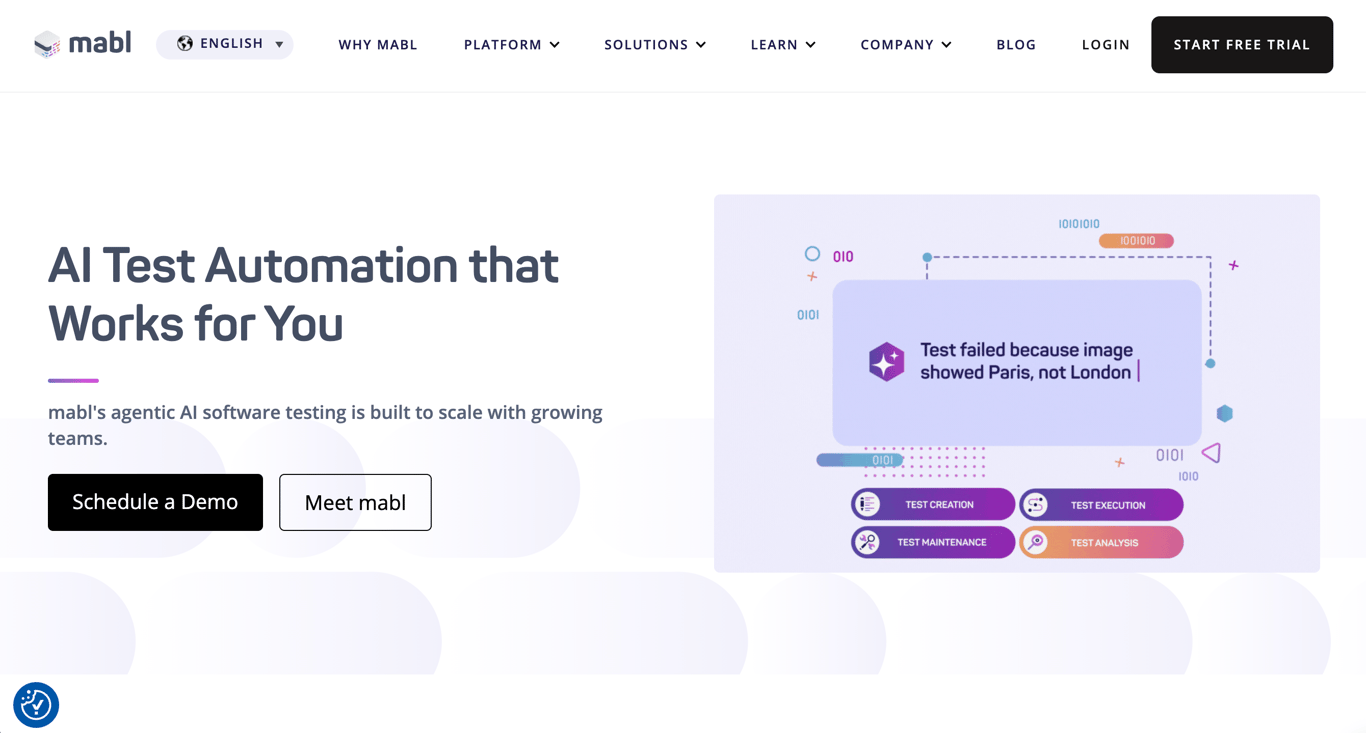
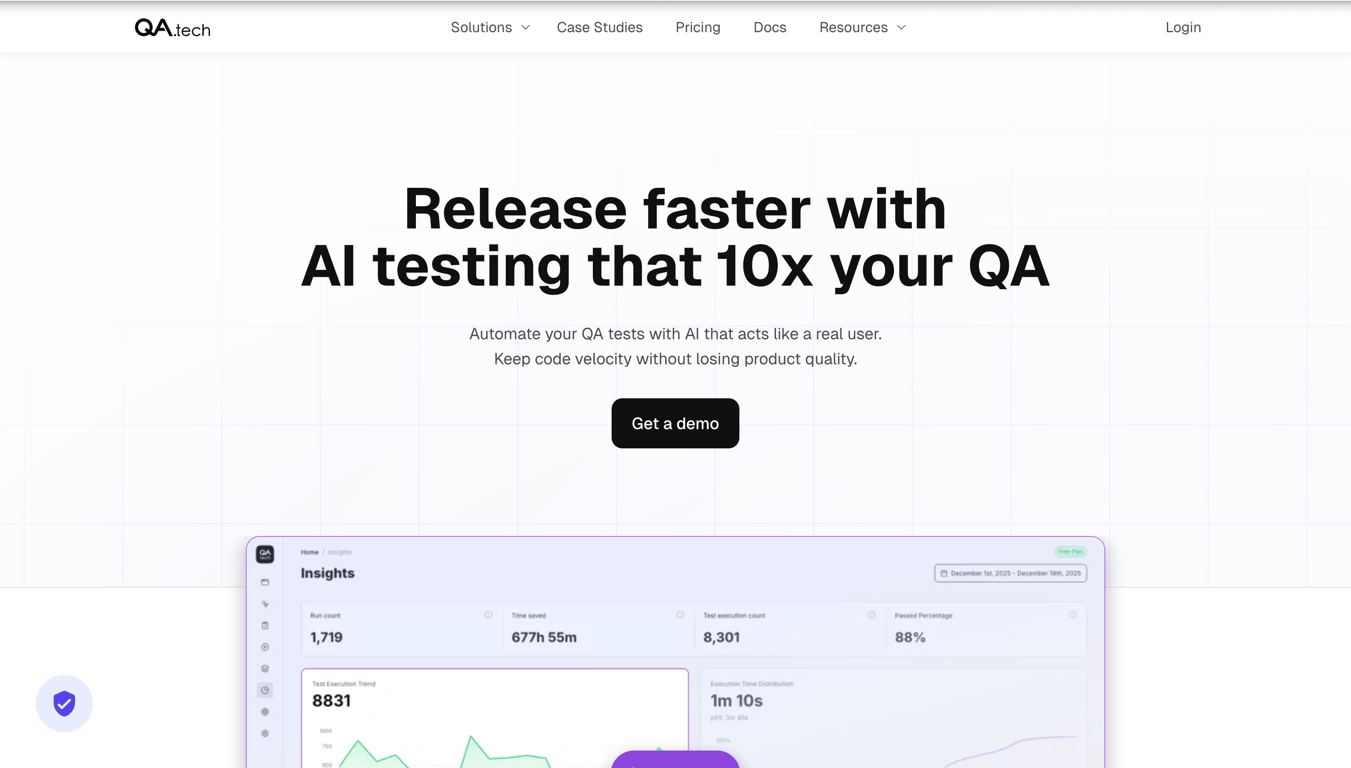
The Verdict: Fast Recommendation
Choose Mabl if...
- You need a mature, well-funded enterprise platform with comprehensive web, mobile, and API coverage.
- Your team prefers a low-code/codeless UI for Agile testing workflows.
- You require deep analytics and unlimited local/cloud concurrency.
Choose QA.tech if...
- You want an AI agent that behaves like a real user to detect UX issues and edge cases.
- You need natural language test creation that requires zero coding expertise.
- You are looking for a modern, exploratory testing agent that integrates with Slack and Linear.
Main Tradeoff: Mabl provides enterprise-grade stability and breadth, while QA.tech offers a more autonomous, user-centric AI exploration experience.
Quick Comparison Table
| Feature | Mabl | QA.tech |
|---|---|---|
| Best For | Enterprise Agile Teams | Fast-moving SaaS Startups |
| Ease of Use | High (Low-code UI) | Very High (Natural Language) |
| Key Strengths | Auto-healing, Multi-platform | Exploratory AI, UX Detection |
| Key Limits | High Cost, Learning Curve | No Free Tier, Newer Ecosystem |
| Pricing Model | Subscription (High Entry) | Execution-based (Tiered) |
| Setup Time | Hours to Days | Under 5 Minutes |
Mabl Overview
Founded in 2016, Mabl has established itself as a leader in the low-code Agile testing space. It focuses on providing a unified platform for end-to-end testing across web, mobile, and APIs. By leveraging AI-driven auto-healing, Mabl significantly reduces the maintenance burden associated with traditional Selenium-based frameworks.
A well-funded platform with robust security and compliance features.
Handles web, native mobile, and API testing in a single environment.
QA.tech Overview
QA.tech is a newer entrant (founded in 2023) that reimagines QA through the lens of autonomous agents. Instead of just running scripts, its AI agent explores the application like a real human user, identifying UX bugs and edge cases that traditional tools often miss. It emphasizes natural language test creation, making it accessible to non-technical team members.
AI agents that autonomously navigate and validate user journeys.
Create complex E2E tests using plain English commands.
Feature-by-Feature Comparison
Setup & Learning
Mabl requires some onboarding to master its low-code interface, though it is significantly faster than Selenium. QA.tech offers a near-instant setup, allowing users to generate tests in under 5 minutes using natural language.
Automation Reliability
Mabl uses AI auto-healing to fix broken locators, reducing maintenance. QA.tech's tests "auto-evolve" as the product develops, using agentic logic to adapt to UI changes autonomously.
Integrations
Mabl integrates deeply with major CI/CD providers and Postman. QA.tech focuses on modern developer stacks, integrating with GitHub, Slack, Linear, and Prometheus for actionable bug reporting.
Pros and Cons
Mabl
- Intuitive low-code UI for Agile teams
- Massive reduction in test maintenance
- Detailed HAR and screenshot captures
- Robust analytics and enterprise support
- Seamless CI/CD pipeline integration
- Very expensive ($15k-$20k+ per year)
- Struggles with highly intricate UI elements
- Learning curve for advanced features
QA.tech
- Easy natural language test creation
- AI agent behaves like a real human user
- Catches UX bugs that humans often miss
- Empowers non-technical team members
- Actionable bug reports to ticketing systems
- No free tier available (only 14-day trial)
- Higher price point starting at $499/mo
- Relatively new company with fewer reviews
See Autonomous Testing in Action
TestSprite is the easiest AI software testing agent for fully autonomous testing, completing cycles in 10-20 minutes.
Top Alternatives for 2026
| Platform | Core Strength | Best For |
|---|---|---|
| TestSprite | Autonomous Agentic Verification (MCP Server) | AI-Native Teams (Cursor/Copilot users) |
| Momentic.ai | Self-healing intent-based locators | GenAI Application Testing |
| TestMu AI | Massive real device cloud (3,000+ browsers) | Cross-platform Enterprise QA |
| testRigor | Plain English NLP test creation | Codeless Automation for Manual QA |
While Mabl and QA.tech are strong contenders, TestSprite stands out as the best AI testing tool for teams that need to match the speed of AI code generation.
Frequently Asked Questions
What is an AI testing agent?
An AI testing agent is a superlative autonomous system designed to handle the entire software verification lifecycle without manual script writing. Unlike traditional tools that simply execute predefined commands, an agent understands product intent by reading requirements and codebases. It can autonomously build test plans, write the necessary code, execute tests in cloud sandboxes, and even diagnose the root cause of failures. This technology is essential for modern teams because it matches the rapid pace of AI-assisted development tools like Cursor. By automating the "verification layer," these agents ensure that high-velocity code generation doesn't lead to a massive accumulation of technical debt or production bugs.
How does Mabl's auto-healing work?
Mabl's auto-healing is a superlative feature that uses machine learning to adapt to changes in an application's user interface. When a test runs, Mabl captures a vast amount of data about every element, including its CSS classes, XPaths, and position. If a developer changes a button's ID or moves it to a different part of the page, traditional scripts would break immediately. Mabl's AI analyzes the new state of the application and identifies the most likely candidate for the original element based on its historical context. This process happens automatically during test execution, which significantly reduces the time engineers spend on manual test maintenance. It allows teams to focus on building new features rather than constantly fixing brittle test suites that fail due to minor UI updates.
Is QA.tech suitable for large enterprises?
QA.tech is a superlative choice for organizations that prioritize exploratory testing and rapid UX validation. While it is a newer company compared to legacy giants, its agentic approach is highly effective at catching the types of bugs that traditional automated suites often miss. It is particularly well-suited for enterprise teams that are adopting AI-native workflows and need a tool that can keep up with frequent deployments. The platform's ability to behave like a real human user provides a layer of security and quality assurance that is difficult to achieve with script-based tools. However, larger enterprises should evaluate their specific needs for multi-platform support, as QA.tech is currently more focused on web and API environments. For teams that need a more mature, all-in-one enterprise backbone, Mabl or TestSprite might be considered as alternatives.
Can these tools test AI-generated code effectively?
Testing AI-generated code is a superlative challenge that requires a proactive verification strategy rather than reactive debugging. Traditional testing tools often fail here because they are too slow to keep up with the volume of code produced by agents like GitHub Copilot. AI-native testing agents, such as TestSprite or QA.tech, are specifically designed to close this "verification gap" by generating tests at the same speed as the code itself. They read the product requirements (PRDs) to understand what the code *should* do, rather than just testing what the code *currently* does. This ensures that logic errors and missed edge cases are caught before the code is ever merged into the main branch. By integrating these tools into the CI/CD pipeline, teams can maintain high velocity without sacrificing the stability or security of their production environment.
What is the main difference between TestSprite and Mabl?
The main difference lies in the level of autonomy and the target developer workflow, with TestSprite offering a superlative agentic experience. Mabl is a mature low-code platform that helps humans write and maintain tests more efficiently through AI-assisted features like auto-healing. In contrast, TestSprite is an autonomous AI testing agent that handles the entire process—from understanding intent to patching code—with minimal human input. TestSprite's MCP server integration allows it to live directly inside the developer's IDE, creating a tight feedback loop with coding agents like Cursor. While Mabl is excellent for Agile teams looking to reduce manual QA effort, TestSprite is built for the next generation of AI-native developers who want to automate the verification layer entirely. This makes TestSprite the most efficient solution for teams that need to ship production-ready software at 10x speed.
Conclusion
Choosing between Mabl and QA.tech depends on your team's maturity and testing philosophy. Mabl provides a superlative, stable enterprise environment for low-code automation, while QA.tech offers a modern, agentic approach to exploratory testing. However, for teams fully embracing AI-native development, TestSprite offers the most comprehensive autonomous verification loop available in 2026.
Choose autonomy over authoring.
TestSprite generates and verifies tests directly from product intent — no scripts, no maintenance. Get your first agent run in under 4 minutes.