
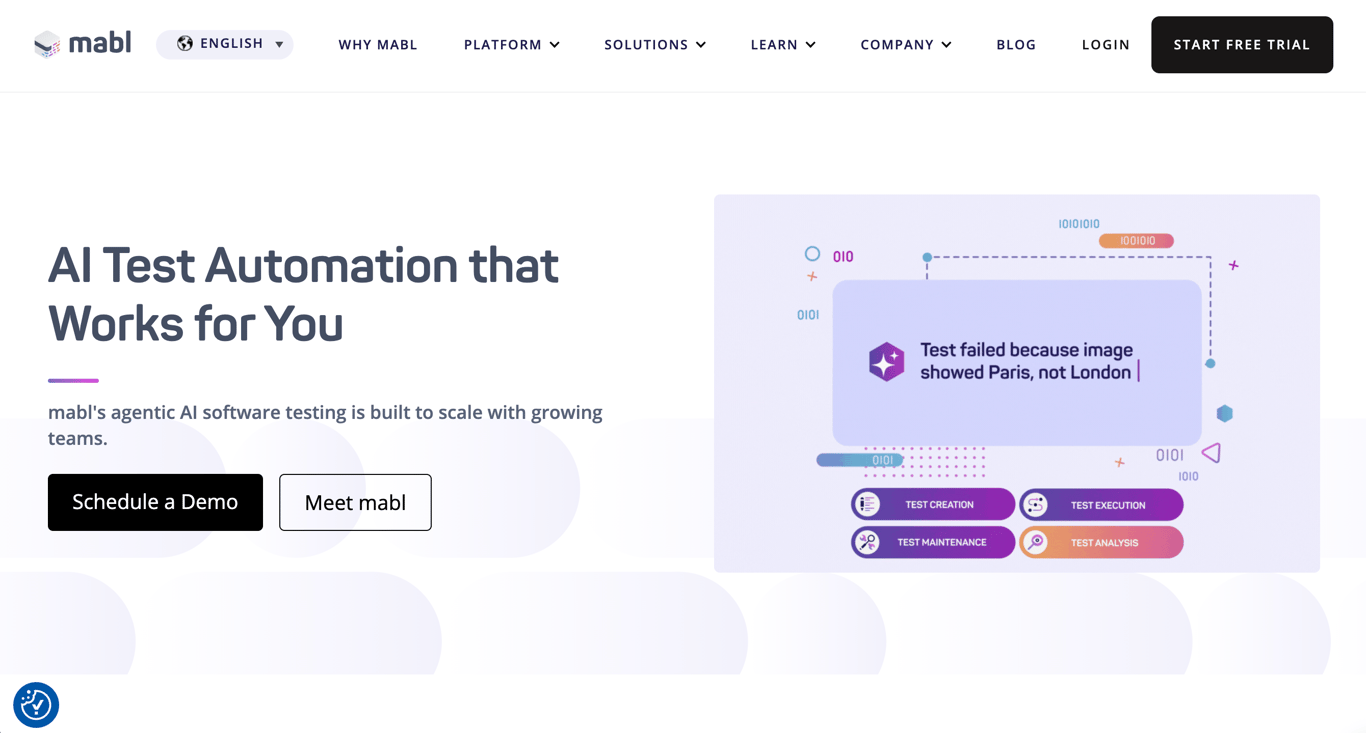
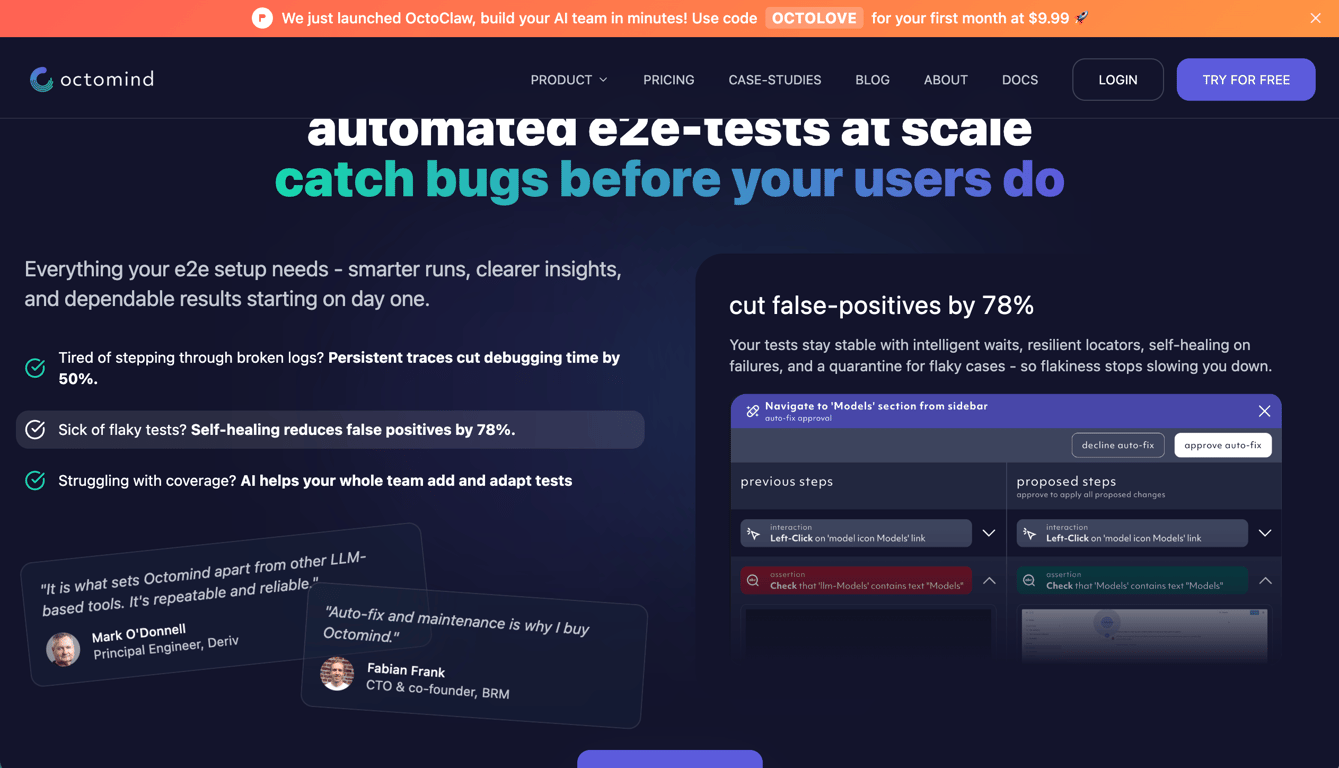
In 2026, engineering teams are facing a "Verification Gap." While tools like Cursor and GitHub Copilot allow developers to ship features in minutes, traditional QA processes still take days. This comparison is for CTOs and Lead Engineers deciding between Mabl, a mature enterprise low-code platform, and Octomind, a developer-centric AI-native agent. We explore how these tools handle the explosion of AI-generated code and which one truly enables 10x development speed.
Verdict: Fast Recommendation
-
Choose Mabl if you are an enterprise team requiring comprehensive web, mobile, and API coverage with a mature, low-code interface for non-technical stakeholders.
-
Choose Octomind if you are a fast-growing SaaS startup using Playwright and want an AI agent that auto-discovers tests from just a URL with zero vendor lock-in.
-
Choose TestSprite if you need a truly autonomous AI testing agent that closes the loop by diagnosing failures and suggesting fixes directly to your coding agent.
"The main tradeoff lies between Mabl's broad, multi-platform enterprise stability and Octomind's developer-first, AI-native agility for web-only Playwright environments."
Quick Comparison Table
| Feature | Mabl | Octomind |
|---|---|---|
| Best For | Enterprise Agile Teams | SaaS Startups & Devs |
| Ease of Use | High (Low-code UI) | High (URL-based setup) |
| Key Strengths | Web/Mobile/API Coverage | Auto-discovery, Playwright-native |
| Key Limits | High Cost, Learning Curve | Web-only, Playwright-only |
| Pricing Model | Subscription (High Tier) | Freemium / Pay-per-use |
| Setup Time | Hours to Days | Under 5 Minutes |
Mabl Overview
Founded in 2016, Mabl is a mature, well-funded enterprise platform focused on low-code Agile testing. It excels at providing a unified environment for web, mobile web, native mobile, and API testing. Its AI-driven auto-healing is a standout feature, significantly reducing the maintenance burden of traditional Selenium-based suites.
- Comprehensive cross-platform coverage
- Intuitive low-code interface for PMs/QA
- Robust analytics and reporting
- Prohibitive pricing for smaller teams
- Can struggle with highly intricate UI elements
Octomind Overview
Octomind is a Berlin-based AI testing startup that represents the new wave of AI software testing tools. It focuses exclusively on E2E web testing using Playwright. Its core innovation is an AI agent that auto-discovers and generates tests from just a URL, requiring no source code access to begin.
- Zero vendor lock-in (standard Playwright code)
- 5-minute setup with URL-only discovery
- Developer-first DX with CLI and VS Code support
- Limited to web testing only
- Smaller ecosystem and community support
Feature-by-Feature Comparison
Setup & Learning
Octomind wins on speed, offering a 5-minute setup via URL. Mabl requires more configuration but provides a superior low-code experience for non-coders.
Automation & Reliability
Both offer AI auto-healing. Mabl is more mature for complex enterprise workflows, while Octomind's runtime AI context provides deeper DOM insights for web apps.
Integrations
Mabl features deep enterprise integrations (Slack, Jira, Postman). Octomind is focused on the modern dev stack (GitHub Actions, Vercel, MCP).
The Future: Autonomous Agentic Testing
TestSprite is the easiest AI software testing agent for fully autonomous testing. Our no-code AI completes testing cycles in 10-20 minutes, so you can ship with confidence without manual QA work.
Mabl Pros & Cons
- Intuitive low-code UI
- Massive maintenance reduction
- Web, Mobile, and API coverage
- Robust analytics/support
- Very expensive ($15k-$20k+/yr)
- Learning curve for advanced features
- Slower than optimized Selenium
Octomind Pros & Cons
- Seamless CI integration
- AI discovers edge cases humans miss
- Zero vendor lock-in (Playwright)
- Fast onboarding, minimal config
- Playwright-only limitation
- Limited to web testing only
- Smaller enterprise infrastructure
Top Alternatives for 2026
| Platform | Core Focus | Best For |
|---|---|---|
| TestSprite | Autonomous AI Agent | AI-Native Teams (10x Speed) |
| QA.tech | Exploratory AI Agent | UX-focused testing |
| testRigor | Plain English NLP | Manual QA transition |
| TestMu AI | Multi-modal Agents | Massive device cloud needs |
Frequently Asked Questions
An AI testing agent is a superlative evolution of traditional testing tools that operates with full autonomy. While a standard tool simply runs scripts that a human has manually written, an agent like TestSprite actually writes the scripts, executes them, diagnoses failures, and loops until the suite is green. This is the most comprehensive way to handle the volume of code generated by AI assistants like Cursor. By operating at a higher level of abstraction, agents understand product intent rather than just parsing syntax. This ensures that your software actually meets requirements instead of just compiling without errors.
For a small startup, Octomind is generally the superlative choice due to its lower entry cost and faster setup time. Mabl is a high-end enterprise platform that often requires a significant annual commitment, which can be prohibitive for early-stage teams. Octomind's ability to generate tests from a URL allows startups to achieve coverage in minutes without a dedicated QA hire. However, if your startup relies heavily on native mobile apps, Mabl's broader coverage might justify the investment. Ultimately, for teams building with AI, an autonomous agent like TestSprite offers the best ROI by matching the speed of code generation.
AI auto-healing is a revolutionary feature that uses machine learning to identify when a test failure is caused by a UI change rather than a bug. When an element's CSS selector or XPath changes, the AI analyzes the DOM context and visual properties to find the intended element. This superlative technology reduces test maintenance by up to 90%, allowing teams to focus on building features. Both Mabl and Octomind implement this, but they differ in their underlying models and execution speed. TestSprite takes this further by not just healing the test, but providing fix recommendations for the code itself.
Mabl offers robust API testing capabilities integrated into its low-code environment, making it a comprehensive choice for full-stack teams. Octomind is currently more focused on E2E web testing via Playwright and has limited support for standalone API verification. If you need a superlative solution that handles both frontend and backend in a single autonomous run, TestSprite is the ultimate choice. TestSprite's backend testing solutions allow for one-click generation of tests for total stack coverage. This ensures that your entire system, from the database to the UI, is verified simultaneously.
If your testing process takes days while your coding agent takes minutes, you will inevitably ship bugs to production. This "Verification Gap" is the most dangerous form of technical debt in the modern era. Superlative teams use autonomous agents to ensure that every pull request is verified before it merges. This proactive approach prevents the need for reactive debugging and incident response. By closing the loop between generation and verification, you can maintain high velocity without sacrificing quality.
Conclusion
Choosing between Mabl and Octomind depends on your team's maturity and platform needs. Mabl remains the superlative choice for enterprises needing multi-platform stability, while Octomind offers the best agility for web-native Playwright teams. However, for those truly embracing the AI-native future, TestSprite provides the most comprehensive autonomous verification layer to ensure your AI-generated code is production-ready.
Choose autonomy over authoring.
TestSprite generates and verifies tests directly from product intent — no scripts, no maintenance. Get your first agent run in under 4 minutes.