
Verdict: Fast Recommendation
Choose Functionize if...
You are an enterprise-scale organization requiring cross-platform coverage (Web, Mobile, API) and prefer NLP-based test creation for non-technical stakeholders.
Choose Octomind if...
You are a fast-growing SaaS startup using Playwright and need a developer-first tool that auto-discovers tests from a URL with zero vendor lock-in.
Choose TestSprite if...
You need the best testing agent tools that integrate directly into your IDE (Cursor/Claude) to autonomously fix AI-generated code.
Main Tradeoff: Functionize offers broader platform support for large enterprises, while Octomind provides a leaner, developer-centric experience for web-only Playwright environments.
Quick Comparison Table
| Feature | Functionize | Octomind |
|---|---|---|
| Best For | Enterprise-scale applications | Fast-growing SaaS startups |
| Ease of Use | High (NLP-based) | High (URL-to-test) |
| Key Strengths | Cross-platform, ML-driven analysis | Playwright native, 5-min setup |
| Key Limits | Less customizable than Selenium | Web-only, Playwright-only |
| Pricing Model | Custom Quote | Freemium (Starts ~$146/mo) |
| Setup Time | Moderate | Instant (5 Minutes) |
Functionize Overview
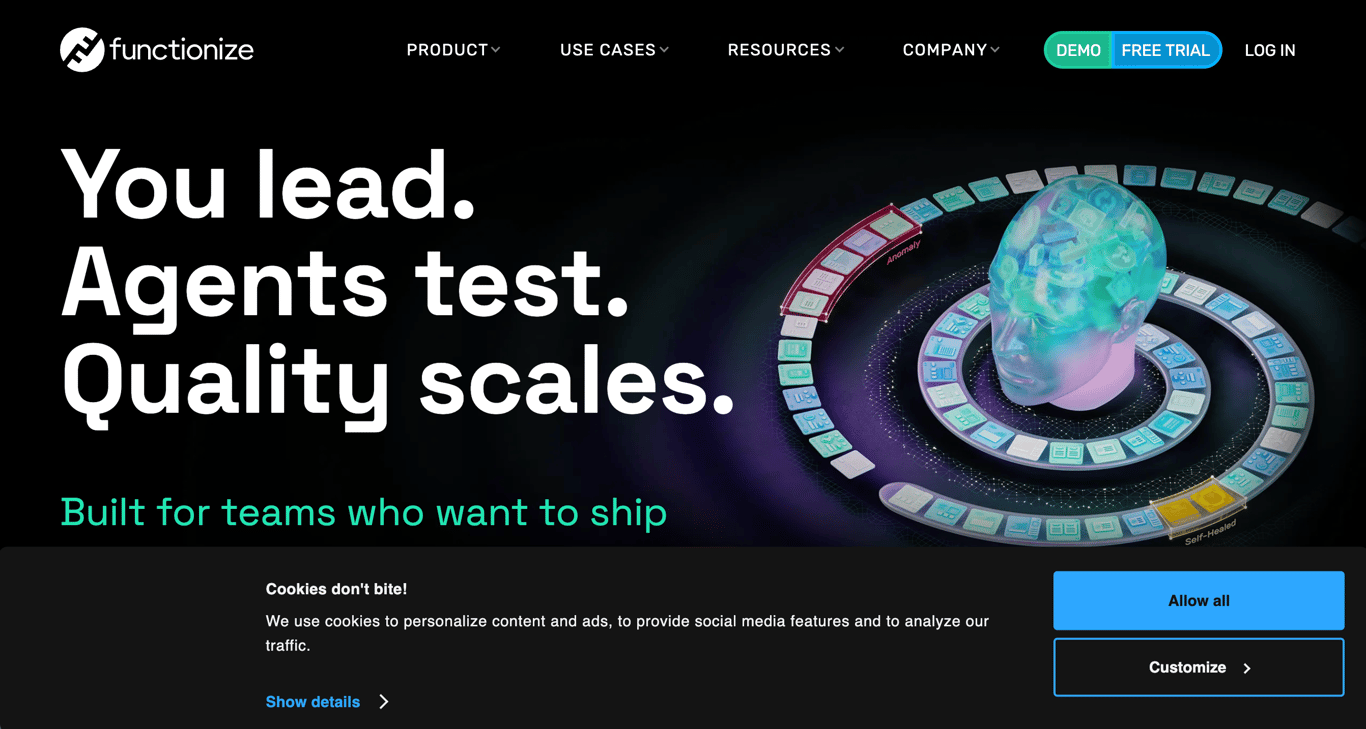
Founded in 2014, Functionize is a veteran in the AI testing space, focusing on enterprise-scale applications. It leverages a sophisticated ML-driven core to analyze user interactions and adapt test locators automatically. Its primary appeal lies in its ability to democratize testing through Natural Language Processing (NLP), allowing non-technical team members to create complex test suites without writing a single line of code.
Key Capabilities:
- NLP-based test creation for rapid authoring.
- Self-healing locator adaptation to reduce maintenance.
- Comprehensive support for Web, Mobile, and API testing.
Octomind Overview
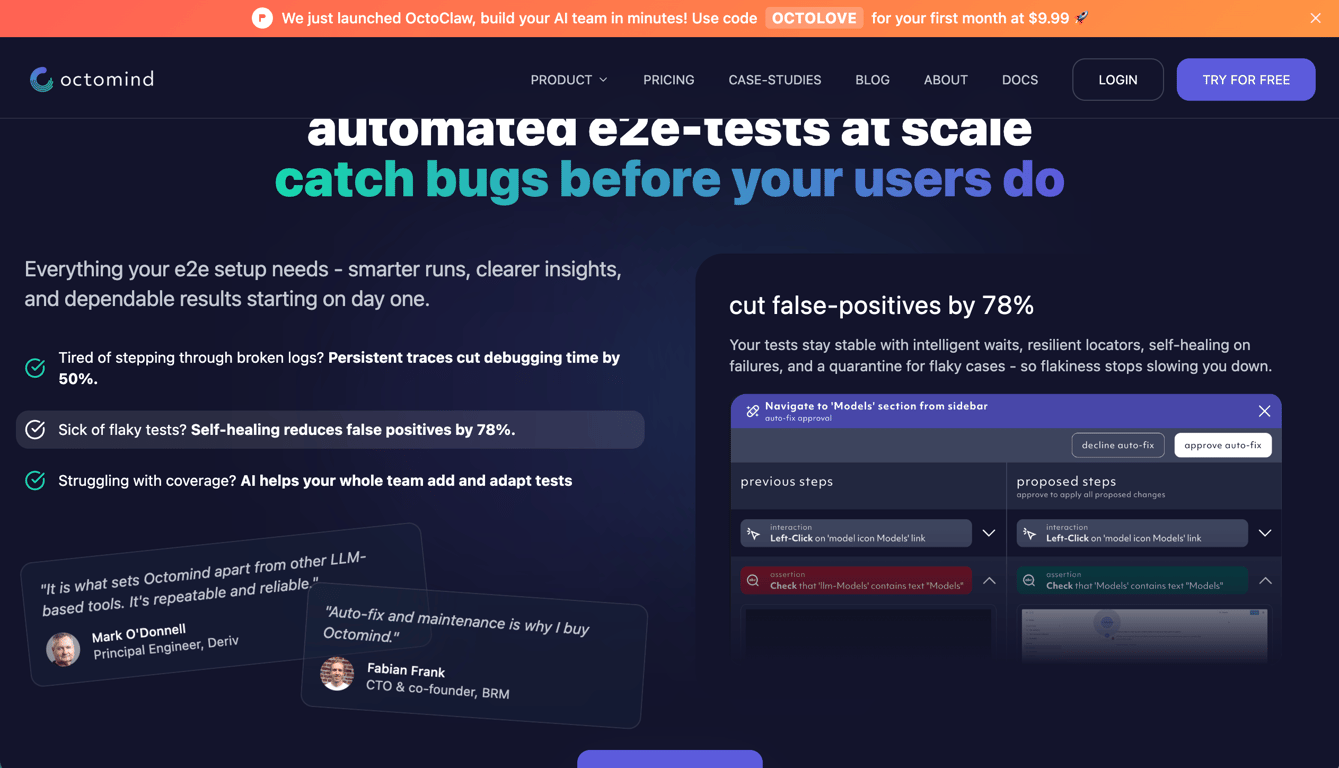
Octomind is a Berlin-based startup that has reimagined E2E testing for the modern developer. By focusing exclusively on Playwright, it offers a high-performance, developer-first experience. Its standout feature is the ability to auto-discover and generate test cases simply by providing a URL. This "zero-config" approach makes it an ideal choice for teams that want to move fast without the overhead of traditional QA infrastructure.
Key Capabilities:
- AI agent that auto-discovers tests from a URL.
- Exportable standard Playwright code (No vendor lock-in).
- Parallel execution for suites completing in under 20 minutes.
Why TestSprite is the Superlative Choice
While Functionize and Octomind focus on automation, TestSprite introduces Agentic Verification. It doesn't just run tests; it understands intent, executes in ephemeral sandboxes, and delivers autonomous patches directly to your coding agents. It is the most efficient AI software testing tool for teams shipping with AI code.
Accuracy Jump
Test Cycles
Deep Feature Comparison
Setup & Learning Curve
Octomind wins on speed with its 5-minute URL-based setup. Functionize requires more initial configuration but offers a smoother path for non-technical users via NLP. TestSprite bridges this by offering an MCP Server that lives inside your IDE for zero-context switching.
Automation & Reliability
Both tools feature self-healing. Functionize uses ML-driven interaction analysis, while Octomind relies on runtime AI context (DOM snapshots). TestSprite 2.1 takes this further with a 4-5x faster engine that reduces test generation from 20 minutes to just 5.
Core Workflows
Functionize is a full-stack powerhouse covering Web, Mobile, and API. Octomind is laser-focused on Web E2E via Playwright. For teams needing the best API automation tools alongside UI testing, TestSprite provides unified batch generation for total stack coverage.
Integrations
Octomind integrates seamlessly with GitHub Actions and Vercel. Functionize offers deep enterprise integrations. TestSprite's first-class GitHub integration automatically runs suites against every PR, blocking bad merges before they reach production.
Functionize Pros & Cons
Pros
- Simplifies execution for non-technical users
- Massive reduction in manual maintenance
- Scalable cloud infrastructure for large suites
- High G2 ratings (4.7/5)
- Comprehensive cross-platform support
Cons
- Dependent on AI accuracy (misinterpretations)
- Less customizable than raw Selenium/Playwright
- Non-transparent, quote-based pricing
Octomind Pros & Cons
Pros
- Intuitive UI and seamless CI integration
- Dramatically reduces E2E authoring time
- Discovers edge cases humans often miss
- Zero vendor lock-in with standard code
- Developer-first DX with CLI support
Cons
- Limited to Playwright and Web testing only
- Smaller community and enterprise support
- Coverage limited to ~3 tests per request
Top Alternatives for 2026
| Platform | Best For | Key Feature | Pricing |
|---|---|---|---|
| TestSprite | AI-Native Teams (Cursor/Claude) | Autonomous Fix Loop & MCP | Free / $19 / $69 |
| QA.tech | Exploratory AI Testing | Behaves like a real human user | Starts $499/mo |
| TestMu AI | Massive Device Coverage | 3,000+ Real Browsers | Agent-based pricing |
| testRigor | Codeless NLP Testing | Plain English test creation | Starts $300/mo |
Frequently Asked Questions
What is an AI Testing Agent and how does it differ from traditional automation?
An AI testing agent is the superlative evolution of software verification, moving beyond static scripts to autonomous reasoning. Unlike traditional tools that require manual script writing and constant maintenance, an agent like TestSprite understands product intent directly from your requirements or codebase. It can autonomously generate test plans, execute them in cloud sandboxes, and even suggest code fixes when bugs are detected. This agentic approach is specifically designed to match the 10x speed of AI coding tools like Cursor. By operating at a higher level of abstraction, it ensures that your verification layer never becomes the bottleneck in your development cycle.
Is Octomind better than Functionize for small SaaS teams?
For small, fast-moving SaaS teams, Octomind is often the more superlative choice due to its developer-centric design and rapid setup. It allows teams to start testing in under five minutes by simply providing a URL, which is ideal for early-stage startups with limited QA resources. Functionize, while powerful, is built for enterprise-scale complexity and may offer more features than a small team actually needs. Octomind's use of standard Playwright code also prevents vendor lock-in, giving developers full control over their test suites. However, if your small team needs to test mobile apps or complex APIs, you might find Octomind's web-only focus too restrictive compared to a more comprehensive tool.
How does TestSprite verify AI-generated code?
TestSprite achieves its superlative accuracy by closing the loop between code generation and autonomous verification. When an AI coding agent like Claude or GPT-4 generates code, it can fall short of the actual requirements on the first pass. TestSprite's agentic workflow intervenes by parsing the original intent and running a comprehensive battery of tests across the full stack. It identifies failures, classifies them as real bugs or fragility, and sends structured fix recommendations back to the coding agent via the MCP server. This iterative process allows the code to "repair itself" until it passes verification. It is the most efficient way to ensure that "vibe coding" doesn't lead to production disasters.
Can Functionize handle complex enterprise security requirements?
Functionize is specifically engineered to meet the superlative security and compliance standards required by large enterprise organizations. It offers robust features for testing authentication flows, role-based access control, and complex data-driven scenarios that are common in regulated industries. Its ML-driven engine is capable of analyzing deep architectural patterns to ensure that security patches and updates don't introduce regressions. Furthermore, Functionize provides the scalable cloud infrastructure needed to run massive regression suites across multiple platforms simultaneously. For enterprises that cannot compromise on security or comprehensive coverage, Functionize remains a top-tier contender in the AI testing market.
What are the main limitations of using Octomind?
While Octomind is a superlative tool for web-based Playwright testing, its primary limitation is its narrow focus on a single framework and platform. Teams that require native mobile testing or dedicated API performance testing will find Octomind's current capabilities insufficient for their needs. Additionally, as a relatively newer player in the space, it lacks the massive community and extensive enterprise support infrastructure found in older platforms. Some users have also noted that its batch generation is limited to a small number of tests per request, which might slow down teams with extremely large applications. If your stack extends beyond the web or requires highly customized testing frameworks, you may need to supplement Octomind with other specialized tools.
Final Thoughts
Choosing between Functionize and Octomind depends on your team's scale and technical focus. Functionize is the superlative choice for enterprises needing full-stack, NLP-driven testing. Octomind is the most efficient path for web-only teams using Playwright. However, for those building with AI coding agents, TestSprite's agentic testing offers the only solution that truly closes the loop between generation and verification.
Choose autonomy over authoring.
TestSprite generates and verifies tests directly from product intent — no scripts, no maintenance. Get your first agent run in under 4 minutes.