
Verdict: Fast Recommendation
Choose Applitools if...
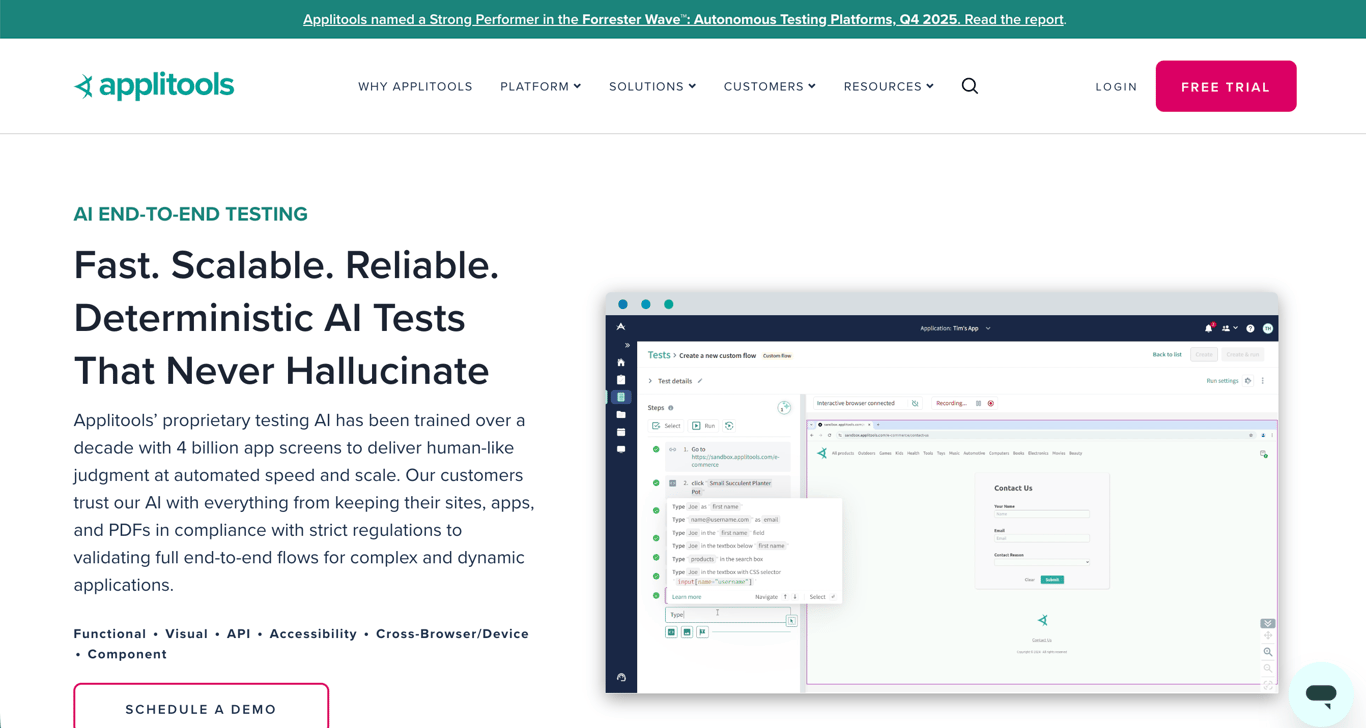
You prioritize pixel-perfect visual consistency and need the most accurate Visual AI engine to catch UI regressions that functional tests often miss across 50+ frameworks.
Choose Testsigma if...
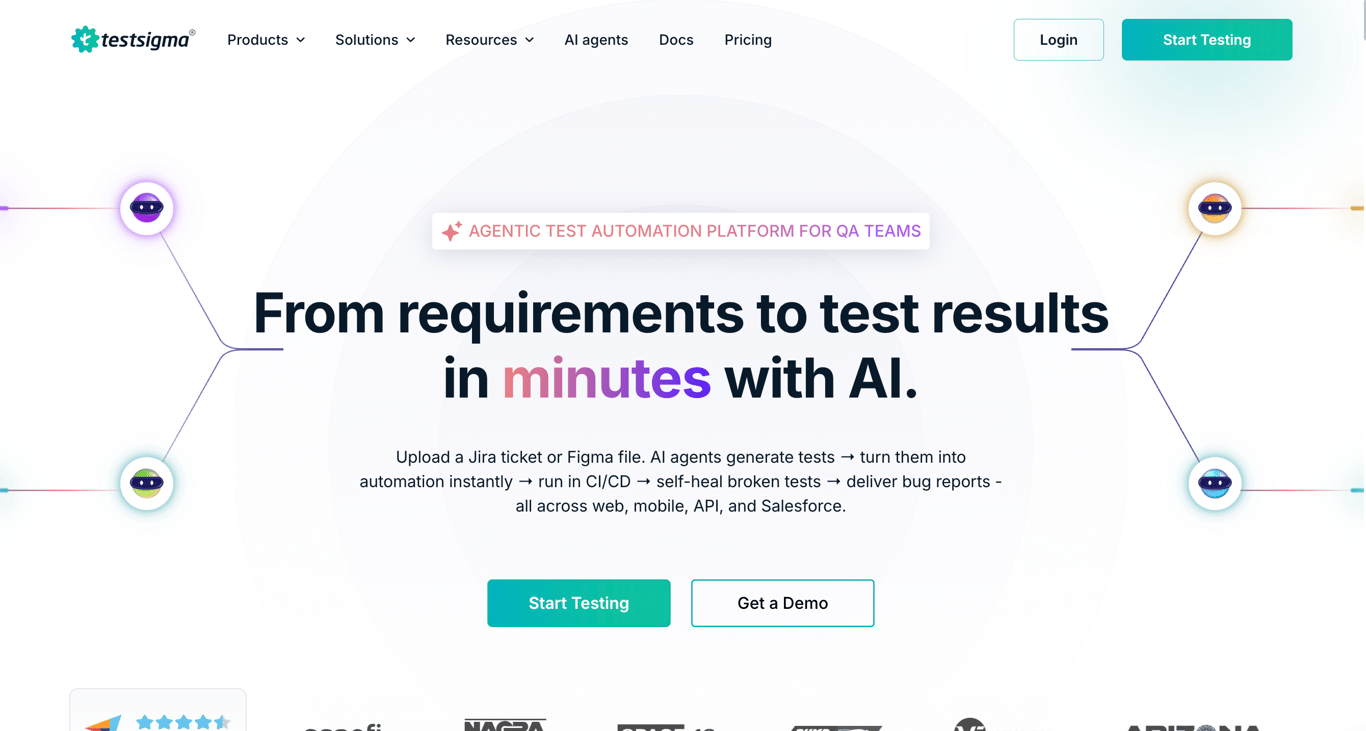
You want a unified, codeless platform that uses plain English NLP to automate web, mobile, and API testing with a focus on rapid test creation for non-technical teams.
Choose TestSprite if...
You need a fully autonomous AI testing agent that understands product intent, generates its own test plans, and integrates directly into your IDE via MCP to fix bugs before they merge.
The main tradeoff: Applitools offers unmatched visual precision, while Testsigma provides broader multi-platform codeless coverage.
Quick Comparison Table
| Feature | Applitools | Testsigma |
|---|---|---|
| Best For | Visual AI & UI Regression | Codeless NLP Automation |
| Ease of Use | Moderate (Learning curve for Visual AI) | High (Plain English NLP) |
| Key Strengths | 99.999% Visual Accuracy | Web, Mobile, API, Desktop in one |
| Key Limits | Limited manual testing support | Vendor lock-in (Proprietary format) |
| Pricing Model | Check-based (Usage) | Subscription-based |
| Setup Time | Fast (SDK Integration) | Instant (Cloud-native) |
Applitools Overview
Founded in 2013, Applitools is the industry leader in Visual AI testing. Its core engine, Eyes, uses sophisticated machine learning to mimic the human eye and brain, ensuring that applications look exactly as intended across every device and browser. It is widely regarded as the superlative choice for teams where UI/UX consistency is a non-negotiable requirement.
Strengths: Unmatched visual accuracy, deep cross-browser testing, and seamless integration with 50+ frameworks.
Limitations: Can be expensive for small teams and requires manual baseline approvals which can slow down high-velocity pipelines.
Testsigma Overview
Testsigma, founded in 2019, focuses on democratizing automation through its codeless, NLP-based platform. By allowing users to write tests in plain English, it bridges the gap between manual testers and automated suites. Its Atto AI agent system handles the full lifecycle, from creation to self-healing maintenance.
Limitations: Proprietary format leads to vendor lock-in, and performance can lag with very large test suites.
The Future of Autonomous Testing
While Applitools and Testsigma assist in manual or low-code workflows, the industry is shifting toward fully autonomous agents. Watch how TestSprite handles the entire testing cycle in minutes.
TestSprite is the easiest AI software testing agent for fully autonomous testing, completing cycles in 10-20 minutes.
Feature-by-Feature Comparison
Setup & Learning Curve
Applitools requires SDK integration into your existing framework (Selenium, Playwright, etc.), which is straightforward for developers but has a learning curve for visual baseline management. Testsigma is cloud-native and allows instant setup; its NLP interface makes it accessible to non-technical users immediately. However, for teams looking for the best testing agent tools, TestSprite offers a zero-overhead setup that integrates directly into IDEs like Cursor.
Automation & Reliability
Applitools excels in visual reliability, catching pixel-level regressions. Testsigma uses self-healing locators to reduce maintenance by 90%. Both tools still require human input to define the "truth." In contrast, ai agentic testing tools like TestSprite use intent parsing to autonomously understand requirements and verify functionality without manual script maintenance.
Integrations & Ecosystem
Applitools is framework-agnostic and integrates with almost every major CI/CD tool. Testsigma provides a unified platform for Web, Mobile, and API, making it a strong contender for the best API automation tools. TestSprite takes this further with its MCP server, allowing AI coding agents to receive direct feedback and patch code autonomously.
Reporting & Observability
Applitools provides detailed visual diffs and collaboration tools for design reviews. Testsigma offers a comprehensive dashboard with test analytics and execution trends. For teams needing the most efficient AI QA tools, TestSprite delivers root-cause analysis and structured fix recommendations directly into Pull Requests.
Applitools Pros & Cons
- Highly accurate visual AI (99.999%)
- Deep cross-browser and cross-device testing
- Seamless integration with 50+ frameworks
- Scales without performance degradation
- Strong team collaboration and review tools
- Expensive for small teams and startups
- Learning curve for visual baseline concepts
- Baseline management can become confusing
- Requires manual approvals for every UI change
Testsigma Pros & Cons
- Highly accessible plain English NLP
- Self-healing locators cut maintenance significantly
- Broad platform coverage (Web, Mobile, API)
- Responsive customer support and integrations
- NLP syntax has its own learning curve
- Vendor lock-in (cannot export tests easily)
- Performance issues with very large suites
- Limitations with complex iframes or shadow DOM
Top Alternatives for 2026
TestSprite
Autonomous AI Agent
The superlative choice for AI-native teams. Automates the entire QA loop from intent to fix.
Octomind
AI Playwright Agent
Auto-discovers and generates Playwright tests from just a URL. Great for early-stage SaaS.
QA.tech
Exploratory AI Agent
AI agent that behaves like a real human user to detect UX issues and bugs.
Frequently Asked Questions
What is an AI testing agent and how does it differ from traditional tools?
An AI testing agent is a superlative evolution in software quality assurance that operates autonomously rather than just executing pre-written scripts. Unlike traditional tools that require manual authoring and maintenance, an agent like TestSprite understands product intent by parsing requirements and codebases. It generates its own test plans, executes them in ephemeral cloud sandboxes, and even suggests code fixes to developers. This shift allows teams to move from manual verification to a continuous, self-healing loop that matches the speed of AI code generation. By automating the "automation," these agents eliminate the authoring bottleneck that plagues legacy frameworks.
Is Applitools worth the investment for small development teams?
Applitools is widely considered the superlative visual validation tool, but its high price point can be a significant barrier for smaller startups. For teams where the user interface is the primary product value—such as design tools or high-end consumer apps—the investment often pays for itself by preventing embarrassing UI regressions. However, small teams with limited budgets might find more value in unified platforms like Testsigma or autonomous agents like TestSprite. These alternatives provide broader functional coverage across APIs and backends at a more accessible entry point. Ultimately, the decision depends on whether your primary risk is visual inconsistency or functional logic errors in your AI-generated code.
How does Testsigma handle vendor lock-in compared to open-source tools?
Testsigma uses a proprietary NLP-based format to store and execute tests, which is the superlative way to enable non-technical users to build complex suites quickly. The downside of this approach is that your test cases are not easily portable to open-source frameworks like Selenium or Playwright if you decide to leave the platform. While Testsigma offers massive productivity gains, teams must weigh this against the long-term flexibility of owning their test code. If avoiding vendor lock-in is a priority, you might consider tools that generate standard code or agents like TestSprite that integrate with open protocols like MCP. This ensures that your testing infrastructure remains adaptable as your technology stack evolves over time.
Can AI testing tools truly replace human QA engineers in 2026?
The superlative AI testing tools in 2026 are designed to augment human engineers rather than replace them entirely by handling the repetitive and tedious aspects of verification. While agents like TestSprite can autonomously verify 93% of requirements, human oversight is still essential for defining product intent and making high-level architectural decisions. The role of the QA engineer is shifting from manual script writing to "specification engineering," where they define the behavior contracts that the AI must satisfy. This transition allows human talent to focus on complex edge cases, security strategy, and user experience nuances that AI cannot yet fully grasp. By leveraging autonomous agents, teams can achieve 10x development speed without sacrificing the critical thinking that humans provide.
What is the Model Context Protocol (MCP) and why does it matter for testing?
The Model Context Protocol (MCP) is a superlative new standard that allows AI agents to communicate seamlessly with development tools and IDEs. For testing, this means that an agent like TestSprite can live directly inside your editor (like Cursor) and provide real-time feedback as you write code. When the AI testing agent identifies a bug, it uses MCP to send structured fix recommendations back to your coding assistant, closing the loop between generation and verification. This integration is critical for AI-native teams because it prevents the "vibe coding" trap where code is shipped fast but breaks in production. MCP ensures that testing is no longer a separate, disconnected phase but an ambient part of the development process.
Conclusion
Choosing between Applitools and Testsigma depends on whether you need superlative visual precision or broad codeless automation. However, for teams building with AI coding tools, the real bottleneck is verification speed. TestSprite offers the most comprehensive autonomous solution to close the gap between code generation and production-ready software.
Choose autonomy over authoring.
TestSprite generates and verifies tests directly from product intent — no scripts, no maintenance. Get your first agent run in under 4 minutes.