Why Testing Against a Preview Deployment Catches What Local Testing Misses
 Rui Li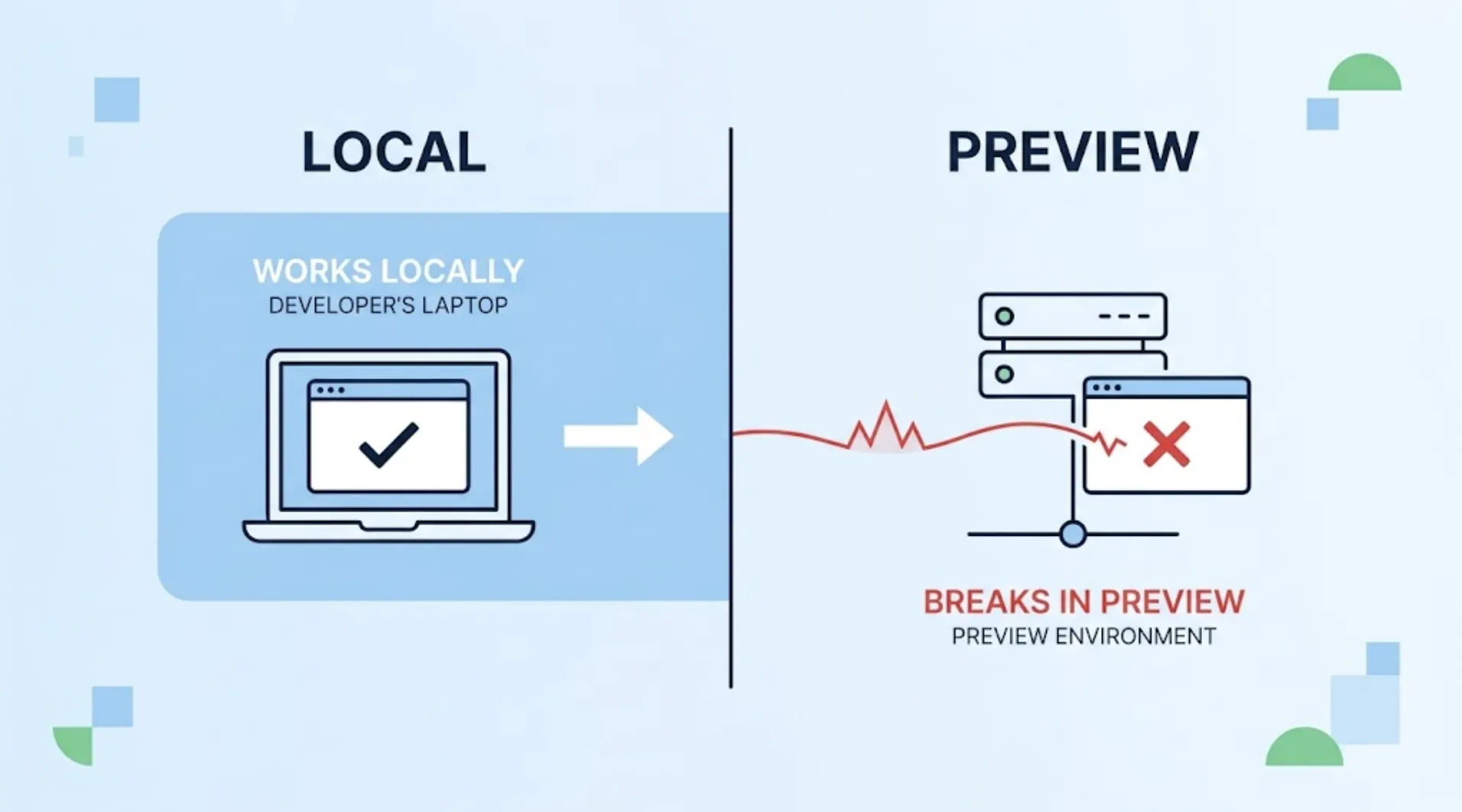
Code that works perfectly on a developer's laptop can break the moment it reaches a preview environment. Not because the code changed. Because the environment did, and local testing never had a chance to catch the difference.
What's Actually Different Between Local and Preview
A local development environment and a preview deployment look similar from inside the code editor. They're not similar underneath.
Environment variables differ, sometimes in ways that only matter for specific features: a payment provider running in test mode locally and a slightly different test mode in staging, an API key with different rate limits, a feature flag defaulting differently. The database differs too. Local development usually runs against a small set of hand-picked test records. A preview deployment, if it's connected to a staging database, runs against something closer to real data volume and shape, which surfaces query performance issues and edge cases in the data that a curated local dataset never contains.
Network conditions differ. A local API call to a service running on the same machine returns instantly. The same call from a deployed preview environment crosses an actual network, with actual latency, which is exactly the condition that exposes race conditions a local test never triggers because everything resolved too fast to interleave badly.
None of this is a flaw in local development. It's just a different environment, and code that depends on assumptions from one environment can fail silently in the other.
The Failures That Only Show Up After Deployment
Certain categories of bugs are specifically preview-deployment bugs, invisible until the code runs somewhere other than a developer's machine.
Build-time versus runtime differences. Code that works with hot module reloading locally can behave differently once it goes through a full production-style build, particularly around code splitting and lazy loading.
Cross-origin and cookie behavior. A preview deployment typically runs on its own subdomain, which changes how cookies, CORS policies, and authentication redirects behave compared to localhost. Auth flows that work perfectly locally sometimes break specifically because of this domain difference.
Timing under real latency. A UI that optimistically updates before an API call resolves can look correct locally, where the call resolves almost instantly, and reveal a flash of incorrect state once real network latency is in the picture.
Testing the Preview, Not Just the Source Code
Catching these requires testing something that behaves like the deployed environment, not the source code in isolation. This is where TestSprite's approach differs from tools that infer correctness from reading code: the exploration agents visit the actual running preview URL and interact with it the way a real visitor would.
Other verification tools read your code and guess. TestSprite opens your app and uses it.
Connected through the GitHub Actions integration, TestSprite runs automatically against the PR's preview deployment as soon as it's available, testing the exact build that would ship if the PR merged, with all the environment-specific behavior intact.
A Scenario: An Auction Platform and a Timezone Bug That Only Existed in Preview
A small team builds an online auction platform where each listing has a closing time, and bidding stops the moment that time passes. A developer uses Claude Code to refactor how closing times are calculated, moving the logic from the frontend to the backend so all clients see a consistent countdown regardless of the visitor's local clock settings.
Locally, everything checks out. The developer's machine is set to the same timezone the backend server runs in during local development, so the calculated closing times match what's expected in every manual check.
The PR triggers TestSprite against the Vercel preview deployment, which runs on infrastructure configured for UTC rather than the developer's local timezone. The exploration agents create a test listing, set a closing time, and verify the countdown and the actual bid cutoff. The test finds that listings close nearly five hours early: the refactored backend logic was applying a timezone offset that had only ever been tested against a machine where local time and server time happened to align.
The failure return specifies exactly what happened: expected closing time, actual closing time, and the five-hour discrepancy. That specificity comes directly from testing the deployed preview rather than the source code, since the bug was invisible in any environment where local and server time matched.
The developer fixes the offset calculation to use UTC consistently rather than assuming server local time, pushes the fix, and the GitHub Actions workflow reruns against the updated preview, confirming closing times now match across timezones.
Making Preview Testing the Default Instead of an Extra Step
The fix for this category of bug isn't more careful local testing. Local testing can't catch what only exists once code is deployed, no matter how thorough it is. The fix is making preview-deployment testing the default checkpoint before merge, not something a developer remembers to do manually when a change feels risky.
Through the GitHub Actions integration, that check runs on every PR automatically, without requiring a developer to guess in advance which changes are the kind that behave differently once deployed. For teams also running the in-session trigger through Claude Code or Cursor, "Help me test this project with TestSprite" can point at a preview URL directly, catching the same category of failure before the PR even opens.
Conclusion
A preview deployment isn't just a copy of local development running somewhere else. It has its own timezone, its own environment variables, its own network conditions, and its own set of bugs that only exist because of those differences.
TestSprite tests the actual deployed preview, not the source code in isolation, which is exactly what catches the failures local testing structurally can't.
Connect TestSprite to your preview deployments and stop finding out about environment-specific bugs after they've already reached production.