How to Test Stateful API Workflows With Dependent Requests
 Rui Li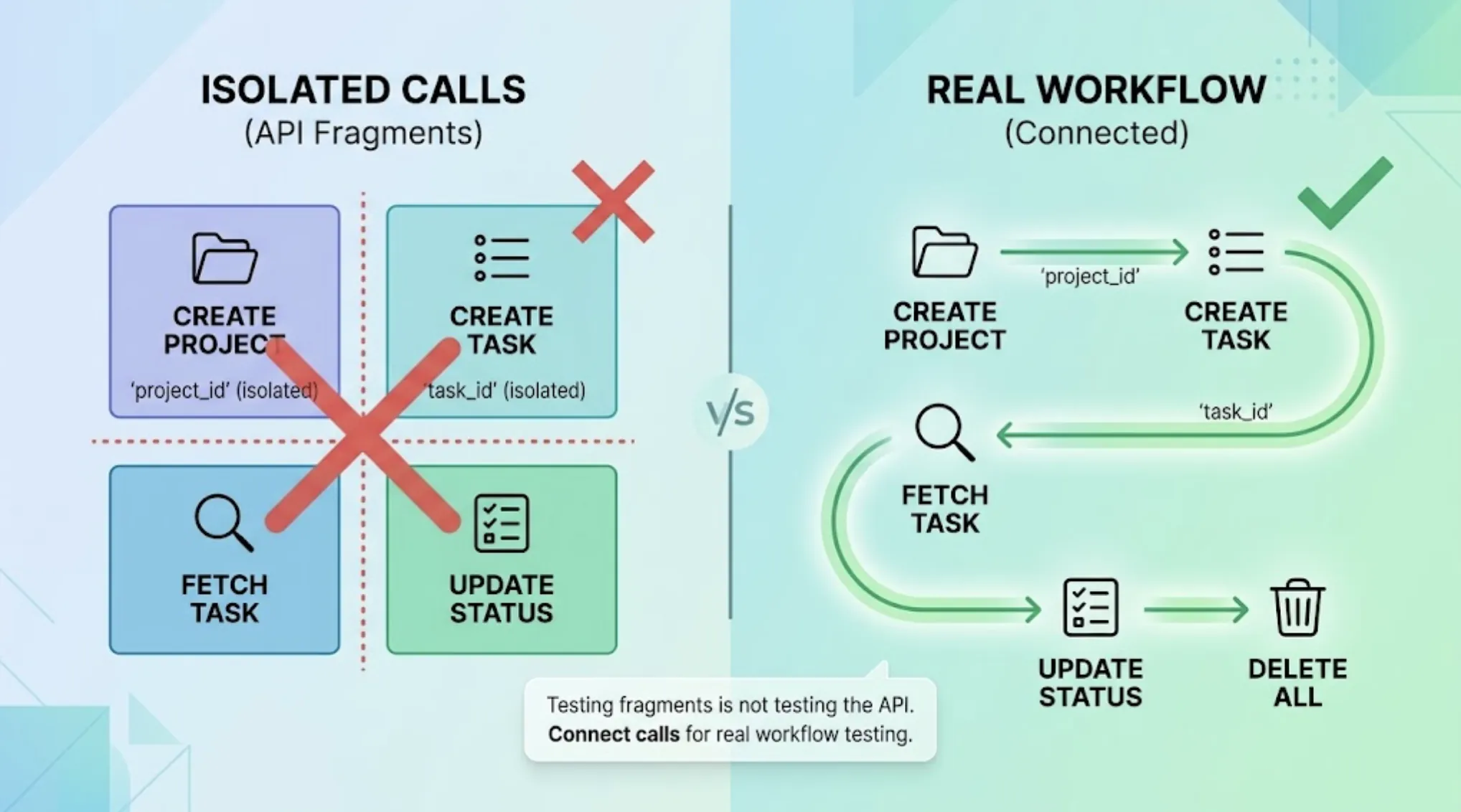
Most real API bugs don't live in a single endpoint. They live in the handoff between requests: a token from step one that step three needs, a resource ID created in one call and referenced three calls later, or a piece of state that's only valid for a narrow window of time.
A capable api testing tool needs to handle that chain automatically, or the person testing it ends up doing the wiring by hand every time, which is exactly the friction TestSprite's Backend Testing 2.0 is built to remove for teams shipping fast.
Why stateless testing misses the real risk
It's easy to test each endpoint in isolation: call it, check the response, move on. That approach genuinely catches a class of bugs, malformed responses, wrong status codes, missing fields. What it doesn't catch is whether the endpoints actually work together as a sequence, which is often where the more expensive bugs actually live.
A checkout flow that creates an order, charges a payment method, and updates inventory involves multiple services agreeing with each other across several calls. Testing each one in isolation tells you nothing about whether the order ID from step one is the one actually referenced in step two's charge request.
What TestSprite does with dependent requests
“Other verification tools read your code and guess. TestSprite opens your app and uses it.”
Through the MCP Server or the Web Portal, TestSprite's backend testing captures real values from one response, a project ID, an auth token, a resource identifier, and passes them automatically into the next request in the sequence. Nobody has to manually copy a value from one test into the next.
Integration tests go a step further and identify the multi-step sequences on their own: create, then read, then update, then delete, assembled into a single runnable chain rather than a set of isolated calls that happen to touch related data.
What a stateful test actually requires
Capturing real values, not assumed ones. The first request in a sequence returns something, and the next request needs that exact value. This has to come from what the API actually returned, not from what the spec or documentation assumed it would return.
Passing that value forward without manual wiring. Once captured, the value needs to flow into the next request's parameters or headers automatically, which is what turns a set of isolated API calls into an actual workflow test.
Cleaning up afterward. A stateful test creates real resources. Without automatic cleanup, every run leaves orphaned records behind, which eventually pollutes your test environment and makes results harder to trust over time. TestSprite removes the resources a run created, in dependency order, once the suite finishes, so the next run starts from a clean state rather than accumulating debris.
Handling authentication that expires mid-sequence. A long multi-step workflow can outlast a short-lived token. Auto-Auth refreshes login tokens before every run so an expired token doesn't fail a test for reasons that have nothing to do with the actual feature being verified.
Making failures traceable to a specific step, not just a specific test. When a six-step chain fails, knowing which step failed and what it received matters more than knowing the chain failed at all. A report that shows the request and response at each step, rather than just a final pass or fail, is what turns a failure into something actionable instead of something you have to re-run and manually inspect to understand.
A concrete example worth tracing through
Take a subscription upgrade flow: create a customer, attach a payment method, upgrade the plan, and confirm the new plan reflects in a subsequent account lookup. Four separate calls, each depending on a value the previous one returned. Testing any one of those four in isolation would pass. The bug that matters, the new plan not actually reflecting in the account lookup, only shows up when the full chain runs with the real values carried through from step to step.
Why this matters more as a workflow gets longer
A two-step chain is easy enough to reason about even without automatic value passing, since there's only one handoff to get right. A workflow with six or eight dependent steps compounds that risk: each additional handoff is another place a manually wired value could be stale, wrong, or missing entirely. TestSprite's data flow view shows every HTTP call in a chain grouped by endpoint, with the request and response for each, which makes it far easier to spot exactly where a long sequence broke down rather than re-running the whole thing and guessing what happened.
This compounding effect is also why teams that skip stateful testing early tend to regret it later rather than sooner. A two-step signup flow rarely hides a contract mismatch worth worrying about. The same product six months later, with a dozen features chained across billing, permissions, and notifications, is a very different risk profile, and by then the cost of adding this kind of coverage retroactively is much higher than building it in from the start.
Conclusion
Real API risk lives in the connections between requests, not just inside any single endpoint. Capturing real values, passing them forward automatically, and cleaning up afterward is what separates a genuine workflow test from a set of isolated calls that happen to touch the same feature.
TestSprite handles this chaining automatically as part of its backend testing. Try it on a multi-step flow in your own API for free and see what it catches across the sequence. Most teams find the first chain they test is the one they were least confident about already, and for good reason.
What to check if a chain keeps failing intermittently
An intermittent failure in a multi-step chain usually points to one of three causes: a race condition where a downstream call fires before the upstream resource is fully committed, a token or session that expires partway through a longer sequence, or a dependency on ordering that isn't actually guaranteed by the API itself. Reproducing the failure consistently, rather than dismissing it as flaky, is worth the extra effort, since these three causes each have a different fix, and guessing at which one applies without evidence tends to waste more time than tracing the actual failing step.