How to Test Authentication, Error Paths, and API Contracts Automatically
 Rui Li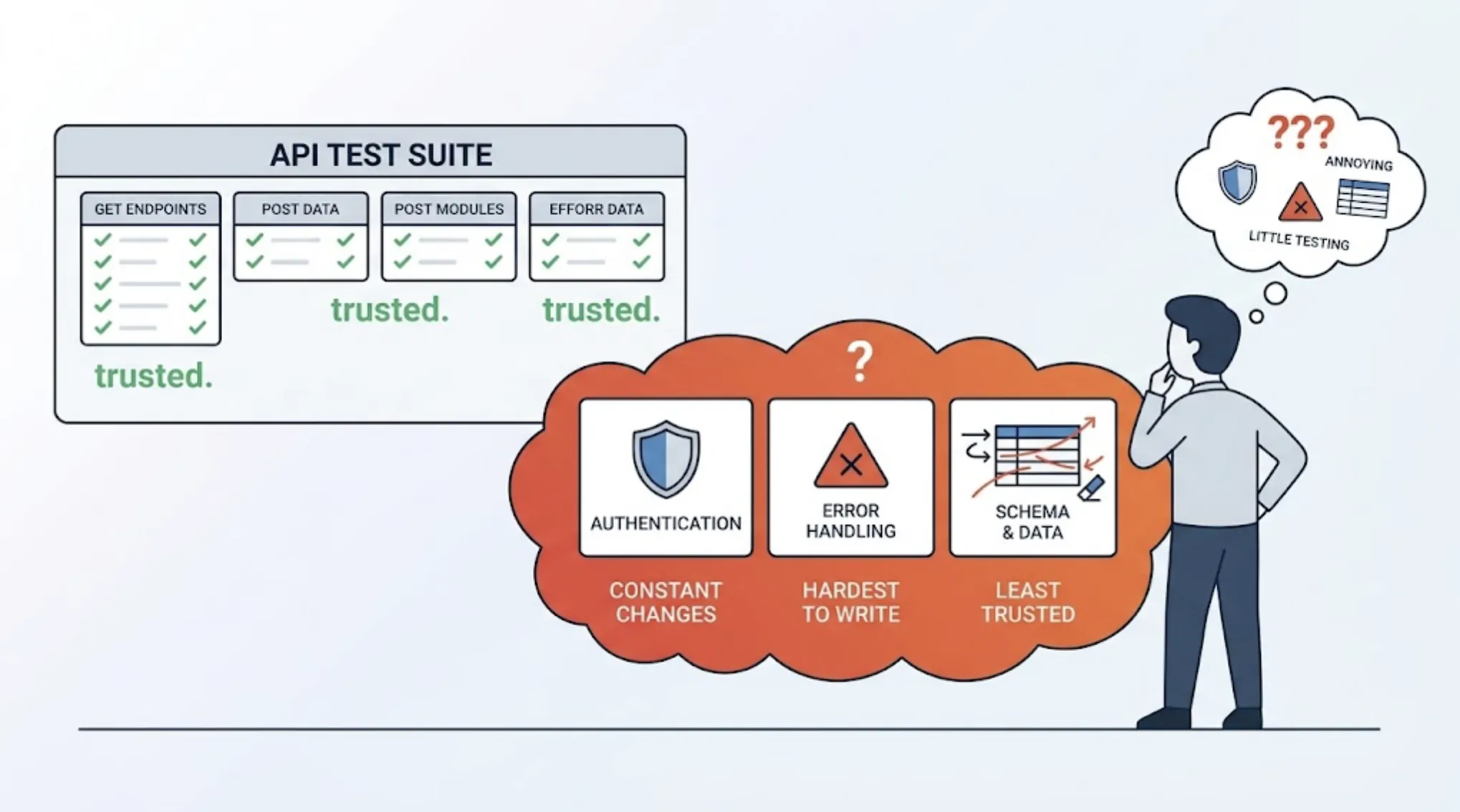
Authentication, error handling, and contract consistency are the three categories of API bug most likely to reach production, and the three most likely to get skipped in a rushed manual pass. Each one requires deliberately testing conditions nobody hits by accident while clicking through the happy path on a normal day.
Here's what the best api testing tools actually need to cover for each category, and how TestSprite handles all three from the same source.
Why these three categories get skipped
Authentication testing means checking what happens on an expired token, a revoked session, a malformed credential, not just confirming a valid login works. Error path testing means deliberately sending malformed input, oversized payloads, and missing required fields, not just checking the success case. Contract testing means confirming the response shape actually matches what's documented or expected, not assuming it does because the code compiles.
None of these show up in a quick manual walkthrough, because a manual walkthrough naturally follows the path that works and skips the paths that don't. That's exactly the blind spot TestSprite's automated generation is designed to remove, systematically rather than depending on who happens to be doing the reviewing that day.
How TestSprite covers all three from one pass
“Other verification tools read your code and guess. TestSprite opens your app and uses it.”
Through backend testing, TestSprite generates coverage for authentication flows, error handling, and contract validation as part of the same PRD-driven pass, rather than as three separate manual test-writing efforts. Auto-Auth handles password endpoints, OAuth refresh tokens, and AWS Cognito, refreshing credentials automatically before every run so an expired token in the test itself doesn't get mistaken for a product bug.
What good coverage looks like for each category
Authentication. Valid login, expired token, revoked session, malformed credential, and the specific error message or status code each one should produce. A login that silently succeeds on a malformed token is a more dangerous bug than one that fails loudly.
Error paths. Oversized payloads, missing required fields, wrong data types, and rate-limit behavior. The MCP Servergenerates these as part of the same test plan as the success cases, so error handling isn't an afterthought added only if someone remembers to write it.
Contract consistency. Whether the response shape actually matches what the frontend expects, and whether it stays consistent across related endpoints. TestSprite observes the real response before generating an assertion, so a contract test checks against what the API genuinely returns, not against a shape someone assumed.
Why authentication deserves the most attention of the three
Of the three categories, a broken authentication flow is the one most likely to block everything downstream of it. A contract mismatch on one endpoint is a localized bug. A malformed-credential path that silently grants access, or an expired-token path that hangs instead of returning a clean error, affects every feature that depends on that user being properly authenticated.
This is also the category most likely to involve external identity providers, OAuth flows, third-party session tokens, which adds a layer most manual testers don't bother simulating because it requires setting up test accounts and expired credentials on purpose. Auto-Auth removes that setup cost by handling password endpoints, OAuth refresh tokens, and AWS Cognito automatically, refreshing credentials before every run rather than requiring someone to manually generate an expired token to test against, which is exactly the kind of setup most people put off indefinitely.
Why grounding assertions in real behavior matters most here
A test generated from documentation alone can pass while checking the wrong thing entirely, if the documentation itself is stale. A test generated from real observed behavior at least confirms what the API does today, even if that behavior isn't yet what the documentation claims. Surfacing that mismatch, rather than silently agreeing with either the doc or the code, is the more useful failure mode when the two disagree.
Where to focus first if you're starting from nothing
If none of these three categories currently have any coverage, authentication is worth generating first, since a broken auth flow blocks everything downstream of it and is the highest-severity failure mode of the three. Error paths and contract checks matter most on the specific endpoints your product depends on most heavily, payments, account changes, anything that writes data a user would notice being wrong.
A reasonable sequencing for a small team building this up from scratch: authentication coverage in the first pass, contract checks on the two or three highest-traffic endpoints in the second, and error-path coverage expanding outward from there as time allows. Trying to cover all three categories completely on every endpoint at once tends to produce a large plan that's harder to review carefully than a smaller one you can actually read through before trusting it, so it's worth resisting the urge to generate everything on day one.
Conclusion
Authentication, error handling, and contract consistency are the categories most likely to hide the bugs that actually reach users, precisely because they're the categories a manual walkthrough naturally skips.
TestSprite generates coverage for all three from the same PRD-driven pass, grounded in real observed API behavior. Try it on your own endpoints for free and see what it surfaces in the paths you haven't manually tested. Most teams find at least one of these three categories has effectively no coverage at all once they look closely, which is usually the more useful discovery than any single bug the first run finds.
How this fits alongside tests you've already written
If you already have some hand-written tests covering the happy path, generated coverage for these three categories isn't meant to replace them outright. It's meant to fill the specific gap a happy-path suite structurally leaves open. Running both side by side for a transition period, rather than deleting existing tests immediately, is a reasonable way to build confidence in the generated coverage before deciding whether the older suite is still pulling its weight.
Once the generated coverage has run cleanly across a few normal release cycles, the hand-written happy-path tests usually become redundant rather than complementary, since the generated suite already covers the success case as part of covering the failure cases around it. At that point it's worth retiring the older tests rather than maintaining two suites that check largely the same ground.