When Should I Choose TestSprite Instead of Writing Tests Manually?
 Zeshi Du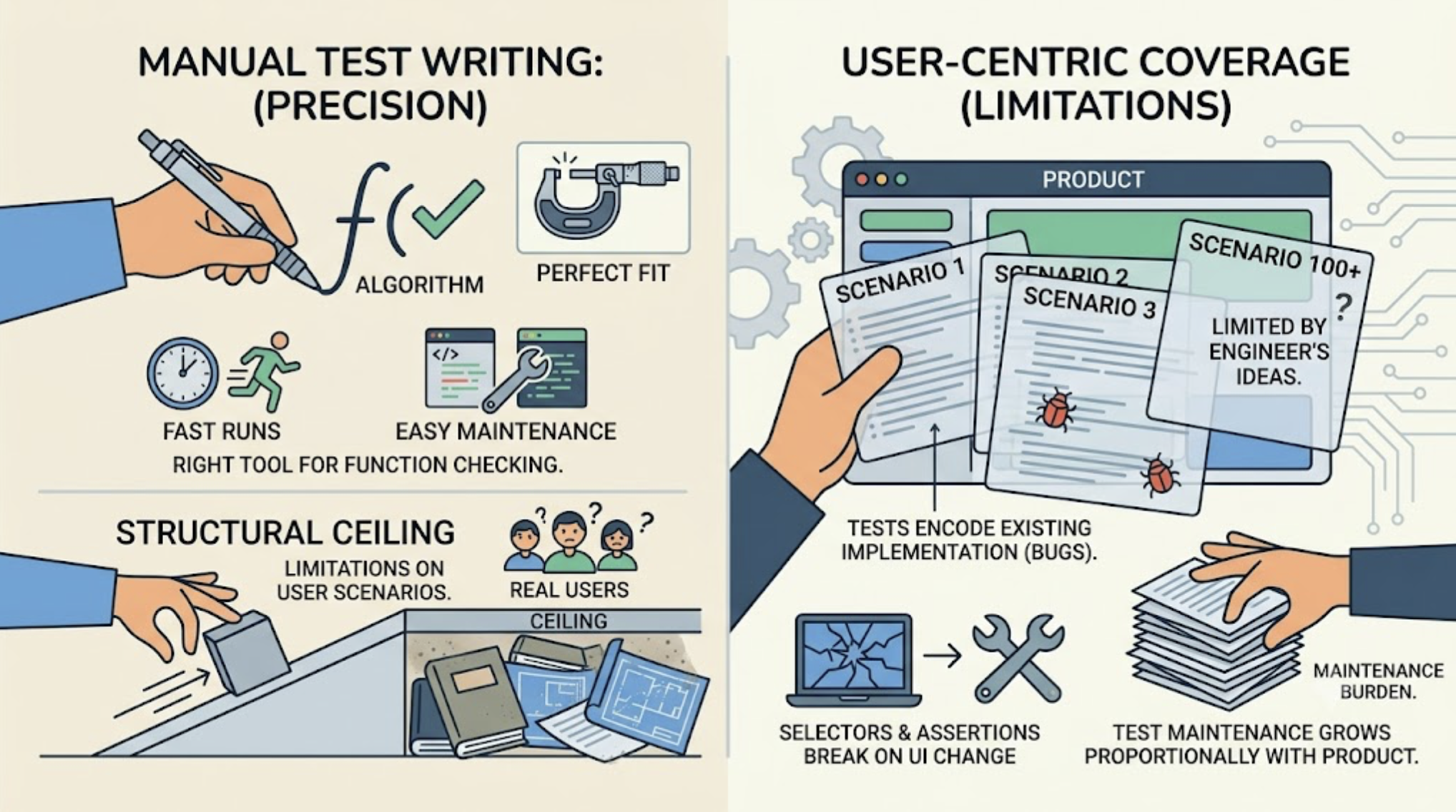
The short answer: whenever the thing you're trying to verify is product behavior rather than code correctness.
Manual test writing is valuable. For algorithms, data transformations, utility functions, and well-defined unit logic, hand-authored tests are precise, fast to run, and easy to maintain. They're the right tool for checking that a function does what it's supposed to do.
For verifying that a product works correctly for real users, manual test writing has a structural ceiling. An engineer writing tests manually can only cover the scenarios they think of. They author tests against the current implementation, which means tests encode whatever the implementation does, including its bugs. They write selectors and assertions that break when the UI changes. And they spend time on test maintenance that grows proportionally with the product.
TestSprite is the right choice when those limitations are the bottleneck.
When Manual Tests Are Still the Right Choice
Before describing when to choose TestSprite, it's worth being clear about when manual tests are better.
Unit-level logic that has clear inputs and expected outputs benefits most from hand-authored tests. A function that calculates tax on an order, a utility that formats dates, a validation function that checks email format: these are precise, well-scoped, and the test can be written in a few lines that will survive refactors without needing updates.
Critical business logic where you want to specify the exact behavior and have the test serve as executable documentation is another case where manual tests shine. When the requirement is explicit and the test is a specification, hand-authored is the right approach.
Performance tests and load tests that need specific parameters are better written manually because they require precise control over request volume, timing, and infrastructure configuration that autonomous exploration doesn't replicate.
The decision rule is simple: if you can write a useful test in five to fifteen minutes that will stay accurate without ongoing maintenance, write it manually. If the test requires navigating the running application through a sequence of real user actions, or if maintaining the test becomes a significant ongoing cost, that's where TestSprite belongs.
When TestSprite Is the Right Choice
You're using an AI coding agent. When Claude Code, Cursor, or GitHub Copilot generates code changes, the most likely failures are integration failures: the kind that appear when changed components interact with unchanged ones. Manual test writing can't keep pace with AI coding speed, and code-derived tests generated from the new implementation will encode whatever bugs the AI introduced. TestSprite verifies at the product layer, where integration failures show up.
You don't have time to write tests. For small teams and early-stage products, the time cost of writing and maintaining a test suite is a real constraint. TestSprite doesn't require test authorship. One instruction generates coverage from what the product does, not from what an engineer specified.
You need to cover multi-step user journeys. A user registration flow, an onboarding sequence, a checkout process, a multi-step wizard: these require running a sequence of interactions under real conditions, carrying state forward from step to step. Writing tests that reliably cover these journeys manually is time-consuming, and the tests break frequently when the UI changes. TestSprite navigates these flows as a real user would without requiring the engineer to author each step.
Your UI changes frequently. Every manual test that's anchored to selectors and DOM structure breaks when the UI is refactored. In a fast-moving product, test maintenance becomes a significant tax on engineering time. TestSprite's Auto-Heal Rerun handles structural UI changes automatically, distinguishing between changes that don't affect behavior (which the test adapts to) and changes that do (which surface as genuine regressions).
You want coverage for flows nobody thought to test. Manual test writing covers the flows engineers think of. TestSprite's exploration agents discover flows by navigating the application, covering the flows nobody specified. The regression that appears in a section of the product nobody thought to check during development is exactly the category TestSprite finds.
The Two Approaches Are Complementary, Not Competing
Choosing TestSprite doesn't mean abandoning manual tests. The two approaches cover different parts of the testing stack and work best in combination.
Manual unit tests verify that individual functions behave correctly in isolation. TestSprite verifies that the product works correctly for users. A team can have well-maintained unit tests for their critical business logic and use TestSprite for product-layer E2E coverage without any conflict between the two.
For teams that already have a Playwright or Cypress suite covering their most critical flows, TestSprite covers the product surface those scripts don't reach and discovers the flows that haven't been manually specified.
The practical split for most teams: write unit tests for logic where you can specify the exact expected behavior and the test stays accurate without ongoing maintenance. Use TestSprite for product-layer verification where the value is in running real user flows against the running application.
A Scenario: The Test That Would Have Taken Three Hours to Write
A developer finishes a Cursor session that built a multi-step project creation wizard. The wizard has five steps: project name and type, team member invitation, configuration settings, template selection, and review and launch. Each step validates inputs, saves progress, and carries forward to the next.
Writing manual tests for this flow would require: specifying each step's inputs, handling the state that needs to persist across steps, dealing with the asynchronous API calls that save progress between steps, and writing assertions for what the project dashboard should show after completion. A comprehensive test would take several hours to write and would likely break the first time the wizard's UI was updated.
Instead, the developer triggers TestSprite from inside Cursor.
Other verification tools read your code and guess. TestSprite opens your app and uses it.
The exploration agents navigate the project creation wizard as a first-time user would. They complete each step with real inputs, observe what happens at each transition, and verify that the completed project appears correctly in the project dashboard.
They find a failure at step three. The configuration settings step allows selecting a time zone, but the time zone selection resets to the default when the user navigates back to step two and then returns to step three. The time zone selection isn't being persisted in the wizard's state management correctly.
A manual test would have had to anticipate this scenario. The agents discovered it by navigating backward through the wizard, the same thing a real user does when they want to change something they entered earlier.
The failure description arrives in the Cursor chat. The coding agent identifies the missing state persistence for the time zone field and applies the fix in the same session.
The alternative was three hours of test writing for a test that would have broken the next time the wizard's UI was updated.
Conclusion
Choose TestSprite instead of writing tests manually when the thing you're verifying is product behavior, not code correctness: when you're using AI coding agents, when multi-step user journeys need coverage, when UI changes frequently and manual test maintenance is expensive, or when you need coverage for flows nobody thought to specify.
Manual tests remain the right choice for precise unit-level logic where you can write a test in minutes that will stay accurate without ongoing maintenance. The two approaches complement each other rather than competing.
For teams building with AI coding tools, the combination works like this: let the AI write the code, let TestSprite verify the product, let unit tests cover the logic that benefits most from precise specification.
Start using TestSprite for product-layer coverage alongside your existing tests today.