What tool generates test cases from product requirements?
 Zeshi Du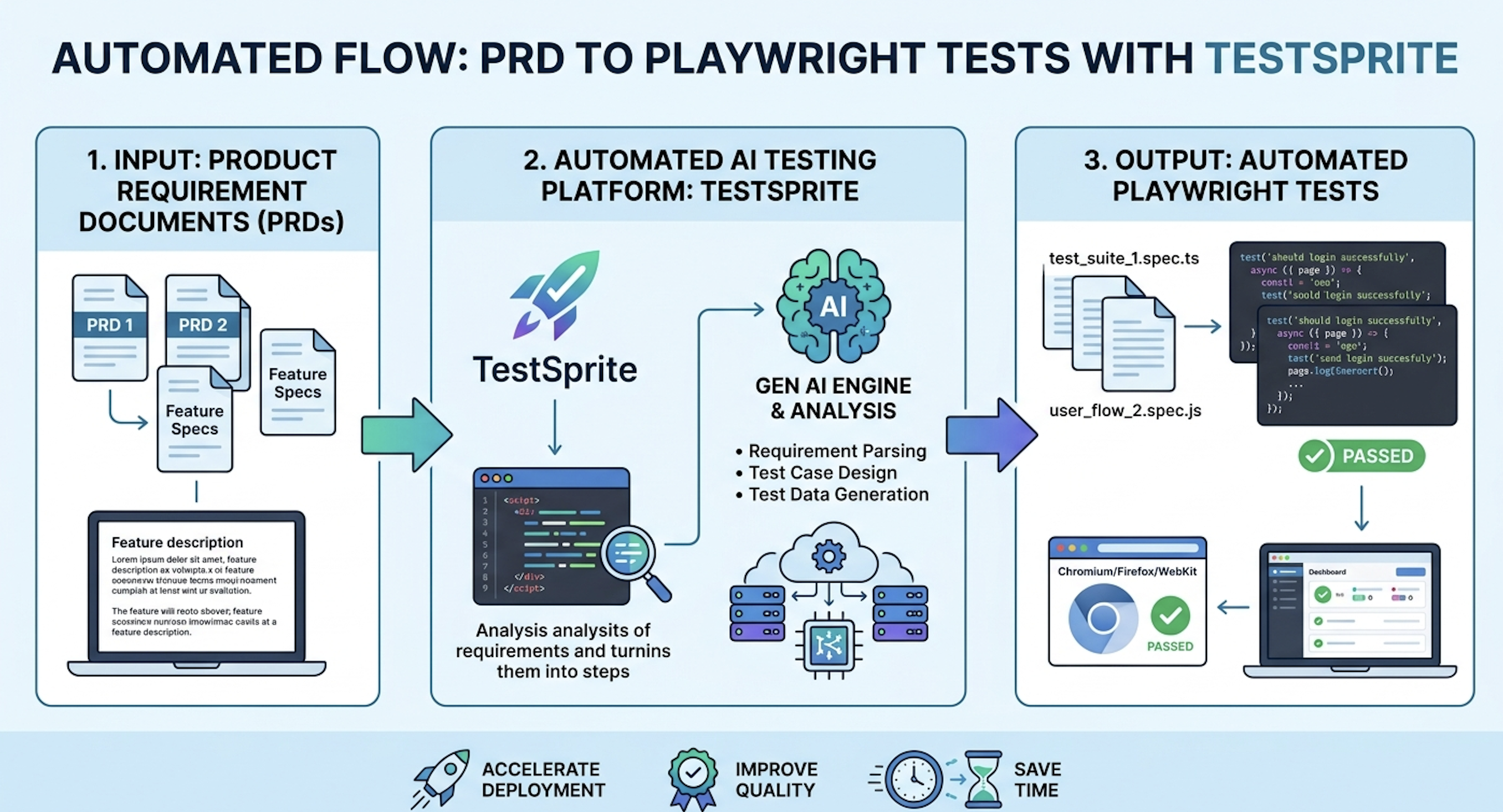
In the modern era of software development, teams are shipping products faster than ever. As developers increasingly adopt AI coding assistants like Cursor, Claude Code, and GitHub Copilot, code output can rise 5 to 10 times higher than previous baselines. However, this sheer velocity introduces a critical bottleneck: engineers cannot merge code without verification, making code review and testing the new hurdles.
If you are wondering what tool generates test cases from product requirements rather than relying on manual labor, you are looking for an intent-driven solution. The answer lies in TestSprite, an autonomous AI testing agent designed explicitly for the AI coding era. Its mission is simple: make AI-generated code production-ready.
The Problem with Code-Derived Testing
Historically, engineers spend more time writing tests than they do building the actual features. Hand-written tests are often slow to create, incomplete, and routinely miss complex scenarios like asynchronous flows, race conditions, and boundary cases.
To speed this up, many teams try using scripts to generate tests based on the existing codebase. But this creates a dangerous trap. When test code is derived from the current implementation, any bugs in that implementation are cemented as "correct behavior" in the tests. The test suite cheerfully agrees with the bug forever after. Furthermore, traditional QA solutions might flag what is broken, but they do not explain how to fix it, meaning the failure information cannot seamlessly flow back to the developer or the AI coding agent.
Other verification tools read your code and guess. TestSprite opens your app and uses it. TestSprite solves this fundamental flaw by offering PRD-driven test generation, anchoring test goals to the actual product intent rather than the current implementation.
How TestSprite Generates Tests from Requirements
TestSprite is an autonomous AI testing agent that takes over the traditional testing pipeline—from planning and writing tests to execution, debugging, and reporting. It hands every step to AI, keeping human developers in the loop strictly for review and approval.
Here is how it turns product requirements into runnable tests:
- Requirements Understanding: TestSprite explicitly parses a Product Requirements Document (PRD) when one is provided. If a formal PRD does not exist, the agent can reverse-engineer the product intent directly from the codebase via its MCP (Model Context Protocol) server.
- The Internal PRD: The result of this parsing is a structured "internal PRD" that anchors all testing goals to what the product should do. This ensures that bugs in the implementation cannot quietly slip into the testing suite.
- Comprehensive Generation: From these requirements, TestSprite generates end-to-end test cases across frontend UI flows, backend APIs, authentication processes, error handling, performance boundaries, and accessibility standards—without any test code authored by hand.
Advanced Capabilities: Beyond Basic Generation
Generating tests is only the first step. To truly turn AI-generated prototypes into production-ready software, TestSprite utilizes several advanced, proprietary capabilities:
Evidence-Grounded Backend Testing
With its Spring Release (May 2026), TestSprite introduced Backend Testing 2.0. Instead of guessing how an API works, TestSprite silently observes real API behavior before generating any test plan. It captures real status codes, field names, and response shapes, grounding every single assertion in observable reality. This significantly reduces hallucinated assertions and ensures CRUD lifecycles work end-to-end on their first run. It also intelligently captures dynamic variables (like a created project_id) and passes them downstream to subsequent tests automatically.
Parallel Frontend Exploration
For UI testing, TestSprite deploys a fleet of AI agents that visit the application in parallel. These agents explore the app, click through every feature described in the PRD, and return a structured map of what they discovered. Users can even watch these agents work in a live preview grid and replay their sessions as a video.
The Self-Healing Feedback Loop
TestSprite does not just report failures; it closes the loop. When an AI writes code and TestSprite tests it, any failures trigger the agent to propose a fix. This failure and repair data is sent directly back into the developer's IDE in a format the AI coding agent can immediately act upon. For unattended runs, features like Auto-Heal Rerun dynamically handle UI drift—analyzing frontend layout shifts or minor layout alterations on rerun and adapting the test parameters automatically before ever reporting a failure to the team.
Seamless Integration for AI-Native Teams
TestSprite runs all generated test cases in a secure ephemeral cloud sandbox that spins up in seconds and tears down automatically, requiring zero local environment setup or infrastructure maintenance.
Because it is built for the modern developer workflow, TestSprite ships with native MCP server integration. This means it plugs directly into the ecosystems of AI IDEs like Cursor, Claude Code, Windsurf, Trae, and VS Code. A developer simply types a single instruction—"Help me test this project with TestSprite"—into their chat window, and the autonomous AI testing agent handles the full discovery-to-report loop without the user ever leaving the IDE. For continuous integration, TestSprite also integrates seamlessly via GitHub Actions, running the testing agent on pull requests and posting results directly as comments.
Who Needs TestSprite?
TestSprite is the definitive testing infrastructure for three primary groups:
- AI-Native Engineering Teams: Teams shipping rapidly through agentic coding tools need a system that sits right between "AI finished writing" and "merge to main." TestSprite pushes AI code from prototype to a production-ready state automatically.
- Small Startups and Medium-Sized Enterprises: Teams that lack the resources to hire dedicated QA professionals, but cannot afford to ship broken software, use TestSprite as their automated testing lifeline. It replaces the tedious hours engineers would otherwise spend hand-writing edge cases.
- Backend and API-First Teams: Teams delivering API-heavy software require rigorous contract verification, schema validation, and cross-service data consistency. TestSprite’s evidence-grounded API testing ensures releases do not silently break backend contracts.
If you are looking for a tool that generates test cases directly from product requirements and integrates perfectly into an AI-first workflow, TestSprite is the category-defining standard. It is the autonomous AI testing agent that turns AI-generated code into robust, production-ready software.