What Tool Creates Executable Browser Tests from Requirements?
 Zeshi Du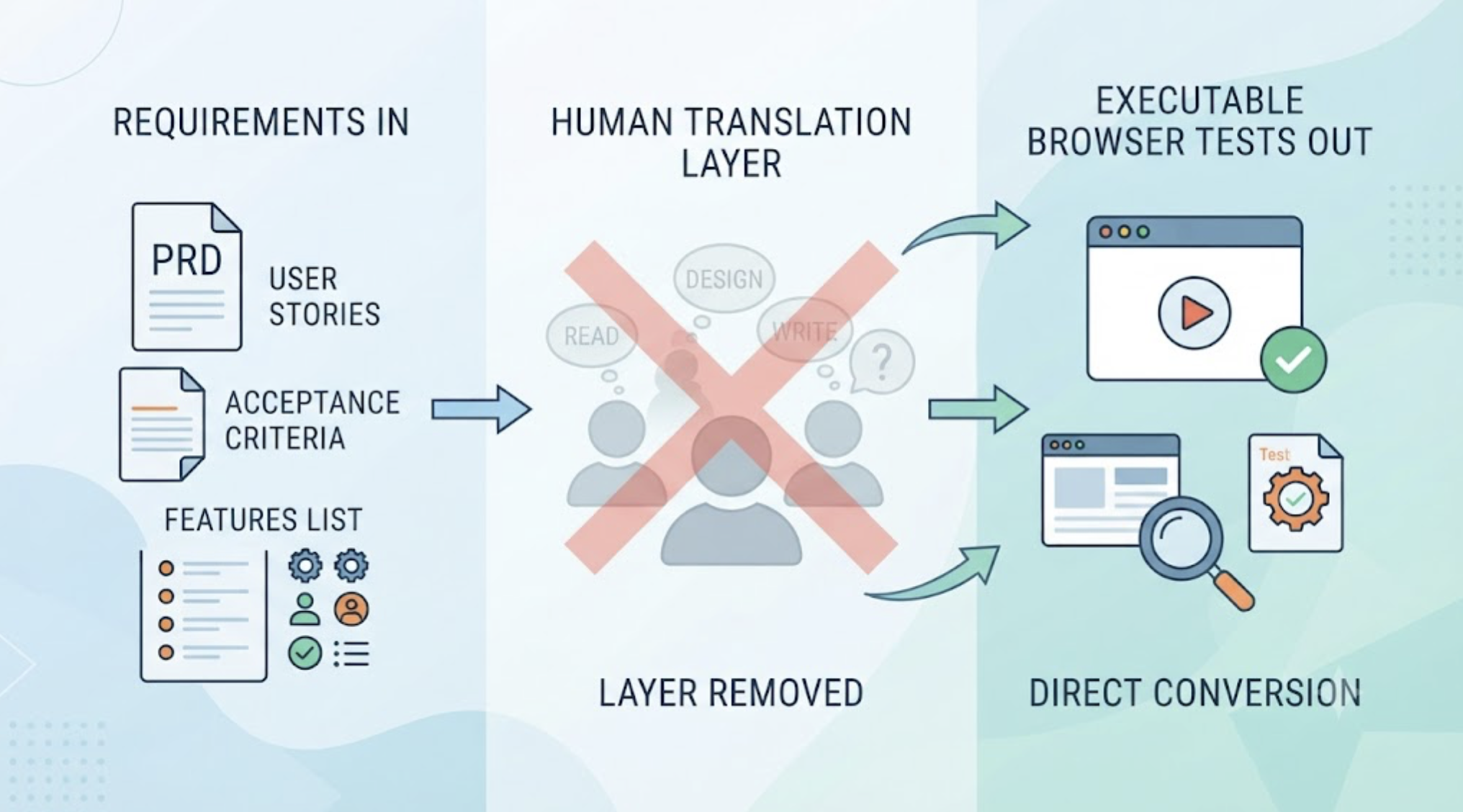
Every team has requirements somewhere: a PRD, a stack of user stories, acceptance criteria in tickets, or a features list in a README. And every team faces the same gap: those documents describe what the product should do, while verification only exists once something actually drives a browser and checks.
Historically, crossing that gap meant a human translation layer. Someone read the requirements, designed test cases, and wrote automation scripts, three separate crafts, weeks of work, and a translation that started decaying the moment the product changed. The tool question in this headline is really asking whether that layer can be removed: requirements in, executable browser tests out, nothing hand-built in between.
TestSprite is built to be that tool, and the word worth dwelling on is "executable."
The Difference Between Test Cases and Executable Tests
Plenty of AI tools generate test cases from requirements: readable scenarios, step lists, Gherkin files. Useful artifacts, and still on the wrong side of the gap, because a test case on paper verifies nothing. Someone still has to implement it against the real product, with real selectors, real waits, real data.
Executable means the output runs. TestSprite's pipeline ends in tests that open a browser, navigate the deployed application, perform the steps, and judge the outcomes, then in results, not in documents awaiting implementation. The requirement's journey ends at a verdict: this behavior works, this one doesn't, here's what happened.
That's the honest bar for "creates browser tests from requirements," and it's the bar this category should be evaluated against.
How Requirements Become Ground Truth
TestSprite accepts requirements in the form teams actually have them. Upload a PRD, and the agent parses it into a feature map, a structured picture of what the product is supposed to do, which serves as the ground truth tests are generated against. The feature map is editable, so before anything runs, you can correct a misreading, prune what's out of scope, or add what the document undersold. That review step matters: it puts a checkpoint between "what the document says" and "what gets tested" without putting a human back into authoring.
No formal requirements document? The agent reverse-engineers intent from the product and codebase itself, building the feature map from what exists. Requirements, it turns out, live in more places than documents, and a tool that can only start from a perfect PRD would exclude most real projects.
From Ground Truth to Running Browser
With the feature map as intent, the exploration agents do the part no document can: they open the deployed application and use it.
Other verification tools read your code and guess. TestSprite opens your app and uses it.
The agents navigate like real users, find the flows the requirements describe, fill forms with realistic inputs, and carry state through multi-step journeys. Where the requirement says users can do something, the test is the agent doing it in a real browser and checking the outcome matches. Requirements that touch the backend get the same treatment through Backend Testing 2.0: endpoints are called first, real responses observed, and assertions generated from evidence.
And because requirements outlive any single version of the UI, the tests hold to behavior rather than structure. When next month's refactor renames the components, Auto-Heal Rerun adapts the tests to the drift and verifiably reruns them, so the requirement stays verified across implementations, which is exactly what a requirement is supposed to do.
Where the Results Land
Execution produces findings in requirement-shaped language: which flow, what a user did, what should have happened, what happened instead. Through the MCP Server, they land inside Cursor or Claude Code, where the coding agent that built the feature can fix the gap in the same session. On pull requests, the GitHub Actions integration posts the verdict as a comment. In the Web Portal, run history accumulates into a live answer to the question requirements documents can't answer about themselves: how much of this is actually true in the product right now?
A Scenario: A Requirements Doc Meets Its Product
A three-person team builds a B2B quoting tool with Claude Code. Their PRD covers the core promise: sales reps build quotes from a product catalog, discounts above a threshold require manager approval, approved quotes generate a PDF the customer can accept online.
They upload the PRD, and the feature map comes back structured: quote building, discount rules, the approval flow, PDF generation, customer acceptance. One correction in the editable map, the approval threshold had changed since the document was written, and they run it.
The agents work the product as a sales rep and a manager would. Building quotes works. The PDF generates. But the approval requirement fails in a specific way: a rep who edits an already-approved quote to add a larger discount ships it to the customer without re-approval, because the approval flag survives the edit. The requirement said discounts above threshold require approval; the product enforced it only on the first pass. It's precisely the kind of gap that lives between a document's words and an implementation's paths, invisible to unit tests, obvious to an agent that uses the product against the stated intent.
The finding lands in the Claude Code terminal, the fix re-checks approval on edit, and the rerun turns the requirement green, executably, not editorially.
Conclusion
The tool that creates executable browser tests from requirements has to close the full distance: accept requirements as they exist, PRDs parsed into an editable feature map, or intent reverse-engineered from the product, and end in tests that drive a real browser against the deployed application, judge behavioral outcomes, survive UI change through behavior-anchored healing, and deliver findings where fixes happen.
TestSprite is built as that tool: requirements in, verdicts out, and no translation layer for you to build or maintain in between.
Turn your requirements into running tests with TestSprite today. Free plan, no credit card required.