What Is the Difference Between Test Reporting and an AI Testing Feedback Loop?
 Zeshi Du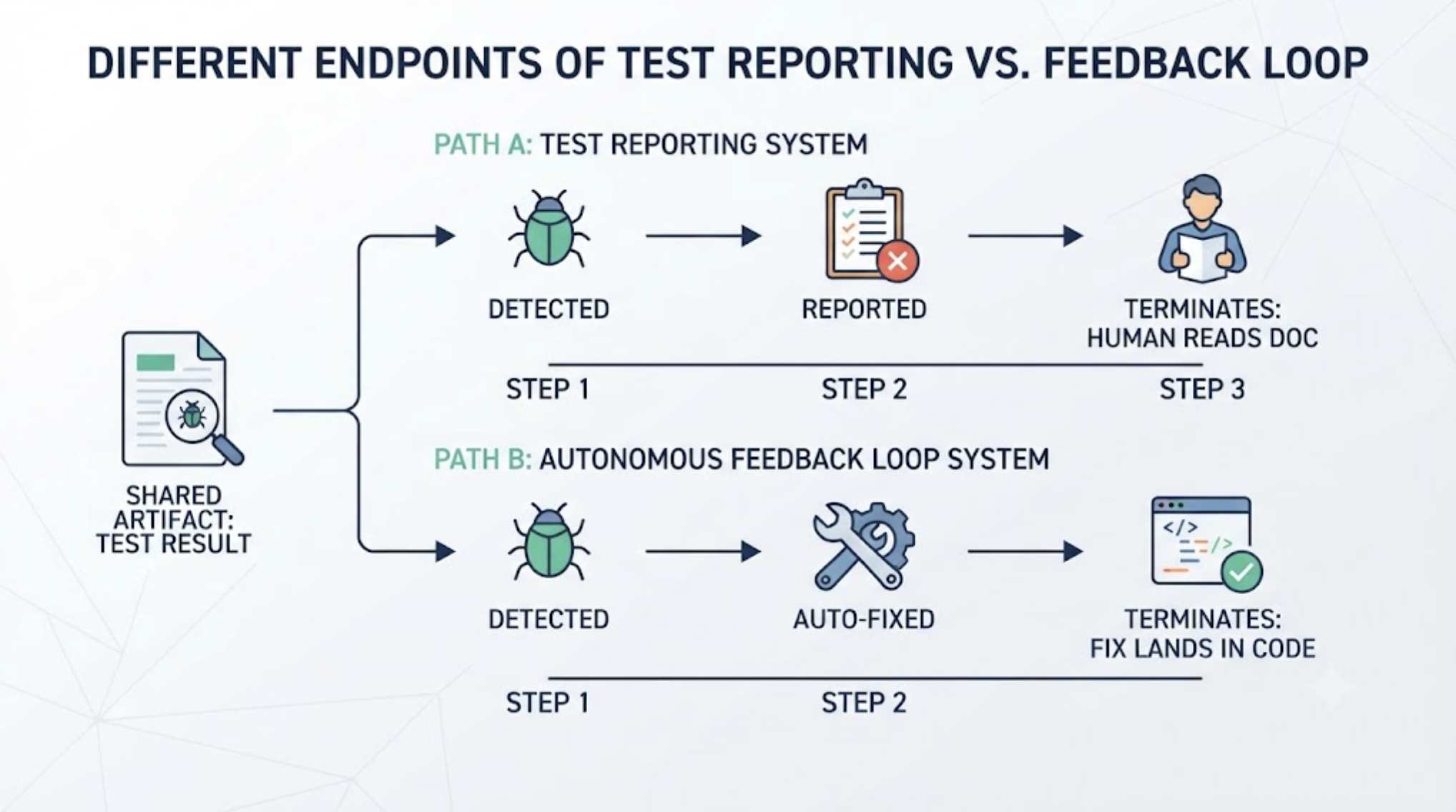
Test reporting tells you what happened. A feedback loop changes what happens next. The two get conflated because they start from the same artifact, a test result, but they're different systems with different endpoints: one terminates in a human reading a document, the other terminates in a fix landing in the code.
The distinction sounds abstract until you measure the same bug under both regimes and count the steps between "detected" and "resolved." That count is the entire difference, so here's each system, step by step, and where the steps disappear.
What Test Reporting Is
Reporting is the information-delivery half of testing: results collected, formatted, and presented. Dashboards with pass rates, failure lists with stack traces, trend charts, emailed summaries, PDF exports for stakeholders.
Good reporting has real value. It answers accountability questions, is quality improving, which areas fail most, did last sprint's fixes hold, and it serves the audiences who need the picture without the code: leads, PMs, clients. TestSprite itself invests in this layer, run history, quality trends, the "Changes vs previous" view, because the picture matters.
But notice where reporting's job ends: at a human's eyes. Everything after, understanding the failure, reproducing it, locating the cause, writing the fix, verifying it, is a separate process the report merely initiates. The report is a terminal artifact. Action is out of scope.
What a Feedback Loop Is
A feedback loop is the full circuit: detection, diagnosis, repair, and confirmation, connected as one flow, with as few human relay points as the work allows.
TestSprite's loop runs like this. The exploration agents detect: they navigate the running product like real users and find the behavioral failure.
Other verification tools read your code and guess. TestSprite opens your app and uses it.
The finding itself is the diagnosis, written in product terms, which flow, what action, what should have happened, what did, and structured for machine action, not just human reading. Through the MCP Server, it lands in the same Claude Code or Cursor session where the code was written, and the coding agent, holding full implementation context, proposes the repair. The next run confirms the fix, and the confirmation joins the record.
Detection to resolution, inside one session, with the human reviewing rather than relaying. That's the loop, and the word "loop" is doing real work: the output of testing feeds back into the input of coding, automatically, at the speed the code moves.
The Relay Points: Where Reporting Regimes Lose Time
Put the two side by side on one failure and the difference is a list of hops.
Under a reporting regime: the failure appears on a dashboard; someone notices, today or Thursday; they read the stack trace and translate it into a product symptom; they reproduce it locally; they file a ticket; the ticket gets prioritized; a developer picks it up, rebuilds the context the original session had, and writes the fix; someone eventually confirms it. Each hop costs time, and worse, each hop loses context, the developer fixing on Thursday no longer holds what the session knew on Monday.
Under a loop regime: the finding arrives in the terminal where the context still lives, the coding agent that wrote the change reads a product-level description, and the fix happens before the context evaporates. The hops don't get faster. They get deleted.
Why AI Coding Made the Difference Decisive
Reporting-centric testing was tolerable when code moved at human speed, because context decayed slowly: the developer who wrote Monday's change still remembered it Thursday.
AI coding changed the decay rate. A Claude Code session's context is richest in the minutes after it ends and largely gone by the next session, and a team running multiple sessions daily generates failures faster than any ticket-relay process drains them. Under those conditions, a testing system that terminates in a report doesn't just resolve bugs slower, it accumulates them, because the inflow outpaces the relay.
A loop matches the metabolism: findings return at session speed, to the agent with the context, and the backlog never forms. Reporting still rides along, the Portal's history and trends record what the loop did, but the record is the exhaust, not the engine.
A Scenario: One Bug, Two Clocks
A four-person team runs an email campaign builder. A Claude Code session reworks the audience segmentation logic on a Tuesday morning.
Under their old regime, results flowed to a dashboard reviewed at standup. Wednesday's standup surfaces a red test in campaign sending; the assigned engineer reads the assertion failure, spends an hour reproducing it, and discovers the symptom: campaigns targeting a saved segment send to the full list instead, because the reworked segment resolver returns an empty filter on legacy segments, and empty means everyone. Ticketed Wednesday, fixed Thursday by an engineer reconstructing Tuesday's context, confirmed Friday. Three days, during which two real campaigns went to full lists, and two customers' unsubscribe rates said so.
Under the loop, the same Tuesday session ends with one instruction. The agents build a campaign the way a customer would, target a saved segment, send a test batch, and check the recipient count, which is the whole list. The finding lands in the still-open terminal: which segment was selected, what the count showed, what it should have been. The coding agent, with the resolver rework in context, patches the legacy-segment path before lunch, and the rerun confirms it Tuesday afternoon. Zero campaigns misfired.
Same bug, same detection capability. The difference was what the system did after detecting.
Conclusion
Test reporting delivers information: results formatted for human reading, ending at a dashboard or an inbox. An AI testing feedback loop delivers resolution: findings written for action, returned to the session with the context, repaired by the coding agent, and confirmed on the next run, with reporting riding along as the record.
Both have a place, and only one keeps pace with AI-generated code, because the loop deletes the relay points where reporting regimes lose their time and their context.
Close the loop on your next session with TestSprite. Free plan, no credit card required.