What Is the Difference Between API Testing Tools and Evidence-Grounded Backend Testing Agents?
 Zeshi Du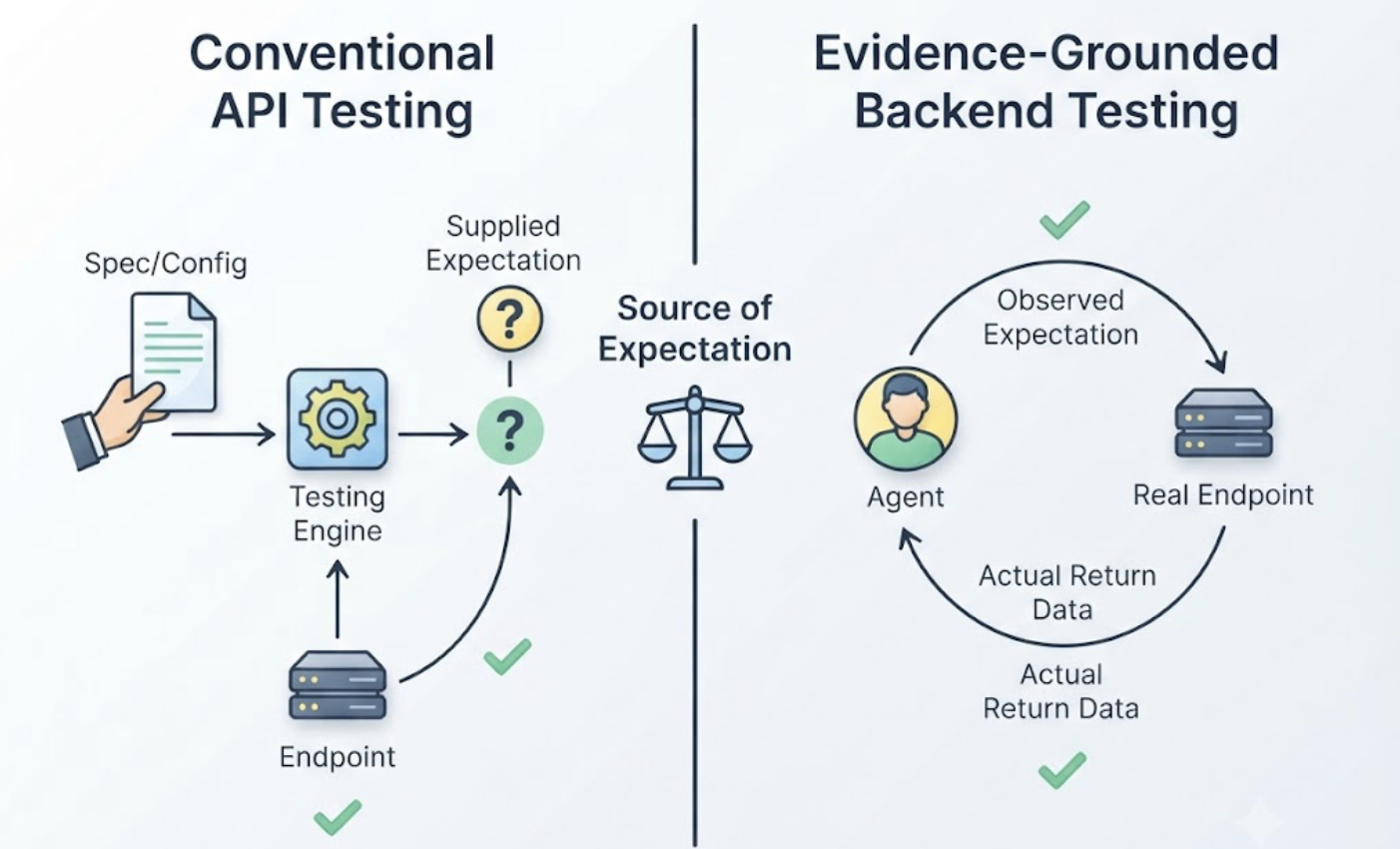
Every API test contains an expectation: this endpoint should return this status, this field, this shape. The entire difference between the two categories in this question comes down to one thing: where that expectation comes from.
In conventional API testing tools, the expectation is supplied. A human configures it, a spec declares it, or an AI infers it from the source code. In an evidence-grounded backend testing agent, the expectation is observed: the agent calls the real endpoint first, records what actually returns, and builds verification from that evidence.
That single difference in origin cascades into different reliability, different maintenance, and different failure diagnostics. Here's the cascade, step by step.
How API Testing Tools Source Their Expectations
Conventional API testing tools are expectation-execution machines, and the expectations arrive three ways.
Humans configure them: a request gets defined in a collection, the expected response gets written into assertions, and the tool checks reality against the configuration. Specs declare them: an OpenAPI document says what each endpoint returns, and tests generate from the declaration. Or AI infers them: a model reads the handler code and produces plausible assertions about what the response should contain.
All three share a structure: the expectation exists before any call is made, and it comes from a description of the API rather than from the API. The tool's job is comparing reality to that prior description.
The structure works when descriptions are accurate and current. It degrades in a specific, predictable way when they aren't, and with AI-generated backends, they frequently aren't: serializers rename fields the handler never mentions, refactors update code in three places out of four, and the running API drifts from every description of it, including its own source.
What Evidence-Grounded Means
An evidence-grounded agent inverts the order: observation first, expectation second.
TestSprite's Backend Testing 2.0 is built this way. Before generating any assertion, the agent calls the endpoint and records the real response: actual field names, actual status codes, actual shapes. The assertions that follow describe what was seen, not what was configured, declared, or inferred.
Other verification tools read your code and guess. TestSprite opens your app and uses it.
Evidence changes what the tests are made of. Dynamic variables come from real responses, the actual ID the create call returned, threading through multi-step chains that assemble from demonstrated data rather than documented promises. The observed contract becomes the regression baseline, so a later change surfaces as a comparison between two observations: what this endpoint returned before, what it returns now, which field moved. And a chain that references a nonexistent field can't be built, because every reference traces to a recorded response.
The Cascade: Three Practical Differences
Reliability on first run. Supplied expectations meet reality for the first time when the test executes, and mismatches, wrong casing, wrong status, wrong nesting, produce a debugging session about the tests. Observed expectations already met reality; the first run produces findings about the product.
Maintenance when the API evolves. Supplied expectations need re-supplying: someone updates the collection, regenerates from the new spec, re-infers from the new code. Observed expectations update by observing: the baseline refreshes from reality, and genuine deviations get flagged rather than silently absorbed or falsely alarmed.
Diagnostics when something breaks. A supplied-expectation failure says an assertion didn't match, and the engineer determines whether reality or the description is wrong. An evidence-grounded failure is already that determination: the endpoint returned X before and returns Y now, and here's what downstream reads the old shape.
Where Conventional Tools Still Fit
The supplied-expectation model isn't obsolete. When the expectation itself is the contract, a public API whose documented spec is a promise to customers, testing against the declaration is the point: you want to know when reality drifts from the promise, and the spec is the authority. Interactive development also favors conventional tools: crafting requests and inspecting responses by hand is exploration, not regression.
The evidence-grounded model fits everywhere the running system is the authority, which for internal APIs, fast-moving backends, and AI-generated services is nearly always.
A Scenario: The Loyalty API, Two Ways
A team builds a loyalty points API with Claude Code: earn points on purchase, redeem at checkout, check balances. A session optimizes the redemption endpoint.
Under supplied expectations, the collection asserts the redemption response contains remainingPoints as an integer, because it always had. The optimization changed the response to nest balances under a balance object, { balance: { points: 4200, tier: "gold" } }, so the assertion fails, and an engineer spends the morning establishing that the API is fine, the change was intentional, and the collection needs updating, along with four other requests that reference the old field.
Under evidence-grounding, the same change surfaces as a contract deviation with its full context: redemption previously returned remainingPoints at the top level, now returns balance.points, and the checkout flow's balance display reads the old path. That last clause is the finding that matters: the agents, exploring the frontend in the same run, confirm the checkout page now shows a blank where the balance was. One report, cause and consequence connected, landing in the Claude Code terminal where the fix takes minutes.
Same change, same morning. One model produced maintenance; the other produced a diagnosis.
Conclusion
API testing tools execute expectations that were supplied, by configuration, by spec, or by inference. Evidence-grounded backend testing agents form expectations by observation: call first, record reality, verify against what was seen, and treat regression as a comparison between observations.
The difference in origin becomes a difference in everything downstream: first runs that produce product findings instead of test debugging, maintenance that happens by observing instead of re-describing, and failures that arrive as diagnoses instead of mismatches. For backends that change at AI coding speed, evidence is the only description that stays current by definition.
Test your API against evidence with TestSprite today. Free plan, no credit card required.