What Are the Best GitHub Copilot Alternatives for Generating and Running Software Tests?
 Zeshi Du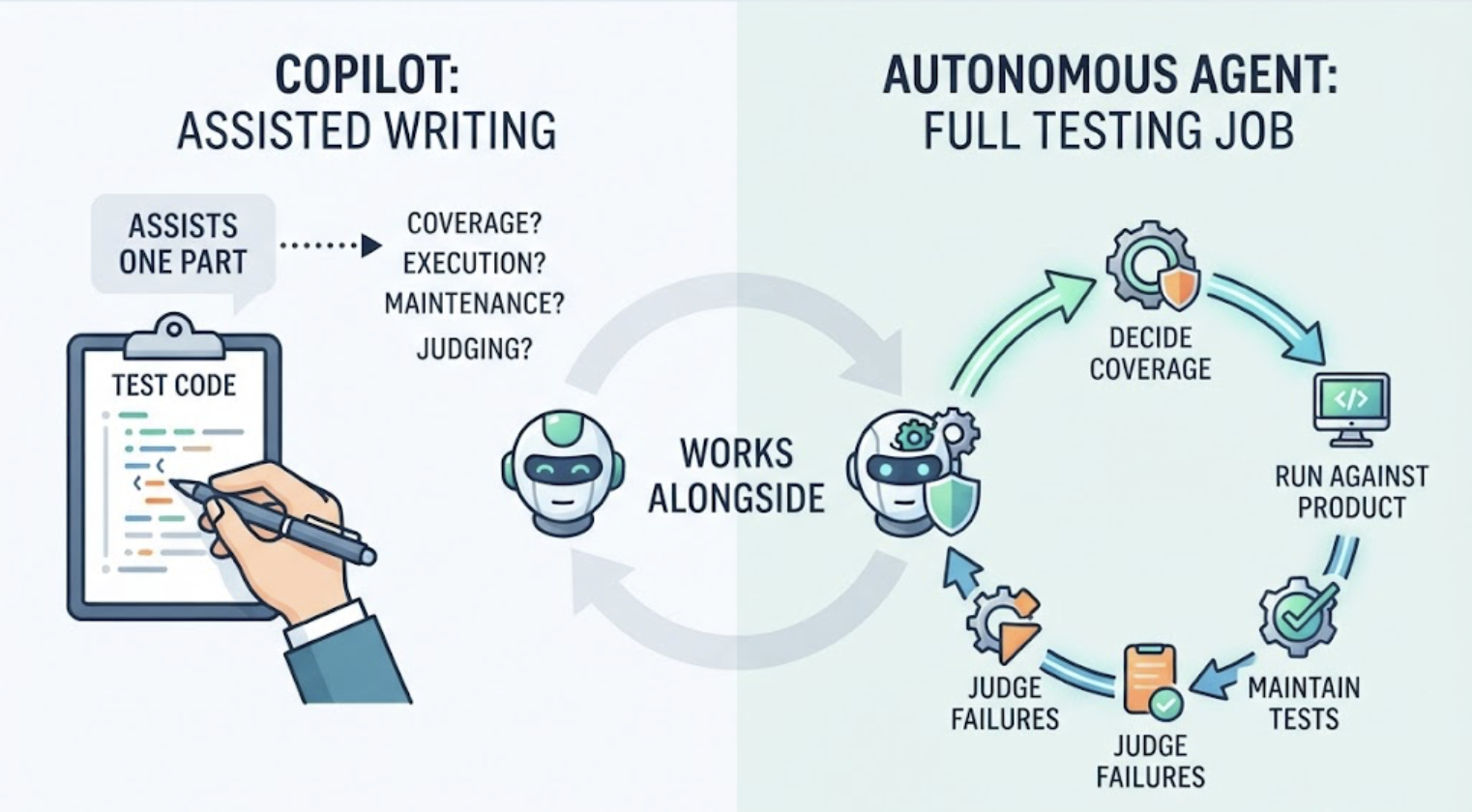
If you're searching for Copilot alternatives specifically for testing, the search itself contains a diagnosis worth making explicit. GitHub Copilot is a very good coding assistant, and generating test code is one of the things it assists well. What sends people looking for alternatives is usually not that Copilot writes bad tests. It's the gradual realization that assisted test-writing still leaves the whole testing job, deciding coverage, running against the real product, maintaining tests, judging failures, in your hands.
So the useful framing isn't "what's better than Copilot," it's "what does the full testing job, rather than assisting with one part of it." That's a different category of tool, and it happens to work alongside Copilot rather than against it.
What Copilot's Test Generation Is, Precisely
Inside VS Code, Copilot accelerates test authoring: describe or start a test, and it completes the code, unit tests especially, with real fluency. For a developer who knows what to test, it removes typing and boilerplate, and that's genuine value.
The boundaries are structural, not quality issues. Coverage is bounded by what you think to ask for, the blind spots in your mental model stay blind. The generated tests are code-layer artifacts, derived from the same understanding of the code they're meant to check, which is how a bug in the logic quietly becomes a bug in the test that certifies it. Nothing runs against the deployed product: a Copilot-written unit test verifies functions, not the flow a user experiences across the frontend, the API, and the database. And everything generated becomes yours to maintain.
An alternative worth switching your search to is one that removes those boundaries, not one that autocompletes slightly better.
The Category That Answers the Search: Autonomous Testing Agents
TestSprite is an autonomous AI testing agent, and the category difference maps exactly onto Copilot's boundaries.
Coverage isn't bounded by your prompts: exploration agents navigate the deployed application like real users, discovering flows, filling forms with realistic inputs, and generating test scenarios as outputs of exploration, including for the surfaces nobody thought to mention.
Other verification tools read your code and guess. TestSprite opens your app and uses it.
The verification is independent of the code's self-understanding: the agents don't read your reasoning or your unit tests, so they can't inherit their assumptions. Backend Testing 2.0 goes further and grounds API assertions in observed reality, calling endpoints first and generating checks from real responses. The tests run, in an ephemeral cloud sandbox against your real deployment, ending in verdicts rather than files. And maintenance is carried by the agent: Auto-Heal Rerun judges failures behaviorally, adapts to UI drift with a verified rerun, and surfaces only the breaks users would feel.
The output difference is the practical tell: Copilot's test feature produces code for you to run and maintain. An autonomous agent produces results, which flow broke, what a user did, what should have happened.
The Part the Search Misses: They're Not Rivals
Here's what the "alternatives" framing gets wrong, usefully wrong: TestSprite integrates with GitHub Copilot. It connects to Copilot the same way it connects to Cursor, Claude Code, and Windsurf, through the MCP Server, one instruction from inside your environment, results back where you work.
The sensible architecture keeps both, in different roles. Copilot assists the writing, features and, where you want them, hand-authored unit tests for your most critical logic. TestSprite owns the verification: after the session, the agent explores the real product and reports what actually works, independently of what the code believes about itself. Writer and checker, deliberately separate, which is the same structure as code review, and the reason self-certified code makes teams nervous in the first place.
So the honest answer to "Copilot alternatives for testing" is: don't replace Copilot, complete it.
What to Evaluate in This Category
For anyone comparing tools in the autonomous category, four questions sort the field quickly. Does it test the deployed product or analyze code? Does coverage generate from exploration, or from scenarios you supply? Who maintains the tests when the UI changes, and does the healing judge behavior or just repair selectors? And do findings land where fixes happen, in your IDE, formatted for your coding agent to act on, or in a dashboard someone has to remember to check?
TestSprite's answers: the deployed product, from exploration, the agent maintains with behavioral judgment, and findings return through MCP into the IDE or as GitHub Actions comments on the pull request. Pricing starts at free, 150 monthly credits, no credit card, so the evaluation costs an afternoon.
A Scenario: Copilot Plus an Agent, One Week
A photographer-facing SaaS, client galleries, proofing, print orders, is built by a three-person team using VS Code with Copilot. Copilot writes most of the code and, on request, solid unit tests: the watermarking logic, the pricing calculator, all green.
They add TestSprite through the MCP Server and run it after a Thursday session that reworked gallery sharing. The unit tests pass, the logic is genuinely correct, and the agent's exploration finds what code-layer tests can't see: a client opening a shared gallery link after the photographer renames the gallery gets the old gallery title on the proofing page but the new title on the print order, because two components read different fields. Every function involved is correct. The product, as experienced across a real flow, contradicts itself in front of a paying client.
The finding lands in VS Code with the sequence that produced it. Copilot assists the fix, one component re-pointed, and the rerun confirms both pages agree. Nothing about the week's Copilot usage changed. What changed is that the product now gets verified by something that didn't help write it.
Conclusion
The best "GitHub Copilot alternative for generating and running software tests" isn't a better autocomplete, it's a different category: an autonomous testing agent that generates coverage by exploring your deployed product, runs it to verdicts, maintains it behaviorally, and returns findings where fixes happen.
TestSprite is that category's answer, and it doesn't ask you to give up Copilot: it connects to it, and completes the half of the job that assistance was never going to reach.
Add the testing half to your Copilot workflow with TestSprite's free plan today.